Tour de France 2026 Stage 13: Dole to Belfort — The Ballon d’Alsace Returns, 121 Years After Starting It All
Last Updated: 12:44 pm CEST - Friday, 17 July 2026
Tour de France 2026 Stage 13 takes place on Friday, July 17, covering 205.8 km from Dole to Belfort, the longest stage of the entire race, and the only one to break 200 kilometres. It’s a stage built in two completely different halves: roughly 150 km of gently rolling, largely uneventful roads through the Jura, followed by a sudden and serious test on the Ballon d’Alsace, the mountain that started Tour de France climbing history back in 1905.
This is a breakaway rider’s dream and a sprinter’s nightmare in roughly equal measure. The sheer distance alone makes it a day of patience before drama, and the road passes directly through Mélisey, the hometown of Thibaut Pinot, France’s most beloved climber of the last decade, who’s marking this exact stage with a homecoming of his own in 2026. By the time the Ballon d’Alsace’s summit comes into view, 30 kilometres from the finish, the stage has earned every bit of its “longest day” reputation.
Merlier made it three, but Chalon-sur-Saône earned every one of them. Lidl-Trek spent the closing 40 km trying to blow the sprint apart entirely — Quinn Simmons, Mathias Vacek, Mattias Skjelmose and Mads Pedersen all launched attacks in turn, hoping to strand the pure sprinters before the line. It didn’t work. The bunch reformed, Merlier found the gap he needed in the final 100 metres, and a nasty crash inside the last 350 m added one more complication to a stage that never settled down. Kooij took second, Philipsen third. Pogačar still holds yellow and, as of Stage 12, the polka dot jersey too — Pedersen’s green lead stretches to 357 points, with Ayuso now the man in white.
Stage 13 changes the entire register. At 205.8 km it’s the longest day of this Tour, and the first 150 km are pure transition — rolling, unremarkable, built for a breakaway to simply go and stay away. Then the road turns serious: the Col des Croix, followed by the Ballon d’Alsace, the exact climb that opened Tour mountain racing back in 1905. It arrives with 30 km still to race, all downhill into Belfort, through a finale that turns technical again with a sharp 90-degree corner just 300 m from the line. UAE have every reason to sit quiet before Saturday’s harder test at Le Markstein, which makes this one of the best remaining days left for anyone still hunting a result of their own.
What Is Tour de France 2026 Stage 13?
Stage 13 is a 205.8 km stage run on July 17, taking riders from Dole to Belfort through the Jura, Doubs, and Haute-Saône, before a sudden climb into the Vosges Mountains via the Ballon d’Alsace decides the day. It’s the longest stage of the entire 2026 Tour and the only one to exceed 200 kilometres, a genuine test of endurance before the climbing even starts.
The defining feature of this stage isn’t any single climb, but its shape. The first roughly 150 kilometres roll gently through open countryside with no categorised difficulty at all, lulling the race into a long, patient rhythm. Then, in the space of about 50 kilometres, the Col des Croix and the Ballon d’Alsace arrive back-to-back, transforming the day from a sprawling endurance test into a genuine tactical battle. This is, by most informed assessments, a breakaway’s best chance of the entire race so far, a “baroudeur’s” stage, in the language cycling uses for riders who specialise in long-range attacks.
How & When to Watch Tour de France Stage 13
Stage 13 Date, Distance, and Start Times
Stage 13 runs on Friday, July 17, 2026, covering 205.8 km. The race starts at 13:00 CEST from Dole, with an estimated finish ranging from roughly 17:46 to 18:00 CEST in Belfort, depending on how the day’s racing unfolds, a wider window than a flat stage typically carries, reflecting the unpredictability the Ballon d’Alsace introduces.
For viewers outside continental Europe: a 13:00 CEST start translates to roughly 12:00 BST in the UK, 07:00 EDT on the US East Coast, and 04:00 PDT on the West Coast. Coverage runs on Eurosport and HBO Max across most of Europe, with NBC Sports and Peacock carrying the race in the United States.
Stage 13 key timings (UK, US & Australia)
| Key Point | Distance to Finish | Fast Schedule | Slow Schedule | UK (BST) | US (EDT) | Australia (AEST) |
|---|---|---|---|---|---|---|
| Dole (official start) | 205.8 km | 13:00 CEST | 13:00 CEST | 12:00 | 07:00 | 21:00 |
| Lure | 79.7 km | 15:58 CEST | 16:12 CEST | 14:58–15:12 | 09:58–10:12 | 23:58–00:12 (next day) |
| Col des Croix (Cat. 3) | 48.4 km | 16:41 CEST | 17:00 CEST | 15:41–16:00 | 10:41–11:00 | 00:41–01:00 (next day) |
| Ballon d’Alsace (Cat. 1) | 29.9 km | 17:12 CEST | 17:36 CEST | 16:12–16:36 | 11:12–11:36 | 01:12–01:36 (next day) |
| Giromagny | 14.4 km | 17:29 CEST | 17:53 CEST | 16:29–16:53 | 11:29–11:53 | 01:29–01:53 (next day) |
| Belfort entry | 2.1 km | 17:44 CEST | 18:10 CEST | 16:44–17:10 | 11:44–12:10 | 01:44–02:10 (next day) |
| Belfort finish | 0 km | 17:46 CEST | 18:12 CEST | 16:46–17:12 | 11:46–12:12 | 01:46–02:12 (next day) |
Best times to tune in
| Viewer Type | UK (BST) | US (EDT) | Australia (AEST) | What You’ll Catch |
|---|---|---|---|---|
| Full-stage viewer | 12:00 | 07:00 | 21:00 | Roll-out, breakaway battle and the full 205 km stage |
| Final climbs viewer | 15:40 | 10:40 | 00:40 (next day) | Col des Croix and the approach to Ballon d’Alsace |
| Mountain showdown | 16:10 | 11:10 | 01:10 (next day) | Ballon d’Alsace, the decisive climb and attacks over the summit |
| Final-only viewer | 16:30 | 11:30 | 01:30 (next day) | Descent from Ballon d’Alsace and the run into Belfort |
| Last-minute viewer | 16:40 | 11:40 | 01:40 (next day) | Belfort entry and the finish |
Tour de France 2026 Stage 13 Route: Full Dole to Belfort Course Guide
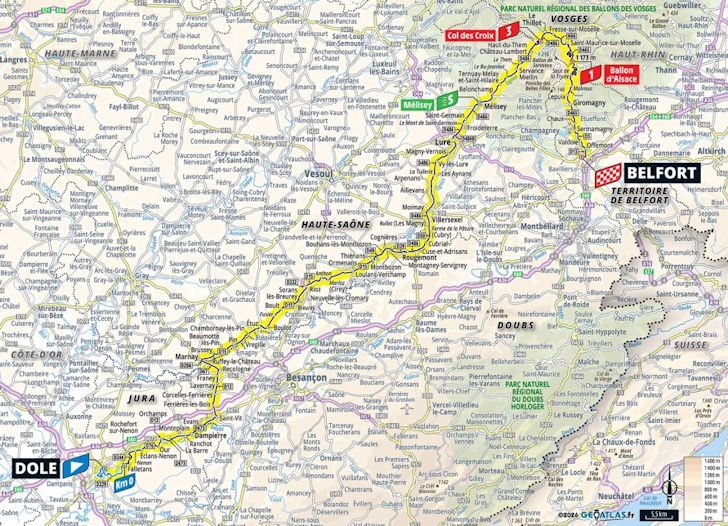
The route runs from Dole northeast through the Jura, Doubs, and Haute-Saône departments, skirting Besançon before passing through Mélisey, then climbing the Col des Croix and the Ballon d’Alsace in close succession, before a long descent and one final sting on the run into Belfort.
Dole: Birthplace of Louis Pasteur and a Four-Time Tour Host
Dole has hosted the Tour de France on four previous occasions, most recently as a départ town in 2022, when the stage set off toward Lausanne. The city’s broader claim to fame extends well beyond cycling: Dole is the birthplace of Louis Pasteur, the scientist whose work on fermentation and pasteurisation transformed both food safety and medicine worldwide. Pasteur’s childhood home in Dole is preserved as a museum today, a fitting starting point for a stage that will spend much of its opening half rolling through the wider Jura region Pasteur himself called home for much of his life.
137 Kilometres of Flat Roads Through the Jura, Doubs, and Haute-Saône
The stage’s opening section is, by design, almost entirely without difficulty. The route rolls gently north-east through the Jura, Doubs, and Haute-Saône departments for roughly the first 137 kilometres, skirting the historic city of Besançon along the way. This isn’t a flat stage in the sprinters’ sense; the profile lacks the kind of guaranteed bunch-sprint finish that defines those days, but it shares their early character: long, undulating roads with nothing categorised to interrupt the rhythm, giving the peloton significant distance to settle into the day before anything decisive happens.
Mélisey: Thibaut Pinot’s Hometown, and a 2026 Homecoming With a Twist
At kilometre 137.8, the route passes through Mélisey, in the Haute-Saône, the hometown of Thibaut Pinot, the French climber who retired from professional racing at the end of 2023 after a career defined by raw emotion as much as results. Pinot lives on a farm in Mélisey with his partner, where he raises goats, sheep, and cattle, a life he has described as more central to his identity than cycling itself ever was. His final competitive Tour appearance, in 2023, passed within sight of his home roads in the Vosges, drawing thousands of fans to a stretch of road nicknamed “the Pinot curve” in his honour, a moment that reportedly brought his long-time team manager to tears.
For 2026, Pinot’s connection to this stage has taken an unusual and very current turn: he has partnered with the Tour’s official sponsor Airbnb to host an exclusive stay at his Mélisey farm timed to coincide with Stage 13 passing through, on the very day the race rolls past his home village. The package reportedly includes a helicopter ride with Pinot himself to watch the stage, a welcome barbecue, and access to the team paddock. Pinot’s own description of the project calls it a chance to “open the doors to my new life” and show that the French countryside he grew up in “has just as much to offer as anywhere else.” For a rider so beloved precisely because he never hid his emotions, hosting fans in his own backyard on the day the Tour passes through feels entirely in character.
The Col des Croix: The First Sign the Flat Roads Are Over
Around kilometre 157, the route tackles the Col des Croix, a Category 3 climb of roughly 5.1 to 5.4 kilometres at an average gradient of 4.8 to 4.9%. It’s the first real signal that the stage’s character is about to change entirely, even though the climb itself is moderate enough not to cause serious selection on its own. A fast, technical descent follows, dropping riders into the Moselle valley before the day’s defining test begins.
The Ballon d’Alsace: Where Tour Mountain History Began
The Ballon d’Alsace is, by most measures, the single most historically significant climb the 2026 Tour will tackle outside the high mountains and 2026 marks 121 years since it first entered Tour de France history. The mountain was first crossed by the race on 11 July 1905, during the Tour’s second edition, after race organiser Henri Desgrange decided the previous climb used in the route, the lower Col de la République, wasn’t dramatic enough to capture public attention. Despite being only marginally higher, the Ballon d’Alsace’s steeper gradient made it a genuine spectacle and Desgrange reportedly declared beforehand that no rider would be able to climb it without walking.
The first rider to prove him wrong was René Pottier, who rode to the summit without ever putting a foot down, but lost the overall lead that day after a puncture cost him precious time before the finish, with Hippolyte Aucouturier taking the stage win instead. Pottier returned the following year, 1906, and this time there was no puncture: he dropped every rival on the climb’s lower slopes, crossed the summit alone, and went on to win the entire Tour de France that July. Six months later, in January 1907, Pottier died by his own hand at just 27 years old. A memorial stone stands at the Ballon d’Alsace’s summit today in his honour — a quiet, permanent marker of cycling’s first true king of the mountains, and a reminder that the sport’s history carries weight well beyond its results sheets.
In 2026, the climb runs 8.7 to 8.9 kilometres at an average gradient of 6.9%, ramping up to 8.8% in its steepest sections, less a brutal wall than what one route analysis has called “a steady drag,” the kind of climb that quietly torments tired legs rather than shattering them outright. The summit arrives roughly 30 kilometres from the finish in Belfort.
30 Kilometres to Belfort: A Long Descent With One Final Sting
From the Ballon d’Alsace’s summit, the road runs mostly downhill toward Belfort, a genuine descent for the first half, before the terrain settles into a gentler downhill grade for the remainder. The stage saves one final surprise for the very end: an 800-metre ramp at roughly 8% inside the final 5 kilometres, sharp enough to disrupt a tired breakaway group’s rhythm right when legs are at their most depleted, and a genuine launching point for anyone with something left for one last effort.
Tour de France 2026 Stage 13 Elevation Profile: Why the Hardest Part Comes Last
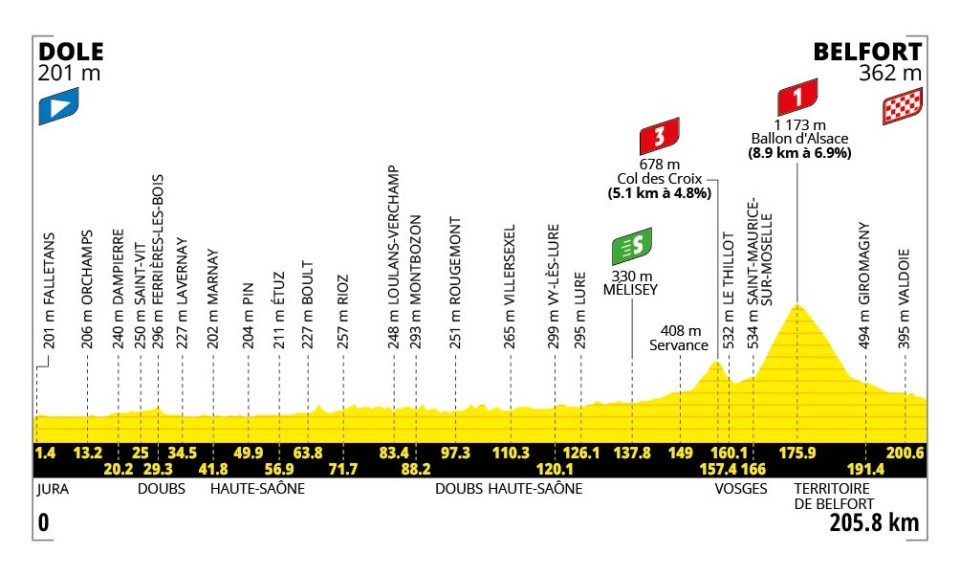
Stage 13 gains roughly 2,500 metres of total elevation across 205.8 km, a figure that, spread over the Tour’s longest stage, undersells just how concentrated the actual difficulty is. Nearly all of that climbing arrives in the final third of the race, with the first 150 kilometres offering almost nothing in the way of categorised terrain.
Stage 13 Climb Data
| Climb | Category | Length | Avg. Gradient | KM Mark | Distance to Finish |
|---|---|---|---|---|---|
| Col des Croix | Cat 3 | 5.1–5.4 km | 4.8–4.9% | ~157 | ~48 km |
| Ballon d’Alsace | Cat 1 | 8.7–8.9 km | 6.9% (max 8.8%) | ~176 | ~30 km |
The Tactical Risk of a Back-Loaded Long Stage
A stage with roughly 150 kilometres of flat racing before any real climbing begins creates a distinct kind of tension compared to a shorter stage where difficulty arrives early or mid-race. With so much distance to cover before anything decisive happens, breakaway groups often take longer to form and stabilise. Riders have less urgency to commit to an early attack when there’s still so much racing left, and teams controlling the bunch have an easier time reeling in tentative early moves over such a long, flat run-up. The result is frequently a more patient, more calculated fight for the day’s escape group than on stages where the climbing starts immediately, with the eventual composition of the breakaway often not settling until well past the race’s halfway point.
Stage 13 Tactics: A Breakaway’s Best Chance Yet
Stage 13’s structure, long flat approach, sudden hard finale, produces a genuinely open tactical picture heading into the Ballon d’Alsace.
Why the Breakaway May Take Time to Form
Given the sheer distance before the Col des Croix even appears, it could take considerably longer than usual for a competitive escape group to establish itself and gain a meaningful gap. Riders with genuine ambitions for the stage have every incentive to wait, conserve energy, and pick their moment carefully rather than committing to a doomed early move on a stage this long.
The Mélisey Intermediate Sprint
The day’s single intermediate sprint comes at Mélisey, kilometre 137.8, Thibaut Pinot’s hometown, and a natural emotional flashpoint for any French rider hoping to make a mark in front of a home crowd this large, even on a sprint with limited direct bearing on the green jersey race given how far it sits from any major climbing.
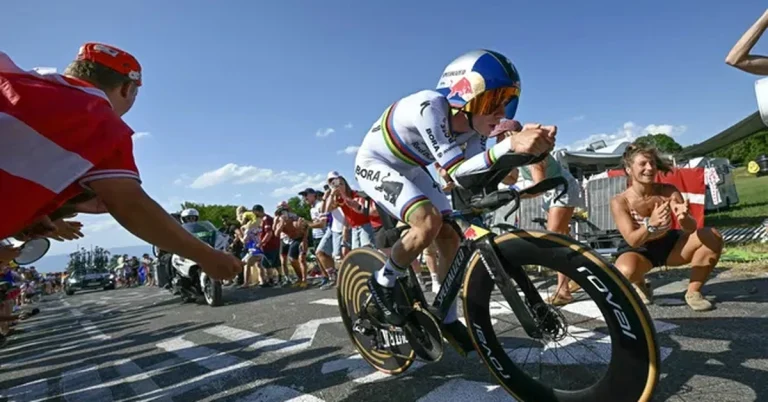
Mathieu van der Poel and the Puncheurs’ Stage
Riders combining strong sustained climbing ability with explosive late-race power, the “puncheur” profile, are widely considered the most likely beneficiaries of a stage shaped like this one. Mathieu van der Poel’s name has been mentioned prominently in this context, given his proven ability to survive a demanding climb and still deliver a decisive late effort. This guide won’t predict a specific winner months ahead of race day, but the formula for success here is clear: survive the Ballon d’Alsace within touching distance of the front group, then have enough left for whatever the final 30 kilometres, including that late 8% ramp demands.
GC Impact: Could the Ballon d’Alsace Create Real Gaps?
With the summit arriving 30 kilometres from the finish, there’s a genuine, if not overwhelming, possibility that an ambitious GC rider could use the climb to test rivals, rather than simply defending position. Whether any of the overall contenders take that gamble, or whether the stage instead plays out as a contest purely among breakaway specialists with the GC group riding cautiously behind, remains one of the stage’s most interesting open questions.
Belfort: The City of the Lion, Hosting the Tour for the 33rd Time
The Lion of Belfort and a City Built on Resistance
Belfort’s defining landmark is the Lion of Belfort, a monumental stone sculpture by Auguste Bartholdi — the same sculptor behind the Statue of Liberty, commemorating the city’s fierce resistance during the siege of 1870–71 in the Franco-Prussian War. The city’s strategic position between the Vosges and Jura mountains has made it a fortified stronghold for centuries, and that history of resilience runs through Belfort’s civic identity to this day, often described locally as the “City of the Lion.”
Belfort’s Tour History: From 1978 to a 2023 Départ
Belfort is hosting the Tour de France for the 33rd time in 2026, a number that places it among the race’s most frequently visited cities. Most of those visits have come as a starting town rather than a finish, including as recently as 2023, when the race departed Belfort for a mountainous stage to Le Markstein. The city’s last stage finish, by contrast, dates back considerably further, to 1978, when Belgian rider Marc Demeyer outsprinted Dutchman Jan Raas to take the win. Stage 13 in 2026 ends that long wait for a finish-line celebration in Belfort itself.
Food and Culture Along the Stage 13 Route
Stage 13 crosses some of France’s most distinctive and least internationally celebrated food and wine terrain, almost entirely overlooked by other race previews. The first half of the route runs directly through Jura cheese and wine country — home to Comté, France’s most popular AOP cheese, made from the milk of Montbéliarde cattle grazing the region’s unspoilt pastures, and aged for months in mountainside cellars before reaching the table. The Jura is equally famous, in wine circles, for Vin Jaune — a remarkable “yellow wine” made entirely from the Savagnin grape, aged for over six years in oak barrels under a protective layer of yeast that gives it a distinctive nutty, sherry-like character unlike almost anything else produced in France. Fittingly, given the stage’s start in Dole, Louis Pasteur himself spent much of his adult life in the nearby wine town of Arbois, where his work on fermentation directly shaped how wines like Vin Jaune are understood today.
As the route climbs into the Vosges toward the Ballon d’Alsace, the culinary character shifts toward Alsace’s better-known traditions on the other side of the mountain — Munster cheese, tarte flambée, and the beginnings of the region’s celebrated Riesling, Pinot Gris, and Gewürztraminer wine country, even though Stage 13 itself stays just on the western edge of that world before finishing in Belfort.
Where to Watch Tour de France 2026 Stage 13: Best Spectator Spots from Dole to Belfort
Stage 13’s sheer length and back-loaded profile make the Ballon d’Alsace the clear centrepiece for spectators, though the finish in Belfort carries its own significant draw given how long the city has waited for a stage win on home soil.
Stage 13 Best Viewing Zones
| Zone | What You’ll See | Access | Best Arrival | Crowd Level |
|---|---|---|---|---|
| Dole start | Stage Village, départ atmosphere, Pasteur heritage | Easy — city centre | Morning of | Light–moderate |
| Mélisey | Thibaut Pinot’s hometown, intermediate sprint, likely emotional crowd | Easy — small-town roads | Early afternoon | Moderate, elevated by Pinot’s local fame |
| Ballon d’Alsace | Stage’s decisive climb, historic significance | Moderate — mountain road, arrives early | Well ahead of the peloton | Heavy — one of the Vosges’ most popular viewing points |
| Belfort finish | First stage finish since 1978, City of the Lion | Easy — central Belfort | Arrive early for a good spot | Heaviest of the stage |
Getting There and Road Closures
Dole has reasonable rail connectivity via SNCF, with services connecting through Dijon and Besançon. Belfort is well served by its own TGV station, making the finish straightforward to reach without a car. Expect road closures on the Ballon d’Alsace to begin well ahead of the peloton’s passage given the climb’s popularity and historic significance, with central Belfort facing its most significant restrictions from mid-afternoon onward.
Where to Stay: Besançon, Mélisey, or Belfort?
Besançon, a historic city the route skirts early on, offers strong accommodation and transport options for visitors wanting a comfortable base with easy access to the start. Mélisey itself has limited capacity but offers a genuinely unique atmosphere for anyone wanting to experience Pinot’s hometown on this particular day. Belfort is the practical choice for most visitors prioritising the finish, with solid infrastructure befitting a city marking its first stage win in nearly five decades.
Weather on Stage 13
Mid-July in the Jura and Vosges typically brings warm conditions in the valleys, with temperatures dropping meaningfully at altitude on the Ballon d’Alsace, comfortably above 1,000 metres at its summit. Given the stage’s significant length, heat management over more than 200 kilometres of racing is a genuine factor for riders independent of any single weather event, and the technical descent off the Ballon d’Alsace carries real risk if conditions turn wet.
How Stage 13 Connects to the Rest of the Tour
Stage 13 marks the Tour’s final push through the Jura and Vosges before the race turns toward its remaining major mountain blocks later in the route. Having just completed the longest stage of the entire Tour, riders face a genuine question of recovery heading into whatever comes next, a reminder that even on a day built for breakaway specialists rather than GC contenders, 205.8 kilometres and a Category 1 mountain finish take a toll that doesn’t simply disappear overnight.
Related Stage Guides: