Le 14 juillet au Lioran : la 10e étape retrouve la montagne qui a fait plier Pogačar — l'histoire peut-elle se répéter ?
Last Updated: 1:28 pm CEST - Monday, 13 July 2026 | 39 minutes read time.
La 10e étape du Tour de France 2026 se déroulera le mardi 14 juillet, jour de la fête nationale, sur un parcours de 166,6 km reliant Aurillac au Lioran à travers le cœur volcanique du Cantal ; elle comptera sept ascensions répertoriées et un dénivelé positif total d'environ 3 900 mètres. Il s'agit de la première étape après la première journée de repos du Tour, et elle s'achèvera dans une ville-étape déjà associée à l'un des épisodes les plus spectaculaires de l'histoire récente de la Grande Boucle.
C’est une étape courte à l’échelle d’un Grand Tour, mais ne confondez pas brièveté et clémence. La quasi-totalité du dénivelé est concentrée dans les 100 derniers kilomètres, avec une succession de cols de 2e et 3e catégories avant que le Puy Mary-Pas de Peyrol et le col de Pertus, aux pentes redoutables, ne déterminent qui arrivera au Lioran encore en mesure de jouer la gagne. Les coureurs sortent de leur première journée de repos sans savoir s’ils retrouveront des jambes fraîches ou engourdies ; sur un tel tracé, la réponse a une importance immédiate.
Au sortir de la 9e étape : Van der Poel concrétise enfin, et la journée de repos rebat les cartes.
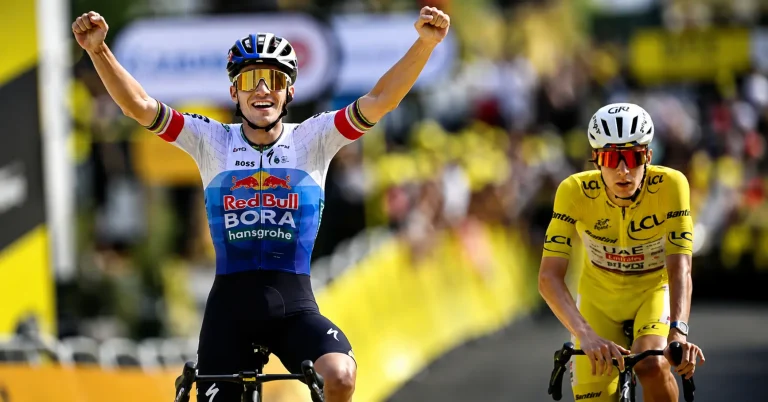
La 9e étape a apporté une réponse on ne peut plus appropriée à la question qui se posait. Mathieu van der Poel, qui avait passé la première semaine à reconnaître — presque en s'en excusant — qu'il ne prenait pas de plaisir, s'est imposé à Ussel au terme d'une échappée, devançant Tobias Halland Johannessen et Tom Pidcock dans le sprint final. Il signe là sa première victoire sur ce Tour, après avoir passé la semaine à préparer les sprints pour Jasper Philipsen plutôt qu'à viser un succès personnel. Johannessen a d'ailleurs admis après la course que tenter de battre Van der Poel à la régulière au sprint relevait d'une certaine « stupidité » ; une déclaration empreinte de franchise qui résume parfaitement le déroulement de ce final.
Derrière l'échappée, la hiérarchie est restée inchangée en tête du classement. Tadej Pogačar a franchi sans encombre cette étape raccourcie en raison de la chaleur ; il conserve le maillot jaune avec une avance de 2 minutes 42 secondes sur Jonas Vingegaard, réalisant exactement la journée calme et sans risque espérée par l'équipe UAE Team Emirates-XRG à la veille de la journée de repos. Isaac del Toro demeure troisième et porteur du maillot blanc.
Cette journée de repos est désormais passée. La 10e étape constitue le premier véritable test pour évaluer l'effet de ce répit sur des jambes sortant tout juste d'une alerte canicule. Certains coureurs reprendront la compétition plus affûtés ; d'autres — comme l'explique plus bas la section de l'article consacrée aux incertitudes liées à la journée de repos — ressentiront exactement l'inverse. Or, sur une étape dont les difficultés sont concentrées en fin de parcours, la différence se fait sentir rapidement.
Un autre point à noter avant la 10e étape : l'ambiance au sein de l'équipe Red Bull-BORA-hansgrohe est tendue depuis l'étape du Tourmalet, Evenepoel ayant exprimé sa frustration à l'égard de son co-leader Florian Lipowitz à l'issue de la course. Reste à savoir si la situation s'est apaisée ou si les tensions couvent toujours à l'approche du 14 juillet ; c'est l'un des petits enjeux secondaires à surveiller dans les 36 prochaines heures.
En quoi consiste la 10e étape du Tour de France 2026 ?
La 10e étape, longue de 166,6 km et disputée le 14 juillet, relie Aurillac au Lioran en traversant la région volcanique du Cantal ; elle comprend sept ascensions répertoriées totalisant environ 3 900 mètres de dénivelé positif. Il s’agit de la première étape après la première journée de repos du Tour ; bien que plus courte que la plupart des autres étapes de montagne de l’épreuve, elle concentre la quasi-totalité de ses difficultés sur les 100 derniers kilomètres, une configuration qui sanctionne une mauvaise gestion de l’effort plus sévèrement que presque n’importe quelle autre étape de ce Tour.
Le Massif central ne présente rien de comparable au spectacle grandiose des sommets emblématiques et imposants des Alpes ou des Pyrénées. Il impose en revanche une épreuve d'usure : une succession incessante de côtes qui épuise les coureurs par accumulation de fatigue plutôt que par un effort unique et décisif. Le fait d'aborder l'étape juste après une journée de repos ajoute une réelle incertitude quant à la réaction des organismes : certains coureurs repartent frais et dispos tandis que d'autres manquent de rythme, et une étape aussi exigeante a tendance à révéler très vite dans quel état se trouve chacun.
Comment regarder la 10e étape du Tour de France 2026 en direct
Date, distance et heures de départ de la 10e étape
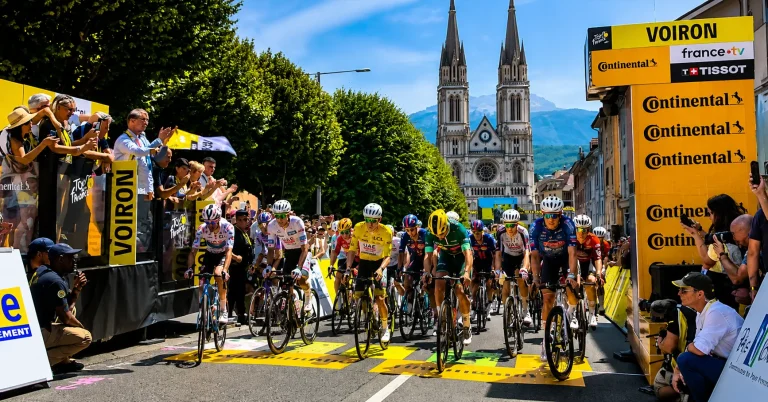
La 10e étape se déroulera le mardi 14 juillet 2026 — jour de la fête nationale française — et couvrira une distance de 166,6 km. Le départ sera donné à 13 h 10 CEST à Aurillac, pour une arrivée estimée vers 17 h 24 CEST au Lioran.
Pour les téléspectateurs situés hors d'Europe continentale : un départ à 13 h 10 (CEST) correspond environ à 12 h 10 (BST) au Royaume-Uni, 7 h 10 (EDT) sur la côte est des États-Unis et 4 h 10 (PDT) sur la côte ouest. La course sera diffusée sur Eurosport et HBO Max dans la majeure partie de l'Europe, tandis que NBC Sports et Peacock assureront la retransmission aux États-Unis.
Trois niveaux de visionnage, si vous ne pouvez pas tout regarder :
- Étape complète : rejoignez le peloton dès le départ — la bataille pour l'échappée est généralement plus intense qu'à l'accoutumée lors de cette étape du 14 Juillet, et le terrain favorise une attaque précoce et bien structurée.
- Phase décisive uniquement : rejoignez-nous vers 15 h 50 CEST / 14 h 50 BST, au moment où la course aborde l'enchaînement Puy Mary – Pertus – Font de Cère.
- Pour le final uniquement : rejoignez-nous à partir de 16 h 45 CEST (15 h 45 BST) pour suivre la course à partir du col de Pertus — une ascension suffisamment raide et située assez tard dans l'étape pour justifier à elle seule le visionnage, même si vous avez manqué le reste.
Comment regarder : Au Royaume-Uni, il faut disposer de TNT Sports ou de HBO Max pour suivre la course en direct ; Channel 5 ne diffuse que des résumés gratuits, et ITV ne détient plus les droits du Tour. Ailleurs : Eurosport dans la majeure partie de l'Europe, NBC/Peacock aux États-Unis, SBS (gratuit) en Australie. Consultez le guide complet de diffusion en direct par région pour suivre le Tour de France 2026.
Itinéraire de l'étape 10 du Tour de France 2026 : guide complet du parcours d'Aurillac au Lioran
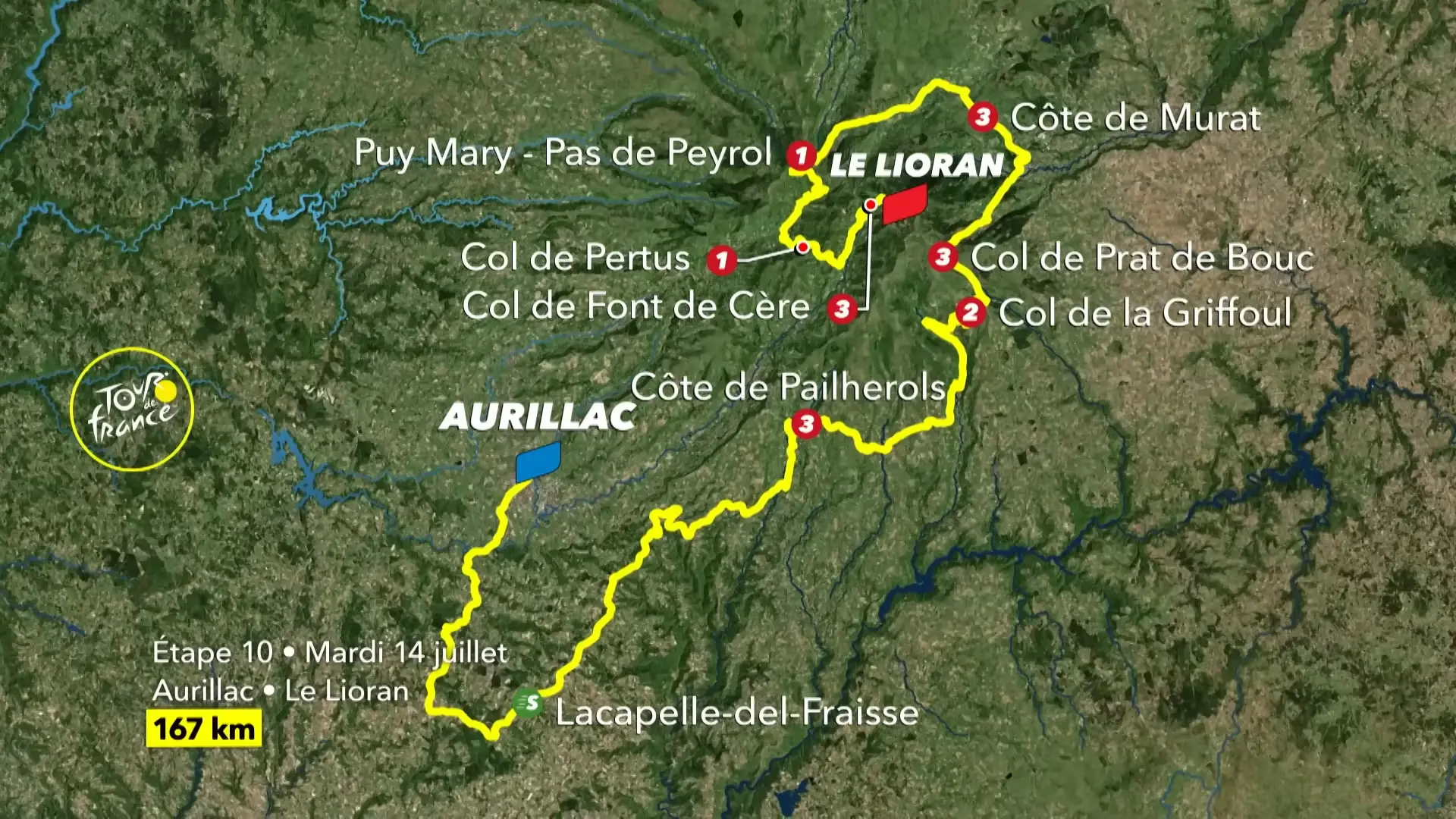
L'itinéraire traverse un paysage au relief modéré sur les 65 premiers kilomètres avant que l'ascension ne commence véritablement avec la côte de Pailherols ; il se poursuit par une série de cols répertoriés aux alentours de Murat, pour aboutir à l'enchaînement final décisif : le Puy Mary-Pas de Peyrol, le col de Pertus — aux pentes redoutables — et le col de Font de Cère, qui mènent à l'arrivée au Lioran.
Aurillac : quinze visites guidées et une ville sur la Jordanne
Située au bord de la Jordanne, Aurillac possède sa propre et authentique histoire liée au Tour. La Grande Boucle a fait étape dans la ville à quinze reprises, la plus récente remontant à 2024, année où le peloton s'est élancé d'Aurillac en direction de Villeneuve-sur-Lot. Ce passé lié à l'édition 2024 se distingue nettement de la notoriété plus récente du Lioran ; il s'agit de deux chapitres distincts de l'histoire du Tour qui, bien que géographiquement proches sur le tracé de 2026, ne doivent pas être confondus. Avec ses quinze accueils, Aurillac figure parmi les villes-étapes les plus expérimentées du parcours 2026, même si elle attire rarement autant l'attention que les départs plus prestigieux des Alpes ou des Pyrénées.
Les 65 premiers kilomètres : un terrain vallonné trompeusement facile
L'étape débute par un relief véritablement doux et vallonné sur les 65 premiers kilomètres, un début susceptible d'inciter le spectateur le moins attentif à croire que la journée sera calme. Il n'en est rien. Ce tronçon initial ne constitue guère plus qu'une longue approche des difficultés à venir ; ces premiers kilomètres relativement plats permettent justement de limiter la distance totale de l'étape tout en concentrant près de 3 900 mètres de dénivelé positif dans sa seconde moitié.
La côte de Pailherols et les premiers signes avant-coureurs
Au kilomètre 68 se présente la côte de Pailherols : 3 km à une pente moyenne de 7,2 %, classée en troisième catégorie. C’est un signal bref mais net que la partie facile de la journée est terminée, même si ce qui suit la fera paraître dérisoire, tant par la longueur que par l’importance des enjeux.
Col de la Griffoul, Prat de Bouc et Côte de Murat : Le Bloc d'Échauffement
Un triptyque d'ascensions constitue la partie centrale de l'étape. Le col de la Griffoul (5,9 km à 6,7 %, 2e catégorie, km 97,3) a été qualifié par un spécialiste du parcours de « grande inconnue » de l'étape ; moins documentée que les cols les plus célèbres du Cantal, cette ascension représente pourtant un véritable test de 2e catégorie. Le col de Prat de Bouc (3,1 km à 6,5 %, km 103,8) s'enchaîne presque immédiatement après la descente, tandis que la côte de Murat (5,2 km à 5,3 %, km 118,8) complète cet ensemble. Malgré leur difficulté intrinsèque, ces trois ascensions ne sont, au regard de la suite du parcours, que de simples mises en jambes avant le véritable dénouement de l'étape.
Puy Mary - Pas de Peyrol : l'ascension la plus célèbre du Cantal
Au kilomètre 135,7, la course atteint le Puy Mary-Pas de Peyrol : une ascension de 7,8 km avec une pente moyenne de 6 %, dont les 2,2 derniers kilomètres affichent une inclinaison plus prononcée de 8,8 %. Classée en première catégorie, c’est l’ascension la plus célèbre de tout le massif du Cantal, et pour cause : le Pas de Peyrol est le col routier le plus élevé du Massif central (1 589 mètres), situé juste en contrebas du sommet du Puy Mary (1 787 mètres). C’est sur cette montée que Tadej Pogačar a lancé son attaque de loin, désormais légendaire, lors d’une autre étape en 2024 — comme détaillé plus bas — et elle reste le type d’ascension capable de donner lieu à ce genre de manœuvre décisive en 2026.
Col de Pertus : l'épreuve la plus raide, à 14,6 km de l'arrivée
Après une descente de 8 kilomètres depuis le Puy Mary, la route remonte aussitôt vers le col de Pertus : 4,4 km à une pente moyenne de 8,5 % — l'ascension soutenue la plus raide de toute l'étape, classée en première catégorie. Le sommet est atteint alors qu'il reste encore 14,6 kilomètres jusqu'à l'arrivée, ce qui en fait le dernier point de lancement réaliste pour une offensive majeure au classement général avant la montée finale de l'étape.
Col de Font de Cère et la Ruée vers Le Lioran
Une descente de six kilomètres mène à Saint-Jacques-des-Blats, après quoi la route remonte presque aussitôt ; toutefois, seuls les 3,3 derniers kilomètres comptent pour le classement de la montagne au col de Font de Cère, avec une pente moyenne de 5,8 %. Depuis le sommet, il reste 2,5 kilomètres jusqu'à l'arrivée au Lioran : la route descend légèrement avant que les dernières centaines de mètres ne s'élèvent à nouveau à 6 %, une arrivée en montée qui favorise les coureurs disposant encore de puissance plutôt que ceux misant sur une vitesse de sprinteur pur.
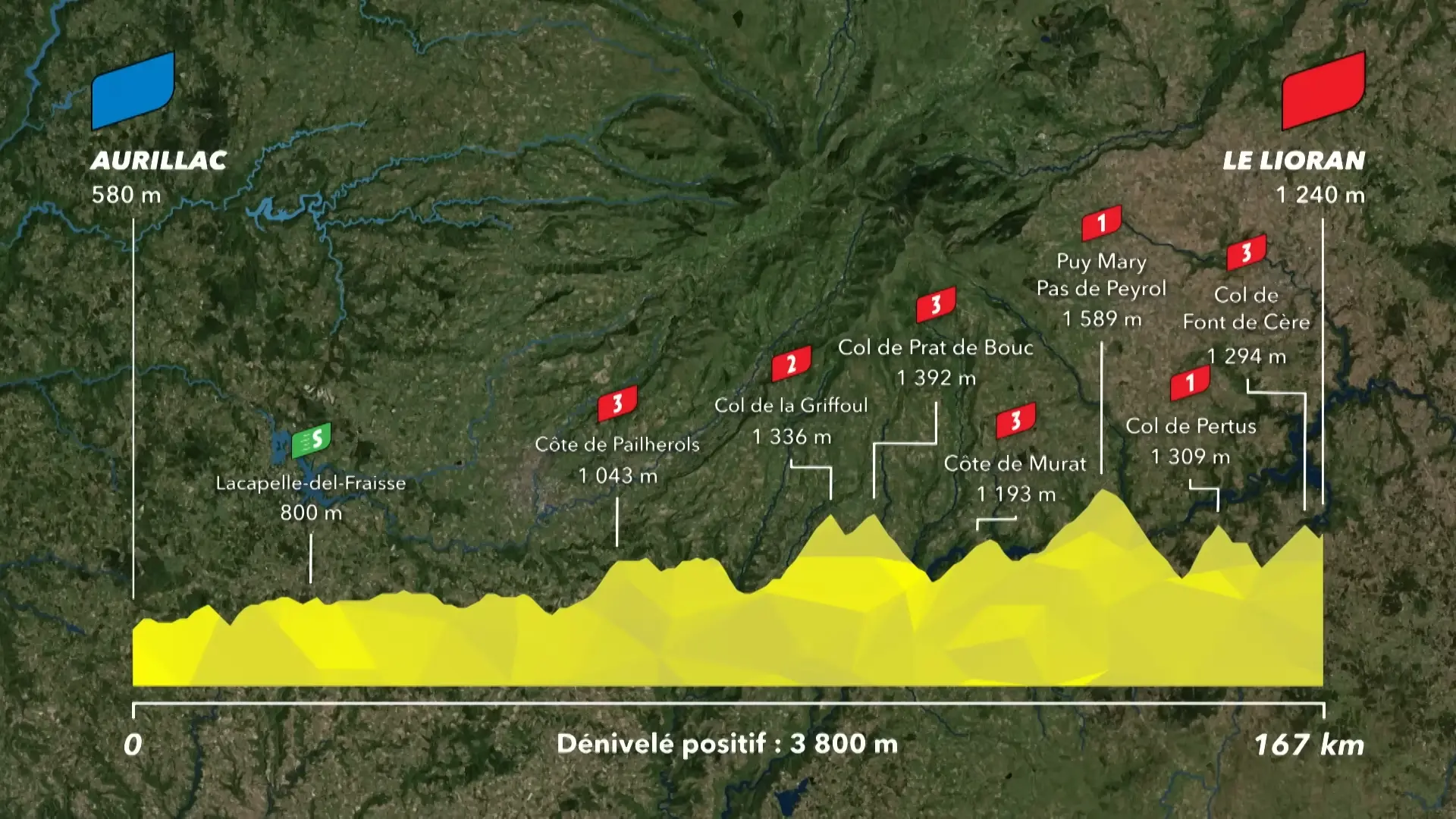
Profil altimétrique de la 10e étape du Tour de France 2026 : 3 900 mètres de dénivelé concentrés sur la seconde moitié du parcours
La 10e étape affiche un dénivelé positif total d'environ 3 900 mètres sur seulement 166,6 km, soit une pente moyenne — en termes de difficulté au kilomètre — nettement plus prononcée que celle de plusieurs étapes de montagne plus longues du Tour ; cela s'explique précisément par le fait que les 65 premiers kilomètres ne présentent quasiment aucune ascension. L'essentiel du dénivelé se concentre dans la seconde moitié de l'étape, montant en puissance jusqu'à l'enchaînement Puy Mary-Pertus-Font de Cère qui sera décisif pour l'issue de la journée.
Les sept ascensions : tableau de données de l'étape 10
| Monté | Catégorie | Longueur | Avg. Gradient | KM Mark |
|---|---|---|---|---|
| Côte de Pailherols | Cat 3 | 3 km | 7.2% | 68 |
| Col de la Griffoul | Cat 2 | 5.9 km | 6.7% | 97.3 |
| Col de Prat de Bouc | Cat 3 | 3.1 km | 6.5% | 103.8 |
| Côte de Murat | Cat 3 | 5.2 km | 5.3% | 118.8 |
| Puy Mary-Pas de Peyrol | Cat 1 | 7.8 km (final 2.2km at 8.8%) | 6% | 135.7 |
| Col de Pertus | Cat 1 | 4.4 km | 8.5% | 152.1 |
| Col de Font de Cère | Cat 3 | 3.1 km | 5.8% | 163 |
Pourquoi une étape courte peut être plus dangereuse qu'une étape longue
Avec ses 166,6 km, la 10e étape est véritablement courte selon les standards actuels du Tour ; d'autres étapes du parcours 2026 affichent en effet 30 à 50 kilomètres de plus. Cette brièveté pourrait laisser présager une journée plus facile, mais elle produit un effet quasi inverse. Une étape longue, où le dénivelé total est réparti uniformément sur une plus grande distance, offre aux coureurs davantage d'occasions de trouver un rythme soutenable et plus de répit entre les efforts. À l'inverse, la 10e étape concentre la quasi-totalité de ses 3 900 mètres de dénivelé positif sur les 100 derniers kilomètres, ce qui laisse très peu de marge d'erreur dans la gestion de l'effort : un coureur qui gère mal son ascension du Griffoul ou du bloc de Murat ne dispose pratiquement plus de portions planes pour récupérer avant d'aborder le Puy Mary et le Pertus. Les étapes courtes au profil « en fin de parcours » (où les difficultés sont concentrées sur la seconde moitié) donnent souvent lieu à une course plus nerveuse et plus décisive que les étapes plus longues de difficulté nominale équivalente, précisément parce que la marge de manœuvre tactique s'y trouve réduite.
Tactiques de la 10e étape : le jour de la Bastille, la remise à zéro après la journée de repos et une possible revanche.
La 10e étape revêt des dimensions tactiques et émotionnelles qui dépassent le simple cadre de son profil : la date, le moment choisi pour la journée de repos et l'histoire récente de la ville d'arrivée sont autant d'éléments qui façonneront le déroulement probable de la course.
Fête nationale : pourquoi les coureurs français se battent davantage pour intégrer l'échappée
Le 14 juillet, fête nationale française, revêt une importance tactique réelle au sein du peloton, bien au-delà de sa simple portée symbolique. Les coureurs français ont une propension avérée à se battre avec une détermination particulière pour intégrer l'échappée du jour lors de cette date précise, motivés par la perspective de la victoire ou simplement par l'envie d'animer la course devant le plus grand public national de l'année. Si cela ne garantit pas pour autant un succès français à l'arrivée, cela se traduit généralement par une lutte plus agressive et plus disputée pour prendre l'échappée dès les premiers kilomètres de l'étape — un détail qui façonne le déroulement de la course bien avant même que le Puy Mary n'apparaisse à l'horizon.
Au sortir d'une journée de repos : jambes fraîches ou jambes rouillées ?
La première étape suivant une journée de repos est notoirement imprévisible. Certains coureurs reprennent la route requinqués, la fatigue accumulée sur trois semaines étant réellement atténuée par ces 24 heures de récupération. D’autres, en revanche, ont les jambes étrangement lourdes — un phénomène souvent évoqué par les coureurs chevronnés et les membres des équipes, et attribué à la perturbation du rythme de l’organisme par un changement soudain de routine. Il n’existe aucun moyen fiable de prédire quel effet l’emportera pour un coureur donné avant que la course elle-même n’apporte la réponse ; c’est ce qui rend la 10e étape — dont le profil est déjà exigeant — encore plus imprévisible que ne le laisseraient supposer les seules données relatives aux ascensions.
Le sprint intermédiaire de Lacapelle-del-Fraisse
Le seul sprint intermédiaire de la journée intervient tôt, à Lacapelle-del-Fraisse (au kilomètre 25,5), au cœur de la section initiale de l'étape, qui présente un profil peu exigeant. Compte tenu de l'éloignement de ce sprint par rapport à la véritable difficulté du parcours, les équipes qui le disputeront ne devraient pas en payer le prix sur le plan tactique ; les calculs pour le maillot vert ne seront guère complexifiés par les ascensions à venir.
2024 revisité : le duel Vingegaard-Pogacar au Lioran
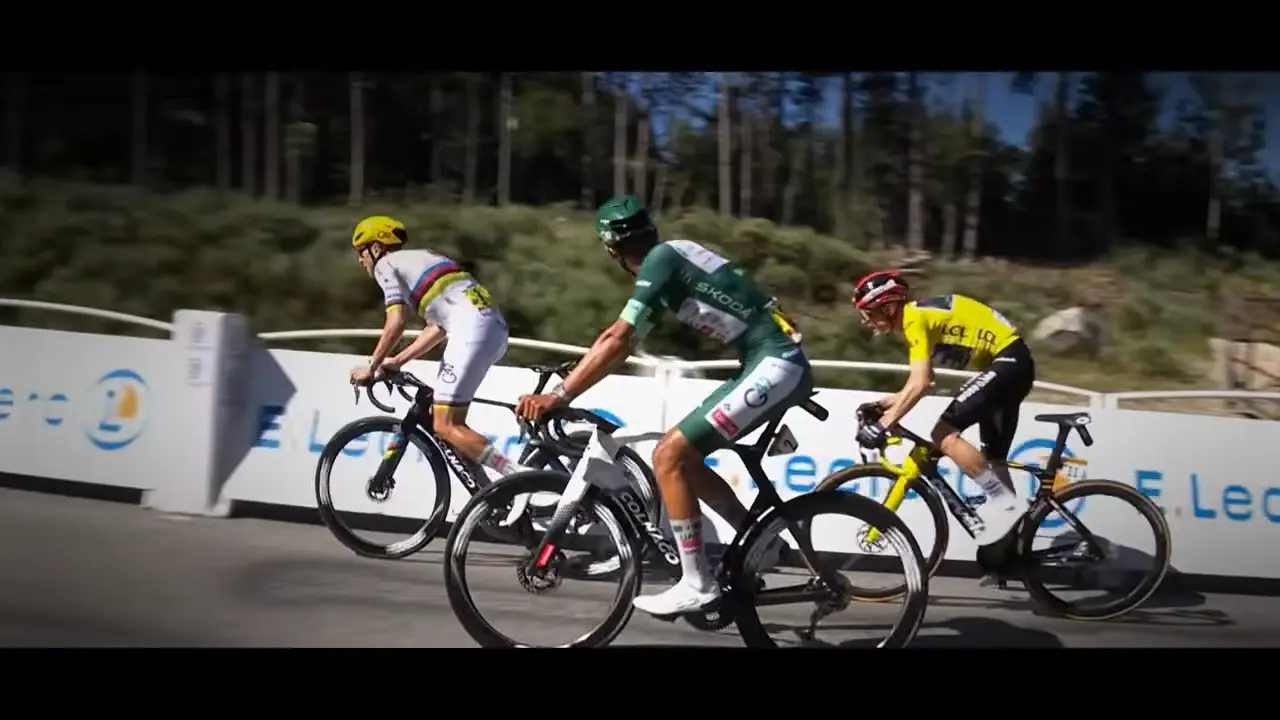
La place du Lioran dans l'histoire récente du Tour mérite d'être rappelée avec précision, car on a vite fait de la confondre avec l'histoire propre à Aurillac. En 2024, Jonas Vingegaard a signé au Lioran l'une des victoires les plus émouvantes de sa carrière ; toutefois, cette étape — la 11e du Tour 2024 — s'était élancée à plus de 200 kilomètres de là, depuis Évaux-les-Bains, un itinéraire bien différent de celui du départ d'Aurillac prévu pour l'édition 2026. Vingegaard avait rejoint Pogačar dans le col de Pertus et le duo avait franchi la ligne d'arrivée ensemble — Remco Evenepoel figurant également dans le groupe de tête — avant que Vingegaard ne remporte le sprint ; ce fut d'ailleurs la dernière fois que Vingegaard a battu Pogačar sur le Tour de France.
Les deux coureurs qui franchiront ensemble le Puy Mary et le Pertus en 2026 s'attaqueront aux mêmes ascensions emblématiques, même si l'itinéraire y menant est entièrement inédit. Cela peut-il se reproduire ?
Pronostic pour 2026 : pourquoi Pogačar — et non une revanche — est le choix judicieux
Il y a deux ans, cette ville-étape a été le théâtre de la remontée la plus souvent revue de la saison. On est tenté d'espérer une réédition de l'exploit. Mais la physionomie actuelle de la course suggère le contraire.
Tadej Pogačar aborde la 10e étape fort de deux victoires déjà acquises et auréolé d'une prestation au Tourmalet si dominante qu'elle est d'ores et déjà considérée comme le moment charnière ayant scellé le sort de ce Tour ; il a non seulement devancé Vingegaard dans l'ascension, mais a aussi creusé l'écart dans la descente, illustrant une supériorité technique qui ne risque pas de s'estomper d'ici l'arrivée à Paris. Depuis lors, l'équipe de Vingegaard adopte une stratégie de prudence, excluant toute attaque précoce et privilégiant la survie au jour le jour plutôt qu'un nouveau pari risqué « à quitte ou double ».

Cela ne signifie pas pour autant que l’étape du Lioran sera une simple formalité. L’enjeu le plus captivant ne réside pas dans la capacité de Vingegaard à réitérer sa performance de 2024, mais plutôt dans la question de savoir si Isaac del Toro bénéficiera d’une certaine liberté de la part de l’équipe UAE pour jouer la victoire à titre personnel. C’est le seul coureur en position réaliste de devancer Pogačar sur la ligne d’arrivée, précisément parce qu’il partage la même équipe et n’a pas besoin de l’attaquer. Si UAE souhaite préserver les jambes de Pogačar en vue des Alpes tout en remportant l’étape, envoyer del Toro à l’avant dans l’ascension du Puy Mary ou du col de Pertus constituerait une stratégie logique ; cela offrirait par ailleurs à del Toro une victoire de prestige, le jour de la fête nationale.
Mon pronostic : Tadej Pogačar remporte la 10e étape, soit en s'imposant lui-même, soit en épaulant del Toro vers la victoire.
Si une sélection s'opère parmi les favoris du classement général dans l'ascension du Pertus, il faudra surveiller Richard Carapaz et Paul Seixas ; ce sont les coureurs les plus susceptibles d'animer la course en dehors du trio de tête, car ils possèdent précisément ce profil de puncheur capable d'enchaîner les efforts explosifs, une qualité que ce terrain récompense. La victoire d'une échappée partie de loin reste envisageable (Lennert Van Eetvelt, Ben O’Connor et Thymen Arensman correspondent à ce profil), mais la coïncidence avec le 14 Juillet — qui attire les regards des Français vers leur écran — et la configuration actuelle du classement général rendent plus probable une arrivée groupée des favoris plutôt que le succès d'une échappée jusqu'à la ligne.
Impact sur le classement général : un véritable test, mais les écarts sont déjà établis.
La 10e étape revêt une importance réelle pour le classement général ; l'enchaînement Puy Mary–Pertus offre précisément le type de terrain propice aux écarts, mais elle intervient alors qu'une hiérarchie claire s'est déjà établie. Pogačar devance Vingegaard de 2 min 42 s, tandis que del Toro (+3 min 27 s) et Evenepoel (+3 min 30 s) suivent, avec Ayuso, Seixas et Lipowitz regroupés juste derrière eux. Rien de tout cela n'a changé lors de la 9e étape.
Ce que la 10e étape peut concrètement permettre, c'est d'accentuer les écarts plutôt que de bouleverser la hiérarchie. Une accélération brève et incisive de Pogačar dans le Pertus — à l'image de son offensive au Tourmalet — n'aurait pas besoin de prendre la forme d'un raid de longue haleine pour mettre ses rivaux en difficulté ; il suffirait que le groupe de tête soit suffisamment écrémé pour qu'une attaque près du sommet permette de creuser un écart significatif. Pour Vingegaard, le calcul est différent : il lui faut tester la profondeur de l'effectif d'UAE avant d'aborder les Alpes. Le Pertus, avec ses pentes raides et sa situation en fin d'étape, constitue le terrain idéal pour tenter cette manœuvre, même si une réédition de sa remontée de 2024 semble peu probable au vu de sa forme actuelle.
Le Lioran et les volcans du Cantal
The Cantal: Europe’s Largest Stratovolcano
The mountains Stage 10 climbs through aren’t just scenic, they’re geologically extraordinary. The Cantal massif is widely recognised as the largest stratovolcano in Europe, with a base diameter of roughly 70 kilometres and a surface area of around 2,700 square kilometres, formed through volcanic activity between roughly 13 and 3 million years ago. Puy Mary itself, the climb’s namesake peak, is a remnant of that ancient volcanic structure, its now-iconic pyramidal silhouette the product of millions of years of glacial erosion carving away at what was once a far taller, more conventionally volcano-shaped mountain. The radiating valleys visible from the summit, there are seven in total around the Puy Mary site alone, are glacial in origin, carved during the last Ice Age into the volcanic rock left behind by the Cantal’s eruptions. Few of the Tour’s mountain stages cross terrain with this kind of genuine geological pedigree.
Gastronomie et culture le long de l'itinéraire de la 10e étape
Stage 10 rides directly through one of France’s most distinctive cheese-producing regions, and the connection is about as literal as it gets: Cantal cheese, one of France’s oldest AOC-protected cheeses, takes its name directly from this exact department. Produced from the milk of cattle grazing the volcanic plateaus the route climbs through, Cantal is a firm, semi-hard cheese with a flavour that deepens with age, traditionally used in regional dishes like truffade, a hearty dish of fried potatoes melted together with cheese, a classic of Auvergne mountain cuisine eaten at traditional shelters called burons that dot the high plateaus. For a stage that spends most of its second half grinding through the exact landscape that produces one of France’s most beloved regional cheeses, this is a food-and-culture connection almost too perfect to invent.
Où regarder la 10e étape du Tour de France 2026 : les meilleurs endroits pour les spectateurs, d'Aurillac au Lioran
Stage 10 offers some of the most dramatic mountain spectating of the Tour’s opening fortnight, with the Puy Mary site in particular drawing serious crowds given its fame and accessibility.
Stage 10 Best Viewing Zones
| Zone | What You’ll See | Accéder | Meilleure arrivée | Foulé |
|---|---|---|---|---|
| Aurillac start | Stage Village, Bastille Day atmosphere | Facile — centre-ville | Le matin | Léger à modéré |
| Puy Mary-Pas de Peyrol | Category 1 climb, likely GC action, volcanic scenery | Moderate — mountain road, can close early | Early afternoon, arrive well ahead | Heavy — one of the route’s most popular viewing points |
| Col de Pertus | Steepest test of the day, potential decisive moves | Moderate — narrow mountain road | En milieu d'après-midi | Moderate–heavy |
| Le Lioran finish | Uphill finish, GC reckoning, ski-station infrastructure | Easy — established resort town | Arrivez tôt pour avoir une bonne place. | Heaviest of the stage |
Accès et fermetures de routes
Aurillac has its own regional airport and reasonable rail connectivity via SNCF, making it a practical access point for the start. Le Lioran, as an established ski resort, has solid road infrastructure for a mountain finish town, though access to climb-side viewing points like Puy Mary will require significant advance planning, given the narrow mountain roads and the climb’s popularity even outside Tour years. Expect road closures on the Puy Mary and Pertus sections to begin well ahead of the peloton’s passage, with the steepest and most popular viewing areas closing earliest, given anticipated crowd volume.
Where to Stay: Aurillac, Murat, or Le Lioran?
Aurillac offers the most accommodation near the start with solid transport links. Murat, sitting roughly midway along the route near several of the day’s climbs, makes a strong base for visitors wanting to combine watching the race with exploring the Cantal’s volcanic landscape beyond just race day. Le Lioran itself, as a functioning ski resort, has meaningful accommodation capacity for a mountain finish town, though summer rooms can book out given the area’s hiking and outdoor tourism popularity, independent of the Tour.
Weather on Stage 10
Mid-July in the Cantal typically brings warm conditions in the valleys, with temperatures dropping meaningfully at altitude on climbs like Puy Mary and Pertus, both comfortably above 1,500 metres. The Massif Central’s volcanic terrain can produce localised, sometimes sudden afternoon weather changes, particularly around the higher passes — a detail regional hiking guides note as a genuine safety consideration even outside race conditions. Riders descending technical sections like the eight-kilometre drop from Puy Mary will be watching conditions closely, since a wet descent on terrain this technical carries real risk independent of the climbing itself.
How Stage 10 Connects to the Rest of the Tour
Stage 10 sits at the start of a stretch that continues testing the Massif Central’s climbers before the race eventually turns toward the Pyrenees and Alps in its second half. The riders who manage the uncertainty of returning from Rest Day 1 most effectively, whether they emerge fresh or rusty, set the tone for how the rest of this demanding middle stretch of the Tour is likely to play out, making Stage 10 as much a psychological test as a physical one.
Related Stage Guides: