Decathlon CMA CGM Tour de France 2026: Full Team, Riders & Strategy
Decathlon CMA CGM heads into the 2026 Tour de France with eight riders and two leaders chasing two different kinds of history. Paul Seixas, 19, becomes the youngest rider to start the Tour since 1937. Olav Kooij, 24, gets a sprint-only mandate built around a leadout train that’s missing its strongest piece. Both are making their Tour debuts on the same team, in the same three weeks, with French fans watching for the first home GC threat in a generation.
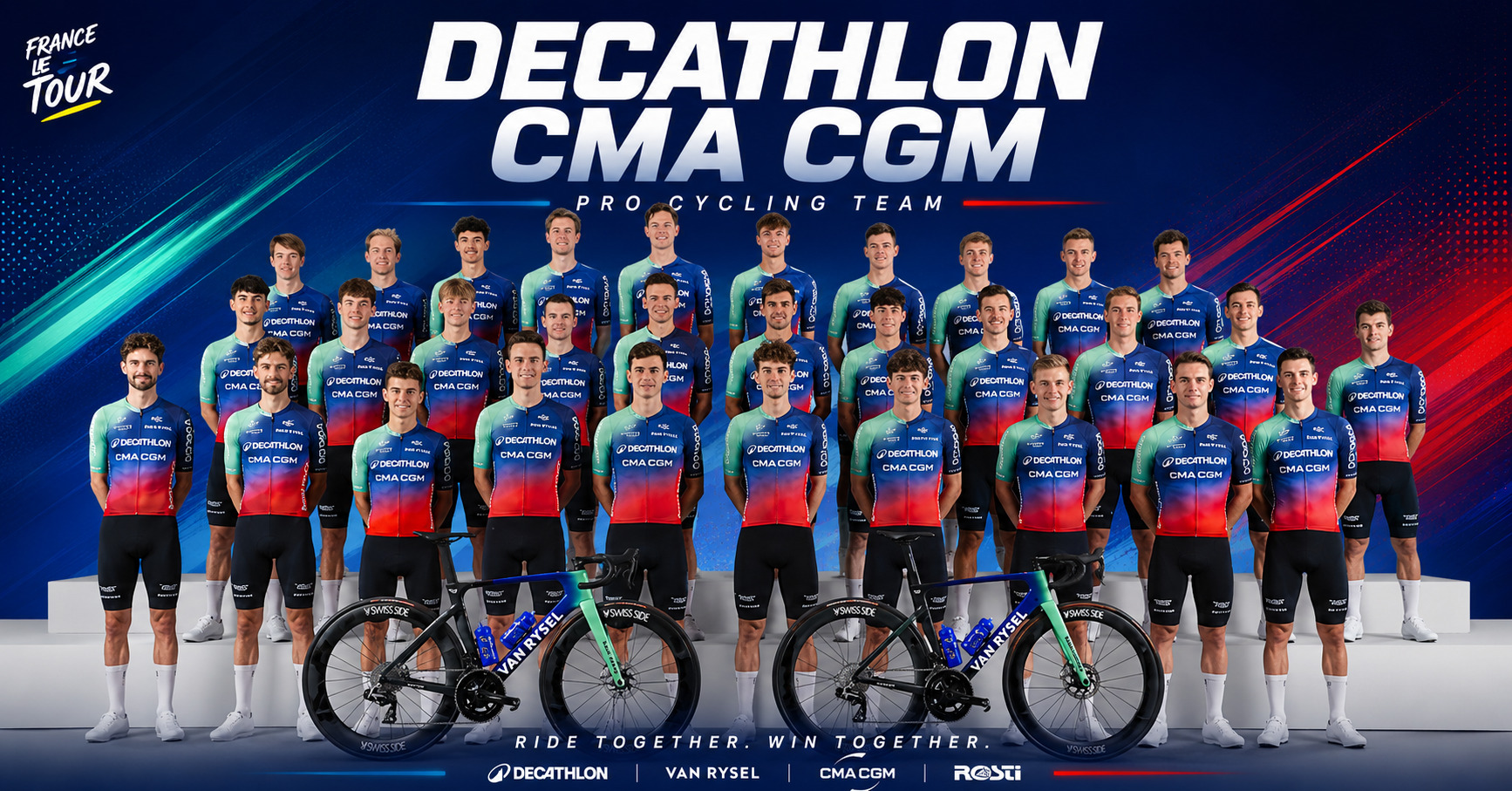
The squad is confirmed: Seixas, Kooij, Tiesj Benoot, Daan Hoole, Cees Bol, Aurélien Paret-Peintre, Nicolas Prodhomme, and Matthew Riccitello, directed from the car by Luke Rowe in his own Grand Tour debut as sports director. Here’s the full breakdown — who’s racing, what each rider’s job actually is, why a key climber didn’t make the cut, and what equipment the team’s riding into Barcelona on.
En bref
- The squad: 8 confirmed riders, built around dual leadership — Seixas for GC, Kooij for sprint stages.
- The history: Seixas, 19 years 9 months 10 days on Stage 1, is the youngest Tour starter since 1937.
- The late change: Climber Gregor Mühlberger was left out in a pure selection call — no injury — opening a clearer run for Kooij’s spot.
- The gear: Van Rysel frames, SRAM Red groupset, Van Rysel/Decathlon wheels.
Seixas, 19, is the youngest Tour starter in nearly a century. Kooij leads the sprint charge — Decathlon CMA CGM bets on youth and speed.
Who Is Racing for Decathlon CMA CGM at the Tour de France 2026?
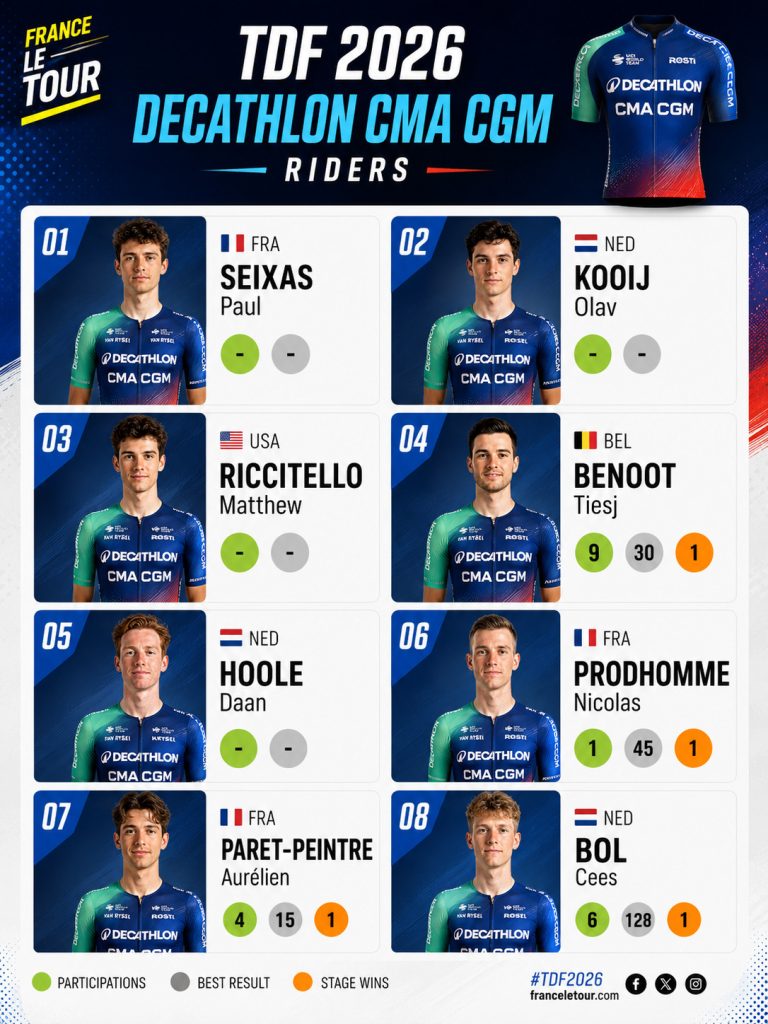
Decathlon CMA CGM’s eight-rider Tour de France 2026 squad is Paul Seixas, Olav Kooij, Tiesj Benoot, Daan Hoole, Cees Bol, Aurélien Paret-Peintre, Nicolas Prodhomme, and Matthew Riccitello. The team confirmed the lineup five days before the Barcelona Grand Départ, ending a week of uncertainty over whether Seixas would recover in time from a crash and whether Kooij would be fit enough after a season disrupted by illness.
The roster splits cleanly into two missions. Seixas rides for the general classification, supported in the mountains by Paret-Peintre, Prodhomme, and Riccitello, three climbers whose entire job for three weeks is keeping a 19-year-old debutant safe, fed, and positioned through terrain he’s never raced before. Kooij rides for stage wins, with Cees Bol as his lead-out man and Daan Hoole doubling as both a flat-stage engine and the team’s strongest individual time-trial asset for the opening team time trial in Barcelona. Tiesj Benoot, the most experienced rider on the team, floats between both missions — mountain support when the road tilts up, raw power on the flat when it doesn’t.
General manager Dominique Serieys framed the selection plainly: the team built “a very well-rounded and united group, made up of rider profiles suited to our goals.” It’s worth being precise about what that means in practice — this isn’t a GC team that happens to carry a sprinter, or a sprint team that happens to carry a GC hope. It’s eight riders split almost evenly across two genuinely separate three-week campaigns running inside the same jersey.
Decathlon CMA CGM’s Dual-Leadership Strategy: Seixas for GC, Kooij for Sprints
Running two leaders through one Grand Tour is a resourcing problem before it’s a tactical one, and Decathlon CMA CGM’s roster makes that tension visible rather than hiding it. Eight riders is the hard ceiling for any WorldTour Tour squad. Splitting that number across a GC campaign and a sprint campaign means neither leader gets what a single-focus team would build around them and the team has been candid about where that bites hardest.
Kooij doesn’t have a full leadout train. He has Cees Bol as his dedicated poisson-pilote and Daan Hoole as a secondary flat-stage engine, but that’s two riders, not the four-or five-man trains that pure sprint squads assemble for a bunch finish. Compare that to a team built purely around a sprinter, and Kooij is racing every bunch sprint at a structural disadvantage — positioning himself further out than he’d like, with less protection through the final kilometers, because three of his eight teammates are permanently allocated to keeping Seixas alive in the mountains instead.
That allocation creates the real strategic question hanging over the next three weeks: on a stage that’s flat enough for Kooij but features a categorized climb mid-route, does the team sacrifice a Seixas mountain domestique for an hour to help control the breakaway for Kooij, or does it protect the GC plan and let Kooij fend for himself? French coverage following the announcement called this exact trade-off “cornélien” — a genuine dilemma with no clean answer, since helping one leader visibly costs the other. Luke Rowe, running his first Grand Tour from the team car, will be making that call live, stage by stage, without the luxury of a single-focus roster to fall back on.
The team’s own framing, “ambition, but also humility”, reads less like marketing language and more like an accurate description of the bet they’re making: that splitting resources across two debutant leaders is worth the cost of not fully resourcing either one.
Paul Seixas: The Youngest Tour de France Rider Since 1937
Paul Seixas starts the 2026 Tour de France at 19 years, 9 months, and 10 days old, the youngest rider to take the start line since 1937, and only the second teenager to start a Tour this century. He arrives with a season that justifies the leadership role outright: seven victories from just 23 race days, including a stage win and second overall at the Volta ao Algarve, a solo win at the Faun Ardèche Classic, runner-up at Strade Bianche, and the headline result, three stage wins and the overall title at Itzulia Basque Country, a race that regularly serves as a form guide for genuine GC contenders.
That trajectory nearly didn’t survive contact with the Tour Auvergne-Rhône-Alpes, where Seixas crashed hard enough to abandon the race and put his Tour participation in real doubt for several days. He skipped the French national championships entirely to protect his recovery, underwent scans to rule out lasting damage, and resumed altitude training at Les Arcs only in the final fortnight before Barcelona. By the team’s own account, his preparation continued “almost as planned, with a few adjustments” for the injuries, which is the kind of understatement worth reading carefully given how close the team came to delaying its entire announcement over his fitness.
Seixas himself has refused to set a target, and the way he’s framed that refusal is worth taking at face value rather than reading as false modesty: “I am not setting myself a more precise objective because I am heading into the unknown, given that I have never raced anything so long and demanding.” That’s an accurate description of the actual unknown, not just an unknown a teenager faces; no rider this young has tested a three-week Grand Tour in the modern era, and the physiological toll of 21 consecutive days of racing is genuinely unproven territory at his age, regardless of how strong his one-week form has been.
There’s a wider story sitting underneath the personal one. A French winner of the Tour de France hasn’t happened since Bernard Hinault in 1985, a 41-year gap that’s shaped how this country’s cycling media covers every promising French climber who’s emerged since. Seixas isn’t being asked to win this July. But he’s the first rider in years whose form makes that 41-year question feel like it’s actually being asked again, rather than asked out of habit.
Olav Kooij: Decathlon’s Sprint Weapon for Stage Wins
Olav Kooij’s path to his Tour de France debut ran through illness, not form. A viral infection delayed the start of his 2026 season well past most of his sprint rivals, and for a stretch this spring his participation looked genuinely unlikely rather than just unconfirmed. “My start to the season was not what I hoped for, but we stayed patient and kept working,” Kooij said of the stretch, a quieter line than most comeback quotes, and one that matches how the team handled his selection: they waited for proof before committing his spot.
The proof arrived in three weeks. Kooij returned to racing in late May and won twice at the Boucles de la Mayenne, then followed it with a stage win at the Baloise Belgium Tour, a result with real teeth, since the riders he beat across the line included Tim Merlier and Jasper Philipsen, two of the most consistent sprinters in the current peloton. Add three Giro d’Italia stage wins across his two prior appearances at that race, and the form case for his selection closed quickly once the results started landing.
What he’s walking into at the Tour is a sprint mandate with real structural limits, covered in the strategy section above: a two-man support unit in Cees Bol and Daan Hoole rather than a dedicated leadout train. Kooij’s own goal, stated plainly after the announcement, sets the bar exactly where the team’s resourcing can realistically support it, “I want to win at least one stage in the sprint.” Given the route includes several sprint-favorable finishes, that target is conservative relative to his sprinting speed and aggressive relative to the support he’ll actually have around him in the final kilometer.
The Domestiques — Decathlon CMA CGM’s Support Riders
The six riders around Seixas and Kooij carry more combined Grand Tour experience than either of their leaders, and that experience gap is the actual safety net behind both debut campaigns.
Tiesj Benoot (Belgium)
He is riding his 11th Grand Tour, the most experienced rider on the roster by a wide margin. His role is the most flexible on the team, genuine all-rounder strength that lets him work for Seixas on a mountain stage and for Kooij’s positioning on a flat one, depending on what the day actually needs.
Aurélien Paret-Peintre, Nicolas Prodhomme, and Cees Bol
They are each riding their eighth Grand Tour. Paret-Peintre and Prodhomme are mountain domestiques whose entire Tour is built around Seixas — climbing support, positioning him before the key selections, and absorbing the workload that lets a 19-year-old conserve energy he doesn’t yet know how to ration across three weeks. Bol’s eighth Grand Tour is spent entirely in service of Kooij, as the team’s dedicated leadout man into the final sprint meters.
Daan Hoole (Netherlands)
He is riding his 6th Grand Tour, is the team’s rouleur, built for flat stages and individual time-trial strength, which makes him the rider most likely to set the pace for Decathlon CMA CGM in the Stage 1 team time trial through Barcelona, alongside his secondary role supporting Kooij on sprint stages.
Matthew Riccitello (USA)
He is riding his 4th Grand Tour but his first Tour de France, is a genuine breakout name in his own right — a fifth-place finish and youth classification win at last September’s Vuelta a España, followed by a stage win and the overall title at the Tour de la Provence this season. He’s been racing directly alongside Seixas for much of 2026, supporting him to second at the Volta ao Algarve before Seixas’s win at Itzulia Basque Country, which makes him one of the riders best positioned to read what Seixas needs in the mountains during a stage.
Why Gregor Mühlberger Is Missing From the Tour de France Squad
Gregor Mühlberger’s absence from the final eight is the sharpest story behind this announcement, and it’s worth being precise about what kind of absence it actually was. This wasn’t an injury. By his own account, posted directly to Instagram, there’s no mention of a setback or fitness issue. Decathlon CMA CGM made a pure selection call and left a rider who’d done everything right at home.
The preparation case makes the decision sting harder. Mühlberger finished 15th overall at the Giro d’Italia while working as a key mountain domestique for Felix Gall’s runner-up finish, a result that should have made him an obvious mountain-support pick for Seixas. He skipped the Tour de Suisse and the Austrian national championships entirely, redirecting that training block into an altitude camp in the French Alps built specifically around Tour preparation. “Full focus, full discipline, no shortcuts and everything was going to plan,” he wrote, before the team told him he wasn’t in.
His reaction was direct rather than bitter: “I will not be starting in Barcelona; I will only watch and cheer for my teammates from home. It’s terrible, but that’s sports.” Teammates responded publicly and warmly, Seixas himself wrote “we’re going to miss you, stay strong, my friend,” and Nicolas Prodhomme and since-departed teammate Robbe Ghys both posted support.
The strategic read connects directly to the dual-leadership decision covered above. Building the squad around two debutant leaders rather than a single, fully-resourced GC campaign meant less room for a specialist like Mühlberger, an experienced climber whose value is concentrated almost entirely in mountain support. That same gap is widely read as what opened the door for Kooij’s spot — the team chose breadth across two missions over depth in one, and an established mountain domestique was the cost of that choice.
Team Management — Sports Directors and Staff
Luke Rowe is making his own debut alongside his riders, directing his first Grand Tour as a sports director after a long career as a rider himself. He’s joined in the car by Julien Jurdie and Nicolas Guillé, and by Mark Renshaw, a late addition to the staff, brought in specifically because Kooij’s selection meant the team needed a directeur sportif with real sprint-finish expertise on hand, something the original staffing plan hadn’t accounted for before Kooij’s spot was confirmed.
General manager Dominique Serieys, who also holds the CEO title at Decathlon CMA CGM, set the team’s public framing for the three weeks: ambition balanced against humility, with two concrete goals, get Seixas as high as possible in the general classification and win at least one stage with Kooij.
Equipment and Sponsors — Van Rysel, SRAM, and CMA CGM
Decathlon CMA CGM races on Van Rysel frames, Decathlon’s in-house bike brand, paired with a SRAM Red groupset and Van Rysel-branded wheels. The clothing and kit come from Van Rysel as well, making this one of the most vertically integrated equipment setups in the WorldTour peloton: sponsor, bike brand, and team are effectively the same parent company, rather than the more typical arrangement of a team licensing an external bike sponsor’s hardware.
CMA CGM, the global shipping and logistics group, provides the team’s other half of its title sponsorship and primary funding alongside Decathlon. The team races under a French license and carries the WT (WorldTour) designation, with the team code DCT.
Decathlon CMA CGM’s Tour de France Build-Up and Preparation
The team’s Tour announcement was originally scheduled days earlier and pulled at the last minute, with French outlet L’Équipe reporting the delay came down to “uncertain cases” within the squad — language that, in hindsight, maps directly onto the two storylines that defined the eventual announcement: genuine doubt over whether Seixas had recovered enough to start, and the unresolved question of whether Kooij’s late-season form was strong enough to earn a spot over an established climber.
Seixas’s recovery played out publicly. He resumed road training in the Alps still visibly bandaged from his Auvergne-Rhône-Alpes crash, was spotted scouting the Col du Galibier in the days before the squad announcement — a strong signal, in hindsight, that his participation was no longer genuinely in doubt and joined his eventual Tour teammates at an altitude training camp at Les Arcs 1950 in the final preparation block. The full squad is set to arrive in Barcelona ahead of the Grand Départ for course reconnaissance and team time trial-specific training, ahead of Saturday’s opening stage.