

Tour de France 2026 – Étape 12 : Parcours, favoris et pronostics – Un record de vitesse est tombé hier ; place désormais à la dernière grande occasion pour les sprinteurs.
Last Updated: 10:02 am CEST - Thursday, 16 July 2026
La 12e étape du Tour de France 2026 se déroulera le jeudi 16 juillet ; longue de 179,1 km, elle reliera le circuit de Nevers Magny-Cours à Chalon-sur-Saône sur un terrain majoritairement plat, laissant présager une arrivée au sprint massif. Il s'agit de la deuxième étape de plaine consécutive après celle reliant Vichy à Nevers, offrant ainsi aux sprinteurs deux occasions d'affilée ; le départ sera donné dans un lieu inédit pour le Tour de France : un ancien circuit de Formule 1, davantage réputé pour ses moteurs V10 que pour les roues de vélo.
Le circuit de Nevers Magny-Cours a accueilli le Grand Prix de France pendant près de vingt ans et possède sa propre place dans la légende du sport automobile. De là, l'itinéraire met le cap à l'est à travers la Bourgogne, franchissant la Loire pour la deuxième journée consécutive avant de gravir trois petites difficultés et de s'achever dans une ville qui a discrètement changé le monde : Chalon-sur-Saône, berceau de l'inventeur de la photographie.
La 11e étape n'a pas seulement révélé un vainqueur surprise : elle a fait tomber les records. Sören Wærenskjold, arrivé bon dernier au Lioran à peine 24 heures plus tôt, a lancé son effort de loin et résisté au retour d'Olav Kooij et de Jasper Philipsen pour s'imposer à une vitesse moyenne de 50,9 km/h — un record de rapidité pour une étape du Tour de France, effaçant ainsi la marque établie par Mario Cipollini en 1999. L'échappée de quatre coureurs, composée uniquement d'hommes n'ayant rien à perdre, n'avait aucune chance face à un tel rythme ; ils ont été repris à 6 km de l'arrivée après avoir brièvement caressé l'espoir d'un exploit. Merlier, toujours en quête d'une victoire d'étape depuis ses déboires en montagne, s'est retrouvé à devoir courir après les roues adverses dans l'emballage final.
La 12e étape pourrait bien être la dernière occasion, pour quelque temps, d'assister à un sprint final sans encombre. Au départ du circuit de Magny-Cours — l'ancien tracé de Formule 1 près de Nevers — le parcours s'étire sur 179 km vers l'est jusqu'à Chalon-sur-Saône ; trois modestes ascensions de 4e catégorie viennent rythmer la seconde moitié de l'étape sans pour autant risquer de bouleverser la hiérarchie. Ce qui donne tout son intérêt à cette étape, ce n'est pas le relief, mais le calendrier : les Vosges arrivent ensuite, marquant le début de la haute montagne pour de bon. Kooij vise une victoire que ses jambes ont déjà méritée à deux reprises. Merlier veut prouver que Le Lioran n'était qu'une exception, et non la règle. Philipsen, lui, attend simplement le moment où son train de sprint parviendra enfin à conclure le travail.
En quoi consiste la 12e étape du Tour de France 2026 ?
La 12e étape, longue de 179,1 km et disputée le 16 juillet, relie le circuit de Nevers Magny-Cours à Chalon-sur-Saône en traversant la Bourgogne ; elle comporte trois ascensions répertoriées de moindre importance et devrait, selon toute vraisemblance, se conclure par un sprint massif. Il s'agit de la deuxième étape de plaine consécutive — elle fait suite immédiate à l'arrivée de la 11e étape à Nevers —, offrant ainsi aux équipes de sprinteurs une véritable fenêtre de deux jours pour viser la victoire avant que le relief ne change à nouveau.
Ce qui rend le départ de cette étape véritablement singulier, c’est le site lui-même. Le circuit de Nevers Magny-Cours a figuré au calendrier de la Formule 1 pendant près de vingt ans, accueillant le Grand Prix de France de 1991 à 2008. Si le cyclisme a déjà fait quelques brèves incursions sur ce tracé, il n’y a jamais fait étape dans le cadre du Tour de France ; cette 12e étape marque ainsi la première véritable arrivée de la course sur un site davantage associé aux moteurs V10 et aux stratégies de stands qu’aux sprints massifs et aux échappées.
Comment et quand regarder la 12e étape du Tour de France 2026
Date, distance et heures de départ de la 12e étape
La 12e étape se déroulera le jeudi 16 juillet 2026 et couvrira une distance de 179,1 km. Le départ sera donné à 13 h 30 (CEST) depuis le circuit de Nevers Magny-Cours, avec une arrivée prévue entre 17 h 30 et 17 h 40 environ (CEST) à Chalon-sur-Saône, selon la vitesse moyenne de la course.
Pour les téléspectateurs situés hors d'Europe continentale : un départ à 13 h 30 CEST correspond environ à 12 h 30 BST au Royaume-Uni, 7 h 30 EDT sur la côte est des États-Unis et 4 h 30 PDT sur la côte ouest. La course est diffusée sur Eurosport et HBO Max dans la majeure partie de l'Europe, tandis que NBC Sports et Peacock assurent la retransmission aux États-Unis.
Parcours de l'étape 12 du Tour de France 2026 : Guide complet du parcours de Magny-Cours à Chalon-sur-Saône
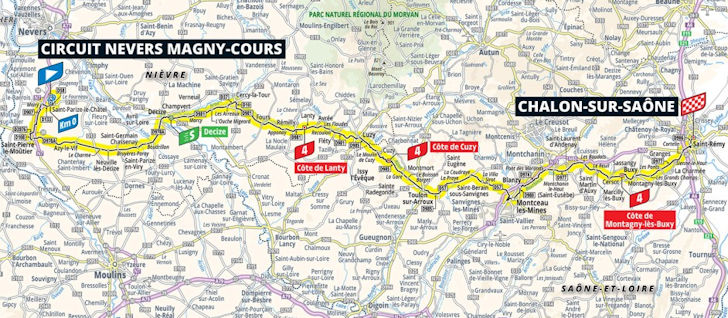
Le parcours quitte le circuit de Nevers Magny-Cours en direction de l'est, traverse la Loire près de Decize avant d'aborder la côte de Lanty et la côte de Cuzy, puis se poursuit par Montceau-les-Mines et longe la bordure sud du parc naturel du Morvan, avant une ultime ascension à la côte de Montagny-lès-Buxy et une descente vers la vallée de la Saône jusqu'à l'arrivée à Chalon-sur-Saône.
Le circuit de Nevers Magny-Cours : de la gloire de la Formule 1 aux débuts sur le Tour de France
Le circuit de Nevers Magny-Cours a accueilli le Grand Prix de France chaque année de 1991 à 2008, et l'anecdote la plus marquante de son histoire en sport automobile remonte à la course de 2000. Engagé dans une lutte acharnée pour la tête avec Michael Schumacher, David Coulthard a tenté une manœuvre agressive ; en réponse, Schumacher l'a serré de près dans un virage, poussant Coulthard à réagir, dans le feu de l'action, par un geste pour lequel il s'est ensuite publiquement excusé. Il a tout de même remporté la course, qualifiant plus tard cette victoire de plus belle performance de sa carrière, portée par une concentration extrême née de sa colère. Quatre ans plus tard, en 2004, Schumacher a lui aussi connu une journée mémorable à Magny-Cours en battant Fernando Alonso grâce à une stratégie audacieuse et inhabituelle : quatre arrêts aux stands. Le cyclisme a fait une incursion plus récente et plus paisible sur le circuit : le contre-la-montre par équipes de Paris-Nice y a pris le départ en mars 2025, une épreuve remportée par l'équipe Visma | Lease a Bike. La 12e étape marque la première fois que le Tour de France lui-même investit les lieux, remplaçant le rugissement des moteurs de Formule 1 par le bruit bien différent de quelque deux cents cyclistes s'élançant à vive allure.
Traversée de la Loire et sprint intermédiaire de Decize
Depuis le circuit, l'itinéraire se dirige vers l'est et franchit la Loire près de Decize au kilomètre 45,8 – lieu du seul sprint intermédiaire de la journée ; il s'agit, fait notable, du même passage de rivière que celui emprunté par le peloton la veille lors de l'étape vers Nevers, mais abordé sous un angle différent.
Les côtes de Lanty et de Cuzy : des tests précoces sans grande conséquence
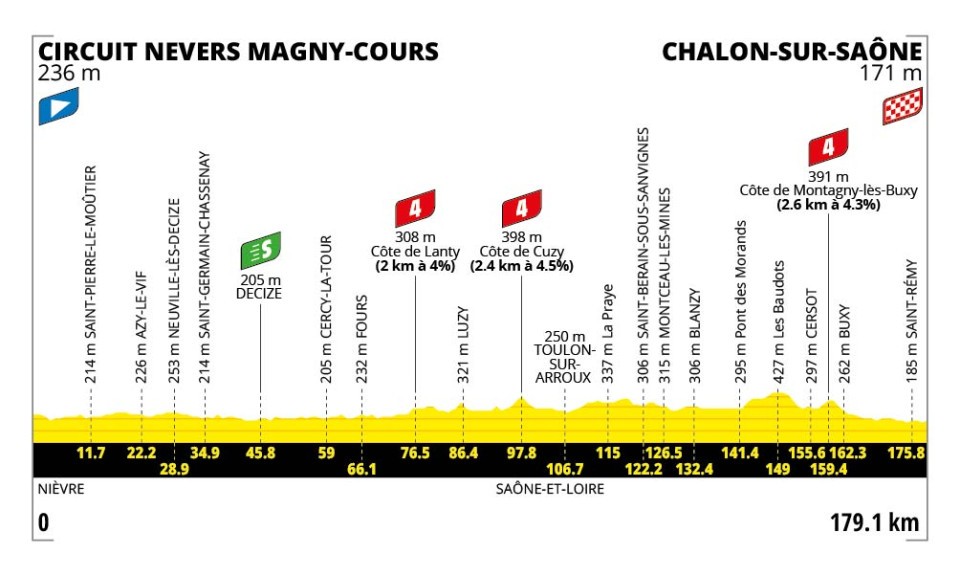
Deux ascensions modestes de 4e catégorie ponctuent la première moitié de l'étape : la côte de Lanty (2 km à 4 %, au km 76,5) et la côte de Cuzy (2,4 km à 4,5 %, au km 97,8). Aucune de ces deux côtes ne présente une difficulté suffisante pour compromettre la maîtrise de la course par une équipe de sprinteurs bien organisée, mais elles permettent toutes deux de glaner quelques points pour le classement de la montagne et d'apporter un peu de relief à une section centrale qui, sans cela, serait totalement dénuée de particularités.
En passant par Montceau-les-Mines et la bordure sud du Morvan
L'itinéraire se poursuit par Montceau-les-Mines, ancienne cité minière, avant de longer la bordure sud du parc naturel du Morvan – une région de moyenne montagne boisée et peu peuplée qui confère à ce tronçon un caractère nettement plus sauvage et verdoyant que les paysages agricoles ouverts dominant une grande partie du reste du parcours.
La côte de Montagny-lès-Buxy : l'ultime difficulté de l'étape, à 20 km de l'arrivée.
À une vingtaine de kilomètres de l'arrivée, le parcours aborde la côte de Montagny-lès-Buxy, une ascension de 2,6 km dont la pente moyenne oscille entre 3,9 % et 4,3 % selon les sources, et dont le sommet est situé au kilomètre 159,4. Il s'agit du dernier obstacle significatif de l'étape et de la seule occasion plausible de voir un rebondissement en fin de course : si un ou deux sprinteurs venaient à décrocher à cet endroit, ils conserveraient une réelle chance de revenir sur le peloton avant le sprint final, compte tenu des quelque 20 kilomètres de terrain majoritairement plat restant à parcourir.
La descente finale à travers les vignobles chalonnais jusqu'à Chalon-sur-Saône
Depuis la côte de Montagny-lès-Buxy, le parcours descend vers la vallée de la Saône en traversant le vignoble chalonnais — limite méridionale du vignoble bourguignon — avant de rejoindre la ligne d'arrivée dans les rues de Chalon-sur-Saône même, sur le quai Saint-Cosme, en bord de Saône.
Profil altimétrique de la 12e étape du Tour de France 2026 : 1 800 mètres de dénivelé sur le relief vallonné de Bourgogne
La 12e étape présente un dénivelé positif total d'environ 1 800 mètres sur 179,1 km, un profil modeste qui reflète le relief vallonné et tout en douceur typique du centre de la Bourgogne. Aucune des trois ascensions du jour n'est assez exigeante pour compromettre sérieusement la maîtrise de la course par les équipes de sprinteurs, bien que la côte de Montagny-lès-Buxy, située à seulement 20 km de l'arrivée, revête une importance tactique légèrement supérieure à celle des deux autres réunies.
Données d'ascension de la 12e étape
| Monté | Catégorie | Longueur | Avg. Gradient | KM Mark | Distance jusqu'à l'arrivée |
|---|---|---|---|---|---|
| Côte de Lanty | Cat 4 | 2 km | 4% | 76.5 | ~103 km |
| Côte de Cuzy | Cat 4 | 2.4 km | 4.5% | 97.8 | ~81 km |
| Côte de Montagny-lès-Buxy | Cat 4 | 2.6 km | 3.9–4.3% | 159.4 | ~20 km |
Tactique pour la 12e étape : une deuxième journée consécutive pour les sprinteurs
Stage 12’s tactical picture closely mirrors Stage 11’s, a flat profile, minor climbs with limited bite, and every reasonable expectation pointing toward another bunch sprint.
La Côte de Montagny-lès-Buxy pourrait-elle gâcher la fête des sprinters ?
C'est une question légitime, compte tenu de la position de cette ascension à seulement 20 km de la ligne, mais la réponse honnête penche nettement vers la négative. Une échappée motivée pourrait certes profiter de la montée pour tenter de creuser un écart décisif, et un sprinteur en méforme risquerait effectivement de décrocher dans l'ascension elle-même. Toutefois, avec près de 20 kilomètres de plat pour rejoindre l'arrivée, le rapport de forces favorise largement le peloton, qui serait en mesure de combler un tel écart bien avant la fin ; il s'agit d'une ascension capable de mettre les organismes à l'épreuve, mais pas de décider du sort de l'étape à elle seule.
Le sprint intermédiaire de Decize
Le seul sprint intermédiaire de la journée intervient tôt, à Decize (au kilomètre 45,8), bien avant les difficultés montagneuses de l'étape et suffisamment loin de l'arrivée pour que les prétendants au maillot vert puissent le disputer sans trop entamer les réserves d'énergie de leur équipe en vue du sprint final, prévu quelque 133 kilomètres plus loin.
Impact sur le classement général : une nouvelle journée calme pour les favoris.
Tout comme l'étape de la veille menant à Nevers, la 12e étape n'aura pratiquement aucune incidence sur le classement général, si ce n'est le risque permanent de chaos lors du sprint massif final. Il faut s'attendre à ce que les favoris adoptent une attitude prudente, privilégiant un bon placement plutôt que de prendre des initiatives en course.
Chalon-sur-Saône : berceau de la photographie et histoire des sprints d'étape
Nicéphore Niépce : l'homme qui a inventé la photographie — et bricolé les premiers vélos
La principale renommée de Chalon-sur-Saône ne doit rien au cyclisme, mais tout à la manière dont le monde moderne capture des images. La ville est le berceau de Joseph Nicéphore Niépce, l'inventeur à qui l'on attribue la création de la première photographie permanente au monde dans les années 1820, grâce à un procédé qu'il a baptisé « héliographie ». L'œuvre de Niépce intitulée *Point de vue du Gras* — réalisée dans la propriété familiale près de Chalon — est aujourd'hui reconnue comme la plus ancienne photographie encore existante d'une scène réelle ; cette image unique et ténue, montrant des toits et un poirier, marque véritablement la naissance de la photographie en tant que médium. Détail presque trop parfait pour une présentation du Tour de France, Niépce fut également un inventeur infatigable dans des domaines totalement différents : avec son frère Claude, il a co-développé l'un des premiers moteurs à combustion interne au monde, propulsant un bateau sur la Saône — la rivière même le long de laquelle le peloton termine son étape — et, en 1818, il a construit un engin précurseur du vélo, inspiré d'une invention allemande de l'époque, qu'il a nommé « vélocipède ». Le musée Niépce de Chalon-sur-Saône conserve aujourd'hui une grande partie de cette histoire, au sein d'une ville que le Tour visite rarement, mais qui a discrètement façonné la manière dont le monde entier allait se percevoir.
L'histoire du sprint à Chalon-sur-Saône
Dylan Groenewegen est le dernier vainqueur d'étape du Tour de France à Chalon-sur-Saône en date, s'étant imposé au sprint devant Caleb Ewan et Peter Sagan en 2019. Parmi les autres vainqueurs ayant triomphé dans la ville figurent Thierry Marie (1988), Rik Van Linden (1975) et Jean Stablinski (1961), la victoire de Brian Robinson en 1959 témoignant d'une tradition du Tour encore plus ancienne pour la cité. Compte tenu du profil plat de la 12e étape, il est fort probable qu'un nouveau sprinteur vienne s'ajouter à cette liste en 2026.
Où regarder l'étape 12 du Tour de France 2026 : les meilleurs spots pour les spectateurs de Magny-Cours à Chalon-sur-Saône
La 12e étape offre une logistique simple pour les spectateurs, avec un site de départ original et vraiment intéressant, couplé à une ville d'arrivée bien établie.
Meilleures zones pour suivre l'étape 12
| Zone | Ce que vous verrez | Accéder | Meilleure arrivée | Foulé |
|---|---|---|---|---|
| Circuit Nevers Magny-Cours start | A former F1 venue’s first-ever Tour départ | Easy — circuit infrastructure built for large crowds | Le matin | Light–moderate, elevated by novelty |
| Côte de Montagny-lès-Buxy | Stage’s only real tactical moment, vineyard scenery | Facile — routes de campagne | Mid-to-late afternoon | Léger à modéré |
| Chalon-sur-Saône finish | Sprint finish along the Saône, Quai Saint-Cosme | Easy — central Chalon, riverside roads | Arrivez tôt pour avoir une bonne place. | Heaviest of the stage |
Accès et fermetures de routes
Le circuit de Nevers Magny-Cours, conçu à l'origine pour accueillir un large public lors de grands événements de sports mécaniques, dispose d'infrastructures d'accès performantes — y compris pour un départ d'épreuve cycliste — et bénéficie de liaisons routières pratiques depuis la ville voisine de Nevers. Chalon-sur-Saône est desservie par un réseau ferroviaire efficace, avec des liaisons directes vers Paris, Lyon et Dijon, ce qui rend le site d'arrivée facilement accessible sans voiture. Il convient de noter que des fermetures de routes seront mises en place plusieurs heures avant le passage du peloton, les restrictions les plus importantes étant prévues dans le centre de Chalon-sur-Saône dès le début de l'après-midi.
Où loger : Nevers, Montceau-les-Mines ou Chalon-sur-Saône ?
Nevers, ville détaillée dans le guide de la 11e étape, constitue un point de chute pratique pour les visiteurs souhaitant suivre ces deux étapes à la suite. Montceau-les-Mines offre une alternative à mi-chemin plus calme et authentique pour ceux qui désirent associer la course à une découverte plus tranquille du Morvan. Quant à Chalon-sur-Saône, c’est le choix tout indiqué pour privilégier l’arrivée, grâce à une offre d’hébergement solide et à un accès facile vers le vignoble bourguignon.
Météo de la 12e étape
Mid-July in Burgundy typically brings warm, settled conditions, with daytime temperatures often reaching the high 20s°C. The region’s gently rolling, open farmland does carry some background crosswind risk, a factor at least one competitor preview has flagged as worth monitoring, though the terrain here is generally less exposed than the flatter, more open plains seen on some of the Tour’s other sprint stages.
How Stage 12 Connects to the Rest of the Tour
Stage 12 closes out the back-to-back sprint pairing that began in Vichy, with the terrain set to change again immediately afterward. Stage 13 is the longest stage of the entire 2026 Tour at 205.8 km, running from Dole to Belfort through the Jura hills, a notable step up in difficulty that signals the true end of this brief flat interlude and the build toward the demanding mountain stages still to come in the race’s final week.
Related Stage Guides: