
Tour de France 2025 Stage 3: Detailed Route, Favorites & Sprint Drama
The Tour de France 2025 Stage 3 promises an exciting day of racing as the peloton takes on a 178.3km flat stage from Valenciennes to Dunkerque on July 7th, 2025. On paper, this is one for the sprinters — but as every seasoned cycling fan knows, northern France’s open roads and unpredictable crosswinds can transform even the calmest of stages into tactical chaos.
Riders will journey through historic towns such as Béthune and Cassel, facing the day’s only categorised climb at Mont Cassel, before racing toward the coast for a likely high-speed finale near the Stade Marcel Tribut in Dunkerque. With both green jersey points and time bonuses on the line, and a forecast hinting at possible crosswinds in the closing kilometres, Stage 3 of the 2025 Tour de France could shape up to be far more dramatic than the flat profile suggests.
Let’s unpack this stage properly:
What’s Special About Stage 3?
After two days of fireworks — a bruising hilly brawl on Stage 2 and the nerve-wracking opener — 3rd Stage is the first true sprinters’ playground. But don’t be fooled by the “flat” label; this one’s got more nuance than a Parisian café menu.
Here’s what makes it stand out:
It’s the first classic North Sea coast flat stage of the Tour de France 2025, and if you know your cycling folklore, you know what that means — crosswinds and carnage.
Sprinters’ teams will be licking their lips, sharpening their lead-out trains for a high-speed finale in Dunkerque.
GC teams can’t snooze here either. A stray crosswind can shatter the peloton faster than you can say “echelon“.
Dunkerque’s no stranger to Tour drama — the city’s finish line parties are legendary and the roads into town are made for photofinish madness.
It’s also the day where the peloton’s rhythm settles. Riders will start to figure out who’s got legs and who’s bluffing.
A day that looks vanilla on paper, but with the right gust of wind, it’ll turn into a full-blown battle royale on two wheels.
VALENCIENNES & DUNKERQUE’S HISTORY WITH THE TOUR DE FRANCE
Every town that hosts a stage wants a slice of Tour legend baked into its cobbles — and these two northern gems aren’t new to the party.
VALENCIENNES: A Starting Line With Bite
- First appeared in the Tour: Way back in 1906. Yep, over a century ago, when riders fixed their own bikes mid-race and caffeine meant wine.
- Known for hosting gritty northern stages — narrow streets, sharp corners, and locals leaning out of windows with flags and cold beer.
- Last saw Tour action in 2010, when a young sprinter named Mark Cavendish (ever heard of him? 😉) scorched the final meters for a textbook win.
DUNKERQUE: Where Wind Meets Wild
- Debut appearance: 1949 — and let’s just say it’s never been a calm finish here.
- Famous for crosswinds off the North Sea turning flat stages into tactical chaos. Even seasoned pros turn pale when the breeze kicks up.
- Legendary moment: 2012 Stage 4, where the bunch sprint was so tight, they needed a photo finish to declare a winner. Classic Tour drama.
HISTORY TABLE
City | First Tour Stage | Tour Claim to Fame |
|---|---|---|
Valenciennes | 1906 | Sprint finishes & city center chaos |
Dunkerque | 1949 | Crosswind carnage by the beach |
DID YOU KNOW?
Dunkerque’s Six-Day cycling race was once one of the biggest indoor events in France, with champagne-fueled crowds and jazz bands playing till dawn. Riders slept in bunk beds at the velodrome. Now that’s old-school cycling glam.
These aren’t just dots on a map — they’re character-packed cycling towns with a knack for turning flat days into headline-makers. Stage 3’s route? It’s carrying decades of scrappy northern racing DNA.
Stage 3 Detailed Overview: Valenciennes to Dunkerque
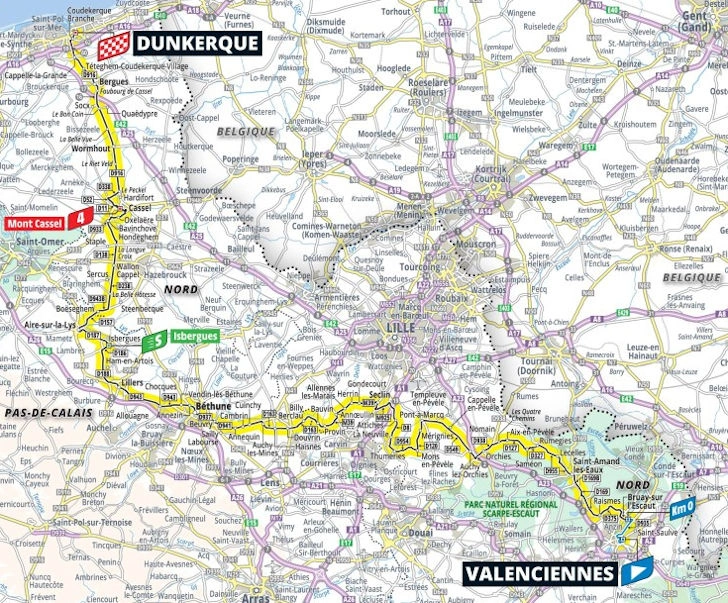
The Stage 3 detailed route of the 2025 Tour de France covers 178.3 kilometres, starting in Valenciennes with a départ fictif before the racing officially begins in Bruay-sur-l’Escaut. From there, the peloton heads northwest through a series of towns rich in history and northern French character.
The race weaves through places like Raismes, Saint-Amand-les-Eaux, and Orchies, with the riders passing local landmarks such as the Terril Sabatier Sud and the historic Abbey Tower at Saint-Amand. The flat nature of the course continues toward Mons-en-Pévèle, famous for its role in Paris-Roubaix, though no cobbled sectors feature today.
After navigating through Wahagnies, Seclin, and Douvin, the race hits Béthune, a town known for its Grand Place and belfry. The stage then heads to Isbergues, where riders contest the intermediate sprint — a crucial moment for those targeting the green jersey.
Next comes the day’s only categorised climb: the Mont Cassel (Category 4), a 2.3km ascent at 3.8% average. This climb isn’t steep enough to split the peloton but could offer a small prize for opportunistic riders chasing the single KOM point.
The route then turns northward on long, straight Roman roads toward Wormhout, Quaëdypre, Bergues, and eventually the Channel coast. The final kilometres into Dunkerque are fully exposed to potential crosswinds, making this section strategically dangerous if the wind rises.
The race finishes on Rue de la Cunette by the Canal de Bergues, opposite the Stade Marcel Tribut, with a likely mass sprint finish — unless the wind creates havoc in the closing stretch.
Mini Data Table
Feature | Details |
|---|---|
Date | Monday, July 7, 2025 |
Start | Valenciennes |
Finish | Dunkerque |
Distance | 178 Km |
Stage Type | FLAT (with attitude) |
Elevation Gain | ~650 m |
Expected Finish | Full-throttle bunch sprint |
What makes it dicey:
It’s not the Alps, but it’s no armchair ride either.
STAGE 3 PROFILE & ROUTE BREAKDOWN
178 km of northern France’s finest cycling mischief — a classic ‘flat’ stage that’s as flat as a plate of spaghetti in a storm.
THE ROUTE IN REAL TALK:
- KM 0–30:
- Outta Valenciennes — cobbled streets, narrow lanes, and all the nervous energy of a first-date handshake. Expect elbows, shoulders, and cursed radios.
- KM 30–85:
- The peloton punches through wide-open farmland. Crosswinds? Oh baby — you can bet your bidon. Teams will be lined up like a string of Christmas lights. One gust, and the echelons will split like a dropped croissant.
- KM 85–125:
- Twitchy sector. Small towns, tight corners, road furniture straight from a nightmare. GC teams will surf the front like it’s Paris-Roubaix Lite. Breakaway’s best shot here, though their leash won’t be long.
- KM 125–160:
- Coastal approach, where wind off the Channel plays kingmaker. It’s gonna be a 50 kmph suffer-fest for any poor soul caught out. If a big team hits it here, half the peloton’s Tour might be over before dinner.
- KM 160–178:
- The run into Dunkerque — fast, flat, and full-gas. Lead-out trains will rev like dragsters. Final 5 km: Technical corners, two chicanes, and a roundabout at 1.2 km to go. One wrong wheel = goodbye.
PROFILE & ROUTE MAP OF THE 3rd STAGE
For those closely following the Tour de France 2025 Stage 3, the official detailed route map and stage profile provide crucial insights into how the race is likely to unfold.
The Stage 3 route map shows the peloton starting in Valenciennes and weaving its way through the Hauts-de-France region, passing through towns like Saint-Amand-les-Eaux, Béthune, and Isbergues, before heading to the only categorised climb of the day at Mont Cassel. From there, it’s a flat run to the coast and a finish in Dunkerque.
The Stage 3 route profile confirms that while the day is classified as a flat stage, there are minor undulations along the way. The Mont Cassel (Category 4) climb — 2.3km at 3.8% — is a small challenge but unlikely to disrupt the sprinters’ plans unless crosswinds stir up late-race chaos. The final kilometres into Dunkerque are completely flat and exposed, creating the ideal setting for a high-speed sprint finish.
Riders and team directors alike will pay close attention to the wind forecast, as the exposed profile of the final 30km makes the route perfect for echelons and splits if crosswinds pick up.
Visual assets typically included here:

Distance | Terrain/Feature | |
|---|---|---|
0–30 km | Rolling out on narrow cobbled streets | Peloton nerves |
30–85 km | Open farmlands, crosswind hot zone | High |
85–125 km | Twisty towns, tight lanes, echelons | Very High |
125–160 km | Coastal approach, exposed roads | Nuclear |
160–178 km | Flat finish, technical last 5 km | Chaos |
Climbs: None worth a KOM point, but every gust is a battle.
Max Elevation: 94 m (Don’t laugh, it’ll feel like Everest when you’re hanging in the gutter at 60 km/h.)
CLimbs and Intermediate Sprints on Stage 3
Although Stage 3 of the 2025 Tour de France is largely a flat affair, it features a couple of minor challenges for the peloton — including a single category 4 climb and one intermediate sprint that will matter for the green jersey contenders.
The first notable point is the intermediate sprint in Isbergues, around kilometre 108. Sprinters and their lead-out trains will want to be well-positioned here to pick up vital green jersey points — from 20 points for 1st place down to 1 point for 15th.
Shortly after, the riders tackle the Mont Cassel climb — the only categorised ascent of the day:
- Mont Cassel (Category 4): 2.3km at an average 3.8%
- The climb awards 1 KOM point to the first rider over the summit.
- While minor by Tour standards, the climb arrives at a crucial point, just before the exposed final kilometres.
What makes this stage tense is less about climbing and more about the potential for crosswinds after the Côte de Cassel. Teams fighting for GC positions and sprinters targeting the stage win will need to stay sharp here, especially as echelons could split the peloton in the run to Dunkerque.
Stage 3 Summary of Key Points:
- 1 intermediate sprint: Isbergues (Green Jersey points available)
- 1 categorised climb: Mont Cassel (Category 4)
- Potential crosswinds and splits in the final 30km
Possible additions:
If context allows, we can briefly mention earlier climbs from the opening Danish stages like Côte de Koldingvej and Côte de Hejlsminde Strand as comparative reference points for those following the Tour de France 2025 climbs leaderboard.
Stage 3 Tour de France 2025: Race Timings and Schedule
For those planning to follow the Stage 3 Tour de France 2025 route in real time, here’s a clear breakdown of the official start, intermediate points, and estimated finish times. This stage is scheduled for Monday, July 7th, 2025, with racing taking place in the Hauts-de-France region.
Official Start Times:
- Départ Fictif (neutralised start): 13:10 CEST (7:10 am EST)
- Départ Réel (official race start): 13:25 CEST (7:25 am EST) in Bruay-sur-l’Escaut
Key Stage 3 Timings:
- Intermediate Sprint at Isbergues: Between 14:14 CEST (8:14 am EST) and 16:14 CEST (10:14 am EST) depending on race speed
- Mont Cassel Climb: Between 14:56 CEST (8:56 am EST) and 16:56 CEST (10:56 am EST)
- Estimated Finish in Dunkerque:
- Fast Schedule: 15:40 CEST (9:40 am EST)
- Slow Schedule: 17:40 CEST (11:40 am EST)
The stage is expected to take 4 hours 10 minutes to 5 hours 30 minutes, depending on wind conditions and race dynamics. The exposed final kilometres make this one of those stages where team tactics and weather could dramatically shift the predicted timings.
Stage 3 Summary Schedule Table:
| Event | Fastest | Average | Slowest |
|---|---|---|---|
| Départ Fictif | 13:10 CEST | 13:10 CEST | 13:10 CEST |
| Départ Réel | 13:25 CEST | 13:25 CEST | 13:25 CEST |
| Intermediate Sprint (Isbergues) | 14:14 CEST | 15:14 CEST | 16:14 CEST |
| Mont Cassel Climb | 14:56 CEST | 15:56 CEST | 16:56 CEST |
| Finish (Dunkerque) | 15:40 CEST | 16:40 CEST | 17:40 CEST |
Food, Culture & Local Highlights
As the riders race from Valenciennes to Dunkerque, Stage 3 of the 2025 Tour de France also offers a culinary and cultural journey through Hauts-de-France.
🍲 Regional Flavours
- Carbonade Flamande: A rich beef and onion stew, simmered in local beer — the perfect hearty dish to enjoy while watching the action.
- Coq à la Bière: Chicken cooked in a creamy beer sauce, reflecting the region’s long brewing tradition.
- Moules Frites and flamiche (a cheese tart with Maroilles) are other regional classics.
🍺 Beer Culture
Dunkerque lies in one of France’s brewing heartlands. Local beers like La Goudale pair perfectly with regional dishes, and Appel Jenever (Dutch gin) is a favourite apéritif.
🏰 Historical Highlights
- Mont Cassel, with its modest climb today, has a military past, including a decisive 1677 battle during the Franco-Dutch War.
- Dunkirk’s wartime history remains legendary. In 1940, its beaches became the scene of the famous Operation Dynamo, where over 340,000 Allied soldiers were evacuated under enemy fire.
Stage 3 Weather Forecast and Crosswind Threat
On flat sprint stages like Tour de France 2025 Stage 3, the biggest wildcard isn’t always the road — it’s the sky. With much of the final third of the Stage 3 detailed route running through exposed farmland and open plains, crosswinds can wreak havoc on the peloton, splintering the bunch and shaking up general classification standings.
Expected Conditions for July 7th, 2025
- Morning Start (Valenciennes): 16°C, light SW breeze 12–15 km/h
- Midday (Isbergues / Mont Cassel): 20°C, wind picking up to 20–25 km/h from WSW
- Afternoon (Dunkerque finish): 21°C, stronger coastal winds 30–35 km/h from W, possible gusts 40+ km/h near the finish line
Crosswind Hotspots
- After the Côte de Cassel, the roads heading north toward Dunkerque become wide open and directly exposed.
- The final 25km to 30km stretch along the D916 and surrounding rural roads are ideal conditions for echelons — where riders form diagonal formations to shelter from crosswinds.
- A well-timed split could derail GC contenders and isolate sprinters without strong team protection.
Tactical Implications
Every rider and directeur sportif will play amateur meteorologist here. If the winds stay calm, it’s a classic high-speed bunch sprint at the Marcel-Tribut Stadium. But should those gusts pick up to predicted speeds, expect:
- Splintered groups
- Panic chases
- Potential GC shake-ups before the first mountain stages
This is one of those Stage 3 Tour de France 2025 days where the Stage 3 favorites may have to be as tactical as they are fast.
Climb and Sprint Point Highlights — Tour de France 2025 Stage 3
Though Stage 3 of the 2025 Tour de France is classified as a flat stage, there are valuable points on offer for both the polka dot jersey (KOM) and green jersey (points classification) contenders along the Stage 3 route.
📈 Categorized Climb
- Mont Cassel (Category 4)
- Length: 2.3 km
- Average Gradient: 3.8%
- Max Elevation: 144m
- KOM Points: 1 point for the first rider over the summit
- Though modest in profile, the Mont Cassel climb is tactically positioned around km 120, just before the exposed final section of the stage, where teams may try to line out the bunch ahead of potential crosswinds.
🏁 Intermediate Sprint
- Isbergues (km 97)
- Green Jersey Points: 20 points for 1st down to 1 point for 15th
- Expect sprinters like Jasper Philipsen, Jonathan Milan, and Tim Merlier to battle for these, with a possible early breakaway trying to steal points.
⚠️ Climb Profiles from Danish Grand Départ
Though not part of Stage 3 Tour de France 2025, it’s worth recalling similar Category 4 climbs from earlier Danish stages for comparative purposes:
- Côte de Koldingvej: 4.2%, steepest 500m at 6.4%
- Côte de Hejlsminde Strand: 4.7% average
- Côte de Genner Strand: 3.1% average
This illustrates how Mont Cassel compares to prior climbs in steepness and strategic placement.
Primary KW integrated:
- Tour de France 2025 stage 3
Related KWs naturally worked in:
- Stage 3 route profile
- Stage 3 detailed route
- Stage 3rd of the 2025
WHO BENEFITS? SPRINTERS, REJOICE
If there’s ever been a day made for the speed merchants — this is it.
No KOM points worth a croissant, no uphill drags to ruin the party. Just pure, unfiltered, 70 km/h thunder down to the coast.
TOP SPRINTERS EXPECTED TO THROW HANDS:
🚴♂️ Rider | Team | 🔥 Form |
|---|---|---|
Jasper Philipsen | Alpecin-Deceuninck | 🔥🔥🔥 |
Sam Bennett | Decathlon AG2R | 🔥🔥 |
Arnaud Démare | Arkea-B&B Hotels | 🔥 |
Dylan Groenewegen | Jayco-AlUla | 🔥 |
Dark Horse: Keep an eye on Kaden Groves — he’s got a kick like a mule on espresso.
WHY THIS IS A SPRINTER’S DREAM:
- No real climbs to drop the fastmen.
- Long straights on the run-in to Dunkerque.
- Lead-out trains will be stacked like dominos, ready to unleash chaos.
- Final 5 km: Technical, but no uphill finish — it’s pure speed warfare.
GC RIDERS? STAY OUTTA TROUBLE:
Expect guys like Pogacar, Vingegaard, and Evenepoel to surf the front like paranoid hawks in the wind.
Their only job: stay upright, stay in the first 30 wheels, don’t lose time.
Bonus seconds don’t matter here. It’s survival mode.
BREAKAWAY HOPES? DEAD ON ARRIVAL
Let’s be honest — unless some wildcard squad throws a kitchen sink move into the crosswinds:
Breaks won’t survive today.
Sprinters’ teams won’t let it happen, with eyes glued to that finish line glory.
Tour de France 2025 Stage 3 Favourites and Predictions
As the peloton prepares for a fast and exposed run into Dunkerque, all eyes turn to the likely Stage 3 favourites. While crosswinds remain a variable, in calm conditions this is a textbook day for the sprinters.
🥇 Top Sprinters to Watch
- Jasper Philipsen (Alpecin-Deceuninck)
The undisputed sprint king of recent seasons. Philipsen’s positioning and Alpecin’s leadout train make him the rider to beat for this Stage 3 Tour de France 2025 finish. - Jonathan Milan (Lidl-Trek)
Milan’s power in long, slightly uphill sprints makes him a real contender, especially if the bunch splinters. - Tim Merlier (Soudal-Quick Step)
A pure sprinter with blistering top-end speed, Merlier thrives in straightforward finales like Rue de la Cunette. - Dylan Groenewegen (Jayco AlUla)
The experienced Dutchman will be eager to open his Tour account and has a fast-finishing instinct perfectly suited to a flat run-in.
🌬️ Wildcard Scenarios
Should crosswinds pick up after Mont Cassel, teams like INEOS Grenadiers, UAE Team Emirates, and Visma-Lease a Bike could split the peloton into echelons. In that case, a reduced group sprint or late solo move from a Classics specialist is possible.
📊 Prediction
- Most Likely: Jasper Philipsen
- Dark Horse: Jonathan Milan
- Wildcard: A small group sprint from a crosswind split
TL;DR:
It’s a sprinter’s bonanza, a bunch sprint showdown, and a day for the adrenaline junkies.
One wrong wheel = race over. One perfect wheel = victory photo and a post-race beer in Dunkerque.
Stage 3’s not about fireworks up the mountains or GC ambitions crashing and burning. No — this is about pure speed, polished lead-out trains, and the tight chess match of positioning on narrow northern roads.
Expect the big sprint names to be licking their chops for this one. Flat terrain? Check. Fast finish? Check. Coastal crosswinds for a bit of drama? You bet. It’s the kind of stage where one missed wheel can be the difference between Tour glory and a finish in the laughing group.
As the locals might say, “C’est la vie de sprinteur.”
Don’t Blink — Follow The Full Race:
Tour de France 2025 Stage 3 promises both spectacle and strategic intrigue. The flat 178.3km route looks perfect for a mass sprint finish, but crosswinds after Mont Cassel could still unleash chaos and echelons in the final run to Dunkerque.
Expect a showdown between Jasper Philipsen, Jonathan Milan, Tim Merlier, and Dylan Groenewegen if the weather stays calm. If not, the stage could produce one of those memorable wind-blown dramas that reshuffle the General Classification early.
Who’s your pick to take victory on Stage 3? Drop your prediction in the comments below — let’s see who gets it right!
Stick with us for blow-by-blow updates, spicy previews, and tactical breakdowns. Stage 4 and the hills are calling. It’s gonna sting.
Miss this sprint showdown? That’d be like leaving a baguette out in the rain. Don’t do it.