
Tour de France 2026, 8e étape : de Périgueux à Bergerac — Merlier a triomphé à Bordeaux, place à un nouveau test pour les jambes des coureurs.
Last Updated: 05:38 am CEST - Saturday, 11 July 2026
Le scénario à Bordeaux s'est déroulé exactement comme prévu, jusqu'à ce qu'il bascule. L'équipe Alpecin-Premier Tech a parfaitement placé Jasper Philipsen à l'entame du dernier kilomètre — le travail de préparation de Mathieu van der Poel a été à la hauteur des attentes — mais Philipsen a lancé son sprint à 250 mètres de la ligne et a tout simplement manqué de distance. Tim Merlier a alors trouvé l'ouverture laissée dans son sillage et a surgi par le centre pour décrocher sa première victoire sur ce Tour. Søren Wærenskjold a pris la deuxième place, devant Biniam Girmay. Mads Pedersen a terminé neuvième du sprint, sans faire d'éclats, mais il avait déjà rempli sa mission au sprint intermédiaire, consolidant ainsi son avance au classement du maillot vert. Aucun changement pour Pogačar, toujours solidement installé en tête avec 2 minutes 42 secondes d'avance.
La 8e étape pose la même question, mais sur un ton différent. Le parcours de 180 km entre Périgueux et Bergerac est officiellement plat, mais il ne s'agit pas d'une simple répétition de l'étape de Bordeaux : deux ascensions de 4e catégorie en seconde moitié de course — à Domme et au Buisson-de-Cadouin — apportent juste assez de relief pour compter, tandis que le sprint intermédiaire de Saint-Cyprien représente un enjeu réel de 25 points pour le maillot vert. Un facteur plus déterminant encore pourrait être bien plus simple que le profil des côtes : il s'agit de la deuxième étape de plaine consécutive disputée sous une chaleur écrasante, et les trains de sprinteurs ne récupèrent pas sur commande. Merlier aborde l'épreuve en pleine confiance. Kooij, Philipsen et Girmay, eux, doivent prouver que la journée d'hier n'était pas le signe avant-coureur d'une tendance durable.
En bref
- Stage 8 at a glance: July 11, Périgueux to Bergerac, 180.4 km, mostly flat with two Cat. 4 climbs — the second sprint chance in as many days.
- L'itinéraire passe à portée de vue de Lascaux, la grotte préhistorique dont les peintures, vieilles de 17 000 ans, ont inscrit cette région sur la carte du patrimoine mondial.
- Sarlat-la-Canéda and Domme offer two of the best-preserved medieval and bastide townscapes anywhere on the 2026 route.
- Périgueux and Bergerac share Tour history — Jacques Anquetil demolished Charly Gaul here in a 1961 time trial, and Miguel Indurain raced the same pairing in 1994.
- This is also one of the Tour’s great food-and-wine stages — truffles, foie gras, and the golden dessert wines of Monbazillac all sit directly along the route.
La 8e étape du Tour de France 2026 se déroulera le samedi 11 juillet ; longue de 180,4 km, elle reliera Périgueux à Bergerac en traversant le cœur du Périgord et devrait se conclure par un sprint massif. Il s'agit de la deuxième étape de plaine consécutive propice aux sprinteurs après celle de Bordeaux, offrant une véritable seconde chance aux hommes rapides qui ont manqué le coche lors de la 7e étape, le tout alors que le peloton traverse certains des paysages les plus pittoresques du parcours de cette édition.
Sur le papier, c’est une étape facile : peu de dénivelé, deux ascensions répertoriées mineures et une ligne d’arrivée taillée pour la vitesse. Dans les faits, la 8e étape concentre, au kilomètre, une richesse culturelle et historique qui surpasse presque tout ce que propose la première semaine de course : les peintures rupestres préhistoriques de Lascaux, les ruelles médiévales de Sarlat-la-Canéda, les villages pittoresques accrochés aux falaises de la vallée de la Dordogne, ainsi qu’une ville d’arrivée ayant accueilli certains des duels les plus spectaculaires de l’histoire du Tour en contre-la-montre. Qui dit plat ne dit pas forcément sans intérêt.
En quoi consiste la 8e étape du Tour de France 2026 ?
La 8e étape, longue de 180,4 km et disputée le 11 juillet, relie Périgueux à Bergerac en traversant le Périgord (Dordogne) ; elle comporte deux ascensions répertoriées de moindre importance et présente un dénivelé positif total d'environ 1 150 mètres. Il s'agit de la deuxième journée consécutive taillée pour les sprinteurs, après l'arrivée à Bordeaux lors de la 7e étape ; elle offre une nouvelle chance aux finisseurs rapides ayant manqué le coche la veille, avant que la course ne quitte cette région de la France.
Ce qui distingue la 8e étape d’une simple journée de transition sans grand intérêt, c’est le tracé lui-même. Loin des plaines agricoles monotones et sans relief, l’itinéraire traverse certains des paysages les plus spectaculaires et les plus chargés d’histoire du sud-ouest de la France ; il serpente entre les vallées de la Vézère et de la Dordogne, longeant grottes préhistoriques, cités médiévales et bastides perchées, pour finalement rejoindre une ville d’arrivée qui possède elle aussi un lien historique fort avec le Tour. Si la course en elle-même peut sembler classique, le décor et l’histoire qui l’entourent, eux, ne le sont pas.
Stage 8 Date, Distance, and Start Times
Stage 8 runs on Saturday, July 11, 2026, covering 180.4 km. Based on official stage scheduling, the race is set to start at approximately 13:15 CEST from Périgueux, with an estimated finish around 17:20 CEST in Bergerac, though as with any stage, exact timing can shift slightly as pace scenarios play out across the day.
Pour les téléspectateurs situés hors d'Europe continentale : un départ à 13 h 15 CEST correspond environ à 12 h 15 BST au Royaume-Uni, 7 h 15 EDT sur la côte est des États-Unis et 4 h 15 PDT sur la côte ouest. La course est diffusée sur Eurosport et HBO Max dans la majeure partie de l'Europe, tandis que NBC Sports et Peacock assurent la retransmission aux États-Unis.
Horaires clés de l'étape 8 (Royaume-Uni, États-Unis et Australie)
| Indiquer | Dist. | Rapide | Lente | UK (BST) | US (EDT) | Australia (AEST) |
|---|---|---|---|---|---|---|
| Perigueux (neutralised) | 180.4 | 13:15 | 13:15 | 12:15 | 07:15 | 21:15 |
| Perigueux (route proper) | 180.4 | 13:25 | 13:25 | 12:25 | 07:25 | 21:25 |
| Montignac-Lascaux | 140.4 | 14:17 | 14:22 | 13:17–13:22 | 08:17–08:22 | 22:17–22:22 |
| Les Eyzies | 112.1 | 14:54 | 15:02 | 13:54–14:02 | 08:54–09:02 | 22:54–23:02 |
| Cote de Domme Cat 4 | 77.8 | 15:39 | 15:52 | 14:39–14:52 | 09:39–09:52 | 23:39–23:52 |
| Saint-Cyprien (sprint) | 57.6 | 16:05 | 16:20 | 15:05–15:20 | 10:05–10:20 | 00:05–00:20next day |
| Cote du Buisson-de-Cadouin Cat 4 | 40.0 | 16:28 | 16:46 | 15:28–15:46 | 10:28–10:46 | 00:28–00:46next day |
| Bergerac entry | 4.2 | 17:15 | 17:37 | 16:15–16:37 | 11:15–11:37 | 01:15–01:37next day |
| Bergerac finish | 0 | 17:20 | 17:43 | 16:20–16:43 | 11:20–11:43 | 01:20–01:43next day |
Fast = 42 km/h (green) · Slow = 38 km/h (red) · Cat 4 climbs in purple · BST = UTC+1 · EDT = UTC-4 · AEST = UTC+10 (Sydney). Australian times roll into the following day after midnight.
Le meilleur moment pour se connecter
| Type de spectateur | UK (BST) | US (EDT) | Australia (AEST) | Ce que vous attraperez |
|---|---|---|---|---|
| Visualiseur plein champ | 12:15 | 07:15 | 21:15 | Roll-out, breakaway formation and the day’s chase |
| Intermediate sprint watcher | 15:00 | 10:00 | 00:00next day | Final hour, Saint-Cyprien sprint and the decisive run-in |
| Final 40 km viewer | 15:25 | 10:25 | 00:25next day | Cote du Buisson-de-Cadouin and the finale into Bergerac |
| Visualiseur de version finale uniquement | 16:00 | 11:00 | 01:00next day | Last 20 km, sprint trains forming and the finish |
| Spectateur de dernière minute | 16:15 | 11:15 | 01:15next day | Bergerac entry and the bunch sprint |
Tune-in times in local time zones. BST = UTC+1 · EDT = UTC-4 · AEST = UTC+10 (Sydney). Australian times after midnight roll into the following day.
Itinéraire de l'étape 8 du Tour de France 2026 : guide complet du parcours de Périgueux à Bergerac
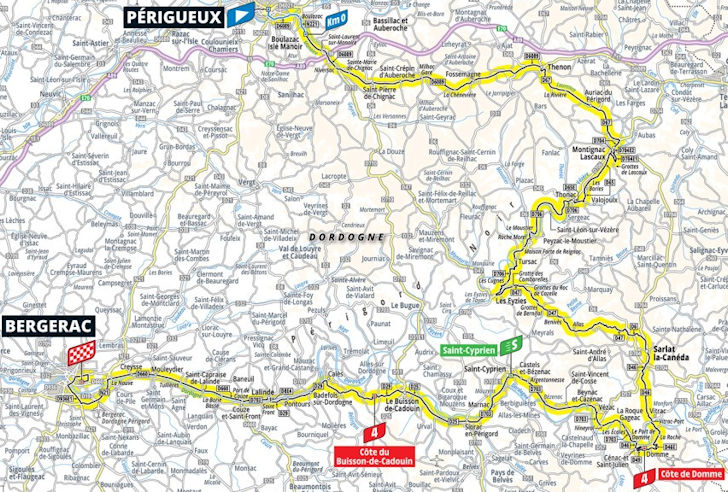
L'itinéraire part de Périgueux vers le nord-est, traverse la vallée de la Vézère en passant par Montignac-Lascaux, puis met le cap au sud via Sarlat-la-Canéda et la bastide perchée de Domme ; il longe ensuite la Dordogne en passant par La Roque-Gageac et Beynac-et-Cazenac, avant d'aborder la dernière ligne droite par Le Buisson-de-Cadouin et Lalinde en direction de Bergerac. Kilomètre après kilomètre, c'est l'un des tronçons les plus pittoresques que le Tour 2026 empruntera de toute l'épreuve.
Périgueux: Romans, Vikings, and Anquetil’s 1961 Time Trial Masterclass
Périgueux carries a genuinely deep history. Long before the Romans arrived, a fortified settlement already stood on the site; the Romans later built the city of Vesunna here, and the Vikings plundered the town on three separate occasions during the early medieval period. Today, the city is dominated by Saint-Front Cathedral, rising above the Isle River in the heart of the old town. The Tour’s connection to Périgueux runs deep, too. In 1961, Jacques Anquetil delivered one of the most complete individual time-trial performances of his career here, beating Charly Gaul by nearly three minutes through the city’s streets. It’s the kind of detail that turns a “start town” into a place with its own racing pedigree before a single kilometre of Stage 8 has even been ridden.
Through the Vézère Valley: Montignac and the Lascaux Cave Paintings
The route’s opening half traces the Vézère river through Montignac-Lascaux, named for the world-famous cave whose paintings, dated to roughly 17,000 years ago, depict aurochs, horses, deer, and other animals in extraordinary detail. The Vézère valley holds UNESCO World Heritage status in its own right, recognised for containing 147 prehistoric sites and 25 decorated caves dating from the Palaeolithic era. The original Lascaux cave itself has been closed to the public for decades to preserve the paintings, but a meticulously reconstructed facsimile nearby lets visitors experience the artwork without the same conservation risk. For a stage that will otherwise be remembered for a bunch sprint, riding past a site this significant to human history is a detail worth knowing before the peloton speeds through.
Sarlat-la-Canéda: The Medieval Heart of Périgord Noir
Sarlat-la-Canéda is widely considered one of the best-preserved medieval towns in France, its honey-coloured stone streets and Renaissance facades largely untouched by the kind of modern development that reshaped so many French towns in the 20th century. It sits at the centre of the Périgord Noir, the “Black Périgord,” named for the truffles found in its oak forests, and the town’s Saturday market remains one of the most respected traditional food markets in the entire region. The Tour passing directly through Sarlat, even without stopping, puts one of France’s genuine architectural treasures on global television for a few crucial seconds.
The Côte de Domme: A Climb With a View
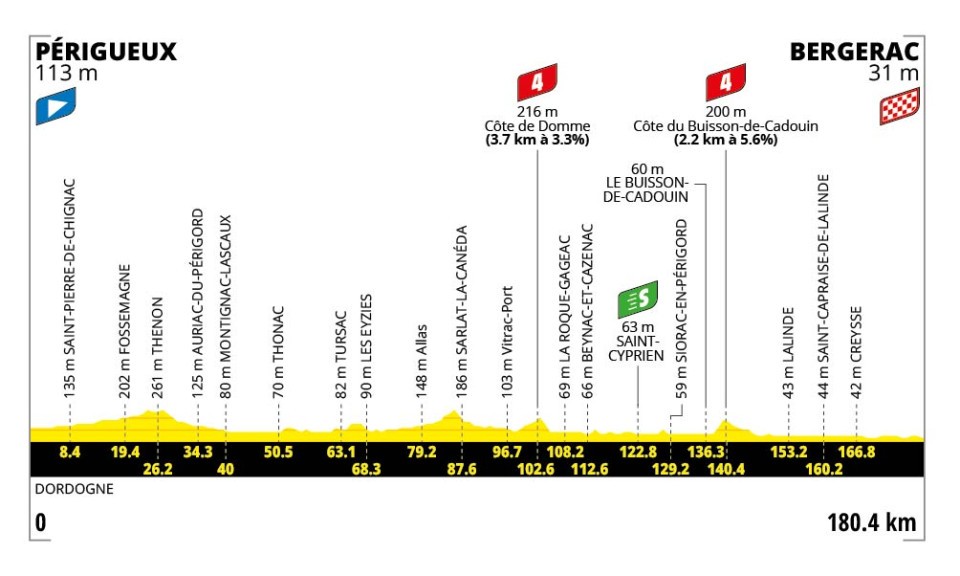
At kilometre 102.6, the route tackles the Côte de Domme, a Cat. 4 climb of 3.7 km at an average gradient of 3.3%, gentle enough that it poses no real tactical threat to the sprint teams. What it does offer is one of the most photogenic moments of the entire stage: Domme is a hilltop bastide town, built defensively in the 13th century, with sweeping views over the Dordogne valley below. Riders won’t pause to admire it, but the helicopter shots from this section of the route are likely to be some of the most replayed images of the day.
La Roque-Gageac and Beynac-et-Cazenac: Cliffside Villages Along the Dordogne
Past Domme, the route tracks the river through La Roque-Gageac and Beynac-et-Cazenac, two villages frequently named among the most beautiful in France, and for good reason. La Roque-Gageac is built directly into a limestone cliff face above the Dordogne, its golden stone houses stacked almost vertically against the rock. Beynac-et-Cazenac is dominated by its medieval château, perched on a clifftop directly above the river, one of the best-preserved castles in the entire Dordogne valley. Few stages in professional cycling pass through two villages this visually striking back to back, and this stretch alone justifies treating Stage 8 as more than a transitional sprint day.
The Côte du Buisson-de-Cadouin and the Run to Bergerac
The day’s second and final categorised climb comes at the Côte du Buisson-de-Cadouin, 2.2 km at an average gradient of 5.6%, cresting at kilometre 140.4, meaningfully steeper than Domme, though still short enough to avoid threatening a well-drilled sprint team. From here, the route runs through Lalinde and along the Dordogne toward Bergerac, with the final kilometres flattening out into exactly the kind of fast, straightforward run-in that favours a clean bunch sprint finish.
Tour de France 2026 Stage 8 Elevation Profile: 1,150 Metres of Rolling Périgord
Stage 8 gains roughly 1,150 metres of total elevation across 180.4 km, noticeably more rolling than Stage 7’s near-flat profile, but nowhere close to threatening the GC picture. The two categorised climbs, Domme and Buisson-de-Cadouin, sit far enough apart and gentle enough in gradient that they function more as scenic punctuation than genuine tactical obstacles. The real character of this stage’s terrain is constant, gentle undulation through river valleys, never hard enough to drop a sprinter, but enough to make this more demanding on tired legs than a truly pancake-flat day.
TDF 2026 Stage 8 Climb Data
| Monté | Catégorie | Longueur | Avg. Gradient | KM Mark | Distance jusqu'à l'arrivée |
|---|---|---|---|---|---|
| Côte de Domme | Cat 4 | 3.7 km | 3.3% | 102.6 | ~78 km |
| Côte du Buisson-de-Cadouin | Cat 4 | 2.2 km | 5.6% | 140.4 | ~40 km |
Stage 8 Tactics: A Second Sprint Chance, a Points Battle, and Minimal GC Risk
Stage 8 hands the sprinters exactly what the route profile promises, but the details still matter for anyone trying to understand how the day will actually unfold.
Why the Sprinters Who Missed Out in Bordeaux Get Another Shot
Back-to-back flat stages are rare in any Grand Tour route, and the 2026 Tour’s decision to pair Stage 7 and Stage 8 this way matters tactically. A sprinter who lost out at the line in Bordeaux — caught behind a rival’s lead-out, boxed in at the wrong moment, or simply beaten by a faster finisher — gets almost no time to dwell on it before another genuine chance arrives. Momentum matters in sprinting: a team that nailed its lead-out in Bordeaux will look to repeat the formula here, while a team that fumbled it has every incentive to fix the mistake immediately rather than wait days for the next opportunity.
The Saint-Cyprien Intermediate Sprint and the Green Jersey Race
The day’s single intermediate sprint comes at Saint-Cyprien, kilometre 122.8, roughly 58 km from the finish. With two intermediate sprints built into most stages this year, points accumulated here matter meaningfully for the green jersey race across the full three weeks. Expect the same calculation seen on Stage 7: contesting this sprint costs a lead-out train real energy, and the points classification contenders’ teams will be weighing that cost against the value of the points on offer.
Two Cat. 4 Climbs Late in the Stage — Could They Cause a Split?
The Côte du Buisson-de-Cadouin’s position, just 40 km from the finish, is worth a closer look than most previews give it. At 5.6% average gradient over 2.2 km, it’s not a hard climb by any meaningful measure, but a stage this long, with a second categorised climb arriving this close to the finish, is exactly the kind of terrain where a weaker sprint team can start to fray at the edges. It’s unlikely to produce a genuine selection among the fast men, but it’s a real test of which teams have managed their domestiques’ energy properly across 140 kilometres of racing, and which are running on fumes heading into the final, flatter 40 km.
Impact sur le classement général : une nouvelle journée calme pour les favoris.
As with Stage 7, the GC picture should remain essentially undisturbed here. The terrain offers nothing for an ambitious break to exploit, and the overall contenders will treat this as another day of careful positioning and energy conservation, banking the kind of uneventful stage that, after the demands of the opening week’s mountains, every GC team is quietly grateful for.
Bergerac: Cyrano’s Town and a History of Fast Finishes
1994: When Indurain and Rominger Raced This Same Pairing
Périgueux and Bergerac have shared the Tour’s stage before, in a completely different format. In 1994, Miguel Indurain raced a 64 km individual time trial from Périgueux to Bergerac, taking a two-minute advantage over Tony Rominger — a result that, in the era of Indurain’s dominance, surprised almost no one. The 2026 route uses the exact same two towns but an entirely different course and format: a long, scenic road stage rather than a focused time-trial duel. It’s a small but satisfying piece of Tour symmetry, three decades apart.
Bergerac’s Past Stage Winners
Bergerac has hosted a Tour de France finish three times before 2026, making this the fourth. Beyond Indurain’s 1994 time-trial triumph, the town has seen Ramunas Navardauskas win here in 2014, and Marcel Kittel take a bunch sprint in 2017 ahead of fellow German John Degenkolb and Dutch sprinter Dylan Groenewegen. Given the flat profile leading into 2026’s edition, another fast finisher’s name is the overwhelming favourite to join that list.
Food and Wine Culture Along the Stage 8 Route
Stage 8 might be the single richest food-and-wine stage of the entire 2026 Tour, and it’s almost entirely overlooked in most race previews. The Périgord region the route crosses is one of France’s most celebrated culinary heartlands, built around duck and goose products, confit de canard, magret de canard, and above all foie gras, produced here in greater volume than almost anywhere else in the country. The region is equally famous for its black truffles, foraged from beneath oak trees through the winter months and traded at legendary markets in towns like Sarlat, which the route passes directly through. Sarlat’s own Saturday market remains one of the most respected traditional food markets in the region, drawing serious buyers for truffles, walnuts, and Cabécou goat cheese alike.
As the route nears its finish, the wine character shifts. Bergerac sits at the heart of its own wine appellation, producing both robust reds and the area’s signature dessert wine, Monbazillac — a golden, botrytis-affected sweet wine made from Sémillon, Sauvignon Blanc, and Muscadelle grapes, traditionally paired with the region’s foie gras. Less internationally famous than Bordeaux’s wines just up the road, Bergerac and Monbazillac nonetheless represent one of southwest France’s most distinctive and historically rich wine traditions and the Tour rolls directly through the heart of it on the way to the finish line.
Where to Watch Tour de France 2026 Stage 8: Best Spectator Spots from Périgueux to Bergerac
Stage 8 offers some of the most scenic spectator options of the entire 2026 Tour, with several genuinely worthwhile stops beyond the obvious start and finish.
Stage 8 Best Viewing Zones
| Zone | Ce que vous verrez | Accéder | Meilleure arrivée | Foulé |
|---|---|---|---|---|
| Périgueux start | Stage Village, départ atmosphere, Saint-Front Cathedral | Facile — centre-ville | Le matin | Léger à modéré |
| Sarlat-la-Canéda | Medieval town backdrop, no stop but a striking pass-through | Easy — town accessible by road | Midday | Light, scenic rather than crowded |
| Domme | Hilltop bastide, Cat 4 climb, valley views | Moderate — narrow approach roads | En début d'après-midi | Modéré |
| Bergerac finish | Sprint finish, fourth Tour finish in town history | Easy — central Bergerac | Arrivez tôt pour avoir une bonne place. | Heaviest of the stage |
Accès et fermetures de routes
Périgueux has solid rail connectivity via SNCF, with direct or connecting services from Bordeaux, Limoges, and Paris. Bergerac is somewhat less well connected by rail but has its own regional airport and good road access from Bordeaux, roughly 90 km away. Expect road closures along the full racing route to begin several hours ahead of the peloton’s passage, with the most significant restrictions around the narrow approach roads near Domme and Sarlat given the area’s popularity with both Tour spectators and regular summer tourism traffic.
Where to Stay: Périgueux, Sarlat, Domme, or Bergerac?
Périgueux offers the most accommodation near the start with strong transport links. Sarlat-la-Canéda makes a genuinely excellent base for combining the race with the region’s tourism highlights, Lascaux, Domme, and the cliffside villages are all within easy reach, though rooms book quickly in peak summer season. Domme itself is charming but limited in capacity. For most visitors wanting to see both the cultural highlights of the route and the finish, basing in Sarlat with a drive to Bergerac on race day is the most practical combination.
Weather on Stage 8
Mid-July in the Dordogne typically brings warm, dry conditions, with daytime temperatures regularly reaching the high 20s°C and occasionally pushing into the low 30s°C inland away from the river valleys. The terrain’s gentle, rolling character means there’s less specific weather risk than a stage with major climbs or fully exposed flat plains, the river valleys and forested sections offer some natural shelter from the kind of crosswind risk seen on Stage 7’s more open Landes terrain. Riders are more likely to be managing heat and hydration on a long, warm July day than worrying about any single dramatic weather event.
How Stage 8 Connects to the Rest of the Tour
Stage 8 closes out a rare three-stage sprint block, Stages 5, 7, and 8, that has given the fast men three genuine chances across the Tour’s first ten days. There’s no gentle exit from this opening week, though: Stage 9 immediately turns the difficulty back up, running 185 km from Malemort to Ussel through the Corrèze department, a stage with no summit finish and no HC-rated climb, but constant rolling terrain and roughly 3,400 metres of cumulative climbing that leaves almost no flat ground to recover on. After two days built for speed, the legs that benefit most from a clean, low-drama Stage 8 may be exactly the ones suffering most by the finish of Stage 9.
Related Stage Guides: