Tour de France 2026 Stage 18: Voiron to Orcières-Merlette — the Alps Open Where Ocaña Broke Merckx
Last updated: 4:40 am CEST - Thursday, 23 July 2026
Stage 18 of the Tour de France 2026 is a 185.2-kilometre mountain stage from Voiron to Orcières-Merlette on Thursday 23 July, the first of three consecutive Alpine stages that close out the race. It carries roughly 3,900 metres of climbing, finishes with a 7.1-kilometre summit climb at 1,825 metres, and lands on a mountain that already has one of the most famous afternoons in Tour history attached to its name. Official start is 12:50 CEST, with the finish expected around 17:25.
This is also, by ASO’s own description, the last big chance for a pure climber outside the GC picture to win a stage alone. Two harder mountain days follow, Stage 19 and Stage 20’s Alpe d’Huez double, and once those arrive, the GC group is expected to control the racing far more tightly. Italian media have a phrase for a day like this: aperitivo prima dell’abbuffata — the aperitif before the feast.
TL;DR
- What is Stage 18? A 185.2km mountain stage on Thursday 23 July, from Voiron to a summit finish at Orcières-Merlette (1,825m), carrying around 3,900m of climbing. It’s the first of the Tour’s final Alpine trilogy.
- Why does it matter? It’s the last realistic day for a climber outside the GC top ten to win solo before the race’s hardest terrain arrives and the overall contenders take full control. Stage 17 finished as a breakaway win for Jasper Philipsen with no GC change, so the standings arriving into Stage 18 are settled and largely unmoved.
- The history: Orcières-Merlette is where Luis Ocaña broke Eddy Merckx in 1971, riding alone for 60 kilometres to win by 8 minutes 42 seconds — still one of the most one-sided afternoons the Tour has ever produced.
Stage 18 key facts
| Detail | Confirmed data |
|---|---|
| Stage number | 18 of 21 — first of the Alpine trilogy |
| Date | Thursday, 23 July 2026 |
| Start | Voiron (Isère) |
| Finish | Orcières-Merlette (Hautes-Alpes) |
| Distance | 185.2 km |
| Elevation gain | ~3,900–3,950m |
| Finish altitude | 1,825m |
| Neutralised start | 12:35 CEST |
| Official start | 12:50 CEST |
| Est. finish | ~17:25 CEST (range 17:12–17:40) |
| Intermediate sprint | Corps, km 129 |
| Weather | Start ~27–31°C, sunny. Finish ~21–23°C at altitude, light wind throughout |
Where Stage 18 sits in the race right now
Stage 17 is done, and it played out as a genuine breakaway classic rather than the bunch sprint its “flat” billing suggested. Jasper Philipsen won it, his first stage victory of this Tour, arriving after what he later admitted had been a difficult opening fortnight, ahead of Mauro Schmid and Olav Kooij. Crucially for Stage 18, nothing changed at the top of the general classification. Tadej Pogačar remains in yellow, Remco Evenepoel second at 4 minutes 32 seconds, Isaac del Toro third at 6:51, with Paul Seixas just twenty seconds further back in fourth.
Two names that would ordinarily headline any Alpine stage preview are missing from that picture entirely. Jonas Vingegaard fractured his collarbone and abandoned on Stage 15. Florian Lipowitz crashed out during Stage 16’s time trial. Both were genuine podium contenders a week ago. Neither will start Stage 18. Any preview still framing this race as a fight involving either rider is working from outdated information, this Tour’s GC battle now runs through Pogačar, Evenepoel, del Toro, and Seixas, with Ayuso and Skjelmose next in line.
The route: Vercors climbs, the Drac valley, then the long rise to altitude
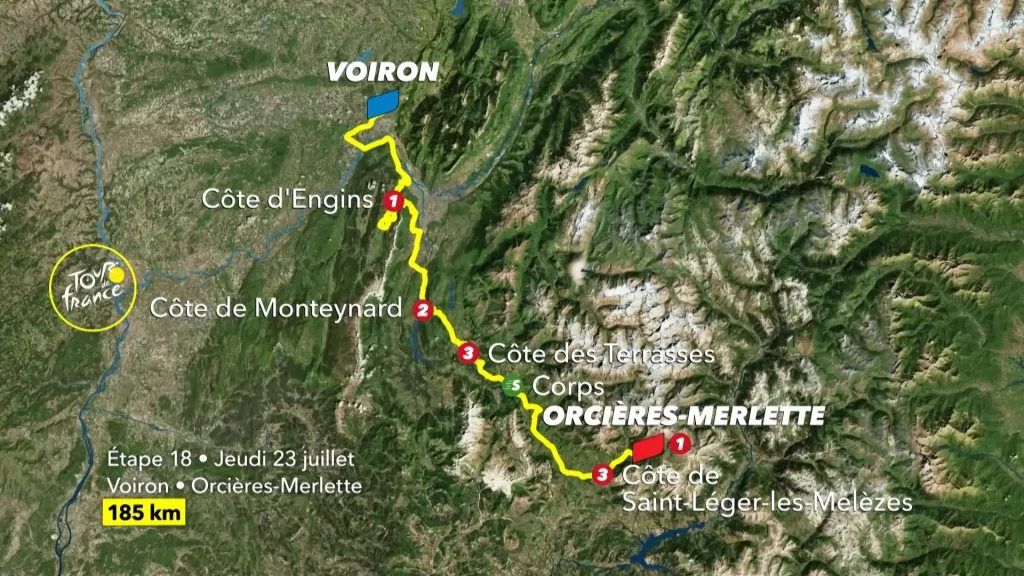
Stage 18 leaves Voiron and heads south toward Grenoble, but turns off before reaching the city to tackle the first serious climb of the day. From there, the route threads through the Vercors massif, drops into the Drac valley, climbs again toward Monteynard, spends a long stretch rolling across a high plateau, and then begins a gradual, near-continuous rise over the final 32 kilometres into Orcières-Merlette.
Côte d’Engins and the false flat that follows
Category 1 | 11.4km | 5.4% | km 36.7
The climbing starts in earnest with Côte d’Engins, and the effort doesn’t end when the categorised section does. A long false flat continues all the way to Saint-Nizier-du-Moucherotte — a detail worth knowing, since the climb “officially” finishing at the village line doesn’t mean the road actually flattens out. Riders keep working well past the point most route maps would suggest they can recover.
The uncategorised climbs nobody talks about
Near Grenoble, the route also crosses two smaller uncategorised climbs, Col de la Comboire (1.3km at 6.5%) and Col de la Festinière (3.4km at 4.9%). Neither will decide the stage. Both add to a day that’s considerably busier underfoot than the headline climb count suggests.
Monteynard, the high plateau, and Côte des Terrasses
After Côte d’Engins, the road drops to the banks of the Drac river before climbing again toward Monteynard — 9.7 kilometres at 5%, Category 2. What follows is the stage’s strangest stretch: instead of a real descent, the route stays around 900 metres of altitude for tens of kilometres, rolling continuously without ever properly flattening or properly climbing. The Côte des Terrasses, 3.4 kilometres at 6.6%, is the toughest ramp in that section, but it’s the accumulated rolling terrain around it that does the real damage.
Where the finale actually begins
From La Fare-en-Champsaur, with 32 kilometres still to race, the road starts rising and doesn’t stop. It begins gently, but this is the point serious analysts consider the true start of the day’s finale — several kilometres before the “official” Orcières-Merlette climb marker appears on the profile. The Côte de Saint-Léger-les-Mélèzes, 2.5 kilometres at 6.9%, is the standout ramp inside that stretch. By the time riders reach the base of the categorised final climb, they’ve already been climbing, in effect, for half an hour.
Orcières-Merlette: 7.1km at 6.7%, remarkably even
Category 1 | 7.1km | 6.7% average | ramps to 8.2% | finish altitude 1,825m
The final climb itself is almost gentle by modern Tour standards — no brutal double-digit ramps, no hairpin drama, just a steady, even gradient that holds close to 6.7% from bottom to top with the hardest sections touching 8.2%. From Saint-Léger-les-Mélèzes onward, this is the exact same finale the Tour used in 2020. Same road, same gradient, same final 7.1 kilometres. What’s different is the context: in 2020 this was Stage 4, with three weeks of racing still ahead and most GC riders content to protect their position. In 2026 it’s Stage 18, with only two mountain stages left after it, and nobody left in the race with any reason to hold back.
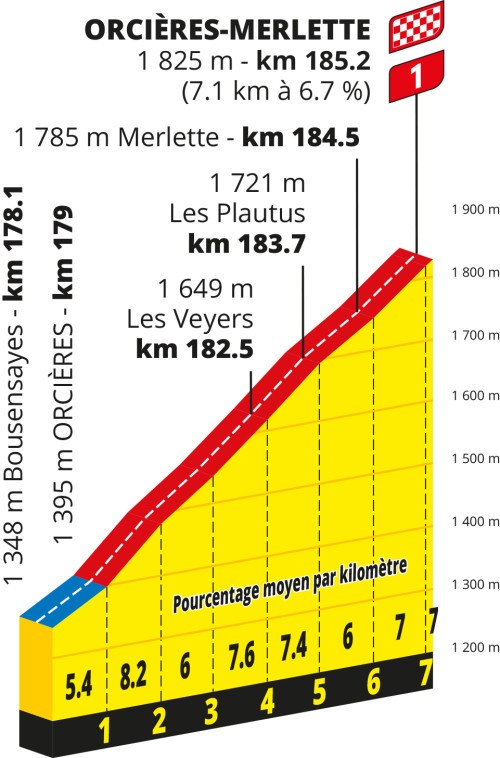
Full climb profile
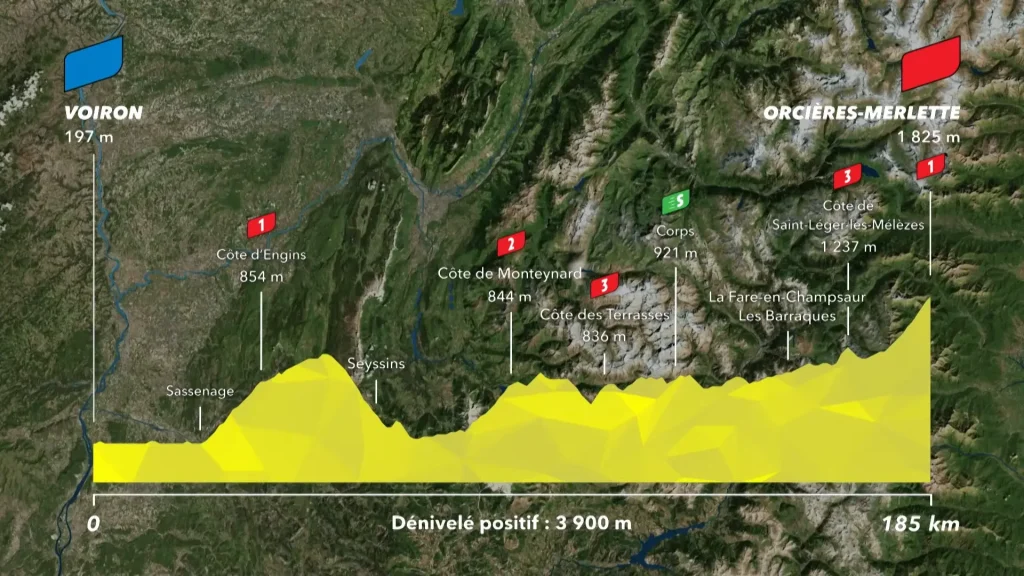
| Climb | Category | km marker | Distance | Avg gradient | Notes |
|---|---|---|---|---|---|
| Côte d’Engins | Cat. 1 | 36.7 | 11.4 km | 5.4% | False flat continues well past the summit |
| Col de la Comboire | Uncategorised | ~55 | 1.3 km | 6.5% | Near Grenoble |
| Col de la Festinière | Uncategorised | ~60 | 3.4 km | 4.9% | Near Grenoble |
| Côte de Monteynard | Cat. 2 | 92.2 | 9.7 km | 5.0% | Followed by ~900m plateau, no real descent |
| Côte des Terrasses | Cat. 3 | 112.8 | 3.4 km | 6.6% | Toughest ramp of the rolling middle section |
| Côte de Saint-Léger-les-Mélèzes | Cat. 3 | 166.2 | 2.5 km | 6.9% | Marks where the true finale begins, 19km from the line |
| Orcières-Merlette | Cat. 1 | 185.2 | 7.1 km | 6.7% | Ramps to 8.2%. Finish altitude 1,825m. Identical to the 2020 finale |
1971: the day Ocaña broke Merckx
Orcières-Merlette’s reputation in cycling history rests almost entirely on one afternoon. On 8 July 1971, during a 134-kilometre stage from Grenoble, Luis Ocaña attacked from the Côte de Laffrey, extended his advantage over the Col du Noyer, and then rode alone for the final 60 kilometres into Orcières-Merlette. Eddy Merckx, at that point chasing his third consecutive Tour title and considered close to unbeatable, could do nothing about it. Ocaña crossed the line 8 minutes and 42 seconds ahead of him, took the yellow jersey, and did something almost nobody had managed against Merckx in four years: he made the greatest cyclist of his generation look human.
It didn’t last. Days later in the Pyrenees, on the descent of the Col de Menté in a violent storm, Merckx lost control and crashed into a low wall. Ocaña, following close behind, couldn’t avoid the collision and went down hard, struggling to release his cleats before being struck again by a chasing Joop Zoetemelk. Merckx got back up and rode away. Ocaña didn’t get back up at all — he was airlifted to hospital, and though he attempted to continue the Tour in the days that followed, he eventually abandoned with bronchitis, handing Merckx his third title without another pedal stroke needed. Ocaña would finally get his revenge two years later, winning the 1973 Tour outright in Merckx’s absence. But Orcières-Merlette remains the afternoon everyone remembers first, the day the invincible champion looked beatable, followed by the crash that meant nobody actually got to find out.
2020: Roglič’s statement win
The last time the Tour finished at Orcières-Merlette was 2020’s Stage 4, and it produced a different kind of drama — a select group arriving together, Jumbo-Visma controlling the pace on the final climb before Primož Roglič countered a late attack from Guillaume Martin to take the win. Tadej Pogačar finished second, the same time as Roglič, with Martin third. Most of the GC favourites arrived safely in that same group, with only a handful losing meaningful time.
There’s a sharp bit of irony sitting inside that result now. Roglič’s win at Orcières-Merlette was read at the time as a statement of dominant form early in that Tour, and it was, right up until Stage 20’s individual time trial, where Pogačar produced one of the most stunning rides in modern Tour history to overturn the gap between them and take the title. The rider who lost at Orcières-Merlette in 2020 ended up winning the whole race. The mountain has a habit of not telling the whole story.
Last chance for the breakaway
Stage 18 carries real weight for riders with no realistic path to the GC podium but a genuine shot at a stage win. ASO’s own framing calls it the last chance for strong climbers who’ve broken away, after this, Stages 19 and 20 bring terrain hard enough, and stakes high enough, that GC teams are expected to ride far more controlling, aggressive racing that makes breakaway survival considerably harder.
Visma-Lease a Bike’s situation adds an extra layer here. With Vingegaard out of the race, the team has openly shifted its remaining ambitions toward stage wins, with Matteo Jorgenson, Sepp Kuss, and Davide Piganzoli all mentioned as riders now racing for daily opportunities rather than protecting a GC leader who no longer exists. A team with nothing left to defend and multiple capable climbers is exactly the kind of team that animates a day like this.
Stage winner prediction
Top picks: Valentin Paret-Peintre (Soudal Quick-Step) and Richard Carapaz (EF Education-EasyPost) enter as the strongest-rated favourites — both proven at exactly this kind of high-altitude, steady-gradient summit finish, and both riding for teams without a GC leader to protect today.
Outsiders: Tadej Pogačar himself can’t be ruled out if UAE Team Emirates-XRG decide there’s value in extending his lead further rather than conserving, though a below-100%-effort ride is just as plausible given the terrain still to come. Sepp Kuss and Davide Piganzoli represent Visma’s stage-hunting pivot, while Tobias Halland Johannessen and Tom Pidcock both have the engine for a day like this without any GC incentive holding them back.
Long shots: Remco Evenepoel could go on the attack if he judges the terrain suits him better than it suits del Toro or Seixas, though defending second overall likely takes priority. Egan Bernal, Alex Baudin, Thymen Arensman, Luke Plapp, Pablo Castrillo, and Lenny Martinez round out a deep field of climbers capable of a surprise on their day.
GC picture: still quiet, but not for long
| Pos | Rider | Team | Gap |
|---|---|---|---|
| 1 | Tadej Pogačar | UAE Team Emirates-XRG | Leader |
| 2 | Remco Evenepoel | Red Bull-BORA-hansgrohe | +4:32 |
| 3 | Isaac del Toro | UAE Team Emirates-XRG | +6:51 |
| 4 | Paul Seixas | Decathlon CMA CGM | +7:11 |
| 5 | Juan Ayuso | Lidl-Trek | +9:22 |
| 6 | Lenny Martinez | Bahrain Victorious | +10:14 |
| 7 | Mattias Skjelmose | Lidl-Trek | +12:50 |
| 8 | Tom Pidcock | Pinarello-Q36.5 | +12:58 |
The gap that matters most right now sits just below the podium: Seixas is only twenty seconds behind del Toro for third place and the white jersey that comes with it. Stage 18’s steady, non-explosive final climb isn’t the kind of terrain that typically blows a 20-second gap wide open — but with Stages 19 and 20 still to come, including the Alpe d’Huez double, nobody in that fight is treating today as low-stakes.
World start times and how to watch
| Time zone | Region | Official start | Est. finish |
|---|---|---|---|
| CEST (UTC+2) | France, Germany, Italy | 12:50 | ~17:25 |
| BST (UTC+1) | United Kingdom, Ireland | 11:50 | ~16:25 |
| EDT (UTC-4) | New York, Miami | 06:50 | ~11:25 |
| CDT (UTC-5) | Chicago, Dallas | 05:50 | ~10:25 |
| PDT (UTC-7) | Los Angeles, Seattle | 03:50 | ~08:25 |
| IST (UTC+5:30) | India | 16:20 | ~20:55 |
| AEST (UTC+10) | Sydney, Melbourne | 20:50 | ~01:25 +1 |
| NZST (UTC+12) | New Zealand | 22:50 | ~03:25 +1 |
How to watch: see live viewing guide: Eurosport carries the stage across most of Europe, with HBO Max offering a streaming alternative in the same region. In the US, NBC Sports and Peacock have coverage; FloSports carries it in Canada. SBS broadcasts free in Australia, Sky Sport covers New Zealand, and in Italy the stage airs free on Rai 2 between 14:00 and 18:00, with Eurosport and Discovery+ extending coverage from 12:30 to 18:00 for anyone wanting the full stage rather than the condensed window.
Equipment for the first Alpine stage
Stage 18 marks the point in the race where gearing choices shift meaningfully. After a run of transitional and rolling stages, teams move to full climbing setups, compact chainsets and wider-range cassettes built for a sustained high-altitude effort rather than the punchier, shorter climbs of the past week. It’s a small technical detail, but it’s also a signal: this is the day the Tour visibly becomes a mountain race again, in the equipment choices as much as the terrain.
Spectator guide — Voiron and Orcières-Merlette
Côte d’Engins: The first proper test of the day and a good early vantage point for genuine climbing effort, before the race disappears into the Vercors and the long rolling middle section.
Orcières-Merlette finish: The clear highlight. A summit finish at 1,825 metres on the edge of the Écrins National Park, with the added weight of the 1971 history attached to every metre of the final climb. Expect a strong crowd given both the scenery and the stage’s status as the Alpine trilogy’s opening statement.
Isère and Hautes-Alpes — food and culture
Voiron carries the same Chartreuse liqueur heritage covered for Stage 17’s finish in the same town, the historic distillery, run by Carthusian monks since the 18th century, sits just outside the town centre and remains one of the most distinctive culinary landmarks anywhere on this year’s route.
Further along, as the race crosses into the Hautes-Alpes and the Champsaur and Dévoluy regions near the finish, the food shifts toward heartier mountain fare: tourton, a savoury or sweet stuffed pastry particular to this corner of the Alps, and génépi, the herbal Alpine liqueur that turns up across multiple regions this Tour has passed through, each valley insisting its version is the definitive one.
FAQ — Tour de France 2026 Stage 18
What is Stage 18 of the Tour de France 2026?
Stage 18 is a 185.2km mountain stage from Voiron to Orcières-Merlette on Thursday 23 July 2026, the first of three consecutive Alpine stages that close the race. It carries approximately 3,900 metres of climbing and finishes with a 7.1km summit climb to 1,825 metres altitude.
Who is leading the Tour de France 2026 heading into Stage 18?
Tadej Pogačar leads heading into Stage 18, with Remco Evenepoel second at 4 minutes 32 seconds behind, and Isaac del Toro third at 6:51. Paul Seixas sits fourth, just 20 seconds behind del Toro. Jonas Vingegaard and Florian Lipowitz, both previously podium contenders, are no longer in the race after separate crashes on Stage 15 and Stage 16.
What happened at Orcières-Merlette in 1971?
In 1971, Luis Ocaña attacked Eddy Merckx on the road from Grenoble and rode alone for the final 60 kilometres into Orcières-Merlette, winning by 8 minutes and 42 seconds and taking the yellow jersey. It remains one of the most dominant single-stage performances against Merckx during his career. Days later, Merckx crashed on a mountain descent while Ocaña was following closely; Ocaña was also brought down and later abandoned the race, allowing Merckx to win the title regardless.
Has the Tour de France finished at Orcières-Merlette before?
Yes. Orcières-Merlette has hosted a Tour de France finish twice before 2026: in 1971, when Luis Ocaña’s solo attack made the climb famous, and in 2020, when Primož Roglič won a select-group sprint ahead of Tadej Pogačar. The 2026 finish uses the same final climb as the 2020 stage.
Why is Stage 18 considered the last chance for the breakaway?
Stage 18 is widely described as the final realistic opportunity for a climber outside the general classification picture to win a stage solo, since the two Alpine stages that follow — including the Alpe d’Huez double finish — are expected to be controlled far more tightly by the remaining GC contenders. Teams without a GC leader left in contention, including Visma-Lease a Bike since Vingegaard’s withdrawal, have shifted focus toward exactly this kind of stage-hunting opportunity.
How hard is the final climb to Orcières-Merlette?
The final climb to Orcières-Merlette is 7.1 kilometres at an average gradient of 6.7%, with the steepest sections reaching 8.2%. It is considered a relatively even, non-explosive climb by modern Tour standards, without the sharp double-digit ramps found on climbs like the Col du Haag or Plateau de Solaison earlier in this Tour.
What other climbs are on the Stage 18 route?
Besides the final Orcières-Merlette climb, Stage 18 features Côte d’Engins (11.4km at 5.4%), Côte de Monteynard (9.7km at 5%), Côte des Terrasses (3.4km at 6.6%), and Côte de Saint-Léger-les-Mélèzes (2.5km at 6.9%), along with two uncategorised climbs near Grenoble — Col de la Comboire and Col de la Festinière — that rarely appear in English-language race previews.
Is Stage 18 likely to change the GC standings?
Significant GC changes are considered unlikely on Stage 18, since the final climb’s steady gradient doesn’t typically produce large time gaps and most contenders are expected to conserve energy for the harder terrain of Stages 19 and 20. The tightest current battle — Paul Seixas just 20 seconds behind Isaac del Toro for the final podium position — is more likely to be decided in the Alps that follow than on this stage specifically.