
Tour de France Femmes avec Zwift 2026 Route: Full Stage-by-Stage Guide, Map & Elevation Profiles
Updated: 10:02 am CEST - Friday, 7 August 2026
Tour de France Femmes avec Zwift 2026 route confirmed by ASO race director Marion Rousse in October 2025. Stage distances below are the official figures; this page will be updated if anything changes before the Grand Départ.
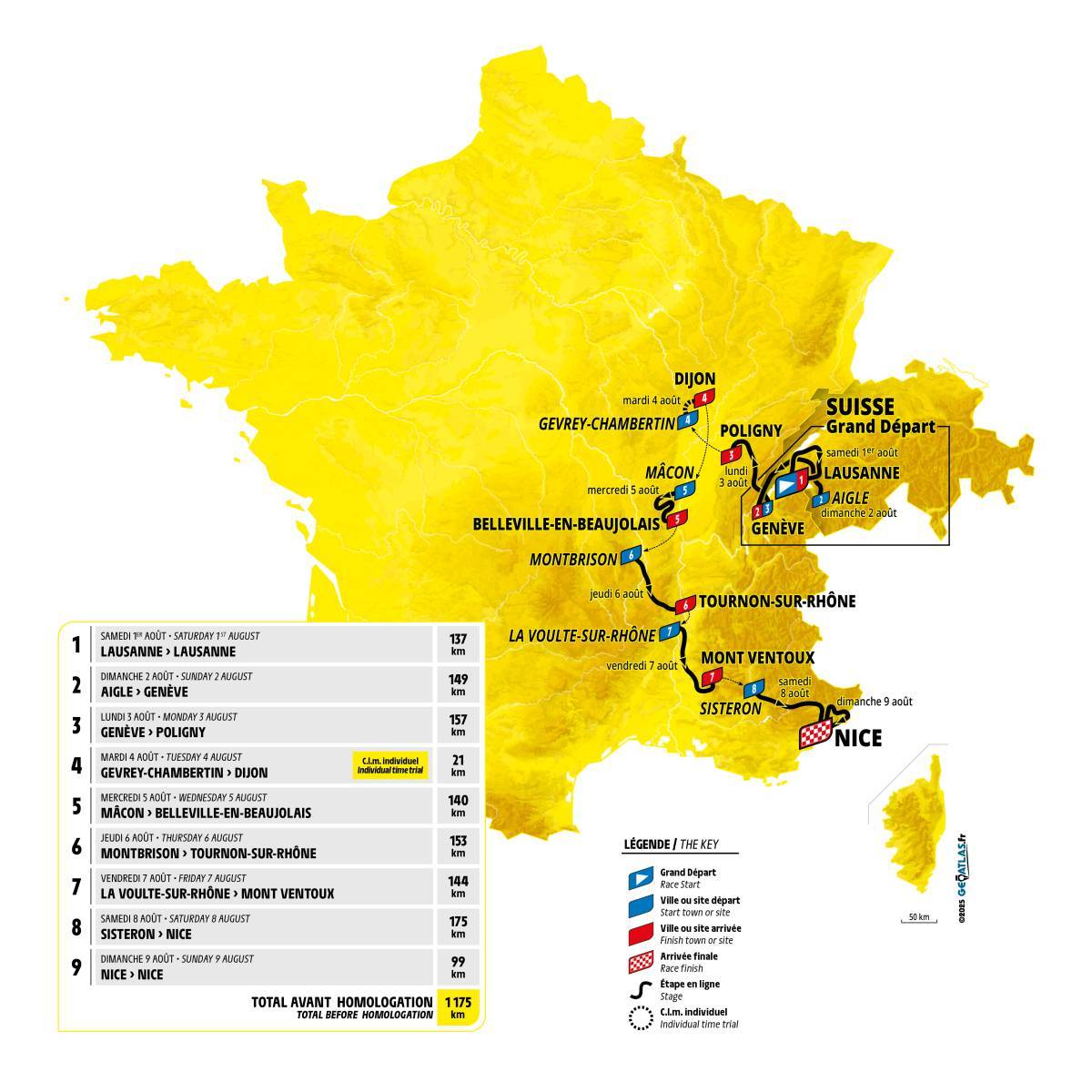
Looking for the full 2026 Tour de France Femmes route? Here it is: nine stages, 1,175km, and 18,795m of climbing between Lausanne on August 1 and Nice on August 9, the longest and hilliest route in the race’s five-year history. Below is every stage, every categorized climb, the queen stage on Mont Ventoux, the return of the individual time trial, and how this year’s course compares to the four editions that came before it.
TL;DR
- The route: Lausanne to Nice, 9 stages, 1,175km, 18,795m of elevation gain, a record on both counts.
- The queen stage: Stage 7 finishes atop Mont Ventoux, the first time the “Giant of Provence” has featured in the women’s race.
- The time trial: Stage 4’s 21km test into Dijon isn’t flat; a mid-course climb makes it a real GC weapon, not a rolling formality.
- The finale: No processional last day. Stage 9 climbs the Col d’Èze four times before the yellow jersey is decided in Nice.
- The sprinters’ window: Real chances exist on Stages 1, 2, and 8, but only Stage 2 is close to a guaranteed bunch sprint.
At a Glance: Femmes 2026 Route by the Numbers
Figure | Detail |
|---|---|
Dates | August 1–9, 2026 |
Stages | 9 (3 flat, 3 hilly, 2 mountain, 1 ITT) |
Total distance | 1,175km — longest Tour de France Femmes route yet |
Total elevation gain | 18,795m — most climbing in race history |
Countries | 2 (Switzerland, France) |
French regions crossed | 3 (Bourgogne-Franche-Comté, Auvergne-Rhône-Alpes, Provence-Alpes-Côte d’Azur) |
Departments crossed | 12 |
Mountain ranges | 3 (Jura, Massif Central, Alps) |
Riders at the start | 147 (21 teams of 7) |
Longest stage | Stage 8, Sisteron–Nice, 171.9km |
Time trial distance | 21km (Stage 4, Gevrey-Chambertin–Dijon) |
Highest point | Mont Ventoux summit, 1,910m |
Queen stage climbing | 3,565m (Stage 7) |
Femmes avec Zwift 2026 – The Full Route Map
The complete route runs in a rough anti-clockwise arc: west out of Lausanne, south through the Jura and Beaujolais, across the Massif Central into the Rhône valley, and finally along the Côte d’Azur to Nice. ASO publishes the official downloadable route map (PDF), and each stage has its own official profile page — Stage 1, Stage 2, Stage 3, Stage 4, Stage 5, Stage 6, Stage 7, Stage 8, and Stage 9.
What Kind of Route Is This?
This isn’t a route built around one signature mountain and a handful of transfer stages. It’s back-loaded with difficulty in a way the previous four editions weren’t. Only one stage, Stage 2, is genuinely built for a clean bunch sprint. Everything else asks a question: can you survive the climbing, and can you still produce a result once you have?
That shows up in the numbers. The three stages officially labeled “hilly” (3, 5, and 6) each carry over 2,400m of climbing, more vertical gain than some races call a mountain stage. Add a hilly time trial, a summit finish on one of cycling’s most famous climbs, and a final day that isn’t remotely ceremonial, and the picture is clear: this route rewards riders who can climb, recover, and climb again, not specialists who only need to be good at one thing.
Week 1: The Swiss Opening and the Road Into France (Stages 1–4)
Stage 1 — Lausanne to Lausanne | 138km | Flat (on paper)
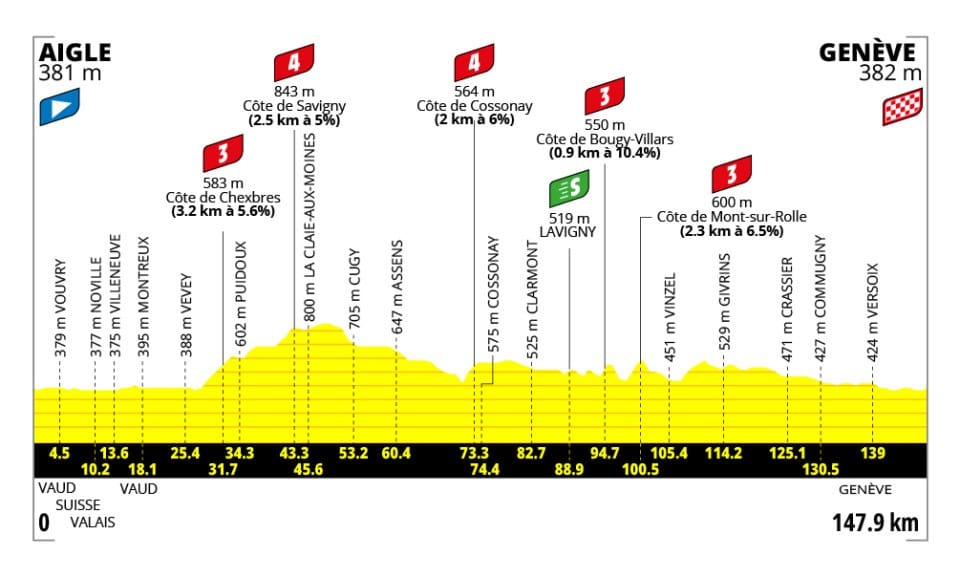
The Tour starts and finishes in the same city for the first time since the race’s foreign Grand Départs began. On the surface, 138km around Lausanne with a start and finish in the same place reads as a formality for the sprinters. It isn’t. Two categorized climbs sit in the second half, and the finish itself rises via the Côte Saint-François, roughly 2.5km at 4.6%, arriving directly into the line. A rider who can survive that finale and win takes the race’s first yellow jersey along with the stage, and with a bonus-seconds sprint on offer, several fast finishers have real reason to fight for it rather than treat it as a warm-up.
Stage 2 — Aigle to Geneva | 147.9km | Flat
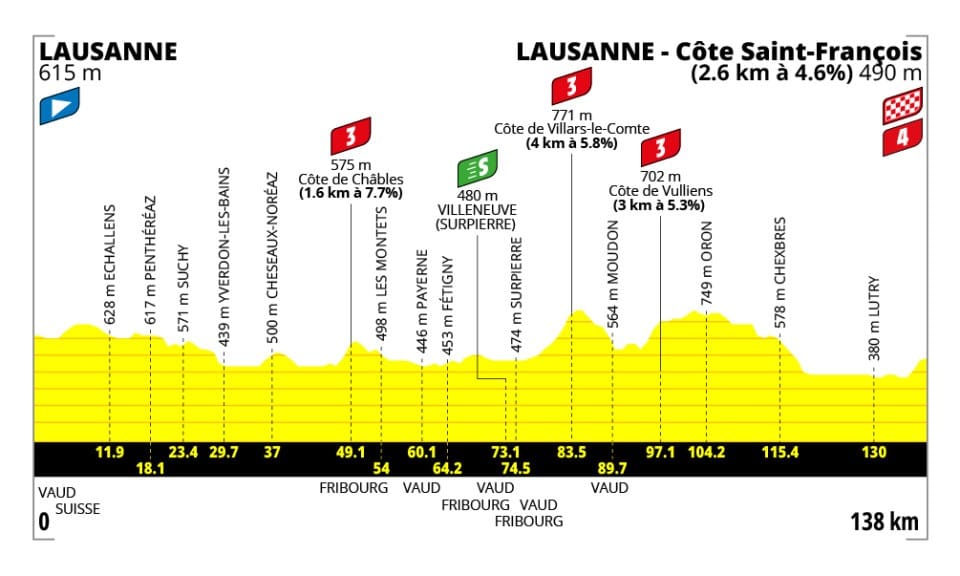
This is the stage the sprint teams will have circled first. Starting in Aigle, home of the UCI and the World Cycling Centre, the route has five small climbs, but none inside the final 40km. That’s the detail that matters: enough distance for any rider distanced on the early hills to return to the bunch before the finish in Geneva. If the 2026 Tour produces one textbook, full-bunch sprint finish, this is it.
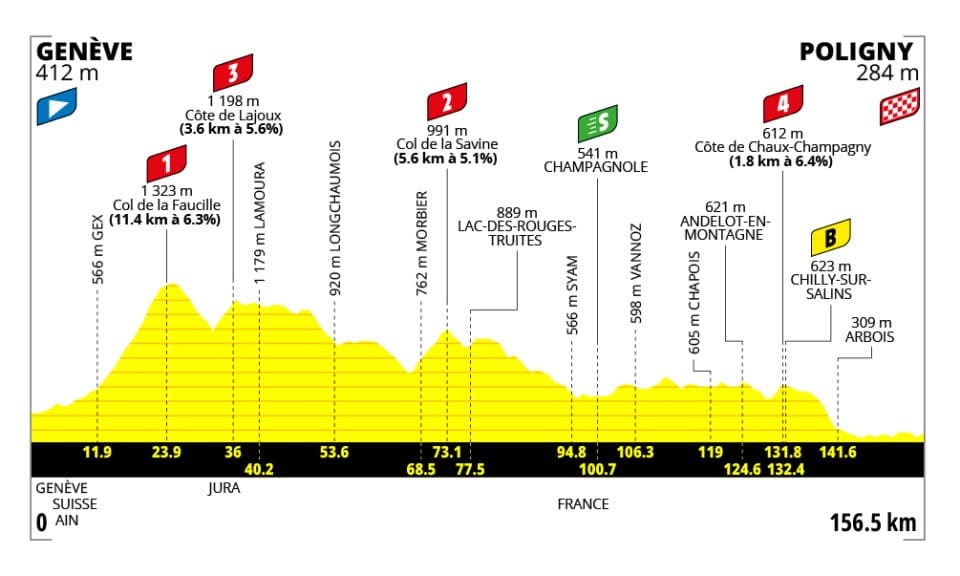
Stage 3 — Geneva to Poligny | 156.5km | Hilly
Switzerland hands off to France here. The stage starts in Geneva and crosses the border within the opening kilometres, heading into the Jura mountains for the longest climb of the race so far: the Col de la Faucille, 11.4km at roughly 6.3%. It arrives early, inside the first 15km, which means the rest of the stage is less about that one climb and more about who’s still standing afterward. A shorter late climb near Chaux-Champagny, about 1.8km at 6.4%, sets up the finish in Poligny. Depending on how hard the early pace is, this can settle into a reduced bunch sprint or open the door to a breakaway.
Stage 4 — Gevrey-Chambertin to Dijon | 21km | Individual Time Trial
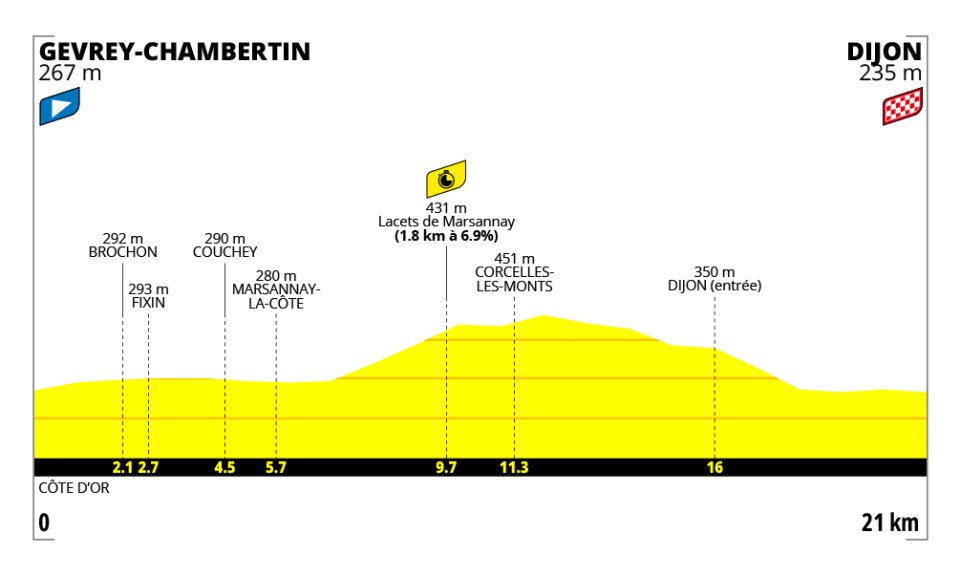
The time trial returns to the Tour de France Femmes after sitting out the 2025 edition, and it isn’t the flat formality some were expecting. Twenty-one kilometres from Gevrey-Chambertin to Dijon, with a climb, the Lacets de Marsannay, around 2km at 6.6–6.9%, sits in the middle of the course. That’s enough to separate pure time-trial specialists from climbers who can hold a TT position, and enough distance afterward for the descent and flat run into Dijon to reward whoever paced the climb correctly rather than whoever simply has the most raw power. Compare that to the flat, 6.3km Rotterdam time trial in 2023: this is a genuinely different test, and it’s likely to open real gaps in the general classification days before the race reaches the mountains.
The Final Push: Stages 5–9, Beaujolais to the Riviera
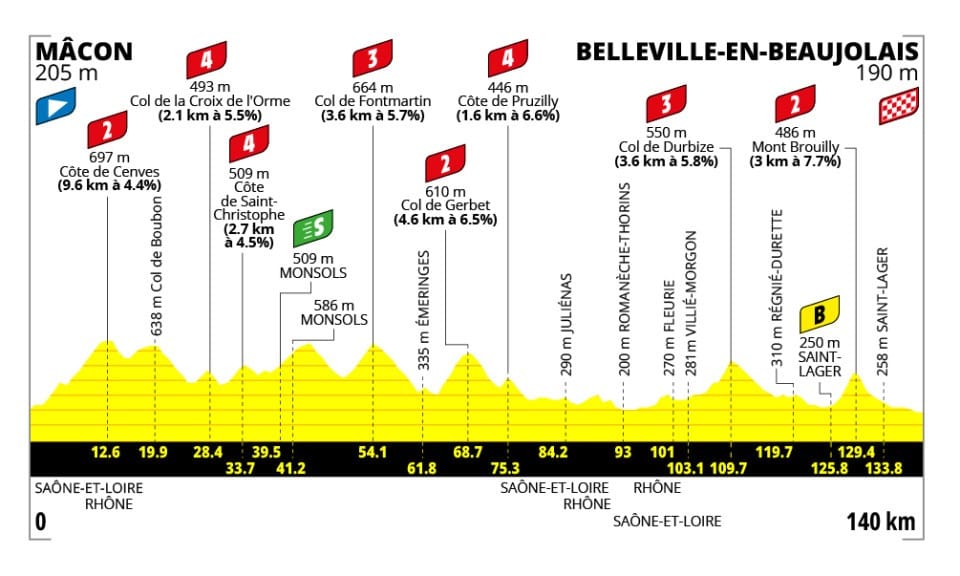
Stage 5 — Mâcon to Belleville-en-Beaujolais | 140 km | Hilly
Eight categorized climbs in 140km, and barely a flat kilometre between them. The stage opens with its longest ascent, the Côte de Cenves at 9.6km, and doesn’t let up from there. The final test, Mont Brouilly, roughly 3km at 7%, cresting around 7–11km from the finish depending on which official figure you use, is exactly the kind of late, punchy climb that turns a bunch into a small group. This is a breakaway-friendly day, and a legitimate opportunity for the tougher sprinters who can survive repeated climbing rather than the pure speed specialists.
Stage 6 — Montbrison to Tournon-sur-Rhône | 153.4km | Hilly
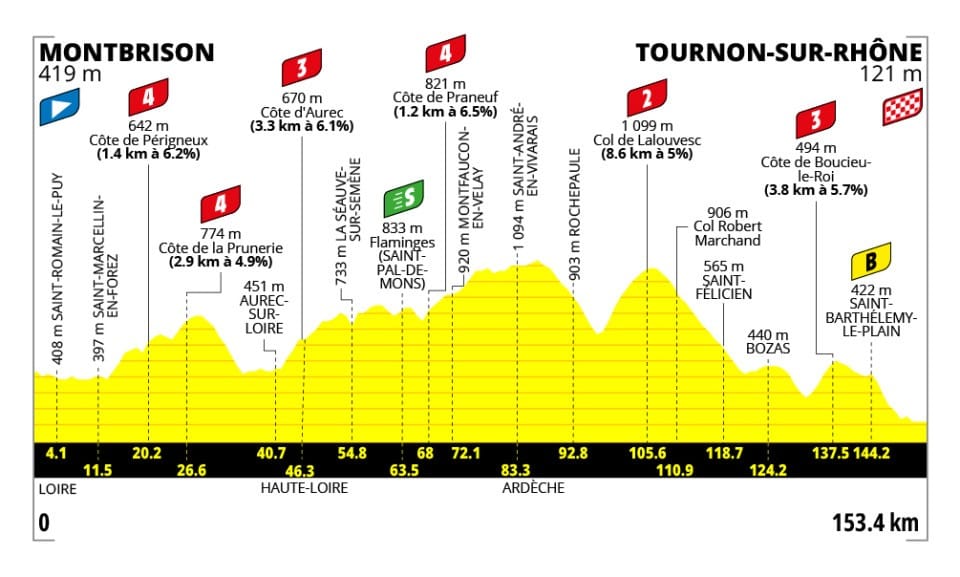
The race pushes into the Ardèche on the second of back-to-back hilly stages. Six categorized climbs fill the route, the toughest being the Col de Lalouvesc at 8.6km/5%, with a shorter, steeper test, the Côte de Boucieu-le-Roi, roughly 3.8km at 5.7%, inside the final 20km. Every GC team knows what’s waiting the next day on Mont Ventoux, which historically makes days like this more aggressive, not less: nobody wants to spend energy controlling a stage when the real fight starts tomorrow.
Stage 7 — La Voulte-sur-Rhône to Mont Ventoux | 146.8km | Mountain (Queen Stage)
The stage that decides the Tour. Full breakdown below.
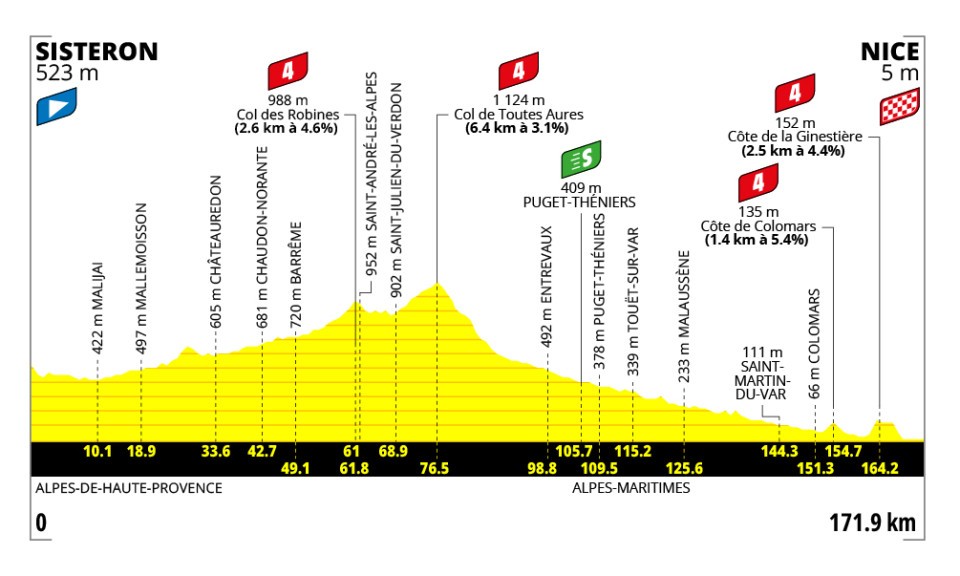
Stage 8 — Sisteron to Nice | 171.9km | Flat (officially)
The longest stage of the race, arriving the day after Ventoux, which changes everything about how “flat” it actually rides. The first 80km trend gently uphill before a long descent toward the coast, and two short, late climbs (the Côte de Colomars and Côte de la Ginestière, both inside the final 17km) give any rider still feeling Ventoux in their legs a reason to attack rather than wait for a sprint. On paper this is a sprinters’ stage. In practice, with tired legs, thinned-out lead-out trains, and a summit finish in very recent memory, a breakaway has a real chance of making it stick.
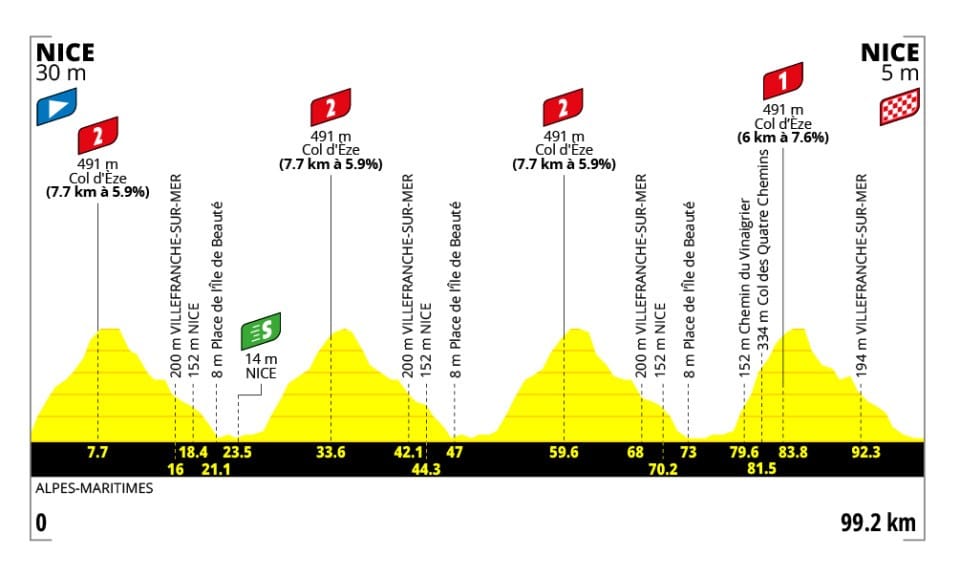
Stage 9 — Nice to Nice | 99.2km | Mountain (Final Day)
There is no processional finish at this Tour. The shortest stage of the race, barring the time trial, sends the peloton up the Col d’Èze four times, the final ascent taken from its steeper side: roughly 6km at 7.6%. Whatever gap exists in the general classification going into the final day will be tested directly on that last climb, with a technical descent back into Nice offering one more place for a bold rider to make a difference before the race is decided.
Summit Finish Deep-Dive: Why Mont Ventoux Changes Everything
Every edition of the Tour de France Femmes since 2022 has built its identity around one defining climb: La Super Planche des Belles Filles in 2022, the Col du Tourmalet in 2023, Alpe d’Huez in 2024, the Col de la Madeleine in 2025. For 2026, that climb is Mont Ventoux, and it’s the first time the “Giant of Provence” has appeared in the women’s race at all.
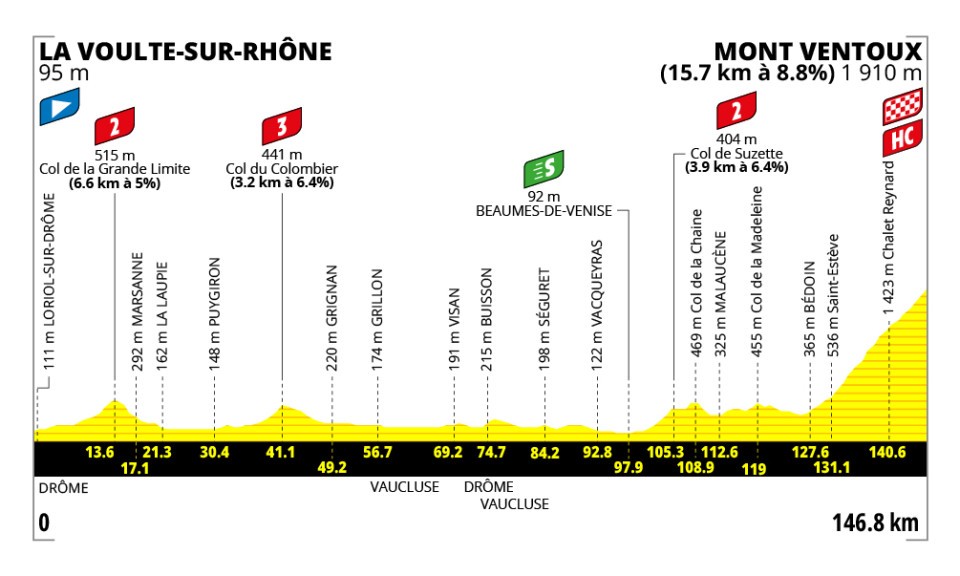
The numbers alone explain the stakes: 15.7km at an average gradient of 8.8%, arriving at the end of a 146.8km stage that has already thrown three smaller climbs at the peloton before the base of Ventoux even begins. What makes Ventoux different from a normal summit finish isn’t just the gradient — it’s the final few kilometres above the treeline, where the road crosses an exposed, barren limestone landscape with essentially no shelter from the wind. Riders can see the summit observatory from kilometres out, which is as much a psychological test as a physical one, and the Mistral wind that regularly sweeps this part of Provence can turn a hard climb into a genuinely dangerous one. Stage plans, and possibly stage outcomes, can change entirely based on wind conditions alone.
Tactically, this is the stage where the Tour gets decided, not just influenced. A time trial four days earlier will have already opened some gaps, but Ventoux is long and hard enough to open new ones or close existing ones outright. Anyone hoping to win the 2026 Tour de France Femmes has to treat August 7 as the day that matters most.
Individual Time Trial Deep-Dive: The Dijon Test
The return of the time trial after its absence in 2025 is one of the more significant route decisions ASO made for 2026, and it’s worth understanding exactly why the profile matters as much as the distance.
At 21km, Stage 4 is more than three times the length of the last Tour de France Femmes time trial, the flat 6.3km test around Rotterdam in 2023, and it isn’t flat. The Lacets de Marsannay, roughly 2km at 6.6–6.9%, sits almost exactly in the middle of the course, meaning riders have to find a pacing strategy that survives a genuine climb without blowing up their legs for the fast, flat run into Dijon that follows. That combination rewards a specific kind of rider: strong enough against the watch to hold an aerodynamic position and high wattage on the flat sections, but comfortable enough out of the saddle to not lose everything on the climb.
It’s also a stage most pure climbers can’t simply write off. A poor time trial on a course with this much elevation change can cost a GC contender minutes rather than seconds, and those are minutes that are very hard to find back later in a race with only one summit finish. Expect this stage to be one of the more closely watched GC moments of the entire nine days, well before the race reaches the mountains.
How 2026 Compares: Five Editions of the Tour de France Femmes
Year | Dates | Stages | Distance | Elevation Gain | Queen Stage | Winner |
|---|---|---|---|---|---|---|
2022 | 24–31 July | 8 | 1,033.6km | — | La Super Planche des Belles Filles | Annemiek van Vleuten (NED) |
2023 | 23–30 July | 8 | 960.5km | — | Col du Tourmalet | Demi Vollering (NED) |
2024 | 12–18 August | 8 | 949.7km | — | Alpe d’Huez | Katarzyna Niewiadoma-Phinney (POL) |
2025 | 26 July–3 August | 9 | 1,168.6km | 17,240m | Col de la Madeleine | Pauline Ferrand-Prévot (FRA) |
2026 | 1–9 August | 9 | 1,175km | 18,795m | Mont Ventoux | — |
The trend is clear without needing to guess at missing numbers: since the race expanded to nine stages in 2025, both distance and difficulty have increased again in 2026. This is now the longest and hilliest Tour de France Femmes yet, by both metrics simultaneously, something no previous edition achieved at the same time.
Who Does This Route Favor?
This route doesn’t hand the race to one type of rider. It’s built to punish anyone with an obvious weakness.
- Climbers with time-trial ability have the biggest advantage. A rider who can defend or gain time in the Dijon TT and then handle Ventoux without cracking is the profile this course is built for, which is part of why defending champion Pauline Ferrand-Prévot and runner-up Demi Vollering both start as obvious favorites.
- Pure time-trial specialists get one real chance to make time, but it comes with a climb attached. Marlen Reusser, the reigning world time trial champion, has the tools to use Stage 4 as a launchpad, if she can also survive Ventoux and the accumulated climbing across the rest of the week.
- Sprinters get three flat-classified stages (1, 2, 8) but only one, Stage 2, that’s likely to play out as a conventional bunch sprint. Riders who can produce a fast finish after climbing, rather than needing a perfectly flat run-in, have a real advantage; that versatility is exactly why a rider like Lorena Wiebes enters with a wider window of opportunity than most other fast finishers.
- Puncheurs and breakaway specialists should target the two consecutive hilly stages (5 and 6) the day before Ventoux, when GC teams have little incentive to control the race and are saving energy for the mountain to come.
The net effect: there’s no coasting through this Tour on one strength alone. Every rider in the general classification conversation will be tested at least twice, once against the clock, once on Ventoux, and the overall winner is likely to be whoever loses the least time on their weakest terrain, not simply whoever is strongest on their best day.