Tour de France Femmes 2026 Grand Départ: The Complete Guide to Switzerland’s Opening Weekend
Last updated: 2:55 pm CEST - Thursday, 30 July 2026
Looking for everything on the 2026 Tour de France Femmes Grand Départ? Here it is: three days in Switzerland, Lausanne, Aigle, and Geneva, before the race crosses into France on Stage 3. It’s the fifth edition of the race, the second Grand Départ held outside French borders, and the opening act of the longest, hilliest Tour de France Femmes route yet.
TL;DR
- Where: Lausanne (Stage 1), Aigle to Geneva (Stage 2), Geneva to Poligny, France (Stage 3).
- When: August 1–3, 2026, kicking off the nine-day race schedule that runs through August 9.
- Why it matters: Only the second Grand Départ outside France, after Rotterdam in 2024, and the first time the race has started in Switzerland at all.
- The field: 21 teams, up to 147 riders, the smallest field since 2022, after a Women’s WorldTour rules change dropped Continental teams from the race entirely.
- Home advantage: Three Swiss riders, Marlen Reusser, Elise Chabbey, and rising talents Noemi Rüegg and Linda Zanetti, get to race a Grand Départ on home roads.
At a Glance: Grand Départ by the Numbers
Figure | Detail |
|---|---|
Host cities | Lausanne, Aigle, Geneva (Switzerland); Poligny (France) |
Dates | August 1–3, 2026 (Stages 1–3 of 9) |
Stage 1 | Lausanne → Lausanne, 138km |
Stage 2 | Aigle → Geneva, 147.9km |
Stage 3 | Geneva → Poligny, 156.5km |
Teams | 21 (14 WorldTeams + 7 ProTeams, no Continental teams) |
Riders | Up to 147 (7 per team); all riders confirmed |
Historical first | Second Grand Départ outside France, after Rotterdam 2024 |
Edition | 5th modern Tour de France Femmes |
Why Switzerland? The Story Behind the Bid
Lausanne didn’t come out of nowhere. The city put in a bid to host the women’s race as far back as 2022, the last year a Tour de France Femmes stage finished there at all, and this year it finally gets the Grand Départ itself. The pairing with Aigle and Geneva isn’t random either: Aigle is home to the UCI and the World Cycling Centre, making it as close to a spiritual capital of world cycling as any town gets, while Geneva brings its own identity as a global diplomatic hub. Race organizers have leaned into that framing directly, calling the stretch along Lake Geneva a “jaw-dropping backdrop” for the race’s Swiss debut, and the opening weekend is built to match: a puncheuse-friendly first stage, followed by a likely sprint finish against the Geneva waterfront.
Local officials from all three host cities have echoed the same theme in the run-up: pride in hosting women’s cycling for the first time, and a deliberate push to use the race as a platform for women’s sport more broadly — Geneva’s tourism office has drawn an explicit parallel to the city’s hosting of Euro 2025 the previous year.
Grand Départ Schedule at a Glance
Stage | Date | Route | Distance | Profile |
|---|---|---|---|---|
1 | Sat, Aug 1 | Lausanne → Lausanne | 138km | Officially flat, tactically hilly |
2 | Sun, Aug 2 | Aigle → Geneva | 147.9km | Flat — the sprinters’ best shot |
3 | Mon, Aug 3 | Geneva → Poligny (France) | 156.5km | Hilly, into the Jura |
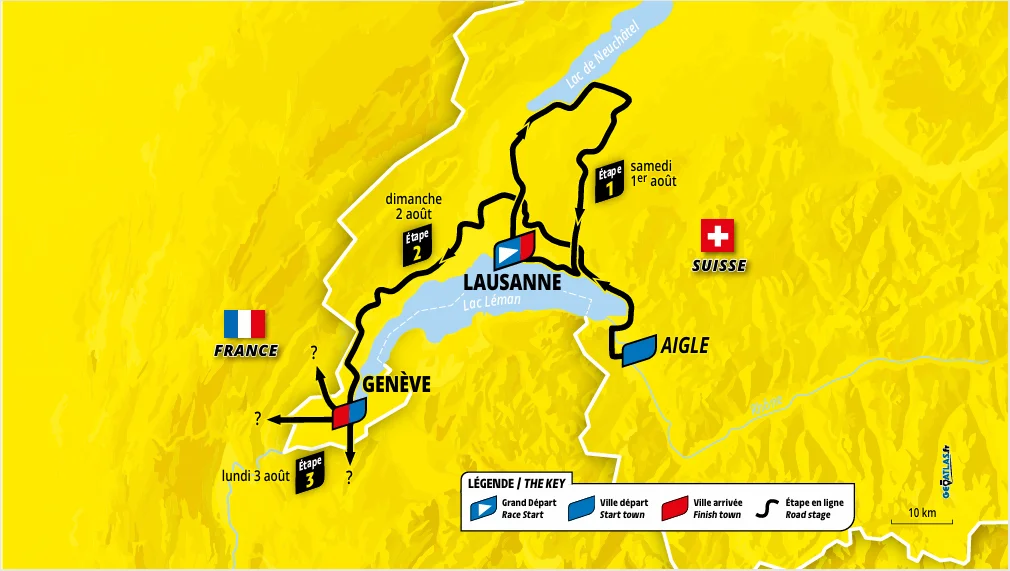
ASO publishes an official downloadable Grand Départ map (PDF), and the dedicated Grand Départ Suisse site carries additional host-city detail as it’s confirmed.
Stage 1 Deep-Dive: Lausanne to Lausanne
The race starts and finishes in the same city, on Avenue de Rhodanie, right on the shore of Lake Geneva. From there, a wide loop pushes out toward Lake Neuchâtel before turning back, and that return leg is where the stage actually gets decided: two climbs, 3.5km at 6.1% and then 3.7km at 4.5%, arrive in the second half.
This isn’t a stage that just tests legs; it’s a stage that shows off the scenery deliberately. The route hugs Lake Geneva past the Lavaux Vineyard Terraces, a UNESCO World Heritage Site, and passes the Olympic Museum shortly before the road tilts up one final time: a 2.3km climb at 5.4%, arriving directly into Place Saint-François at the end of a 400-metre straight. Race organizers have called this a “puncheuse-friendly” opener, and the finish explains why: it’s not a summit finish, but it’s steep enough and close enough to the line that a pure sprinter can’t simply sit in and wait.
Whoever wins Stage 1 takes the race’s first yellow jersey. With bonus seconds on offer at the finish, expect the punchier GC riders and hilly-classics specialists to contest this one hard, rather than concede it to a bunch gallop.
Stage 2 Deep-Dive: Aigle to Geneva
Stage 2 rolls out of Aigle, a town that punches enormously above its weight in cycling terms as the home of the UCI and the World Cycling Centre, and heads toward Lake Geneva via Montreux and Vevey. Three climbs are packed into a 13km stretch near Lac de Bret, with the last of them cresting 35km from the finish. That gap matters: it’s enough road for any rider dropped on the climbs to fight back to the bunch before the finish.
The stage rolls into Geneva along the Quai du Mont-Blanc, finishing directly opposite the Jet d’Eau, Geneva’s 140-metre water fountain and one of the most recognizable backdrops in the city. If the 2026 Tour produces one clean, full-bunch sprint finish, the smart money is on this being it.
Geneva is treating the day as a genuine event, not just a pass-through: a fan zone runs both August 2 and 3, with entertainment and food trucks accompanying the stage finish and the following day’s start.
Stage 3 Preview: Geneva to Poligny
Switzerland hands the race off to France on Stage 3. The start moves to Plainpalais, a central Geneva neighbourhood, before the route crosses into France within the opening kilometres and turns toward the Jura mountains, a genuine change in terrain after two largely flat days, setting up the climbing that defines the rest of the route through French Burgundy, the Beaujolais, and eventually Mont Ventoux.
Three Swiss Champions to Watch
A home Grand Départ means home riders carry extra weight, and Switzerland has more than a supporting cast this year.
Marlen Reusser missed the 2025 Tour de France Femmes entirely after illness forced her out mid-race. She recovered fully and was crowned world time trial champion that September and now lines up for Movistar, having already won stages at this race in both 2022 and 2023. Elise Chabbey, born in Geneva, had her own breakout 2025: she won the polka dot jersey as the race’s best climber, then followed it up with victory at the Tour de Romandie Féminin. Behind them, two more Swiss riders are coming through, Noemi Rüegg (24) and Linda Zanetti (23), following a lineage that includes world champion Barbara Heeb (1996), three-time Giro winner Nicole Brändli, two-time world time trial champion Karin Thürig, and Grande Boucle winner Priska Doppmann.
For a Grand Départ built entirely on Swiss soil, that’s a genuinely deep bench of home interest, not just novelty hosting.
Why Only 21 Teams This Year
If the peloton looks a little smaller this year, that’s not an accident. The Tour de France Femmes ran with 22 teams in 2023, 2024, and 2025. In 2026, that number dropped to 21, 14 UCI Women’s WorldTeams (automatically invited) plus 7 UCI Women’s ProTeams selected by ASO, with zero Continental teams in the field for the first time.
The change comes from a broader Women’s WorldTour restructuring that limits top-tier races to WorldTeam and ProTeam-level squads only. ASO has applied the new rule strictly; other organizers, including the UAE Tour Women, have leaned on exceptions to keep Continental teams involved. The practical effect here: a smaller, more concentrated elite field of up to 147 riders, still larger than the race’s 144-rider debut field in 2022, but the tightest lineup since then.
The Favorites: A Ferrand-Prévot vs. Vollering Rematch
Defending champion Pauline Ferrand-Prévot, the first French winner of the race, heads into the Grand Départ as the rider everyone else is chasing. Demi Vollering, runner-up in 2025 and a past winner herself in 2023, is the most obvious threat, and their rivalry is shaping up as the central storyline of the general classification battle. Behind them, past champion Katarzyna Niewiadoma-Phinney and Swiss favorite Marlen Reusser both have the tools to disrupt a straight two-rider duel, Reusser especially, given the Dijon time trial arrives before the race even reaches the mountains.
None of that gets decided in Switzerland. But the puncheuse-friendly Stage 1 finish and the Stage 2 sprint both offer early looks at form before the real racing starts.
Spectator Guide: Fan Zones & Getting There
Confirmed: Geneva is running a fan zone on both August 2 and 3, with entertainment and food trucks around the Stage 2 finish and Stage 3 start. The Stage 2 finish lands on Quai du Mont-Blanc; the Stage 3 start is from Plainpalais.
Not yet confirmed: Specific road closures and viewing recommendations for Lausanne’s Stage 1 loop weren’t available on official channels as of this writing. Check the Grand Départ Suisse website directly closer to race day rather than relying on secondhand closure times; this is exactly the kind of detail that gets finalized in the final weeks before a Grand Départ.
Local Culture Along the Route
Part of what makes this Grand Départ distinct is that it’s not just passing through Switzerland — it’s routed through some of the country’s signature landscapes and food culture in the same three days. Stage 1 skirts the Lavaux Vineyard Terraces, a UNESCO World Heritage vineyard landscape on the shore of Lake Geneva. Geneva itself is a genuine chocolate destination, with a tradition dating back to 1826, and is also known for its fine watchmaking. And the Jet d’Eau, the fountain framing the Stage 2 finish line, is as much a Geneva icon as any building in the city.
How to Watch & Time Zones
Switzerland and France both run on Central European Summer Time (CEST, UTC+2) in August.
Past editions have been broadcast via France Télévisions and Eurosport; check the official broadcaster page for confirmed 2026 coverage in your region.