Tour de France Femmes 2026 Stage 1 Preview: Who Takes the First Yellow Jersey in Lausanne?
Updated: 10:45 am CEST - Saturday, 1 August 2026
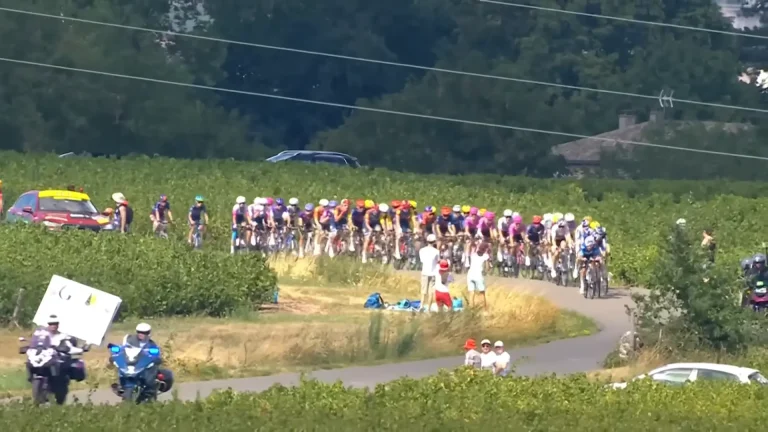
138km opening day of the 2026 Tour de France Femmes from Lausanne back to Lausanne, four categorized climbs, and a finish that punishes anyone who shows up expecting an easy day. This stage 1 hands out the race’s first yellow jersey on August 1, and it isn’t going to a pure sprinter.
TL;DR
- The stage: 138km, Lausanne to Lausanne, 1,700m of climbing.
- The climbs: Four categorized ascents, three on the way out, one deciding the finish.
- The finish: 2.6km averaging 4.6% into Place Saint-François, with an 8% kick roughly 500m from the line.
- The schedule: Neutralised start at 14:15 CEST, finish expected around 17:44 CEST.
- Who it favors: Resilient sprinters and puncheurs, not pure fast finishers, and not the GC climbers either, at least not for the win.
At a Glance: Stage 1 by the Numbers
| Figure | Detail |
|---|---|
| Route | Lausanne → Lausanne |
| Distance | 138km |
| Elevation gain | 1,700m |
| Stage type | Officially flat, tactically punchy |
| Categorized climbs | 4 (three Cat. 3, one Cat. 4) |
| Intermediate sprint | Villeneuve (Surpierre), km 73.1 |
| Neutralised start | 14:15 CEST |
| Expected finish | ~17:44 CEST |
| Date | Saturday, August 1, 2026 |
The Stage 1 Route, Climb by Climb Profile
The stage rolls out from Avenue de Rhodanie, right on the shore of Lake Geneva, and heads north, away from the lake, toward Lake Neuchâtel, briefly crossing into the Canton of Fribourg along the way. For the first 49km, it’s rolling but unthreatening. Then comes Côte de Châbles (Cat. 3, 1.6km at 7.7%) at kilometre 49.1, short, but steep enough to be the day’s first real test, and early enough that nobody’s racing for position yet.
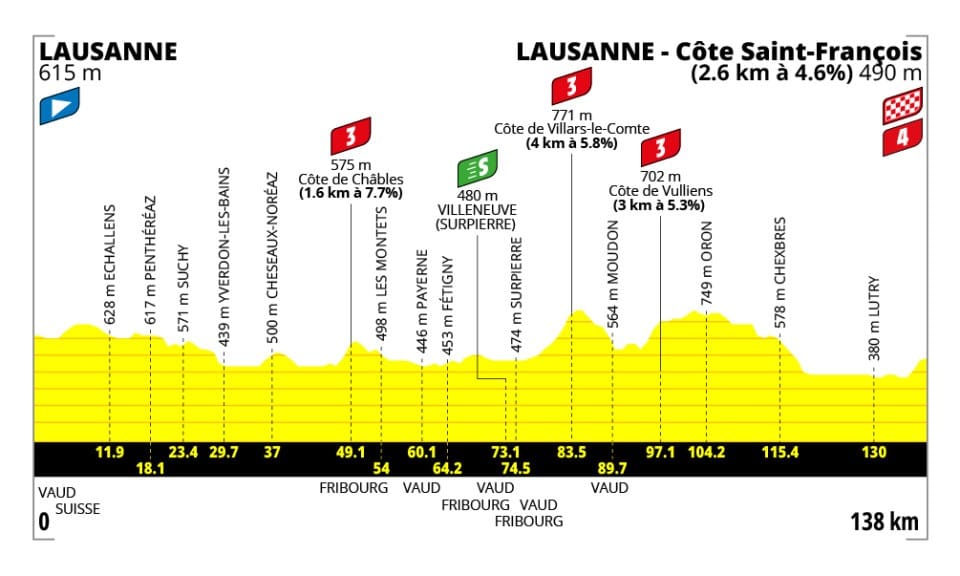
The route continues through Payerne and toward Lucens before the road tilts up twice more in quick succession. Côte de Villars-le-Comte (Cat. 3, 4km at 5.8%) arrives at kilometre 83.5, just past the halfway mark, the longest climb of the day, long enough to actually hurt. Barely any recovery follows before Côte de Vulliens (Cat. 3, 3km at 5.3%) crests at kilometre 97.1, with 40.9km still to race. Two categorized climbs inside 14km of each other, after 97km already in the legs, is exactly the kind of sequence that quietly thins out a bunch without anyone noticing until the flat section afterward, when a few riders just aren’t there anymore.
From the top of Vulliens, it’s a gradual descent back toward Lake Geneva, 18km of it flat and fast along the shoreline, skirting the base of the Lavaux Vineyard Terraces, before the finale.
The Finish: Why Place Saint-François Isn’t a Sprinters’ Finish
This is the part of the stage that actually decides it. Côte Saint-François averages 4.6% over 2.6km, a number that undersells it. The real story is in the shape: a genuinely steep ramp, around 8%, arrives roughly 500m from the line, right when legs are already carrying 135km and three prior climbs. Only after that does the road flatten out for the final 400m into Place Saint-François.
That structure is the whole tactical puzzle of Stage 1. It’s not steep enough, long enough, or early enough to be a true summit finish; a rider who’s simply strong can survive it. But it’s positioned exactly where a pure sprinter’s leadout train falls apart: too far from the line for a clean flat run-in, too short for the climbers to open a gap that sticks. The stage is built, almost precisely, for a rider who can climb hard for 90 seconds and then still find a sprint on the other side.
Through Fribourg and Back: The Full Route Story
Stage 1 isn’t just a loop, it’s a genuine tour through two cantons. After leaving Lausanne, the race briefly enters the Canton of Fribourg, passing through Payerne, home to an 11th-century Cluniac abbey church that’s one of Switzerland’s most significant Romanesque monuments, and Lucens, whose 13th-century castle has an unlikely second life as a former Sherlock Holmes museum, founded by Arthur Conan Doyle’s own son in 1965. Further along, the route skims Yverdon-les-Bains on Lake Neuchâtel, one of the oldest towns in Switzerland, with roots tracing back more than 6,000 years and a history as a thermal spa town that once drew Enlightenment-era visitors.
The return leg is where the scenery peaks: the final 18km hug Lake Geneva past the Lavaux Vineyard Terraces, a UNESCO World Heritage Site since 2007, listed as a “living cultural landscape” shaped by centuries of winemaking on impossibly steep lakeside slopes. It’s a fitting build-up to a finish in a city that’s spent three years bidding for exactly this moment; Lausanne first pitched to host the race back in 2022.
Favorites: Who Wins Stage 1?
The finish favors a specific rider profile: strong enough to handle a steep, short ramp on tired legs, fast enough to still sprint 400m later. That’s a narrower group than “sprinters” or “climbers” as blanket categories.
Most likely to suit the finish directly: riders who combine a hard, short punch with a finishing sprint, the exact profile this stage is built for. Names circulating in early previews include Puck Pieterse, Kim Le Court-Pienaar, and Lotte Kopecky, all of whom have built results on exactly this kind of terrain before.
GC contenders who need to survive, not win, this stage: defending champion Pauline Ferrand-Prévot, runner-up Demi Vollering, and past champion Katarzyna Niewiadoma-Phinney all arrive with the overall classification as the real target. Marion Rousse has already called the 2026 route “mischievous,” noting difficulties on every stage, and Stage 1 is the first test of whether anyone’s legs aren’t quite ready yet. Ferrand-Prévot has called the course “super nice” and says she’s ready to work; Niewiadoma-Phinney says the time trial four days later is what stands out most to her, a sign the GC riders are already looking past Stage 1 rather than fighting for it outright.
A wildcard worth watching: Marlen Reusser, Switzerland’s own world time trial champion, gets a home-soil start and has stage-winning pedigree at this race already, though a punchy finish like this isn’t traditionally her strongest terrain.
Outsiders: Magdeleine Vallières, the reigning UCI Road Race World Champion, lines up as a genuine threat on any day with a hard finish, not just the ones with mountains in the title.
Latest News: Victoire Berteau Ruled Out
One confirmed absence worth knowing before the flag drops: Victoire Berteau, the 2023 French national champion riding for Cofidis, won’t start. She fractured her sacrum crashing in the final kilometre of the Tour of Portugal, a race she’d just won, in early July. It’s her second serious injury of the season, after a radius fracture at the Tour of Flanders in April cost her a start at Paris-Roubaix. Cofidis confirmed her withdrawal from the Tour de France Femmes on July 28, 2026, just days before the Grand Départ.
Start Times & How to Watch Femmes Stage 1
Stage 1’s neutralised start is confirmed for 14:15 CEST, with the finish expected around 17:44 CEST. Switzerland runs on Central European Summer Time (UTC+2) in August. For international audiences:
| Time zone | Local finish time (approx.) |
|---|---|
| UK (BST) | 16:44 |
| US Eastern (EDT) | 11:44 |
| US Pacific (PDT) | 08:44 |
| Australia Eastern (AEST) | 01:44 (Aug 2) |
Past editions have been broadcast via France Télévisions and Eurosport; check the confirmed broadcaster page for confirmed 2026 regional coverage.
Schedule — France, UK & USA Time Zones
Times below use the official pace range (45 km/h fast, 41 km/h slow) from your schedule. UK is one hour behind CEST in August (BST); US Eastern is six hours behind.
| Point | Distance to Finish | CEST (France/Swiss) | BST (UK) | ET (USA East) |
|---|---|---|---|---|
| Start — Lausanne | 138 km | 14:15 | 13:15 | 08:15 |
| Côte de Châbles (Cat.3) | 49.1 km | 15:45–15:52 | 14:45–14:52 | 09:45–09:52 |
| Villars-le-Comte climb | 54.5 km* | 16:31–16:42 | 15:31–15:42 | 10:31–10:42 |
| Côte de Vulliens | 40.9 km | 16:49–17:02 | 15:49–16:02 | 10:49–11:02 |
| Finish — Côte Saint-François | 0 km | 17:44–18:02 | 16:44–17:02 | 11:44–12:02 |
*Distance-to-finish shown; this climb is crested roughly 54 km before the line, per race profile.
TDF Femmes Stage 1 Weather
Early August in the Lausanne region typically runs warm, historically high-20s to low-30s °C with generally settled conditions, though exact race-day conditions should be pulled from a live forecast in the days immediately before August 1 rather than assumed this far out. Warm, still conditions would favor a fast, controlled peloton and make late attacks harder to sustain; heat and no wind generally suit a well-organized chase over a long-range breakaway.