Tour de France 2026 — Red Bull-BORA-hansgrohe: Full Squad Breakdown & Complete Guide
This is the complete guide to Red Bull-BORA-hansgrohe at the Tour de France 2026, covering their confirmed 8-rider start list with role breakdown, the dual Evenepoel-Lipowitz co-leadership model and how the road will eventually decide hierarchy, Specialized S-Works Tarmac SL8 and Shiv TT bike specifications with SRAM Red AXS and Roval wheels, the deliberate exclusion of every sprinter on the roster, the Red Bull Athlete Performance Centre preparation system, and why this is the most tactically interesting, and potentially most volatile, squad at the 2026 Tour de France.
En bref
- Who leads Red Bull-BORA at the 2026 Tour? Remco Evenepoel and Florian Lipowitz as confirmed co-leaders — the only team at this Tour openly giving two riders equal GC leadership. Both finished third at the last two Tour editions. Both won the white jersey. Both believe they can reach the podium in Paris. The road decides which one gets protected when it matters.
- Who’s in the 8-rider squad? Jai Hindley (Giro 2022 winner, Giro 2026 3rd, mountain super-domestique), Maxim Van Gils (Belgian puncheur, Tour Auvergne stage winner fresh off crash comeback), Mattia Cattaneo (TT base work and TTT output), Jan Tratnik (sixth Tour, all-rounder), Nico Denz (three Giro stage wins, engine room), Tim van Dijke (Tour debutant, collarbone fracture recovered, flat stage control).
- What’s the strategic bet? Zero sprinters. Jordi Meeus, Danny van Poppel, and Laurence Pithie all left home. The entire squad is built around GC depth and mountain firepower — consciously surrendering roughly seven flat stage opportunities to maximize climbing support for both leaders.
- Quelles motos conduisent-ils ? Specialized S-Works Tarmac SL8 for all road stages — SRAM Red AXS groupset, Roval Rapide CLX II/III Team wheels with ceramic bearings and DT Swiss carbon spokes, Specialized Turbo Cotton 26mm tyres — plus the Specialized Shiv TT for Stage 1 and Stage 16.
What Is Red Bull-BORA-hansgrohe? Germany’s Cycling Powerhouse, Now With Red Bull Money
The name has changed four times. The location has never moved. Red Bull-BORA-hansgrohe still operates from Raubling, a small town in Bavaria’s Rosenheim district, 50 kilometres southeast of Munich, exactly where Ralph Denk planted his vision for German cycling in 2010.
Denk founded the team as Team NetApp at the UCI Continental level, professional cycling’s third tier, after a career that ran from amateur Bavarian road cycling through a SRAM sales role, a Raubling bike shop, and the Giant Racing mountain bike team he built into a 2006 World Cup overall winner. In 2010, he launched his first senior road team with 14 riders and a Continental licence. By 2012, it had a wildcard Giro d’Italia invitation. By 2014, a Tour de France debut. By 2017, WorldTour status. By 2024, Red Bull.
Red Bull’s acquisition of a 51% controlling stake was confirmed by the Austrian Federal Competition Authority on January 29, 2024, and with it came a budget increase to approximately €50 million annually, placing Red Bull-BORA third or fourth in WorldTour spending. More importantly, it came with access to Red Bull’s Athlete Performance Centers in Salzburg and Los Angeles — sports science, nutrition, recovery technology, and training methodology developed across Formula 1, ski racing, cliff diving, and aerobatics. No other cycling team in the peloton has that cross-sport performance infrastructure sitting behind their GC preparation.
The three brands sharing the jersey represent three different relationships. BORA, German cooktop and extractor hood manufacturer, came to the team through a personal connection. BORA founder Willi Bruckbauer is an enthusiastic cyclist who has known Denk for years. That personal origin produced a commercial partnership that made BORA internationally visible across every race broadcast from 2015 onward. Hansgrohe, a German bathroom fittings manufacturer, joined when the team stepped into the WorldTour in 2017. Red Bull, officially, owns the majority. The team’s stated mission across all three eras: improving the image of road cycling in Germany.
In 2026, the team arrives at its 13th Tour de France as a fully formed sports science and media powerhouse. The budget, the infrastructure, the development pipeline, all are in place. The question is whether any of it is enough to break Pogačar’s four-race winning streak on cycling’s defining three weeks.
The development pipeline behind the squad: Beyond the WorldTour team, Denk has built one of professional cycling’s most complete talent systems. Grenke-Auto Eder, the junior team he founded in 2007, has produced multiple world championship titles and feeds directly into the WorldTour consideration pool. The Red Bull-BORA-hansgrohe Rookies programme, launched for 2025, bridges the gap between junior and U23 racing. Florian Lipowitz is the proof of concept: identified in that system, developed through BORA-hansgrohe’s early years, and now co-leading the Tour de France at 25.
Red Bull-BORA-hansgrohe 2026 Tour de France Start List — All 8 Riders
The squad was confirmed on June 26. Seven changes from the 2025 Tour. Only Lipowitz remains from last year’s selection. Evenepoel is here for the first time. No sprinter is here at all.
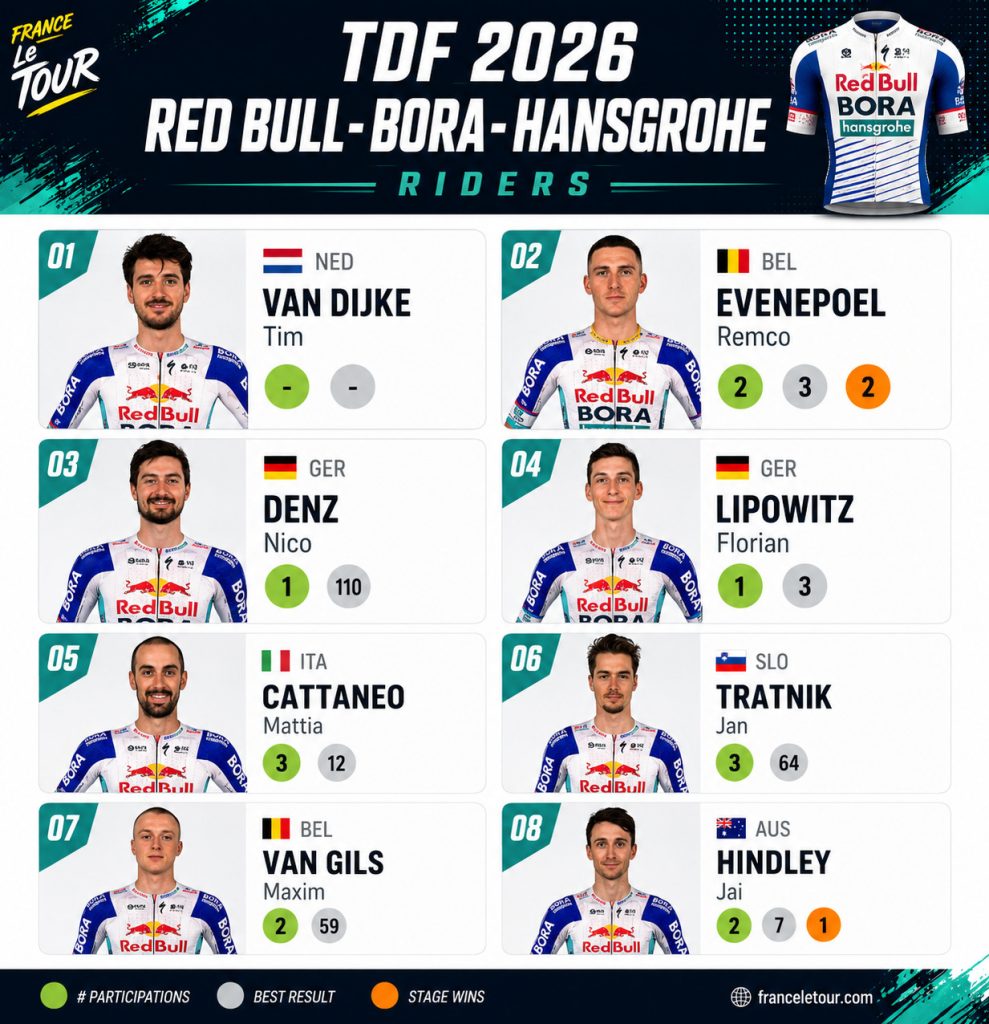
Red Bull – BORA – hansgrohe — Rider by Rider
| Cavalier | Nat | Age | Rôle | Territoire du stade primaire |
|---|---|---|---|---|
| Remco Evenepoel | 🇧🇪 | 26 | GC Co-Leader | TTT · Mountains · Stage 16 ITT |
| Florian Lipowitz | 🇩🇪 | 25 | GC Co-Leader | Mountains · Summit finishes · ITT |
| Jai Hindley | 🇦🇺 | 30 | Mountain Super-Domestique | High mountain finals · Pyrenees |
| Maxim Van Gils | 🇧🇪 | 26 | Puncheur / Stage Hunter | Hilly stages · Mountain support |
| Mattia Cattaneo | 🇮🇹 | 34 | Rouleur / TT Specialist | Flat stages · TTT · Base work |
| Jan Tratnik | 🇸🇮 | 36 | All-Rounder | Hilly stages · Breakaways |
| Nico Denz | 🇩🇪 | 31 | Engine Room / Stage Hunter | Flat stages · TTT · Breakaways |
| Tim van Dijke | 🇳🇱 | 25 | Engine Room / Debutant | Flat stages · TTT · Positioning |
Tour de France History by Rider
| Cavalier | Previous Tours | Tour Stage Wins | Best Tour Result |
|---|---|---|---|
| Remco Evenepoel | 2 | 0 | 3rd overall (2024) |
| Florian Lipowitz | 1 | 0 | 3rd + White Jersey (2025) |
| Jan Tratnik | 5 | 0 | Support role career |
| Mattia Cattaneo | 3 | 0 | Support role career |
| Jai Hindley | 3 | 1 | Stage win Stage 15, 2023 |
| Nico Denz | 2 | 0 | Giro stage winner ×3 |
| Maxim Van Gils | 2 | 0 | Stage hunter |
| Tim van Dijke | 0 | 0 | Debutant |
Remco Evenepoel — The World Champion Who Hasn’t Raced in 60 Days
His credentials are not in question. Double Olympic champion in Paris 2024, road race and time trial on back-to-back days. 2022 World Championship road race. 2022 Vuelta a España winner. 2024 Tour de France third overall. Seven wins before March 2026, including Amstel Gold Race.
His preparation is.
Since Liège-Bastogne-Liège in late April, Evenepoel has not raced. Not a single competitive kilometre. More than 60 days of altitude camps, training blocks, and marginal gains preparation, arriving in Barcelona without the race sharpness that Lipowitz has built across a full spring and early summer. The decision is deliberate: “The goal is to arrive completely fresh,” Evenepoel’s team confirmed. Ralph Denk frames it as “all-in on altitude.”
Whether that gamble pays off depends on a physiological reality that no altitude camp can guarantee: racing sharpness, the edge built through actual competition, through the chaos of pelotons at maximum speed, through sprint finishes and climbing battles where the body adapts not just to effort but to race-specific stimulus, cannot be fully replicated in training. Evenepoel believes he can compensate with peak physical condition. Sixty-plus days without a race stage is the risk.
He is officially team leader, with Lipowitz confirmed as second rider. Denk’s exact words to Het Laatste Nieuws tell a different story: “Remco is still the team leader and Florian Lipowitz is a bit of the second man but in terms of sporting performance, they are on equal footing.”
Equal footing. Not protected. Not predetermined. The road decides.
The Belgian federation suspension risk: An obscure but real pre-Tour threat: the Belgian cycling federation requires every professional licensed in Belgium to ride the elite road national championship. Miss it without a valid exemption, and the rulebook prescribes a nine-day suspension — race days included. Evenepoel’s decision on whether to race the Belgian nationals (or apply for exemption) creates a technical scenario where a nine-day ban could theoretically overlap with the Tour’s opening stages. Red Bull-BORA’s legal team is managing the exemption application. It is the off-bike subplot that could derail the team’s most expensive signing before Stage 1 even begins.
Florian Lipowitz — The Quiet German Who Has Actually Been Stronger All Season
The team spent enormous resources signing Evenepoel for 2026. Then Lipowitz went and finished third at the 2025 Tour, the first Tour podium in team history, at 24 years old, on his Tour debut, with the white jersey confirming him as the race’s best young rider. That performance inverted the hierarchy the transfer budget had assumed.
In 2026, Lipowitz has not stopped. Podiums at Volta a Catalunya, Itzulia Basque Country, and Tour de Romandie before June. Then the Tour of Slovenia: two stage wins and the overall classification, beating the full field by the race’s final weekend. He crossed the Tour of Slovenia queen stage finish line alongside teammate Giulio Pellizzari for a 1-2 that announced he is arriving in Barcelona with race sharpness fully dialled.
His profile is the opposite of Evenepoel’s: patient and consistent rather than explosive. A stage racer who builds through a Grand Tour’s three weeks rather than detonating on one summit and defending. On summit finishes requiring sustained climbing output over 30-40 minutes, Lipowitz’s power curve holds better than Evenepoel’s. On the Stage 16 time trial, Evenepoel’s explosive TT ability likely flips that dynamic. The Tour will play out across both terrain types. Which rider the Alps and the clock favour is the season’s central unanswered question.
Privately: “Lipowitz and Evenepoel say publicly there’s no rift.” Publicly, the team has built a system designed to let the race settle the hierarchy rather than the press conference. That is either cycling’s cleverest co-leadership structure or its most combustible one.
Jai Hindley — Grand Tour Podium Finisher Serving as a Domestique
This is the detail most previews miss entirely.
Jai Hindley is not a journeyman support rider. He won the 2022 Giro d’Italia. He won a stage in the Pyrenees at the 2023 Tour de France. He finished third overall at the 2026 Giro d’Italia, fighting illness mid-race to deliver a Grand Tour podium against a full field that included Vingegaard. He arrives at the 2026 Tour de France with three Grand Tour podiums in his career record.
And he is the super-domestique.
The decision to place a rider of Hindley’s quality in a support role is itself a statement about how deep this Red Bull squad is. Most teams in this peloton would build their Tour campaign around Hindley as a GC leader. Red Bull asks him to pace the Pyrenean climbs, to be the last Red Bull rider at the front of the GC group before the decisive final kilometres, and to absorb whatever Pogačar or Vingegaard throws at the team before Evenepoel or Lipowitz responds.
With Maxim Van Gils still rebuilding form after a spring crash, Hindley plays a specific role in the Pyrenean stages of the first week, where the Col d’Aspin, Col du Tourmalet, and the Gavarnie-Gèdre summit finish test the GC field before the Massif Central and Alps arrive. His ability to stay with the front group at altitude across week one’s climbing, absorbing pace before the decisive selections, is the mountain depth card Red Bull carries that no rival squad matches.
Maxim Van Gils — Stage Winner Ten Days After a Crash
Van Gils crashed seriously in the spring of 2026. He returned at Tour Auvergne-Rhône-Alpes and won a stage from the breakaway within days of his comeback race. That trajectory, crash, recovery, immediate stage win is the form reference Red Bull selected him on.
His profile is Belgian puncheur: dangerous on punchy climbs, able to read breakaways, fast enough in reduced groups to finish on hilly terrain where sprint trains cannot operate. On the 2026 Tour route’s hilly transition stages between the Pyrenees and the Alps, stages where the terrain is hard enough to shatter the peloton but not steep enough to bring the GC leaders to the front, Van Gils is the Red Bull card. He can also contribute mountain support on the Alpine summit finishes, arriving at the base of Alpe d’Huez still capable of producing effort rather than already emptied.
Mattia Cattaneo — The Italian TT Engine in the Background
Cattaneo is 34, Italian, and enters his fourth Tour de France in a role that the race’s broadcast coverage rarely captures but that every GC team depends on: flat-stage control, TTT output, and the valley pace-setting on mountain days that prevents breakaways from gaining dangerous time before the road climbs.
At the 2026 Italian time trial national championships, Cattaneo took bronze, confirming TT form arriving at the Stage 1 Barcelona TTT. With Evenepoel (double Olympic TT champion) setting the standard and Denz, van Dijke, and Tratnik contributing engine work, Cattaneo’s TTT contribution adds the Italian technical precision that has made him a Grand Tour fixture across three different squads.
Jan Tratnik — The Slovenian All-Rounder at His Sixth Tour
Jan Tratnik is 36 and arrives at his sixth Tour de France. The Tour experience he carries, knowing which stage is genuinely dangerous versus which stage looks dangerous, knowing when to let a breakaway go versus when to chase before it becomes a crisis — is institutional knowledge that no coaching session can manufacture.
His profile is all-terrain: hilly breakaways, medium mountain stages, TTT pacing, valley work on Alpine days. The role Tratnik fills is the kind that becomes decisive in stages 10-15, when the race has produced fatigue that young riders haven’t managed before and where his reading of a dangerous move can save Evenepoel or Lipowitz 30 seconds without a single watt of extra output.
Nico Denz — The Engine Room That Can Also Win
Nico Denz has won three Giro d’Italia stages. At the Tour, his role is engine room, flat stage control, TTT output, and the sustained pace-setting that keeps the peloton structured around Red Bull’s positioning in the opening two weeks. But three Giro stage wins establish something important: when the opportunity arrives and the team principal authorises it, Denz can finish. The right breakaway on the right day in weeks one or two could be his window.
“While Denz is a seasoned Grand Tour rider who has already celebrated three Giro stage victories, his role is in the engine room,” the team’s official announcement reads. That framing does not close the door on a stage attempt entirely. It signals that his primary function serves the GC mission and that a secondary function remains available.
Tim van Dijke — Olympic-Level Power on Tour Debut
Tim van Dijke is 25, Dutch, and finished second at the 2026 Omloop Het Nieuwsblad, one of cycling’s classic spring one-day races. He also fractured his collarbone at an altitude training camp. He recovered fully and made his Tour de France debut in Barcelona.
His profile combines road racing intelligence, built through the spring Classics, with the raw power output that a runner-up at Omloop requires. At the Stage 1 team time trial, his engine contributes alongside Cattaneo and Denz to the pace-setting that determines the Red Bull squad’s individual time gaps on the opening day. On the flat stages that follow, his control work keeps Evenepoel and Lipowitz positioned safely through the peloton’s most chaotic moments.
The Dual Leadership Model — Red Bull’s Most Audacious Tour Gamble
Red Bull-BORA-hansgrohe is the only team at the 2026 Tour de France openly telling the world it has two GC leaders with equal standing.
UAE Team Emirates-XRG has Pogačar. If del Toro is climbing with the front group, it is as a tactical weapon for Pogačar, not a co-leader on parallel footing. Visma-Lease a Bike has Vingegaard. Jorgenson helps, not leads. Decathlon CMA CGM has Seixas. Every other team at this Tour knows exactly who their GC rider is and exactly who supports them.
Red Bull does not. Deliberately.
Chief of Sports Zak Dempster states the philosophy: “The Tour is no longer won by an exceptional rider alone, but by an exceptional team. With Remco and Florian, we have two leaders who have already proven they can stand on the Tour podium. Their different strengths give us tactical options that could prove decisive.”
Those tactical options work in specific scenarios. If Pogačar attacks on Stage 19’s Alpe d’Huez and drops Evenepoel, Lipowitz can respond. If Vingegaard gains 40 seconds on Lipowitz at the Stage 16 time trial, Evenepoel can counterattack on Stage 20’s Alpe d’Huez via the Sarenne. Two threats across two different stage types simultaneously. No other team in this race has that capability without committing to a single protected leader.
Sports Director Patxi Vila captures the depth of the cover: “With this team, we have an answer to almost every possible scenario.”
Where it gets complicated: Lipowitz has been the team’s more consistent GC performer across the entire 2026 season. Podiums at Volta a Catalunya, Basque Country, and Romandie, then two stages and the overall at Tour of Slovenia, all while Evenepoel was cracking at the UAE Tour and going silent for 60+ days of training camps rather than racing. The awkward commercial reality is that Red Bull spent enormous money on Evenepoel. The awkward sporting reality is that Lipowitz may be stronger when July arrives.
Denk’s solution is elegant on paper and explosive in practice: “Eventually, there will come a day when one or the other feels better. Then they will have to fight it out between themselves on the road.” That sentence contains a scenario no race director can pre-manage, two riders on the same team, both believing they are protected, both targeting the same podium position, in the final kilometres of an Alpe d’Huez summit finish. The 2026 Tour’s most compelling internal drama is not Pogačar vs. Vingegaard. It is Evenepoel vs. Lipowitz and whether Red Bull can control the fire they have lit.
The no-sprinter decision — explained fully: Meeus, Van Poppel, and Pithie are all at home. The squad has zero pure sprint capability. This is not an accident of squad depth or selection timing. It is a calculated sacrifice: approximately seven flat stage wins given up in exchange for additional mountain depth that serves both GC leaders across the five summit finishes, the Alpe d’Huez double, and every mountain transition day across three weeks.
The calculation only delivers a positive return if Evenepoel or Lipowitz reaches the Tour podium. A team this mountain-heavy without a GC podium result would represent one of the Tour’s most significant strategic failures. Red Bull is betting that two proven podium finishers, one explosive, one consistent, together produce a result that one alone cannot guarantee against Pogačar and Vingegaard.
Can Red Bull-BORA-hansgrohe Beat Pogačar? The 2026 GC Tactical Map
Pogačar has won the last four Tours. Vingegaard won the two before that. Between them, they have shared all twelve podium spots across the last four editions. Breaking into that duopoly requires not just individual quality but tactical innovation — which is precisely what the dual leadership gamble is designed to provide.
Stage 1 TTT in Barcelona — The Opening Salvo
Evenepoel in time trial mode is one of the fastest bikes in the race. Double Olympic TT champion. Stage 16 will be where he targets maximum time from pure climbers. But Stage 1, 19.7km as a team time trial where individual times count, is where Red Bull can immediately establish Evenepoel’s GC advantage over non-specialist climbers before any mountain has appeared. With Cattaneo (bronze at Italian TT nationals), Denz and van Dijke (engine room output), and Hindley and Tratnik contributing solid TTT wattage, the team’s Stage 1 performance could put Evenepoel among the top five individually before the Pyrenees open.
The Pyrenees — Weeks One and Two
Hindley’s specific role is protecting both leaders through the Pyrenean stages that arrive in the first week, Col d’Aspin, Col du Tourmalet, Gavarnie-Gèdre summit finish. These stages are where Grand Tour races sometimes reveal form deficits before anyone expects it. Hindley’s mountain endurance through week one absorbs pace-setting duties that keep Evenepoel and Lipowitz fresh rather than burning early.
Van Gils adds a tactical layer: dangerous enough to go in the right breakaway on hilly Pyrenean stages, capable of stage-hunting while both leaders conserve in the GC group behind.
Stage 16 ITT — Evenepoel’s Biggest GC Opportunity
The 26km individual time trial near Lake Geneva is where Evenepoel’s Olympic-level TT ability should produce maximum gains. Pure climbers, including Vingegaard, whose 2026 season has been focused on climbing form rather than TT speed, typically lose 30-60 seconds to elite TT specialists over this distance. That margin is meaningful in a GC battle where Alpe d’Huez decides the final week.
Stages 19 and 20 — The Decisive Back-to-Back
The back-to-back Alpe d’Huez finishes are where the dual leadership gamble pays its biggest dividend or reveals its fundamental flaw. With both Evenepoel and Lipowitz available as attackers on both days, Pogačar’s team faces a scenario it has not encountered in four Tour wins: covering two simultaneous Red Bull leaders on consecutive summit finishes, each capable of winning.
If Pogačar drops Evenepoel on Stage 19 and then faces Lipowitz attacking on Stage 20 via the Col de Sarenne, the harder of the two approaches, Red Bull’s tactical depth forces Pogačar to make defensive decisions that may not maximize his own time gains. That is the competitive logic behind the dual leadership. Making the strongest rider in the race less efficient, not necessarily beating him outright.
What Bikes Does Red Bull-BORA-hansgrohe Ride at the 2026 Tour de France?
The Specialized partnership is total. Frames, wheels, helmets, shoes, and tyres come from the same Californian brand, the only other WorldTour team with comparable vertical integration is Giant with Jayco AlUla. For Red Bull-BORA-hansgrohe, that integration produces complete optimization across all equipment categories rather than managing compatibility across multiple supplier relationships.
Specialized S-Works Tarmac SL8 — One Bike for Every Road Stage
Specialized’s internal name for the Tarmac SL8 is “One Bike to Rule Them All” and at Red Bull-BORA-hansgrohe, that is not a marketing tagline but an actual fleet management decision. The Tarmac SL8 is used for flat sprint stages, rolling terrain, hilly one-day style stages, and mountain summit finishes. There is no separate climbing model. There is no separate aero model. The SL8’s combination of aerodynamics and low weight, a size 56cm frame at 6.66kg, sitting below the UCI minimum limit, eliminates the terrain-specific bike choice that teams like Giant and Ridley manage across their squads.
The frame uses Specialized’s FACT 12r Carbon, Win Tunnel Engineered aerodynamics, and Rider First Engineered geometry, meaning each frame size receives geometry developed specifically for that size’s rider proportions rather than scaled from a single master template. For Evenepoel at 170cm and Hindley at around 175cm, the geometry difference between their respective sizes is engineered rather than assumed.
The livery is one of the most distinctive in the WorldTour. The “Sticker Slap” design, deep blue base, tone-on-tone graphics that reveal Red Bull logos, BORA text, and hansgrohe branding only as light conditions change, was designed by Specialized’s Lead Concept Graphic Designer Tom Briggs. The result is a bike that looks understated from distance and increasingly elaborate close-up. At 60km/h in a stage finish, it reads as dark blue with the Red Bull wings. Stopped at the team bus, it reveals layers.
Full road stage specification:
- Groupset: SRAM Red AXS wireless electronic — the lightest electronic groupset in the WorldTour, with custom Red Bull-branded crank finish built by Thorsten Wilhelms from SRAM’s Racing department
- Power meters: SRAM Red AXS integrated (crankset-based)
- Wheels: Roval Rapide CLX II/III Team Disc — 51mm depth front, 60mm depth rear (CLX II standard) or 51mm / 48.5mm (CLX III variant for climbing stages). DT Swiss Aerolite II / Arris MTO-255 carbon fiber reinforced BioNylon spokes with titanium end fittings. Ceramic bearings on Roval LF18F (front) and LF19R (rear) hubs. 21mm internal width carbon rims, tubeless-ready
- Tyres: Specialized Turbo Cotton, 26mm — notably narrow given the 35mm external rim width. The team runs some of the narrowest tyres in the WorldTour, prioritizing rolling resistance reduction over the traction advantage of wider rubber
- Cockpit: Roval Rapide integrated bar and stem
- Saddle: S-Works Power with Mirror technology
- Helmets: Specialized S-Works Evade (road stages)
- Shoes: Specialized S-Works Ares
- Computers: Hammerhead Karoo
- Clothing: Sportful
Specialized Shiv TT — Stage 1 and Stage 16
The Specialized Shiv TT is the time trial platform for both Stage 1 (19.7km team time trial in Barcelona, individual times count) and Stage 16 (26km individual TT near Lake Geneva). For Evenepoel, this is his primary GC weapon. Double Olympic gold was won on a time trial bike. The Shiv TT is where his explosive, high-cadence TT style, built through years of track-derived power development, translates into road racing time gaps that accumulate in the general classification.
The Stage 1 Barcelona TTT is Red Bull’s opening opportunity. With Cattaneo (Italian TT nationals bronze), Denz and van Dijke (flat-stage engines), and Hindley and Tratnik contributing clean TTT output, plus Evenepoel potentially delivering the fastest individual split in the race, the team’s Stage 1 result could establish Evenepoel’s GC position before the first Pyrenean climb appears.
The Specialized S-Works Tarmac SL8 in Red Bull-BORA-hansgrohe’s Tour de France “Sticker Slap” livery is produced in a limited annual run of 500 individually numbered bikes.
Red Bull-BORA-hansgrohe Sponsors & Commercial Partners 2026
Three brands share the title sponsorship and each has a distinct relationship with the team’s identity.
Red Bull holds 51% of the team’s ownership structure, a position formalised in January 2024 and rebranded in time for that year’s Tour de France. Beyond financial contribution, Red Bull brings infrastructure: the Athlete Performance Centers in Salzburg and Los Angeles provide sports science access that stretches across all Red Bull-sponsored athletes in multiple disciplines. The training methods, recovery protocols, and performance data generated across Formula 1 drivers, alpine ski racers, and extreme sports athletes feed into how Dan Lorang and the coaching staff prepare Evenepoel and Lipowitz for July.
BORA arrived through a personal relationship that pre-dates the commercial partnership. BORA founder Willi Bruckbauer is a cycling enthusiast who has known Ralph Denk for years — the sponsorship that began in 2015 grew from that personal connection into an international brand awareness platform that neither party could have engineered through a standard commercial process. BORA cooktops and extractors, products that had minimal international recognition before cycling, now appear in showrooms across Europe and Asia alongside the professional team’s results.
Hansgrohe joined when the team reached WorldTour level in 2017, adding the German bathroom fittings manufacturer to a jersey that now carries three German-speaking European industrial brands and one global energy drink empire. The configuration is unusual in the WorldTour, where tech companies and financial services firms dominate title sponsorship. Here, it is German manufacturing and Austrian energy.
Equipment partners: Specialized (bikes, wheels, helmets, shoes, tyres — total supply relationship), SRAM (groupsets and power meters), Sportful (clothing), Hammerhead (computers).
BOSS — the fashion brand — appears on the jersey as official fashion partner, adding a lifestyle dimension to a squad whose marketing strategy increasingly positions around Red Bull’s broader cultural ecosystem rather than pure cycling performance.
Team Management & Staff
Ralph Denk — CEO and Team Manager, founded the team in 2010 after a career that began as an amateur cyclist winning Bavarian regional championships, ran through a four-year stint at SRAM in the 1990s, produced a bike shop in Raubling in 2000, and built the Giant Racing mountain bike team to a 2006 World Cup overall title before Denk’s attention returned to road cycling. Born November 1, 1973, he has managed this team through every name change, from NetApp to Red Bull-BORA-hansgrohe, retaining operational authority as CEO through Red Bull’s acquisition of the majority stake. His stated mission for the team at this stage: “I want to find iconic riders, and the development of young talent is a huge focus for us.”
Zak Dempster — Chief of Sports is the strategic architect of the 2026 Tour campaign, the person who designed the dual leadership structure, made the decision to leave all three sprinters at home, and assembled the eight-rider squad around the specific GC and mountain demands of the 2026 route. His Tour framing: “The Tour is no longer won by an exceptional rider alone, but by an exceptional team.”
Patxi Vila — Sports Director for Tour de France is the race-day voice on team radio across 21 stages. Vila’s role is tactical execution: managing the road hierarchy when the race creates situations the pre-agreed plan cannot cover — which, with two co-leaders on the same team, will happen before the Alps finish. His confidence going in: “With this team we have an answer to almost every possible scenario.”
Dan Lorang — Head of Performance and Coaching oversees training periodization and physical preparation across the squad. Lorang’s integration with the Red Bull Athlete Performance Centre infrastructure is what differentiates Red Bull-BORA’s coaching approach from most WorldTour squads, cross-sport performance science from disciplines with longer marginal gains histories than professional cycling.
Red Bull-BORA-hansgrohe at the Tour de France — 13 Editions, One Growing Mission
2014: Tour debut as NetApp-Endura, a ProTeam wildcard. The same year BORA announces as sponsor for 2015. The team is two years from WorldTour status.
The name progression that follows: BORA-Argon 18 → BORA-hansgrohe (2017, WorldTour) → Red Bull-BORA-hansgrohe (2024). Each name change marks a structural upgrade, not just a commercial switch.
Key Tour milestones across 13 editions: Peter Sagan’s five Tour stage wins and two green jerseys during his five years with the team (2017-2021). Jordi Meeus winning Stage 21 on the Champs-Élysées in 2023. Florian Lipowitz’s 2025 third overall and white jersey — the first GC podium in team history at the Tour, delivered by a 24-year-old on his debut, produced by the very development system Denk built from a Bavarian bike shop.
Beyond the Tour: Jai Hindley winning the 2022 Giro d’Italia. Primož Roglič won the 2024 Vuelta a España. Those results make Red Bull-BORA-hansgrohe the only team besides UAE and Visma to have won a Grand Tour in the past three seasons.
In 2026, for the first time, they arrive at the Tour with two riders who have personally stood on its podium, Evenepoel (third, 2024) and Lipowitz (third, 2025), starting together as acknowledged co-leaders. Whether Ralph Denk’s bet on collective tactical strength over individual hierarchy produces the team’s first Tour de France podium in yellow — or produces the season’s most dramatic internal confrontation — is what 21 stages across three weeks in France will decide.
Foire aux questions
Red Bull-BORARed Bull-BORA-hansgrohe’s confirmed 2026 Tour squad is Remco Evenepoel, Florian Lipowitz (co-leaders), Jai Hindley, Maxim Van Gils, Mattia Cattaneo, Jan Tratnik, Nico Denz, and Tim van Dijke. The squad was announced on June 26 — seven changes from the 2025 Tour roster. No sprinter was selected. Van Dijke is the only Tour debutant.
Remco Evenepoel is a 26-year-old Belgian professional cyclist who rides for Red Bull-BORA-hansgrohe. He is a double Olympic champion — winning both the road race and individual time trial at the 2024 Paris Olympics — as well as the 2022 World Championship road race winner and 2022 Vuelta a España winner. He finished third at the 2024 Tour de France, his first Tour appearance. He started 2026 with seven wins including Amstel Gold Race before entering a 60-plus day racing hiatus in preparation for July.
Florian Lipowitz is a 25-year-old German professional cyclist who finished third overall at the 2025 Tour de France — the first Tour podium in Red Bull-BORA-hansgrohe’s history — winning the white jersey for best young rider. In 2026, he arrived in Barcelona as co-leader after a consistent spring that included GC podiums at Volta a Catalunya, Itzulia Basque Country, Tour de Romandie, and the overall at the Tour of Slovenia.
Both riders finished third at the last two Tour editions and offer different strengths — Evenepoel is more explosive in time trials, Lipowitz is more consistent across three weeks. Chief of Sports Zak Dempster stated their complementary skill sets give the team tactical options against rivals. Team manager Ralph Denk confirmed the road will decide: “Eventually, there will come a day when one or the other feels better. Then they will have to fight it out between themselves.”
Jai Hindley is a 30-year-old Australian who won the 2022 Giro d’Italia and finished third at the 2026 Giro despite illness. He has also won a Tour de France stage — Stage 15 at the 2023 Tour. At the 2026 Tour, Hindley serves as mountain super-domestique for co-leaders Evenepoel and Lipowitz. His three Grand Tour podiums make him the most experienced mountain support rider on the team.
Primož Roglič won the 2024 Vuelta a España with Red Bull-BORA-hansgrohe. He is not included in the 2026 Tour de France squad. His exclusion reflects the team’s decision to build the 2026 Tour campaign entirely around Evenepoel and Lipowitz as the two GC leaders, with no room in the eight-rider squad for a third GC rider of Roglič’s profile.
The deliberate exclusion of sprinters reflects a strategic decision to maximize climbing depth for both GC leaders rather than contesting flat bunch sprint stages. The entire eight-rider squad is built around mountain support for Evenepoel and Lipowitz across the Tour’s five summit finishes, the back-to-back Alpe d’Huez stages, and the overall GC battle.
Maxim Van Gils is a 26-year-old Belgian puncheur who crashed seriously in the spring of 2026 and returned at Tour Auvergne-Rhône-Alpes, where he won a stage from the breakaway within days of his comeback. At the 2026 Tour, he provides mountain support for Evenepoel and Lipowitz and serves as an attacking option on hilly transition stages.
The Specialized S-Works Tarmac SL8 is Red Bull-BORA-hansgrohe’s primary race bike, used for all road stages. A size 56cm frame weighs 6.66kg, below the UCI minimum limit. The Tour configuration runs SRAM Red AXS wireless groupset, Roval Rapide CLX II/III Team wheels with ceramic bearings, and Specialized Turbo Cotton 26mm tyres.
SRAM Red AXS is SRAM’s flagship wireless electronic groupset — the lightest electronic shifting system available in the WorldTour. AXS refers to the wireless protocol connecting the shifter buttons to the front and rear derailleurs electronically rather than through mechanical cables. The groupset integrates with a power meter for real-time wattage data.
Roval is Specialized’s performance wheel brand, supplying Red Bull-BORA-hansgrohe across both road and time trial disciplines. The Tour configuration uses Roval Rapide CLX II or CLX III Team wheelsets with DT Swiss carbon spokes, ceramic hub bearings, and 21mm internal carbon rims designed for tubeless tyre compatibility.
The white jersey is awarded to the best-placed rider in the general classification who is 25 years old or younger at the start of the race. Florian Lipowitz won the white jersey at the 2025 Tour de France — his debut — finishing third overall. At 25, Lipowitz is still eligible for the white jersey at the 2026 Tour. At 26, Evenepoel is not.
A dual leadership structure means two riders on the same team have equal protected status in the general classification. In practice, dual leadership requires the road to eventually designate the stronger rider, at which point the other accepts a subordinate role. Red Bull-BORA-hansgrohe’s approach is to let the race’s natural selection make the decision rather than pre-assigning it.
Tim van Dijke is a 25-year-old Dutch professional cyclist making his Tour de France debut in 2026. He finished second at the 2026 Omloop Het Nieuwsblad. He fractured his collarbone at an altitude training camp during preparation and recovered fully before the Tour start. At the Tour, he serves in the engine room alongside Nico Denz — flat stage control, TTT output, and peloton positioning for Evenepoel and Lipowitz.
Red Bull-BORA-hansgrohe has competed at the Tour de France since 2014, entering its 13th edition in 2026. Key results include Peter Sagan’s five Tour stage wins and two green jerseys, Jordi Meeus winning Stage 21 on the Champs-Élysées in 2023, and Florian Lipowitz’s third overall plus white jersey in 2025 — the team’s first-ever GC podium at the Tour.
Ralph Denk founded the team in 2010 as Team NetApp, working from Raubling, Bavaria. Red Bull acquired a 51% controlling stake in January 2024, with Denk retaining his CEO and Team Manager role. He remains the team’s operational head and public face.
Red Bull holds a 51% controlling stake, acquired in January 2024. Beyond ownership, Red Bull contributes performance infrastructure: Athlete Performance Centers in Salzburg and Los Angeles provide sports science, nutrition, recovery technology, and cross-sport training methodology developed across Red Bull’s portfolio of elite athletes.
Title sponsors are Red Bull (51% owner), BORA (German cooktop manufacturer, sponsor since 2015), and hansgrohe (German bathroom fittings, sponsor since 2017). Equipment partners: Specialized (bikes, wheels, helmets, shoes, tyres), SRAM (groupsets), Sportful (clothing), Hammerhead (computers).
Red Bull-BORA-hansgrohe operates two development programmes: grenke-Auto Eder (junior team, founded by Ralph Denk in 2007) and the Red Bull-BORA-hansgrohe Rookies programme (U23 development squad, launched for 2025). Florian Lipowitz’s development through the team’s internal system is the most public example of the pipeline’s output.
The Belgian cycling federation requires every professional cyclist holding a Belgian licence to compete in the elite national road championship. Missing the race without a formally approved exemption triggers a nine-day suspension. Evenepoel’s decision on the Belgian national championships in late June 2026 created a scenario where, if no exemption was approved, a nine-day ban could theoretically overlap with the Tour de France’s opening stages. Red Bull-BORA-hansgrohe’s legal and administrative team was managing the exemption application before the Tour announcement.
Contenu connexe
- → [1re étape du Tour de France 2026 : Contre-la-montre par équipes à Barcelone — Présentation complète]
- → [Itinéraire du Tour de France 2026 : les 21 étapes expliquées]
- → [Liste complète des partants du Tour de France 2026 : les 23 équipes et les 184 coureurs]
- → [Team Visma | Lease a Bike : Guide complet du Tour de France 2026]
- → [Uno-X Mobility: Tour de France 2026 Complete Guide]
- → [NSN Cycling Team: Tour de France 2026 Complete Guide]
- → [Team Jayco AlUla: Tour de France 2026 Complete Guide]
Last updated: July 23, 2026. Start list confirmed. Belgian federation exemption status current as of publication. Live stage results, GC standings, and breaking news updated throughout the race.