Tour de France Femmes 2026 Stage 3: Geneva to Poligny — the Race Leaves Switzerland Fighting
Updated: 4:10 am CEST - Monday, 3 August 2026
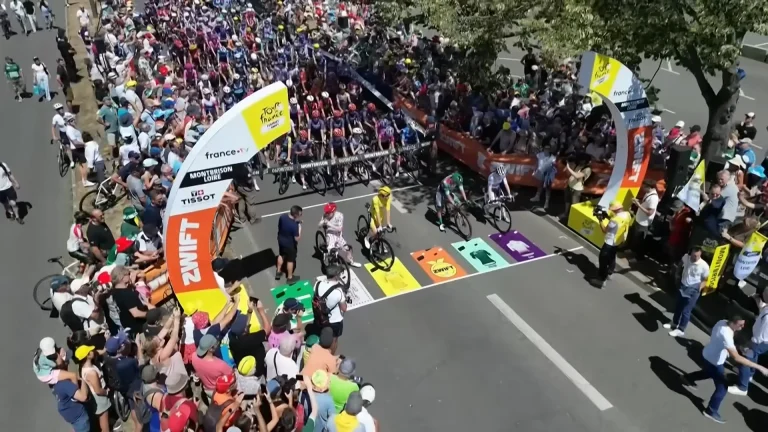
Stage 3 of the Tour de France Femmes 2026 is a 156.5-kilometre stage from Geneva to Poligny on Monday 3 August, carrying the race’s hardest climb yet, the Col de la Faucille, 11.4 kilometres at 6.3%, inside the first quarter of the route, followed by three more categorised tests before a flat run into the Jura wine country. The neutralised start rolls out from the Plaine de Plainpalais at 13:25 CEST, with the finish expected around 17:40.
This is the stage the Grand Départ Suisse has been building toward. Three days in Switzerland end here, at the moment the race crosses into France and finally hits terrain that isn’t just difficult but genuinely dangerous for the overall standings. Lorena Wiebes leads by 14 seconds over Kim Le Court-Pienaar and 16 over Demi Vollering — gaps thin enough that a well-organised split on the Faucille, or a breakaway with the right riders in it, could do real damage to the top of the general classification for the first time in this race.
TL;DR
- What is Stage 3? A 156.5km stage from Geneva to Poligny on Monday 3 August, featuring four categorised climbs including the race’s first Category 1 test, before a flat final 25 kilometres.
- What just happened? Lorena Wiebes won Stage 2 for her second straight victory, surviving a late solo effort from Riejanne Markus. Her 10-second bonus extends her overall lead to 14 seconds over Kim Le Court-Pienaar and 16 over Demi Vollering.
- Why does Stage 3 matter? It’s the first stage where SD Worx-Protime can’t simply control the race for a bunch sprint. The Col de la Faucille is hard enough to split the peloton, and with gaps this tight, today is genuinely capable of reshaping the GC.
Tour de France Femmes 2026 Stage 3 key facts
| Detail | Confirmed data |
|---|---|
| Stage number | 3 of 9 — first stage in France |
| Date | Monday, 3 August 2026 |
| Start | Geneva — Plaine de Plainpalais |
| Finish | Poligny, Jura, France (via the D905) |
| Distance | 156.5 km |
| Elevation gain | ~2,300–2,500m |
| Neutralised start | 13:25 CEST |
| Est. finish | ~17:40 CEST |
| Highest point | Col de la Faucille summit, 1,323m |
| Sprints | Champagnole (km 100.7, points only); Chilly-sur-Salins (km 132.4, bonus seconds 6/4/2) |
How Stage 2 changed the maths
Lorena Wiebes made it two wins from two on Sunday, though this one came with far more drama than her opening-day sprint. Riejanne Markus went clear roughly 40 kilometres from the finish in Geneva and very nearly made it stick, holding an advantage that fluctuated between 25 and 50 seconds for the better part of an hour while SD Worx-Protime committed rider after rider to the chase. Anna van der Breggen did the early work; Lotte Kopecky took over in the closing kilometres, dragging Markus’s lead down to just 12 seconds before swinging off with 2 kilometres to go. Other teams’ sprint trains finally reeled Markus in with under 500 metres remaining, and Wiebes, isolated by that point but perfectly positioned, launched a long sprint to win by several bike lengths over Elisa Balsamo and Marianne Vos.
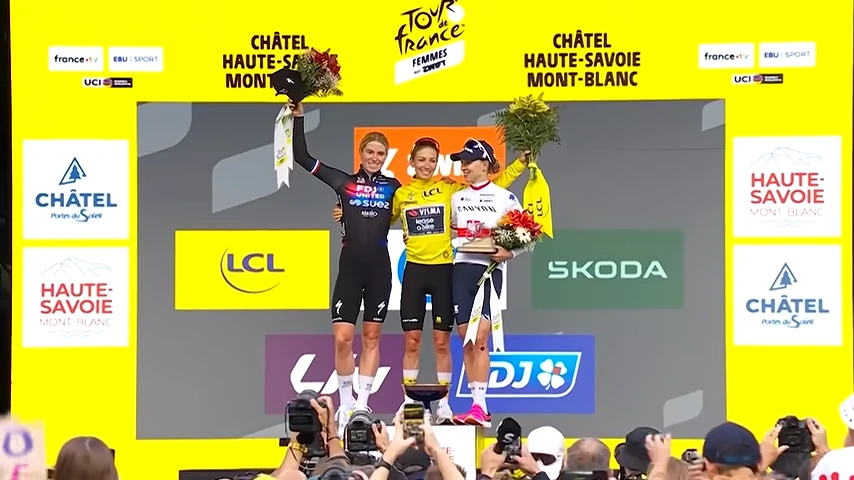
It was Wiebes’s seventh career Tour de France Femmes stage win, and a small but genuine first: she’d worn the yellow jersey once before, after the opening stage of the very first modern edition in 2022, but Sunday was the first time she’d actually won a stage while wearing it. The 10-second bonus that came with the victory stretched her overall lead to 14 seconds over Kim Le Court-Pienaar and 16 over Demi Vollering, margins that held comfortably across two sprinter-friendly days, but which face a genuinely different test today.
See the complete stage 2 results.
Why this is the first stage GC teams can’t relax
Everything about Stage 3’s profile works against the kind of controlled, predictable racing that’s defined the opening two days. The Col de la Faucille is long and hard enough to genuinely split the peloton on its own merits — not just soften it up, but actually separate riders by ability. A gap of 14 or 16 seconds is not a safe cushion against a climb like that, particularly with a bonus sprint offering 6, 4, and 2 seconds later in the stage and another intermediate sprint offering points earlier on. Any GC rider who can put a teammate or two into an early break, then attack over the Faucille or Savine summits themselves, has a real chance of taking meaningful time back today in a way that simply wasn’t available on Stages 1 or 2.
The Stage 3 route: leaving Switzerland, into the Jura
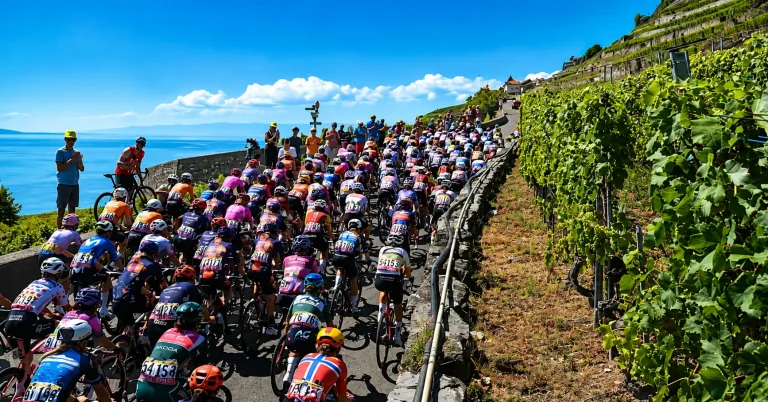
The stage departs the Plaine de Plainpalais in central Geneva and heads north, crossing into France after roughly four kilometres near the Pays de Gex. From there, the road climbs almost immediately, and doesn’t stop being difficult for the best part of 130 kilometres.
Col de la Faucille — the hardest climb of the race so far
Category 1 | 11.4km | 6.3% average | summit 1,323m | km 23.9
This is the race’s first Category 1 ascent and, by a clear margin, the toughest test any rider has faced so far this Tour. It begins in earnest after the peloton passes through Gex, climbing steadily to 1,323 metres, comfortably the highest point of the entire stage. The descent that follows is short, offering barely any recovery before the next climb begins.
Côte de Lajoux — no time to recover
Category 3 | 3.6km | 5.6% | km 36
Lajoux arrives almost directly off the Faucille descent, by which point the peloton has covered just 36 kilometres and already tackled the overwhelming majority of the day’s total elevation gain. It’s an ideal launch point for any rider or team looking to establish a breakaway before the terrain eases.
Col de la Savine and the long run to Champagnole
Category 2 | 5.6km | 5.1% | km 73.1
After a stretch of flat-to-rolling roads following Lajoux, the Col de la Savine provides the day’s last genuinely selective test. Once its summit is past, the hardest climbing of the stage is behind the peloton, and a long descent carries the race toward the intermediate sprint at Champagnole.
Chaux-Champagny and the run to the bonus sprint
Category 4 | 1.8km | 6.4% | km 131.8
The Côte de Chaux-Champagny is steepest at its base rather than its summit, which makes it feel harder in the legs than its modest category suggests. What makes it tactically significant is what comes immediately after: the Chilly-sur-Salins bonus sprint, offering 6, 4, and 2 seconds to the first three riders through, arrives just 600 metres beyond the summit — genuine, GC-relevant time on offer for anyone still fighting for position this late in the stage.
From there, the route runs essentially flat for the final 25 kilometres into Poligny, through Arbois and the edge of the Jura’s wine country.
TDF Femmes stage 3 Full verified climb profile
| Climb | Category | km marker | Distance | Avg gradient |
|---|---|---|---|---|
| Col de la Faucille | Cat. 1 | 23.9 | 11.4 km | 6.3% |
| Côte de Lajoux | Cat. 3 | 36 | 3.6 km | 5.6% |
| Col de la Savine | Cat. 2 | 73.1 | 5.6 km | 5.1% |
| Côte de Chaux-Champagny | Cat. 4 | 131.8 | 1.8 km | 6.4% |
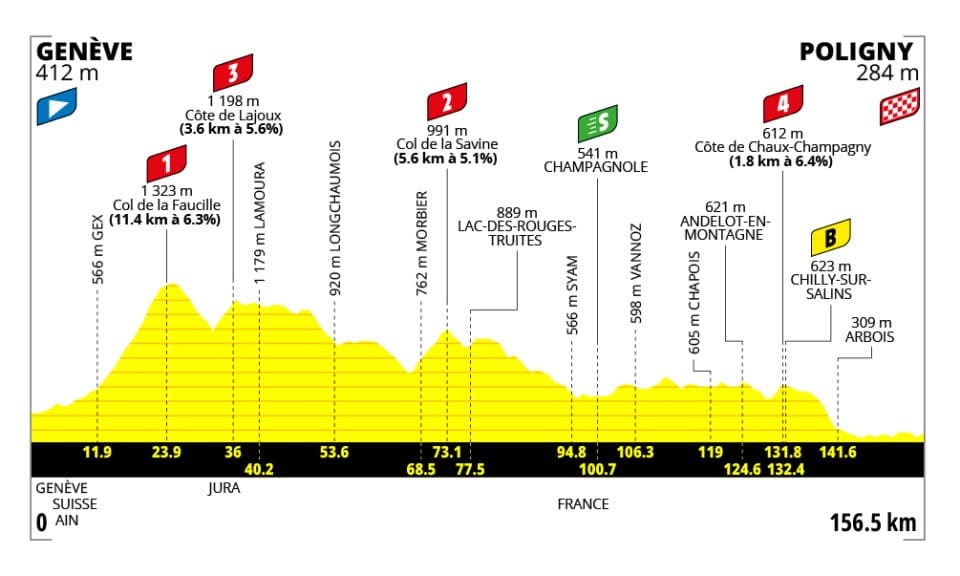
All four categorised climbs are done by kilometre 131.8, leaving a flat run of roughly 25 kilometres into Poligny, enough distance that a bunch sprint remains genuinely possible unless a breakaway’s advantage is already decisive by the base of Chaux-Champagny.
Breakaway or bunch sprint? The tactical picture
Baroudeuses, the breakaway specialists this kind of stage is built for, have real reason to target the Faucille as their launch point, given how early and how hard it arrives. But the maths cuts both ways: SD Worx-Protime has now demonstrated twice in two days that they can organise and sustain a long chase when they need to, and a flat final 25 kilometres gives any pursuing bunch plenty of road to close a gap that isn’t already decisive. The likeliest outcome sits somewhere between the two extremes, a hard-fought morning that thins the front group considerably, followed by a reduced group sprint rather than either a pure bunch finish or a clean breakaway victory.
Stage 3 winner and GC prediction
Pauline Ferrand-Prévot, the defending champion, and Demi Vollering, already sitting third overall and just 16 seconds back, both have obvious reason to make this stage difficult rather than defensive. Paula Blasi, Kasia Niewiadoma-Phinney, Elisa Longo Borghini, and Marianne Vos round out the strongest tier of GC-calibre riders capable of exploiting the terrain. One name worth watching for reasons beyond pure form: Evita Muzic, a Jura native racing through roads she likely knows better than anyone else in the peloton — the kind of local knowledge that can matter enormously on a stage where positioning before the key climbs counts for as much as raw climbing ability.
The CERN connection
At kilometre 8.9 of the route, the peloton passes directly over Cessy, a small French village that happens to sit above the Large Hadron Collider, the most powerful particle accelerator ever built. CERN’s flagship experiment, running beneath the France-Switzerland border in this exact area, confirmed the existence of the Higgs boson in 2012. It’s a genuinely unusual landmark for a bike race to pass directly above, and one that essentially no other Stage 3 preview mentions at all.
Evita Muzic: racing through home roads
Most previews list Evita Muzic among the stage’s contenders without further comment. She deserves more than that today. As a rider from the Jura, this stage takes her through roads she would have ridden long before turning professional, a genuine home-terrain advantage on a stage where knowing exactly where the road ramps up, where it flattens, and where positioning matters most before the Faucille could be worth real seconds over a rider seeing the terrain for the first time.
World start times — key moments converted
| Moment | CEST (France/Switzerland) | BST (UK) | EDT (USA) | AEST (Australia) |
|---|---|---|---|---|
| Neutralised start | 13:25 | 12:25 | 07:25 | 21:25 |
| Col de la Faucille summit | ~14:23 | ~13:23 | ~08:23 | ~22:23 |
| Champagnole intermediate sprint | ~16:16 | ~15:16 | ~10:16 | ~00:16 +1 |
| Estimated finish | 17:40 | 16:40 | 11:40 | 01:40 +1 |
Schedule — France, UK, USA & Australia Time Zones
Times below use the official pace range (40 km/h fast, 36 km/h slow). UK is one hour behind CEST (BST); US Eastern is six hours behind (EDT); Australia is eight hours ahead (AEST).
| Point | Distance to Finish | CEST (France) | BST (UK) | EDT (USA East) | AEST (Australia) |
|---|---|---|---|---|---|
| Start — Geneva | 156.5 km | 13:25 | 12:25 | 07:25 | 21:25 |
| Col de la Faucille | 132.6 km | 14:21–14:25 | 13:21–13:25 | 08:21–08:25 | 22:21–22:25 |
| Côte de Lajoux | 120.5 km | 14:39–14:45 | 13:39–13:45 | 08:39–08:45 | 22:39–22:45 |
| Col de la Savine | 83.4 km | 15:35–15:47 | 14:35–14:47 | 09:35–09:47 | 23:35–23:47 |
| Finish — Poligny | 0 km | 17:40–18:06 | 16:40–17:06 | 11:40–12:06 | 01:40–02:06+1 |
+1 indicates the following calendar day in Australia.
Most Crucial Viewing Window
Best join point: Col de la Faucille, roughly 133 km to go (CEST 14:21–14:25 / BST 13:21–13:25 / EDT 08:21–08:25 / AEST 22:21–22:25). This is the climb that decides who’s even in contention for the breakaway — early, hard, and exactly where the day’s real story starts.
If you can only catch one stretch, stay through from Col de la Savine (CEST 15:35–15:47) all the way to the finish — with significant descending making any chase difficult, this is where a gap either gets defended successfully or gets clawed back, and it’s genuinely uncertain which happens first this week.
Given how comprehensively the breakaway-friendly terrain is being flagged across every preview, this feels like the stage most likely to hand Wiebes her first non-win of the race — worth watching from well before the finish rather than joining late.
How to watch and road closures
Broadcast: France Télévisions and France 2 carry the stage free in France. Spanish viewers have Teledeporte and RTVE Play free. Eurosport and HBO Max cover the race across the rest of Europe, with TNT Sports carrying UK coverage. See the detailed regional broadcast guide.
Road closures to know if you’re travelling to watch: Gex sees closures from 10:00 to 15:00, with the caravan passing around 12:50 and the peloton expected near 14:03. Lajoux closes from 13:00 to 16:00. Morez has restrictions from 11:30 until around 16:00. Chaux-Champagny closes from as early as 10:00 given its position late in the stage.
Spectator guide — the Col de la Faucille experience
The Faucille summit is set up as a genuine spectator destination in its own right, with a giant screen showing live race coverage, a local produce market, and refreshment stands, worth building a day around if you’re travelling to watch rather than just finding a spot along the road. Given the climb’s length and its position as the race’s hardest test so far, expect a serious crowd and arrive with plenty of time before the peloton is due.
The Jura: Comté, Vin Jaune, and a region already worth knowing
This exact stretch of the Jura, Arbois, the Comté-producing highlands, the Vin Jaune wine country, is some of the richest food terrain the Tour touches all year, covered in depth elsewhere for the region’s connection to the men’s race. What’s specific to today’s route is Morez, a town shaped for two centuries first by clockmaking and then by the eyewear industry; it has its own eyewear museum, and Julbo, a partner of the Groupama-FDJ United team, calls the area home. Clément Berthet, who turned professional in 2020 after starting out in cross-country skiing, comes from this exact village and is married to fellow professional cyclist Juliette Labous.