
Tour de France Femmes 2026 Stage 2: Aigle to Geneva — Five Hills, Then the Sprinters Take Over
Updated: 4:00 am CEST - Sunday, 2 August 2026
Stage 2 of the Tour de France Femmes 2026 is a 147.9-kilometre stage from Aigle to Geneva on Sunday 2 August, carrying five categorised climbs inside the first hundred kilometres before forty largely flat kilometres run the peloton home along the shore of Lake Geneva to the Quai du Mont-Blanc. Neutralised start is 14:20 CEST, with the finish expected around 17:47.
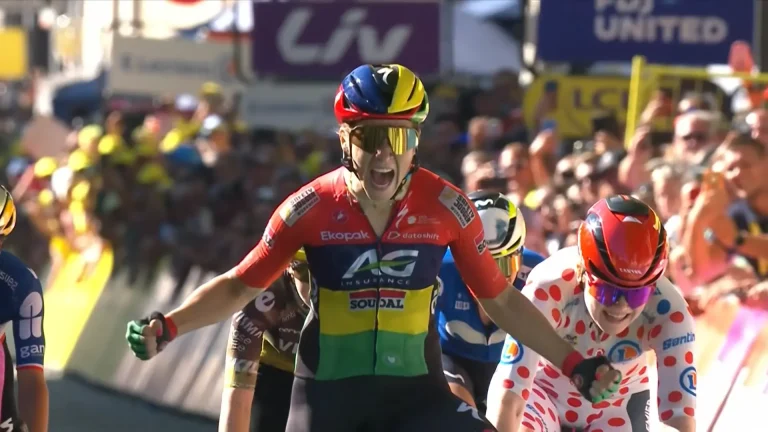
Lorena Wiebes starts the day in yellow, and how she got there matters for reading Stage 2 correctly. Stage 1’s finish into Lausanne was billed as flat and turned out to be anything but, a punchy 2.5-kilometre climb at 4.6% with barely 400 metres of flat road after it, hard enough that Charlotte Kool and Lotte Kopecky were both distanced before the finish. Demi Vollering attacked with 700 metres to go, trying to catch Wiebes cold. It nearly worked. Wiebes closed the gap, held her position through Kim Le Court-Pienaar’s follow-up move, and still had enough left to win the sprint. If she could survive that finish, Stage 2’s five climbs, smaller, more spread out, with 42 clear kilometres of flat road after the last of them, should suit her even more.
TL;DR
- What is Stage 2? A 147.9km stage from Aigle to Geneva on Sunday 2 August, with five categorised climbs in the first 100km and a flat, largely uneventful final 40km built for a bunch sprint finish at the Quai du Mont-Blanc.
- What just happened? Lorena Wiebes won Stage 1’s tricky uphill finish into Lausanne, surviving a late attack from Demi Vollering to take the first yellow jersey of the race. She leads Kim Le Court-Pienaar by 4 seconds and Vollering by 6.
- Why does Stage 2 matter? It’s the first genuinely sprinter-friendly stage of the race, and since the finish is expected to be a bunch sprint rather than a selective climb, most of the tight gaps from Stage 1 should carry through largely unchanged — making the stage win and any bonus seconds on offer the real story of the day.
TDF Femmes 2026 Stage 2 key facts
| Detail | Confirmed data |
|---|---|
| Stage number | 2 of 9 — Tour de France Femmes 2026 |
| Date | Sunday, 2 August 2026 |
| Start | Aigle (home of the UCI and World Cycling Centre) |
| Finish | Geneva — Quai du Mont-Blanc |
| Distance | 147.9 km |
| Elevation gain | ~1,696–1,800m |
| Neutralised start | 14:20 CEST |
| Est. finish | ~17:47 CEST |
| Intermediate sprint | Lavigny, km 88.9 |
| Stage type | Flat / bunch sprint expected |
How Stage 1 actually played out — and why it changes today
Lorena Wiebes won Stage 1 in a finish nobody was entirely sure she’d survive. The stage into Lausanne carried an official “flat” designation that fooled almost nobody paying attention, four categorised climbs whittled the peloton down well before the finale, and the closing 2.5-kilometre ascent at 4.6% removed several fast finishers outright. Charlotte Kool lost contact on the Côte de Villars-le-Comte. Lotte Kopecky, one of SD Worx’s own alternative cards if Wiebes couldn’t hold on, was dropped on the Côte de Vulliens that followed.
Wiebes made it to the base of the final climb in the front group, which was already most of the job done. The finish itself produced real drama: Demi Vollering launched a surprise attack with around 700 metres remaining, trying to catch the sprinters isolated before they could organise. Kim Le Court-Pienaar followed her move. Wiebes had to grit through and close the gap herself, with support from teammate Anna van der Breggen earlier in the final kilometre, before opening her own sprint with the finish line in sight. Neither Vollering nor Le Court-Pienaar could respond. Wiebes crossed the line clear, taking her tenth career Tour stage win, her 132nd professional victory, and the first yellow jersey of this year’s race — a jersey she’d previously worn only once before, after the very first stage of the modern Tour de France Femmes back in 2022.
The overall standings this produced are tight enough that Stage 2’s outcome genuinely matters for more than just the stage win:
| Pos | Rider | Team | Gap |
|---|---|---|---|
| 1 | Lorena Wiebes | SD Worx-Protime | Leader |
| 2 | Kim Le Court-Pienaar | AG Insurance-Soudal | +4s |
| 3 | Demi Vollering | FDJ United-SUEZ | +6s |
| 5 | Noemi Rüegg | EF Education-Oatly | — |
| 6 | Niewiadoma Kasia | UAE Team L’IMAD | — |
| 7 | Elisa Longo Borghini | Canyon-SRAM | — |
| 8 | Pauline Ferrand-Prévot | Visma-Lease a Bike | +10s |
| 10 | Marlen Reusser | Movistar | +10s |
A few names from that list carry their own stories into today. Reusser, one of the pre-race GC favourites, crashed with 21.3 kilometres still to race on Stage 1 but got back up and finished safely in the bunch, keeping her Tour alive and her position inside the top ten intact. Pauline Ferrand-Prévot, defending her 2025 title, looked comfortable through the finale and the sprint despite finishing outside the front group’s bonus seconds, not a bad opening statement from a rider some doubted could handle a punchy uphill finish. Laura Tomasi, meanwhile, became the first rider to abandon this year’s race after an earlier crash on the same stage.
Because Stage 2 is expected to end in a genuine bunch sprint rather than a selective climbing finish, most of these gaps, four seconds here, six there, should survive the day largely intact. The one thing that can move them is bonus seconds: if anyone other than the current top three wins today’s stage, or if the GC contenders are caught out positioning for the sprint, small changes at the top are entirely possible even on a stage nobody expects to reshape the overall race.
The route: five hills PROFILES, then Lake Geneva flat to the line
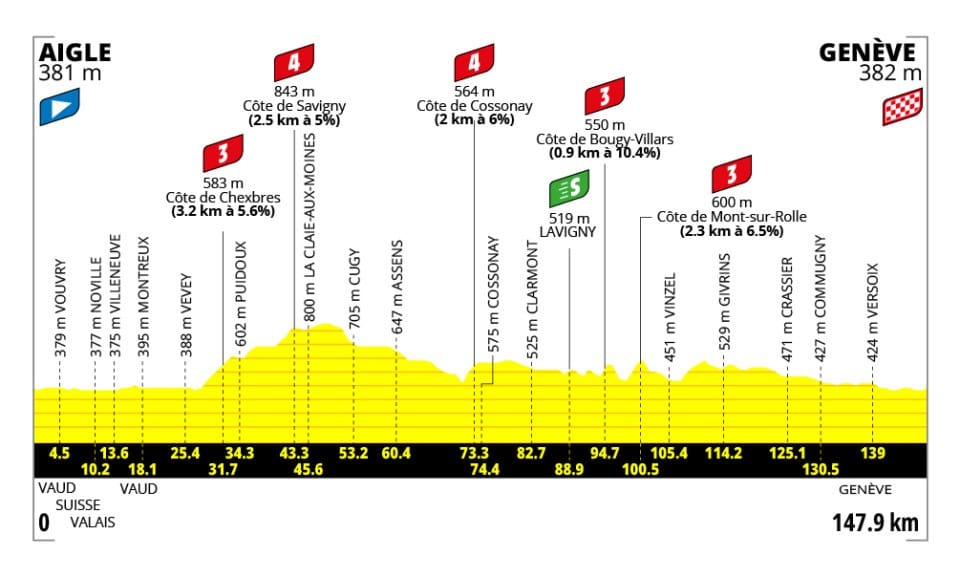
The direct road from Aigle to Geneva along the lakeshore is barely a challenge at all, which is exactly why the route avoids it. Instead, Stage 2 sends the peloton up into the hills above the lake for the first hundred kilometres before finally letting the sprinters’ teams take control.
Aigle: starting from the home of world cycling
The stage departs from Aigle, home to both the Union Cycliste Internationale’s headquarters and the World Cycling Centre, a genuine landmark for anyone following the sport closely, and the starting point for a race that will spend its first three days entirely on Swiss roads before crossing into France.
Côte de Chexbres — the same roads as Stage 1, reversed
Category 3 | 3.2km | 5.6% average | km 31.7
After skirting briefly into the canton of Valais and back into Vaud, the race reaches Lake Geneva’s shore around the 13.6-kilometre mark and follows it before climbing away from the water through the vineyard terraces above Chexbres. The climb reuses roughly ten kilometres of Stage 1’s own route, ridden in the opposite direction, a small but genuine connective thread between the race’s first two days.
Côte de Savigny and Côte de Cossonay — the middle test
Côte de Savigny: Category 4 | 2.5km | 5% | km 43.3 Côte de Cossonay: Category 4 | 2km | 6% | km 73.3
Neither climb is hard enough to threaten a genuine selection on its own, but together with everything around them, they keep the day honest through its middle third, after the route turns west away from Lausanne.
The closing double-test: Bougy-Villars into Mont-sur-Rolle
Côte de Bougy-Villars: Category 3 | 0.9km | 10.4% average | km 94.7 Côte de Mont-sur-Rolle: Category 3 | 2.3km | 6.5% | km 100.5
This is the stage’s real selection point, and it arrives in two parts back to back. The Côte de Bougy-Villars is brutally short and brutally steep, under a kilometre long but averaging over ten percent, the kind of ramp that punishes anyone caught out of position more than it rewards raw climbing ability. It’s followed almost immediately by the longer, steadier Côte de Mont-sur-Rolle. Together, they’re the last real chance for anything to happen before the sprinters’ trains take over completely.
The unclassified climb
After Mont-sur-Rolle, there’s one more rise that doesn’t appear on most route summaries at all: a four-kilometre, uncategorised climb cresting with 37 kilometres still to race. It won’t decide the stage, but it’s real elevation gain that the headline climb count misses entirely.
From there, the route is almost entirely downhill or flat, crossing briefly into Geneva’s canton with 14 kilometres to go before a short loop back into Vaud and the final run along the lakeshore. The last eight kilometres trace the water’s edge into Geneva itself, finishing on the Quai du Mont-Blanc.
Stage 2 Full verified climb profile
| Climb | Category | km marker | Distance | Avg gradient |
|---|---|---|---|---|
| Côte de Chexbres | Cat. 3 | 31.7 | 3.2 km | 5.6% |
| Côte de Savigny | Cat. 4 | 43.3 | 2.5 km | 5% |
| Côte de Cossonay | Cat. 4 | 73.3 | 2 km | 6% |
| Côte de Bougy-Villars | Cat. 3 | 94.7 | 0.9 km | 10.4% |
| Côte de Mont-sur-Rolle | Cat. 3 | 100.5 | 2.3 km | 6.5% |
| Unclassified climb | — | ~111 | 4 km | — |
The last classified summit sits 42 kilometres from the finish, comfortably enough for anyone briefly distanced to fight their way back before the sprint begins in earnest.
Stage 2 winner prediction
Lorena Wiebes enters as the clear favourite, and Stage 1 only strengthened the case. If she can survive a genuine uphill sprint finish against a select group, five smaller, well-spaced climbs followed by 42 clean kilometres of flat road should suit her considerably more than yesterday’s course did. Charlotte Kool and Elisa Balsamo, both proven on uphill-adjacent finishes at the Giro d’Italia, represent the strongest alternative cards if Wiebes’ team can’t fully control the finale, though Kool’s own struggles on Stage 1’s climbs are a mark against her heading into another hilly day, even one this much easier at the finish.
Jersey implications beyond yellow
Wiebes arrives at this Tour defending her green jersey title from previous editions, and a stage built almost entirely around a bunch sprint finish is exactly the kind of day that campaign depends on; both the stage win itself and the points on offer at the intermediate sprint in Lavigny carry real weight for that classification. The mountains competition, meanwhile, is already spoken for in the short term: Nikola Nosková mathematically secured the first polka dot jersey of this year’s race after winning the QOM points on Stage 1, and with only Category 3 and 4 climbs on offer today, that jersey isn’t likely to change hands regardless of how Stage 2 unfolds.
Geneva and the 1990 connection
Geneva’s most recent connection to a major stage race before this Tour de France Femmes visit dates back to 1990, when the Tour de Romandie, Switzerland’s other great national stage race, started in Moutier and finished in the city, won by France’s Charly Mottet. It’s a smaller footnote than Lausanne’s own cycling pedigree, but a real one, and it means Sunday’s finish adds a genuine chapter to Geneva’s cycling history rather than writing on a blank page.
Switzerland’s second Grand Départ — and why it matters
This year’s race marks only the second time the modern Tour de France Femmes, the 2022-revival version of the race, has started outside French borders, following Rotterdam’s Grand Départ in 2024. It’s a fitting way to open the race’s fifth and most demanding edition yet: a record 1,175 kilometres across nine stages, with a record total elevation gain of 18,795 metres, building toward Mont Ventoux’s first-ever Tour de France Femmes summit finish later in the race and a grand finale in Nice on 9 August.
World start times — key moments converted
| Moment | CEST (France/Switzerland) | BST (UK) | EDT (USA) | AEST (Australia) |
|---|---|---|---|---|
| Neutralised start | 14:20 | 13:20 | 08:20 | 22:20 |
| Côte de Chexbres | ~15:12 | ~14:12 | ~09:12 | ~23:12 |
| Lavigny intermediate sprint | ~16:28 | ~15:28 | ~10:28 | ~00:28 +1 |
| Estimated finish | 17:47 | 16:47 | 11:47 | 01:47 +1 |
Schedule — France, UK, USA & Australia Time Zones
Times below use the official pace range (45 km/h fast, 41 km/h slow). UK is one hour behind CEST (BST); US Eastern is six hours behind (EDT); Australia is eight hours ahead (AEST, no daylight saving in August).
| Point | Distance to Finish | CEST (France/Swiss) | BST (UK) | EDT (USA East) | AEST (Australia) |
|---|---|---|---|---|---|
| Start — Aigle | 147.9 km | 14:20 | 13:20 | 08:20 | 22:20 |
| Côte de Savigny (Cat.3) | 104.6 km | 15:28–15:33 | 14:28–14:33 | 09:28–09:33 | 23:28–23:33 |
| Côte de Cossonay | 74.6 km | 16:08–16:17 | 15:08–15:17 | 10:08–10:17 | 00:08–00:17+1 |
| Côte de Bougy-Villars (10.4%) | 53.2 km | 16:36–16:49 | 15:36–15:49 | 10:36–10:49 | 00:36–00:49+1 |
| Côte de Mont-sur-Rolle | 47.4 km | 16:44–16:57 | 15:44–15:57 | 10:44–10:57 | 00:44–00:57+1 |
| Finish — Geneva | 0 km | 17:47–18:06 | 16:47–17:06 | 11:47–12:06 | 01:47–02:06+1 |
+1 indicates the following calendar day in Australia.
These cover the moments that actually matter for planning your viewing — the full kilometre-by-kilometre schedule runs to roughly 80 timing points.
Weather on the shores of Lake Geneva
Expect warm, largely dry conditions typical of the region in early August, with temperatures likely reaching into the high twenties to low thirties Celsius by the finish. Check closer to the stage itself for a fully confirmed forecast, since conditions around the lake can shift quickly.
Spectator guide — Aigle to Geneva
The Chexbres vineyard climb: Genuinely scenic as well as tactically significant, the road climbs directly through the Lavaux terraces, a UNESCO World Heritage vineyard landscape, with Lake Geneva visible below for much of the ascent.
The Quai du Mont-Blanc finish: Classic bunch-sprint atmosphere, with the lake as a backdrop and enough length on the finishing straight for the sprinters’ trains to properly organise before the final effort.
Vaud and Geneva — food and culture
The Lavaux vineyard terraces the race climbs through at Chexbres are a UNESCO World Heritage Site in their own right, producing crisp Chasselas white wines that define this stretch of the Lake Geneva shoreline. Further along the route, Swiss staples like fondue and raclette remain the regional standard, while Geneva itself carries a food identity distinct from the rest of French-speaking Switzerland — shaped as much by its international, cosmopolitan population as by traditional Swiss cuisine.