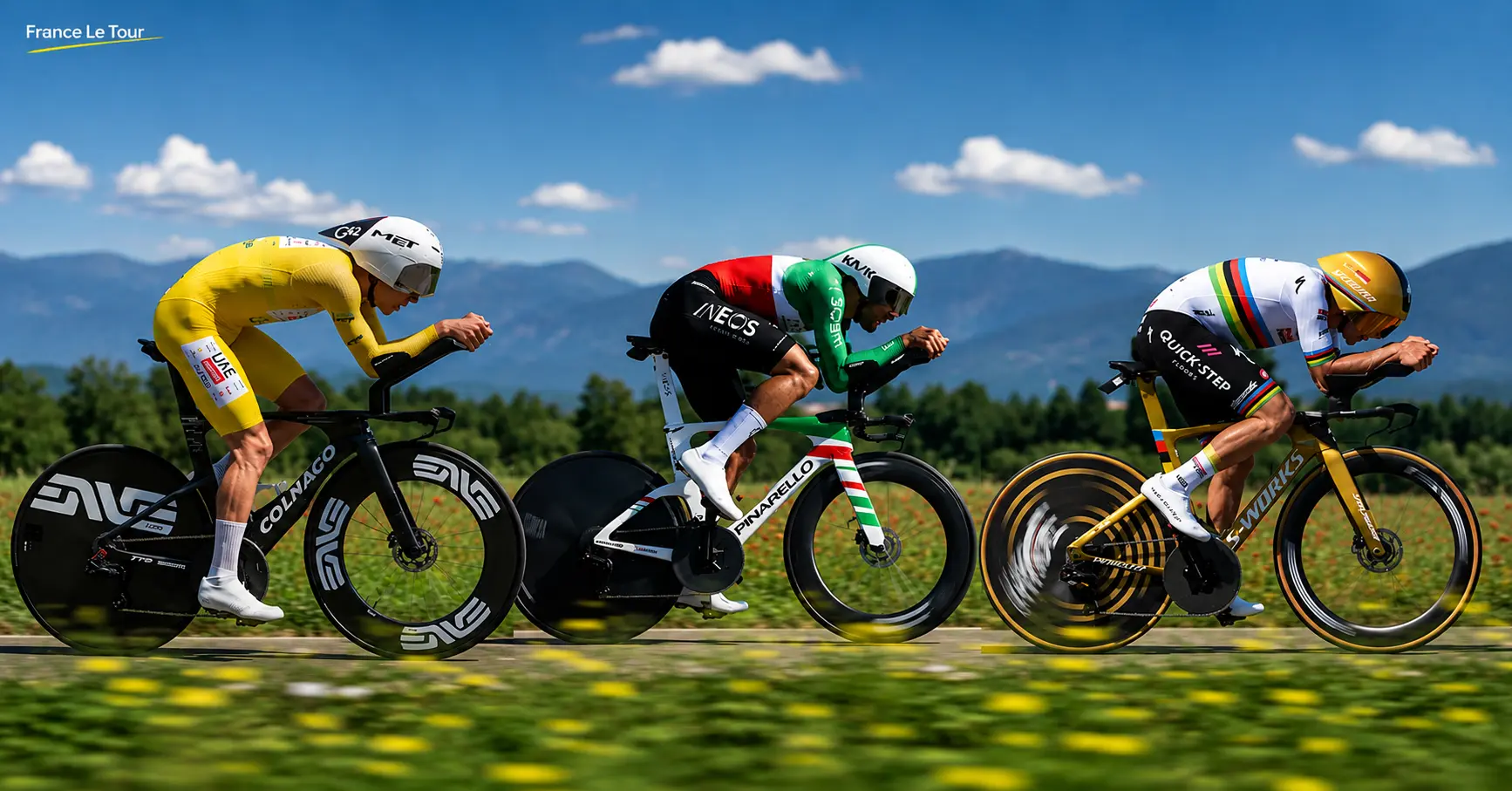
Tour de France 2026 Stage 16: The Time Trial That Decides Who Joins Pogačar on the Podium
Last updated: 7:40 am CEST - Tuesday, 21 July 2026
Stage 16 of the Tour de France 2026 is a 26.1-kilometre individual time trial from Évian-les-Bains to Thonon-les-Bains on Tuesday 21 July, split almost exactly into thirds: a 9.7-kilometre climb to the Côte de Larringes, a technical descent back to Lake Geneva, and a flat run to the finish at the Château de Ripailles. Kamil Gradek starts first at 13:00 CEST. Tadej Pogačar starts last, at 17:15 CEST, with the stage expected to finish around 17:50.
Three days ago, this was a time trial with a settled outcome shape: Evenepoel’s course, Pogačar protecting a lead, Vingegaard trying to claw back what he could. Then Vingegaard crashed out of the race entirely on Stage 15, a fractured collarbone, surgery scheduled, his 2026 Tour over on a roundabout in Bonneville with twenty kilometres left to race. What was going to be a formality is now something else: a genuinely open scrap for second, third, and fourth place, decided by a course that happens to reward exactly the kind of rider fighting for those places.
TL;DR
- What is Stage 16? A 26.1km individual time trial on Tuesday 21 July, from the spa town of Évian-les-Bains to Thonon-les-Bains on Lake Geneva. One-third climb (Côte de Larringes, 9.7km at 4.3%), one-third technical descent, one-third flat. Pogačar starts last at 17:15 CEST; estimated finish 17:50.
- Why does it matter now? Jonas Vingegaard’s crash and withdrawal on Stage 15 leaves the provisional podium wide open behind Pogačar. Evenepoel holds 2nd at +5:00, del Toro 3rd at +5:58, Seixas 4th at +6:23, Lipowitz 5th at +6:48 — gaps small enough, on a course built for pure time-trialling, to genuinely reshuffle by the finish.
- Who wins? Evenepoel is the clear favourite for the stage itself — three-time world ITT champion, on a course several riders have called tailor-made for his engine. The more interesting question is what happens below him.
Stage 16 key facts
| Detail | Confirmed data |
|---|---|
| Stage number | 16 of 21 |
| Date | Tuesday, 21 July 2026 |
| Type | Individual time trial |
| Start | Évian-les-Bains |
| Finish | Thonon-les-Bains (Château de Ripailles) |
| Distance | 26.1 km |
| Elevation gain | ~500m |
| Route structure | 1/3 climb, 1/3 descent, 1/3 flat |
| Key climb | Côte de Larringes — Cat. 2, 9.7km at 4.3%, summit ~799m |
| First starter | Kamil Gradek (Bahrain Victorious), 13:00 CEST |
| Last starter | Tadej Pogačar (race leader), 17:15 CEST |
| Est. finish | ~17:50 CEST |
| Start intervals | 90 seconds, narrowing to 2 minutes for the final 15 riders |
What changed on Stage 15 — and why it rewrites this stage
Jonas Vingegaard crashed roughly 20 kilometres from the finish of Stage 15, clipping a kerb as the peloton came out of a roundabout in Bonneville on the approach to the Plateau de Solaison. He fractured his collarbone, picked up multiple abrasions, and was helped into the medical car with his arm in a sling. Surgery has since been scheduled. His Tour ended there, sitting second overall, four minutes and thirty seconds behind Pogačar.
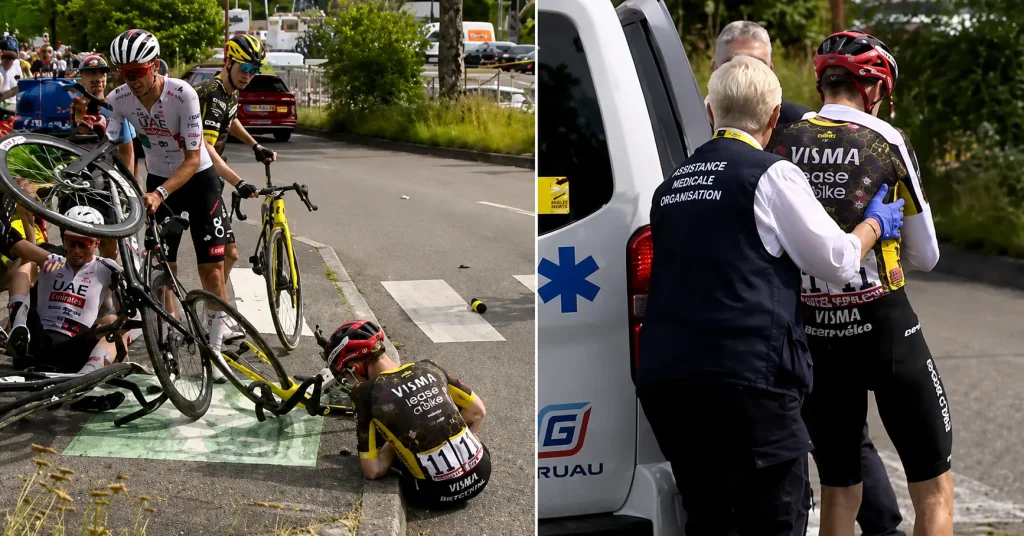
That single crash also caught Isaac del Toro, who went down in the same incident but got back up and finished third on the stage — a result that jumped him from seventh to third overall. Sepp Kuss, Vingegaard’s teammate, was another to fall, losing significant time getting back to the group.
The scale of what this removes from the race is worth sitting with for a second. Pogačar and Vingegaard had finished first and second at the Tour in four consecutive editions between 2021 and 2024, splitting the wins two apiece. Whatever happens in the final week now, this Tour won’t be decided by that rivalry — it’s decided by whoever fills the vacancy Vingegaard left behind. Remco Evenepoel, who beat both Pogačar and del Toro to the stage win on Solaison itself, inherited second place in the process. Pogačar’s own reaction afterward was short and unusually personal: he said he was “really sad to see” his rival go out that way.
For Stage 16, none of this changes what the course does. It changes everything about what the result means.
The route: one-third climb, one-third descent, one-third flat
Tour director Christian Prudhomme’s own description of Stage 16 is “an explosive cocktail”, a phrase that undersells how deliberately built this course is. It isn’t a flat time trial with a hill bolted on. It’s three genuinely distinct efforts stitched into one ride, and how a rider manages the transitions between them matters almost as much as raw power in any one section.
The direct road along the lake from Évian to Thonon is only 11 kilometres and barely rises. ASO sent the route up into the hills instead, on purpose, because the flat road wouldn’t have made for a race.
Côte de Larringes — the section that decides the stage
Category 2 | 9.7km | 4.3% average | summit ~799m
The climb starts almost immediately out of Évian-les-Bains and runs for 9.7 kilometres at a sustained 4.3%, not steep, not punchy, just relentlessly consistent. That consistency is the whole point. A climb this even doesn’t reward a rider who can produce a short, violent effort. It rewards a rider who can hold an enormous, stable power number for half an hour without the gradient ever giving them a reason to back off.
That’s precisely why every source covering this stage names Remco Evenepoel as the standout favourite. He isn’t primarily a climber, but a sustained 4.3% gradient at time-trial pace is a different discipline entirely from an alpine wall, and it plays directly into the aerodynamic, high-cadence engine that’s made him a three-time world time trial champion. Aurélien Paret-Peintre put it plainly before the stage: this is a course that “really suits the three best specialists in this type of effort,” naming Pogačar, Evenepoel, and Paul Seixas as the riders built for exactly this test.
The descent and the technical section to Pont de la Douceur
From the Larringes summit, the road drops back toward the lake — a technical descent where line choice and braking confidence matter as much as raw speed. This is where a rider on the limit can lose more time through hesitation than they gained on the climb through power. It’s also the section least discussed in most previews, which is a mistake: a time trial is won and lost as much in the sections where riders are afraid to commit as in the ones where they’re flat out.
The flat run to Thonon-les-Bains
With roughly nine kilometres remaining, the terrain flattens out completely for the run into Thonon. The final five kilometres bring seven corners, and the last 300 metres tick up at 4% into the finish at the Château de Ripailles — not the pure drag-race conclusion a “flat finish” might suggest. A rider arriving here with nothing left in the legs will lose time in these corners that a fresher rider simply won’t.
Podium mathematics — the real story of Stage 16
This is where Stage 16 stops being a stage and starts being a referendum on four riders’ provisional Paris podium.
| Pos | Rider | Team | Gap to Pogačar | Gap to rider above | Rough TT tier |
|---|---|---|---|---|---|
| 2 | Remco Evenepoel | Red Bull-BORA-hansgrohe | +5:00 | — | ★★★★★ |
| 3 | Isaac del Toro | UAE Team Emirates-XRG | +5:58 | 58s | ★★★ |
| 4 | Paul Seixas | Decathlon CMA CGM | +6:23 | 25s | ★ |
| 5 | Florian Lipowitz | Red Bull-BORA-hansgrohe | +6:48 | 25s | ★★ |
| 6 | Juan Ayuso | Lidl-Trek | +7:25 | 37s | ★★★ |
Look at that table properly and a specific, defensible story appears. Del Toro’s grip on the final podium spot looks fairly secure against Seixas; the gap is only 25 seconds, but Seixas is rated among the weakest pure time-trialists in this entire group, while del Toro carries a moderate rating of his own. That gap should hold, maybe even grow.
It looks far less secure against Juan Ayuso. He’s 1 minute 27 seconds back from del Toro’s third place, but he’s rated in the same time-trial tier, meaning the gap is the kind that a strong day and a slightly-off day can close over 26 kilometres. Ayuso is the quiet threat in this stage, not because anyone’s talking about him, but because the numbers say he should be.
Then there’s the battle nobody’s framing correctly: Seixas at fourth, Lipowitz twenty-five seconds behind at fifth. Seixas is rated the weakest time-triallist of the group. Lipowitz is rated a tier above him. Twenty-five seconds over 26 kilometres, between a poor time-triallist and a moderate one, is not a gap that should survive the day. If there’s one position on this GC that looks most likely to change hands purely on ability rather than form or luck, it’s this one.
Stage winner and podium prediction
The stage win: Evenepoel. Three world time-trial titles, a course built for sustained power rather than explosive climbing, and a direct quote from the man himself before the stage, “I will try to go again for a stage”, that reads less like hope and more like a plan. Pogačar remains a real threat given his own form and Aurélien Paret-Peintre naming him among the three riders this course suits, but he doesn’t need to empty himself to protect a five-minute lead, and that changes how he’ll ride the final kilometres compared to a rider who genuinely needs every second.
The podium reshuffle: Lipowitz to move ahead of Seixas into provisional fourth. The gap is small, the ability gap in the other direction, and Red Bull-BORA-hansgrohe’s own stated priority, getting Evenepoel onto the Paris podium, with Lipowitz as the team’s second card, gives Lipowitz total license to ride flat out for himself today, since there’s no domestique role to play in a solo effort. Keep half an eye on Ayuso too. He’s further back than Lipowitz, but the ability-tier math says he’s capable of a result that looks surprising on paper and isn’t surprising at all once you’ve seen the numbers.
Equipment: why nobody swaps bikes for the climb
A time trial with 500 metres of climbing built in raises an obvious question: does anyone switch to a lighter road bike for the Côte de Larringes, then back to a TT bike for the flat sections? The teams have already answered that. Sports director Yannick Talabardon laid out the stage’s structure and the logic in the same breath: “There are nine kilometres of climbing, eight kilometres of descent and nine kilometres of flat terrain so it’s quite a comprehensive time trial. There’s no point in changing bikes for the climb.”
The 4.3% average on the Larringes simply isn’t steep enough to justify the time lost in a bike change, or the aerodynamic penalty of riding a road bike on the flat two-thirds of the course. Every serious GC contender will ride the same TT machine start to finish, accepting a small climbing penalty in exchange for never sacrificing aerodynamics on the sections where it matters most.
Wind: the variable starting order doesn’t fix
Time trials are usually framed as pure, apples-to-apples tests: same course, same conditions, whoever’s fastest wins. Stage 16 complicates that slightly. The forecast has the wind rotating through the afternoon: north-westerly shifting to northerly at Évian, south-easterly shifting to north-easterly at Thonon. Riders start in reverse GC order, which means the biggest names, Pogačar, Evenepoel, del Toro, ride the course hours after the early starters, in wind conditions that won’t be identical to what those early riders faced.
It’s a small variable, and it cuts in unpredictable directions rather than obviously favouring one rider or another. But it’s a real one, and it’s the kind of detail worth knowing before over-interpreting a time gap between a rider who started at 13:00 and one who started at 17:15.
Full start order and key GC times
| Rider | Team | Start time (CEST) |
|---|---|---|
| Kamil Gradek | Bahrain Victorious | 13:00 (first starter) |
| Juan Ayuso | Lidl-Trek | 17:05 |
| Florian Lipowitz | Red Bull-BORA-hansgrohe | 17:07 |
| Paul Seixas | Decathlon CMA CGM | 17:09 |
| Isaac del Toro | UAE Team Emirates-XRG | 17:11 |
| Remco Evenepoel | Red Bull-BORA-hansgrohe | 17:13 |
| Tadej Pogačar | UAE Team Emirates-XRG | 17:15 (last starter) |
Riders start in reverse general classification order, which is why the current top of the standings rolls down the ramp last, in the tightest two-minute intervals of the day.
⏱️ Tour de France Stage 16 ITT – Featured Riders Start Times
| Rider | 🇬🇧 UK (BST) | 🇫🇷 France (CEST) | 🇺🇸 US EDT | 🇺🇸 US PDT | 🇦🇺 Australia (AEST) |
|---|---|---|---|---|---|
| Joshua Tarling | 12:25:30 | 13:25:30 | 07:25:30 | 04:25:30 | 21:25:30 |
| Filippo Ganna | 12:58:30 | 13:58:30 | 07:58:30 | 04:58:30 | 21:58:30 |
| Mads Pedersen | 13:54 | 14:54 | 08:54 | 05:54 | 22:54 |
| Luke Plapp | 14:01:30 | 15:01:30 | 09:01:30 | 06:01:30 | 23:01:30 |
| Mathieu van der Poel | 14:18 | 15:18 | 09:18 | 06:18 | 23:18 |
| Victor Campenaerts | 14:19:30 | 15:19:30 | 09:19:30 | 06:19:30 | 23:19:30 |
| Tobias Foss | 15:06 | 16:06 | 10:06 | 07:06 | 00:06 (+1) |
| Brandon McNulty | 15:40:30 | 16:40:30 | 10:40:30 | 07:40:30 | 00:40:30 (+1) |
| Tom Pidcock | 15:59 | 16:59 | 10:59 | 07:59 | 00:59 (+1) |
| Lenny Martinez | 16:01 | 17:01 | 11:01 | 08:01 | 01:01 (+1) |
| Juan Ayuso | 16:05 | 17:05 | 11:05 | 08:05 | 01:05 (+1) |
| Florian Lipowitz | 16:07 | 17:07 | 11:07 | 08:07 | 01:07 (+1) |
| Paul Seixas | 16:09 | 17:09 | 11:09 | 08:09 | 01:09 (+1) |
| Isaac del Toro | 16:11 | 17:11 | 11:11 | 08:11 | 01:11 (+1) |
| Remco Evenepoel | 16:13 | 17:13 | 11:13 | 08:13 | 01:13 (+1) |
| Tadej Pogačar | 16:15 | 17:15 | 11:15 | 08:15 | 01:15 (+1) |
Stage 16 ITT – Start Order by Session
| Start Window | 🇬🇧 UK (BST) | 🇫🇷 France (CEST) | 🇺🇸 US EDT | 🇺🇸 US PDT | 🇦🇺 Australia (AEST) |
|---|---|---|---|---|---|
| Opening riders | 12:00–12:58 | 13:00–13:58 | 07:00–07:58 | 04:00–04:58 | 21:00–21:58 |
| Second session | 13:00–13:58 | 14:00–14:58 | 08:00–08:58 | 05:00–05:58 | 22:00–22:58 |
| Third session | 14:00–14:58 | 15:00–15:58 | 09:00–09:58 | 06:00–06:58 | 23:00–23:58 |
| GC contenders begin | 15:00–15:59 | 16:00–16:59 | 10:00–10:59 | 07:00–07:59 | 00:00–00:59 (+1) |
| Final 8 riders | 16:01–16:15 | 17:01–17:15 | 11:01–11:15 | 08:01–08:15 | 01:01–01:15 (+1) |
Final Eight Riders (GC Showdown)
| Order | Rider | 🇬🇧 UK | 🇫🇷 France | 🇺🇸 EDT | 🇺🇸 PDT | 🇦🇺 AEST |
|---|---|---|---|---|---|---|
| 159 | Lenny Martinez | 16:01 | 17:01 | 11:01 | 08:01 | 01:01 (+1) |
| 160 | Mattias Skjelmose | 16:03 | 17:03 | 11:03 | 08:03 | 01:03 (+1) |
| 161 | Juan Ayuso | 16:05 | 17:05 | 11:05 | 08:05 | 01:05 (+1) |
| 162 | Florian Lipowitz | 16:07 | 17:07 | 11:07 | 08:07 | 01:07 (+1) |
| 163 | Paul Seixas | 16:09 | 17:09 | 11:09 | 08:09 | 01:09 (+1) |
| 164 | Isaac del Toro | 16:11 | 17:11 | 11:11 | 08:11 | 01:11 (+1) |
| 165 | Remco Evenepoel | 16:13 | 17:13 | 11:13 | 08:13 | 01:13 (+1) |
| 166 | Tadej Pogačar | 16:15 | 17:15 | 11:15 | 08:15 | 01:15 (+1) |
Time cut explained
Individual time trials use a percentage-based time cut rather than the flat time-gap rule seen on mass-start stages. Riders finishing outside a set percentage of the stage winner’s time, recalculated based on the average speed and difficulty of the specific stage, risk elimination from the race, though race organisers frequently show leniency on time trials for riders clearly riding within themselves to save energy rather than genuinely struggling. For sprinters and domestiques with no GC stake in Stage 16, the objective today is simple: get round inside the cut, lose as little energy as possible, and save whatever’s left for the Alps.
Évian-les-Bains and Thonon-les-Bains: what the record actually shows
Évian-les-Bains has one of the odder footnotes in Tour history. Every early edition of the race started in Paris — until 1926, when organisers broke that pattern without ever fully explaining why, and sent the Grand Départ to this fashionable lakeside spa town instead. The most repeated theory ties it to the Aga Khan, a regular and hugely influential visitor to Évian’s social scene at the time, who may simply have wanted the spectacle brought to him. Nobody has ever confirmed it. The 1926 Tour that followed remains, to this day, the longest in the race’s history: 5,745 kilometres across just seventeen stages, of which only 41 of the 126 starters finished.
Évian’s other notable Tour connection is often mischaracterised. The town hosted the start of the 1979 Stage 15 individual time trial to Morzine-Avoriaz — 54 kilometres, won by Bernard Hinault. The detail that usually gets simplified or garbled is what that win actually did: Hinault didn’t take the yellow jersey in Évian. He already had it, from an earlier time trial win in Brussels, and this ITT simply extended a lead he was defending on his way to his second Tour title.
Thonon-les-Bains carries its own quieter history. In 1981, Sean Kelly won the 231-kilometre Stage 15 into Thonon, a hilly stage rather than a bunch sprint, contested on the road rather than settled by raw speed. What’s easy to miss is that Thonon didn’t just host a finish that year; it hosted the start of the very next stage too, sending the peloton on toward Morzine the following morning. Two Tour connections in one town, back to back, in the same edition.
Stage 16 start times around the world
| Time zone | Region | Pogačar’s start | Est. finish |
|---|---|---|---|
| CEST (UTC+2) | France, Germany, Italy | 17:15 | ~17:50 |
| BST (UTC+1) | United Kingdom, Ireland | 16:15 | ~16:50 |
| EDT (UTC-4) | New York, Miami | 11:15 | ~11:50 |
| CDT (UTC-5) | Chicago, Dallas | 10:15 | ~10:50 |
| PDT (UTC-7) | Los Angeles, Seattle | 08:15 | ~08:50 |
| IST (UTC+5:30) | India | 20:45 | ~21:20 |
| AEST (UTC+10) | Sydney, Melbourne | 01:15 +1 | ~01:50 +1 |
Because this is a time trial, results roll in continuously from 13:00 CEST — the early, non-GC starters finish hours before the final group. If you only want the GC-deciding action, joining from around 16:00 CEST / 15:00 BST covers the entire top-20 start window through to the finish.
How to watch Stage 16 live
| Region | Free option | Paid / full coverage |
|---|---|---|
| France | France Télévisions — free, all stages | France.tv, L’Équipe TV |
| Spain | Teledeporte and La 2 (RTVE Play) — free | — |
| United Kingdom | Channel 5 — free highlights only | TNT Sports / HBO Max — live |
| Australia | SBS — free, all stages live | SBS On Demand |
| USA | — | Peacock Premium; FloBikes live from 6:50am–12:20pm ET |
| Canada | — | FloBikes / FloSports |
| Rest of world | Eurosport (check local availability) | Discovery+ / Max in select markets |
See the complete regional live streaming guide for stage 16. If you want real-time positioning updates, you can follow our stage 16 ITT live stats and live timeline commentary updating every rider every minute.
Spectator guide — watching a time trial in person
An ITT is a genuinely different spectating experience from a mass-start stage. Instead of one peloton passing once, individual riders come through every 90 seconds across more than four hours, meaning the same spot rewards patience rather than a single dramatic moment.
Côte de Larringes: The best place to actually see the effort a time trial demands. On a mass-start stage a climb like this barely registers; ridden alone, flat out, against the clock, it looks like a completely different sport.
Pont de la Douceur (the descent): For anyone who wants to watch line choice and braking under pressure rather than raw power, this technical section is the more interesting watch of the two non-flat thirds.
Thonon-les-Bains finish: The closest thing to a mass-start atmosphere Stage 16 offers, since the GC contenders arrive within minutes of each other late in the afternoon, the one window all day where the crowd will actually feel like a Tour de France crowd rather than a scattered audience for a solo athlete.
Haute-Savoie and Lake Geneva — spa towns and local food
Évian and Thonon share the Haute-Savoie food and lake culture already covered in detail for Stage 15’s finish at the Plateau de Solaison — Tartiflette, Beaufort, Génépy, the Aravis cheese country just inland from the lake. What’s specific to these two towns is the water and the spa heritage: Évian’s mineral water needs no introduction, drawn from the same aquifer the town has built its identity around since the 18th century, while Thonon’s old town and lakeside promenade carry a quieter, less commercialised version of the same belle-époque spa-town character. Both towns are an easy add-on for anyone basing in the region across Stage 15 and Stage 16 — Lake Geneva itself, with its boat trips and lakeside restaurants, ties the two days together far more naturally than a plain route map would suggest.
FAQ — Tour de France 2026 Stage 16
What happened to Jonas Vingegaard at the Tour de France?
Jonas Vingegaard crashed approximately 20 kilometres from the finish of Stage 15, clipping a kerb after a roundabout in Bonneville. He fractured his collarbone and sustained multiple abrasions, and has since had surgery scheduled. He withdrew from the race while sitting second overall, ending his 2026 Tour.
Who is the favourite to win Stage 16 of the Tour de France 2026?
Remco Evenepoel is the clear favourite for Stage 16, a 26.1km individual time trial from Évian-les-Bains to Thonon-les-Bains. He is a three-time world time trial champion, and the course’s sustained 4.3% climb suits his engine better than a steeper, punchier ascent would. Tadej Pogačar and Paul Seixas are considered the next-best specialists for this specific type of effort.
What is the current GC standings before Stage 16?
Tadej Pogačar leads the Tour de France 2026 heading into Stage 16, with Remco Evenepoel second at 5 minutes behind, Isaac del Toro third at 5:58, Paul Seixas fourth at 6:23, and Florian Lipowitz fifth at 6:48. Jonas Vingegaard, who previously held second place, withdrew from the race after a crash on Stage 15. See full GC standings.
How is Stage 16 structured?
Stage 16 is divided into three roughly equal sections: a 9.7km climb to the Côte de Larringes averaging 4.3%, a technical descent back toward Lake Geneva, and a flat run of around 9km into the finish at Thonon-les-Bains. Tour director Christian Prudhomme has described the combination as an “explosive cocktail” of terrain types within a single time trial.
Do riders change bikes during Stage 16?
No. Despite the climbing section, sports directors have confirmed that time trial bikes are used for the entire 26.1km course. The Côte de Larringes climb, at 4.3% average, is not steep enough to justify the time lost in a bike change or the aerodynamic penalty of riding a road bike on the flat two-thirds of the stage.
What time does Tadej Pogačar start Stage 16?
Tadej Pogačar, the race leader, starts last at 17:15 CEST, as time trial riders start in reverse general classification order. The first rider off, Kamil Gradek, starts at 13:00 CEST. Pogačar’s estimated finish time is around 17:50 CEST.
Why does the podium battle matter more than usual on Stage 16?
Jonas Vingegaard’s withdrawal after Stage 15 opened up the provisional Tour podium behind Tadej Pogačar. The gaps between second and fifth place range from 25 seconds to under a minute in places, and Stage 16’s pure time-trial format is exactly the kind of stage capable of reshuffling those positions based on ability alone, rather than tactics or terrain-specific climbing form.
Has Évian-les-Bains hosted the Tour de France before?
Yes. Évian-les-Bains hosted the Grand Départ in 1926, the only year in the Tour’s early history that the race didn’t start in Paris. It also hosted the start of a 1979 individual time trial won by Bernard Hinault, though Hinault was already wearing the yellow jersey at that point from an earlier time trial win rather than winning it for the first time in Évian.
What is the time cut rule for Tour de France time trial stages?
Time trial stages use a percentage-based time cut calculated from the stage winner’s finishing time and the average speed of the stage. Riders finishing outside that percentage risk elimination, though enforcement is often lenient for non-GC riders who are clearly conserving energy rather than genuinely struggling. Sprinters and domestiques typically ride Stage 16 purely to finish inside the cut and save energy for the Alps.
What is the wind forecast for Stage 16 and does it matter?
The forecast has wind shifting direction through the afternoon — north-westerly to northerly at Évian-les-Bains, and south-easterly to north-easterly at Thonon-les-Bains. Because riders start in reverse GC order, the top contenders ride hours after the early starters, in conditions that may differ meaningfully from what earlier riders faced, adding a small but real variable to a stage otherwise designed as a pure test of ability.