Tour de France 2026 Stage 17: Chambéry to Voiron — the Last Sprint Before the Alps Take Over
Last updated: 5:50 am CEST - Wednesday, 22 July 2026
Stage 17 of the Tour de France 2026 is a 174.7-kilometre stage from Chambéry to Voiron on Wednesday 22 July, billed by ASO as flat but carrying close to 2,300 metres of climbing, almost all of it packed into the first 60 kilometres. The neutralised start rolls out at 13:20 CEST, racing begins at 13:35, and the finish is expected around 17:30. It’s the last realistic chance for a bunch sprint before three consecutive Alpine stages close out the race.
It’s also the first stage since the Tour lost two podium contenders to crashes inside 48 hours. Jonas Vingegaard fractured his collarbone and abandoned on Stage 15. Florian Lipowitz went down hard during Stage 16’s time trial and was taken away on a stretcher. Neither crash happened on a stage that looked dangerous on paper. That’s worth remembering on a day like this one, technical, twisty, four climbs and a nervous bunch fighting over position with everything still to lose.
TL;DR
- What is Stage 17? A 174.7km stage from Chambéry to Voiron on Wednesday 22 July, billed flat but front-loaded with four categorised climbs in the first 60km. Neutralised start 13:20 CEST, racing from 13:35, finish expected around 17:30.
- Why does it matter? It’s the sprinters’ last realistic opportunity before the Alps arrive, and the first stage raced since Jonas Vingegaard (Stage 15) and Florian Lipowitz (Stage 16) both crashed out of the race within 48 hours of each other.
- Sprint or breakaway? Genuinely uncertain. Even the Tour’s own route designer, Thierry Gouvenou, won’t guarantee a bunch finish — reduced lead-out trains this late in a three-week race and a technical final kilometre both favour a break surviving.
Stage 17 key facts
| Detail | Confirmed data |
|---|---|
| Stage number | 17 of 21 |
| Date | Wednesday, 22 July 2026 |
| Start | Chambéry (Savoie) |
| Finish | Voiron (Isère) |
| Distance | 174.7 km |
| Elevation gain | ~2,200–2,400m |
| Stage type | Billed flat / genuinely transitional |
| Neutralised start | 13:20 CEST |
| Actual start | 13:35 CEST |
| Est. finish | ~17:30 CEST (range 17:18–17:39 depending on pace) |
| Intermediate sprint | Colombe, km 147.5 |
| Weather | Start 27°C, crosswind. Finish 29°C, wind swinging to a headwind in the final 5km |
Why the race is more cautious than usual today
Two crashes in two days have already ended two Tour campaigns that were, until this week, part of the podium conversation. Jonas Vingegaard clipped a kerb coming out of a roundabout on Stage 15, twenty kilometres from the finish, and fractured his collarbone badly enough to need surgery. A day later, on a course that was supposed to be the purest, safest test of the entire Tour, a solo time trial, no drafting, no bunch to crash in, Florian Lipowitz went down on a corner partially obscured by organisers’ recon vehicles and was taken away on a stretcher. Tadej Pogačar, riding the same course roughly ninety seconds later, admitted he nearly went down at the exact same spot.
Neither of those stages looked, on paper, like the kind of day where a Tour campaign ends. That’s the uncomfortable context Stage 17 carries into Chambéry. This is a technical, twisty route with a genuinely difficult run into the finish, four turns inside the final 1.5 kilometres, the last one just 400 metres from the line, raced by a peloton that’s now watched two GC hopefuls go down in quick succession. Expect the bunch to be tense in the finale, and expect teams protecting sprinters to fight harder than usual for position early, rather than trust they can move up cleanly in the closing kilometres.
The route: all the climbing comes early
Four categorised climbs land inside the first 60 kilometres of Stage 17, then the road spends the remaining 115 kilometres coming back down to earth, rolling terrain giving way to a long, largely descending run into Voiron. It’s the kind of profile that reads as “flat” on a start list and rides as something else entirely for the first ninety minutes.
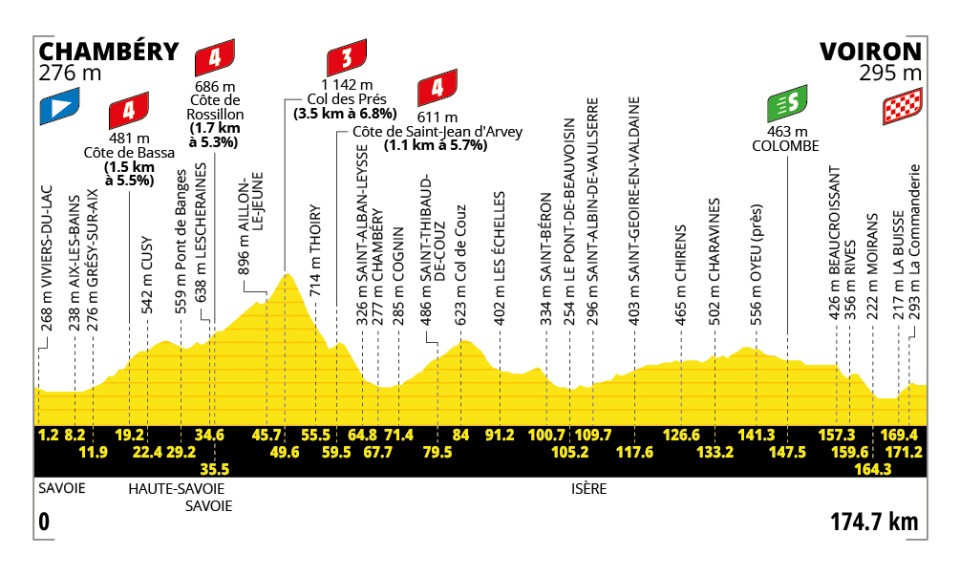
The stage leaves Chambéry, loops out through Aix-les-Bains and the shores of Lac du Bourget, and climbs into the Massif des Bauges before doubling back through Chambéry a second time and heading southwest through the Massif de la Chartreuse toward Voiron. Four climbs, two natural parks, one city crossed twice.
Col des Prés — the high point of the day
Category 3 | 3.5km | 6.6% average | summit 1,142m | km 49.6
Despite the stage being labelled flat, Col des Prés is the highest point anywhere on Stage 17’s route, cresting at 1,142 metres. It arrives after two smaller categorised bumps, Côte de Bassa (1.5km at 5.5%, km 19.2) and Côte de Rossillon (1.7km at 5.3%, km 35.5), both worth a single mountains point each, both there to soften legs before the real test. Col des Prés itself carries a genuine sting at 6.6% across 3.5 kilometres, hard enough that any rider with breakaway ambitions needs to be positioned near the front well before the base.
Côte de Saint-Jean d’Arvey and the run back through Chambéry
A shorter fourth categorised climb, Côte de Saint-Jean d’Arvey, 1.1km at 5.7%, km 59.5, closes out the categorised climbing before the race threads back through Chambéry for a second pass, this time heading toward the Chartreuse massif rather than looping back into the Bauges.
Col de Couz and the long run to Voiron
Uncategorised | 8.6km | 2.8% average | km 84
Col de Couz is long but gentle, 8.6 kilometres at a shade under 3%, and it marks the point where Stage 17’s climbing is essentially finished. From here, the route rolls through the Chartreuse foothills before turning mostly downhill for the final 35 kilometres into Isère.
The final sting — 6km from the line
2.5km | 3.5% | 6km from the finish
One late rise remains before the run-in, arriving with roughly 168 kilometres already in the legs. It’s not hard enough to trouble a genuine climber, but it’s exactly the kind of test that separates the purest sprinters, who need every watt saved for the final 200 metres, from the sprinters who can survive a small kick and still contest the finish. After it, the road runs flat to the line, through a technical final kilometre with four turns in the last 1.5 kilometres and the last of them just 400 metres from the finish.
Full climb profile
| Climb | Category | km marker | Distance | Avg gradient | Points |
|---|---|---|---|---|---|
| Côte de Bassa | Cat. 4 | 19.2 | 1.5 km | 5.5% | 1 |
| Côte de Rossillon | Cat. 4 | 35.5 | 1.7 km | 5.3% | 1 |
| Col des Prés | Cat. 3 | 49.6 | 3.5 km | 6.6% | 2/1 |
| Côte de Saint-Jean d’Arvey | Cat. 4 | 59.5 | 1.1 km | 5.7% | 1 |
| Col de Couz | Uncategorised | 84 | 8.6 km | 2.8% | — |
| Final rise | Uncategorised | ~169 | 2.5 km | 3.5% | — |
Col des Prés is the day’s highest point at 1,142 metres, despite being only the third climb encountered.
Sprint or breakaway? Even the route designer won’t say
Tour route designer Thierry Gouvenou described Stage 17 with a line that’s more honest than most pre-stage framing: “A mixed stage that could end in a sprint, but it’s not at all guaranteed.” That’s not hedging for the sake of it, there’s a real tactical argument on both sides.
The case for a breakaway winning: this deep into a three-week race, sprint teams have thinner lead-out trains than they did in week one, with riders either eliminated by crashes, sacrificed to protect GC leaders, or simply cooked from three weeks of racing. The technical finale, four turns in the last 1.5 kilometres, the final one just 400 metres out, makes organising a clean, fast lead-out considerably harder than a wide boulevard sprint would. And the late 2.5km rise, six kilometres from the line, gives a strong classics rider or puncheur exactly the platform to make a race-winning move stick.
The case for a bunch sprint: this is explicitly billed as the last realistic sprint opportunity before the Alps swallow the rest of the race. Every fast-finishing team left in the race has maximum incentive to control the day, chase down anything dangerous, and not let this chance slip past unused. Three consecutive Alpine stages follow; nobody with sprint ambitions gets another look until Paris.
GC picture: a quiet day by design, not by accident
Stage 17 sits deliberately between Stage 16’s time trial and the Alpine block that follows, the kind of terrain GC teams treat as a day to conserve rather than attack. None of the current gaps are expected to move significantly today.
| Pos | Rider | Team | Gap |
|---|---|---|---|
| 1 | Tadej Pogačar | UAE Team Emirates-XRG | Leader |
| 2 | Remco Evenepoel | Red Bull-BORA-hansgrohe | +4:32 |
| 3 | Isaac del Toro | UAE Team Emirates-XRG | +6:51 |
| 4 | Paul Seixas | Decathlon CMA CGM | +7:11 |
| 5 | Juan Ayuso | Lidl-Trek | +9:22 |
| 6 | Mattias Skjelmose | Lidl-Trek | +10:14 |
| 7 | Lenny Martinez | Bahrain Victorious | +12:50 |
| 8 | Tom Pidcock | Pinarello-Q36.5 | +12:58 |
Two names are missing from where they were a week ago. Jonas Vingegaard, who sat second overall before Stage 15, abandoned after his crash. Florian Lipowitz, fifth overall before Stage 16, joined him on the sidelines a day later. Both exits reshaped the standings without a single attack, the top three positions haven’t changed order since, but the margins around them have, and the real tension left in this GC now sits just below the podium: Paul Seixas is only twenty seconds behind Isaac del Toro for that final podium spot and the white jersey that comes with it, and Lidl-Trek teammates Juan Ayuso and Mattias Skjelmose are separated by just fifty-two seconds. Stage 17 won’t resolve any of that. The Alps will. See the full rankings after stage 16 ITT.
Stage winner prediction
The tactical picture favours a hybrid finisher over a pure sprinter. A late 2.5km rise six kilometres from home, combined with thinner lead-out trains this deep into the race, tilts the maths toward riders who can survive a kick and still finish fast, Mathieu van der Poel and Mads Pedersen are the two names best built for exactly that combination, and both were flagged as top picks precisely because this profile suits a puncheur-sprinter more than it suits a pure fast man.
That doesn’t rule out a straightforward bunch sprint. Olav Kooij, Tim Merlier, and Jasper Philipsen, reportedly “getting in better and better shape” as the race progresses, all remain live if their teams can hold the race together through the technical finale. But between the late rise, the four corners inside the last 1.5 kilometres, and a peloton racing cautiously after two recent crashes, the conditions favour whoever can produce a strong, opportunistic move rather than whoever simply has the fastest raw sprint.
Matej Mohorič, Maxim Van Gils, and Dorian Godon round out the strongest secondary tier, all classics-calibre riders capable of going clear on the late rise if the bunch hesitates even slightly.
Chambéry: a Tour host city on its fourth visit
Chambéry is no stranger to the Tour de France, and this is its fourth appearance. The city first hosted in 1996, starting Stage 7 toward Les Arcs. It returned in 2010 for Stage 10 to Gap, and again in 2017, this time as a stage finish, with the peloton arriving from Nantua on Stage 9. In 2026, Chambéry sends the race off one more time, this time toward Voiron.
There’s a more recent connection too. In 2025, the Tour de France Femmes avec Zwift passed through Chambéry’s streets, with crowds lining the Alpine hairpins to watch the women’s peloton race through, a moment locals still talk about, and one that made Wednesday’s men’s departure feel less like a first encounter and more like a return.
Voiron: the finish town’s Vuelta connection
Voiron doesn’t carry the deep Tour history that Chambéry does, this is new territory for the men’s race, but it’s not unfamiliar with big cycling moments. Ben Turner won a stage there at the 2025 Vuelta a España, giving the town a genuine, recent cycling credential before the Tour de France ever arrived on its streets.
World start times and how to watch
| Time zone | Region | Actual start | Est. finish |
|---|---|---|---|
| CEST (UTC+2) | France, Germany, Italy | 13:35 | ~17:30 |
| BST (UTC+1) | United Kingdom, Ireland | 12:35 | ~16:30 |
| EDT (UTC-4) | New York, Miami | 07:35 | ~11:30 |
| CDT (UTC-5) | Chicago, Dallas | 06:35 | ~10:30 |
| PDT (UTC-7) | Los Angeles, Seattle | 04:35 | ~08:30 |
| IST (UTC+5:30) | India | 17:05 | ~21:00 |
| AEST (UTC+10) | Sydney, Melbourne | 21:35 | ~01:30 +1 |
How to watch: France Télévisions carries the stage free in France. UK viewers need TNT Sports or HBO Max for live coverage, with Channel 5 offering free highlights only. SBS broadcasts free and live in Australia. In the US, Peacock Premium carries full live coverage. Eurosport remains the standard option across most of the rest of Europe; see full live viewing guide.
Weather and the crosswind-to-headwind flip
The forecast has Stage 17 starting at 27°C with a crosswind for most of the route, before the wind swings into a headwind for the final five kilometres into Voiron. That shift matters more than it might sound. A crosswind through the middle of the stage keeps echelon risk alive for anyone caught out of position, while a headwind in the closing kilometres works against any late solo attacker, it’s considerably harder to hold off a chasing bunch into a headwind than a tailwind, which tilts the finish very slightly back toward a bunch sprint compared with what the terrain alone would suggest.
Spectator guide — Chambéry and Voiron
Col des Prés: The day’s highest point and the best place to watch genuine climbing effort on a stage otherwise billed as flat. Since it’s classified and comes with mountain points on the line, expect a real fight for the breakaway’s polka-dot contenders here.
The Voiron finish straight: Technical and compressed — four turns inside the final 1.5 kilometres, the last one just 400 metres from the line. It’s a better spectator experience than a simple wide boulevard sprint, since positioning battles in the final kilometre will be visibly chaotic rather than a clean, predictable leadout train formation.
Savoie and Isère — food and culture
The route through Aix-les-Bains and the Massif des Bauges shares the same Beaufort-and-Tartiflette Savoie food culture already covered for the Stage 15 and Stage 16 finishes near Lake Geneva, cross the same ground here, just further west along the Alpine foothills.
Voiron adds something genuinely distinct: it’s the historic home of Chartreuse, the herbal liqueur distilled by Carthusian monks in the mountains just outside town since the 18th century, using a recipe of botanicals that remains one of the most closely guarded in the spirits world. The distillery and its museum sit a short distance from the finish line, worth knowing if a stage-day detour is on the cards, and a specific, checkable detail that gives Voiron its own identity rather than treating it as an anonymous finish town.
FAQ — Tour de France 2026 Stage 17
What happened to Jonas Vingegaard and Florian Lipowitz?
Both riders crashed out of the 2026 Tour de France within 48 hours of each other. Jonas Vingegaard fractured his collarbone in a crash on Stage 15 and required surgery. Florian Lipowitz crashed during Stage 16’s individual time trial and was taken away on a stretcher. Both were considered genuine podium contenders before their respective withdrawals.
Who is leading the Tour de France 2026 heading into Stage 17?
Tadej Pogačar leads the general classification heading into Stage 17, with Remco Evenepoel second at 4 minutes 32 seconds behind. Isaac del Toro holds third at 6:51, with Paul Seixas just 20 seconds further back in fourth. Juan Ayuso and Mattias Skjelmose, Lidl-Trek teammates, are separated by only 52 seconds in fifth and sixth.
Will Stage 17 end in a bunch sprint?
It’s genuinely uncertain. Tour route designer Thierry Gouvenou has himself said the stage “could end in a sprint, but it’s not at all guaranteed.” A late 2.5km rise six kilometres from the finish, combined with thinner sprint lead-out trains this late in the race and a technical final kilometre, gives a breakaway or a puncheur-style rider a real chance of beating the pure sprinters to the line.
What is the highest point of Stage 17?
The highest point of Stage 17 is the Col des Prés, a Category 3 climb of 3.5 kilometres at 6.6%, cresting at 1,142 metres around kilometre 49.6. Despite the stage being classified as flat, this climb is higher than anything else on the route and arrives early enough to shape which riders make the day’s breakaway.
Why is Stage 17 considered a quiet day for the GC battle?
Stage 17 is positioned deliberately between Stage 16’s individual time trial and the Alpine stages that follow, giving GC teams every incentive to conserve energy rather than attack. The terrain, while harder than its “flat” billing suggests, isn’t difficult enough to force meaningful time gaps among the general classification contenders, most of whom are expected to finish together in the main group.
What is the weather forecast for Stage 17?
The forecast for Stage 17 has temperatures around 27°C at the start rising to 29°C by the finish, with a crosswind for most of the route swinging into a headwind for the final five kilometres into Voiron. The wind shift makes it harder for a late solo attacker to hold off the chasing bunch, slightly favouring a group finish over the closing kilometres.
Where does Stage 17 finish and what is Voiron known for?
Stage 17 finishes in Voiron, in the Isère department. The town is the historic home of Chartreuse, the herbal liqueur distilled nearby by Carthusian monks since the 18th century, and recently hosted a stage win for Ben Turner at the 2025 Vuelta a España.
How many climbs are on Stage 17 and where are they?
Stage 17 features four categorised climbs — Côte de Bassa, Côte de Rossillon, Col des Prés, and Côte de Saint-Jean d’Arvey — all within the first 60 kilometres, plus two uncategorised climbs later in the stage: Col de Couz around kilometre 84, and a final rise of 2.5km roughly six kilometres from the finish in Voiron.