Tour de France 2026 Stage 19: Gap to Alpe d’Huez — History’s First Double Begins With Pogačar’s Army in Pieces
Last updated: 4:55 am CEST - Friday, 24 July 2026
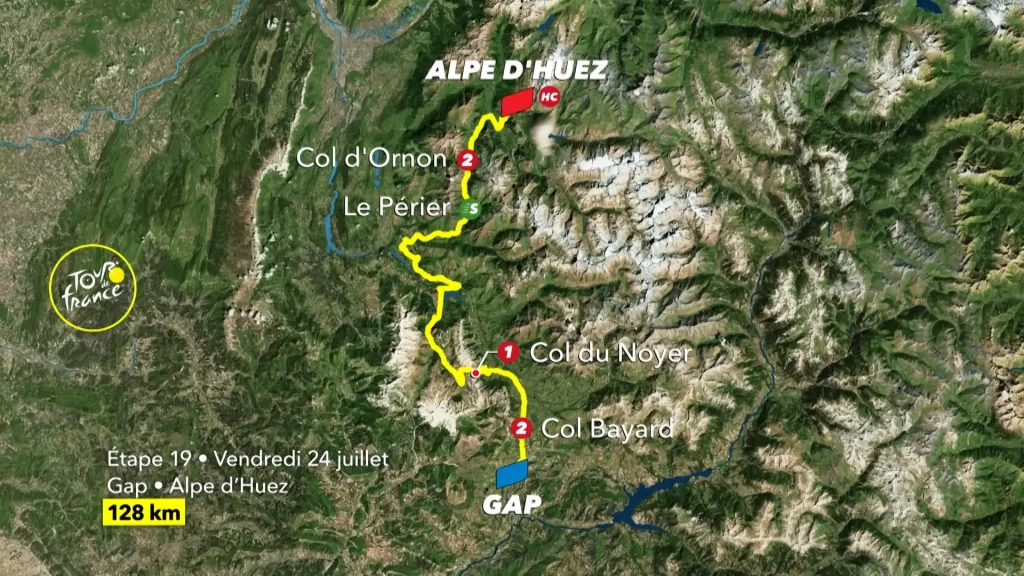
Stage 19 of the Tour de France 2026 is a 127.9-kilometre mountain stage from Gap to Alpe d’Huez on Friday 24 July, the first of back-to-back finishes on cycling’s most famous climb — something the Tour has never done in its history. It carries around 3,500 metres of climbing across four categorised ascents; the official start is 14:15 CEST, and the finish is expected around 17:35.
Here’s what makes this particular running of Alpe d’Huez different from every one that came before it. Tadej Pogačar arrives as race leader, as expected. What wasn’t expected a week ago is the state of the team around him. Brandon McNulty abandoned the race ill during Stage 18. Adam Yates has been fighting a stomach illness serious enough that he lost more than 26 minutes on Stage 17 and needed a teammate to pace him home. That teammate, Tim Wellens, has his own sore throat and congestion. Felix Großschartner hasn’t looked the same since he crashed alongside Jonas Vingegaard back on Stage 15. Pogačar himself is reportedly fine, but he’s about to climb the two hardest stages left in this Tour with less support around him than at any other point in the race.
TL;DR
- What is Stage 19? A 127.9km mountain stage on Friday 24 July, from Gap to a summit finish at Alpe d’Huez (1,850m). It’s the first of two consecutive Alpe d’Huez finishes — a genuine first in Tour de France history.
- Why does it matter now? UAE Team Emirates-XRG enters this stage visibly weakened: Brandon McNulty abandoned ill on Stage 18, Adam Yates is still recovering from a stomach illness, and Tim Wellens has his own symptoms. Pogačar’s usual mountain support is thinner than it’s been all race, right as the terrain gets hardest.
- The history: Alpe d’Huez debuted in 1952 with Fausto Coppi’s solo win, vanished for 24 years, and returns in 2026 for a back-to-back double — Stage 19 today, and again in Stage 20 after the Galibier.
Stage 19 key facts
| Detail | Confirmed data |
|---|---|
| Stage number | 19 of 21 — first of the Alpe d’Huez double |
| Date | Friday, 24 July 2026 |
| Start | Gap (Hautes-Alpes) |
| Finish | Alpe d’Huez (Isère) |
| Distance | 127.9 km |
| Elevation gain | ~3,500m |
| Finish altitude | 1,850m |
| Neutralised start | 14:00 CEST |
| Official start | 14:15 CEST |
| Est. finish | ~17:35 CEST (range 17:24–17:44) |
| Intermediate sprint | Le Périer, km 89.4 |
| Weather | Start ~29°C, sunny. Finish ~22°C, sunny, very little wind |
UAE Team Emirates is falling apart at the worst possible moment
Every Alpe d’Huez preview eventually gets to talking about Tadej Pogačar. This year, before that conversation happens, it’s worth talking about who’s no longer around him.
Brandon McNulty didn’t make it through Stage 18. He’d been struggling from early in the stage, riding increasingly isolated as the race went on, and eventually abandoned while riding alone ahead of the broom wagon, a rider who’d ordinarily be one of Pogačar’s key mountain lieutenants, gone before the mountains that actually needed him arrived.
Adam Yates has been fighting a stomach illness that first showed up around Stage 16 and hit hardest on Stage 17, when he was dropped from the peloton with 66 kilometres still to race and eventually finished more than 26 minutes down, 161st on the stage, his shorts visibly stained with salt from how hard his body had been working just to survive. Tim Wellens paced him home that day rather than protecting his own race. Yates continued to struggle through Stage 18. Team manager Mauro Gianetti says the stomach problem is “almost sorted,” though he’s cautioned that “the legs may be a bit empty”, which is not the sentence you want attached to a rider who’s supposed to be helping defend a Tour lead on Alpe d’Huez.
Wellens isn’t fully well either. “Adam is not feeling well, and I myself don’t feel great either,” he said before Stage 18. “I have a sore throat, mucus, and just don’t feel quite right. But more than half of our team is still in top shape.” That’s the most honest assessment anyone inside the team has given, not a crisis, but not nothing, either.
Then there’s Felix Großschartner, who went down in the same crash that ended Jonas Vingegaard’s Tour on Stage 15. He’s still racing, but reports from the finish line at Orcières-Merlette suggested a rider who wasn’t quite himself — arriving, being met briefly by staff, and heading straight back rather than lingering the way riders usually do after a big mountain stage.
UAE’s response has been to isolate the sick riders as tightly as they can: separate hotel rooms, masks on the team bus, healthy and unwell riders eating apart from each other. Gianetti insists it’s contained, “we only isolated Yates,” he’s said, framing it as a minor, manageable situation rather than a wider outbreak. Pogačar himself is reportedly unaffected, described by his own teammates as looking strong and in good spirits before Stage 18. But strip away the reassurance and the underlying fact doesn’t change: the rider defending the yellow jersey into the two hardest stages of this Tour has fewer healthy teammates to call on than he’s had all race.
The route: two brutal openers, a long lull, then the legend
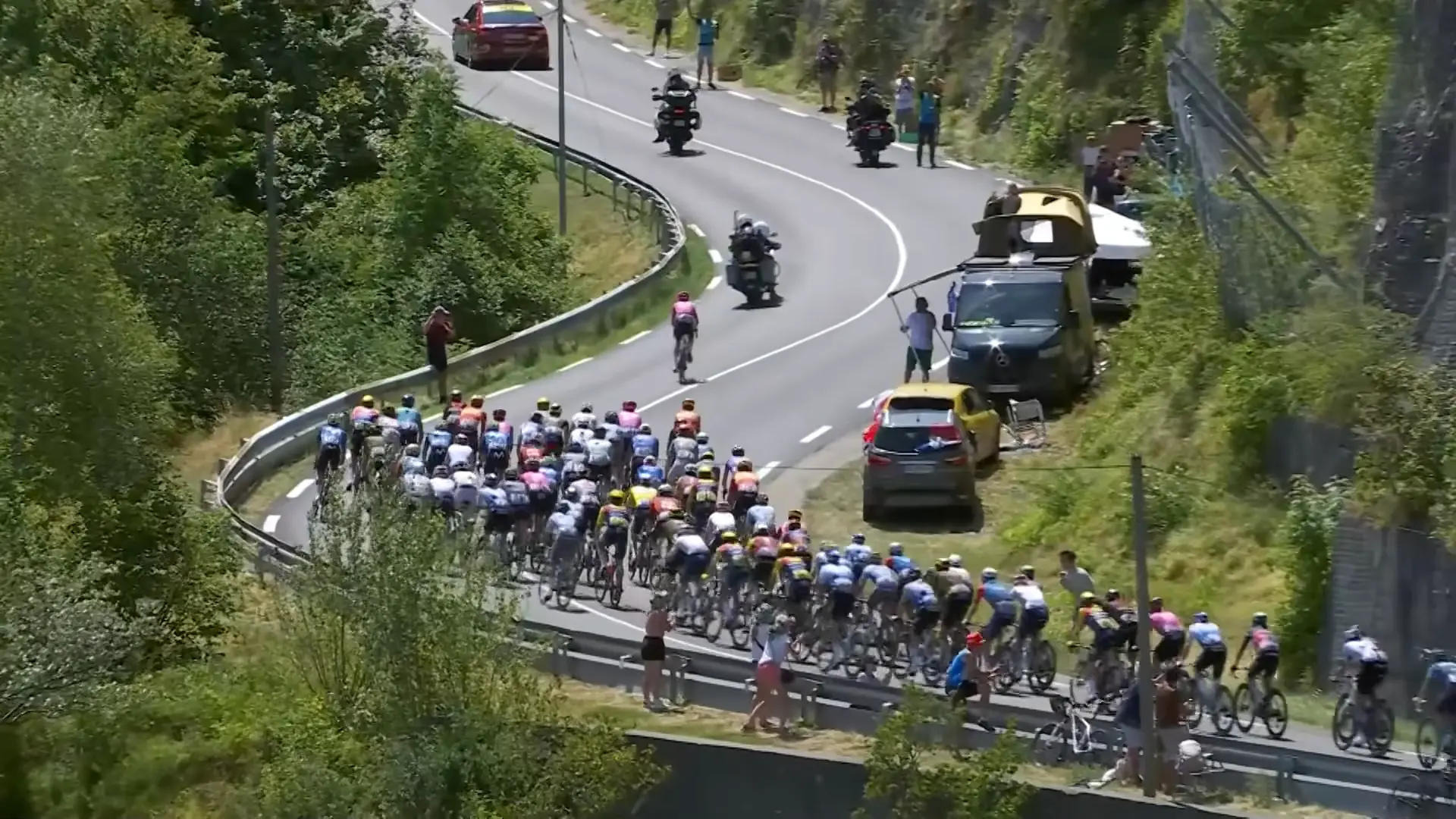
Stage 19 doesn’t ease anyone in. The two hardest non-finish climbs of the day both arrive inside the first 25 kilometres, back to back, before a long valley transition gives everyone a chance to recover ahead of the day’s real business.
Col Bayard and Col du Noyer — no warm-up allowed
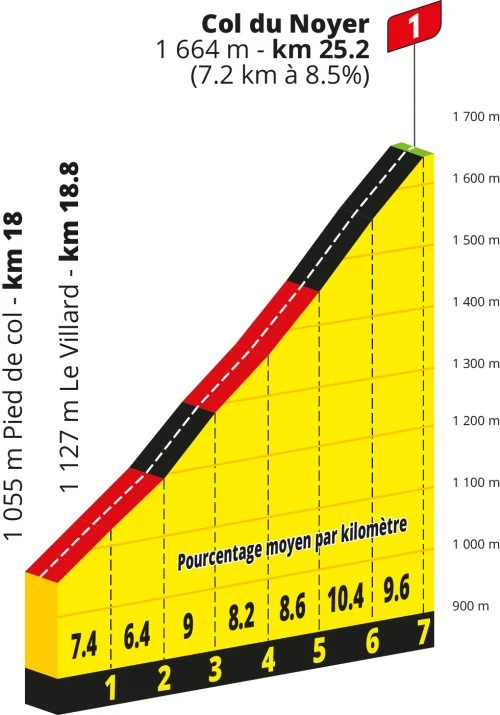
Col Bayard: Category 2 | 4.7km | 7.2% | km 4.8 Col du Noyer: Category 1 | 7.2km | 8.5% | km 25.2
The flag barely drops before Col Bayard begins, and the Col du Noyer follows almost immediately off the Bayard descent, a brutal one-two punch to open a stage that still has over a hundred kilometres left to run. Any rider hoping to make the day’s breakaway needs to survive this opening stretch near the front, since there’s no easing into the day the way a flatter opener would allow.
The uncategorised Lac du Sautet climb
After the Noyer, the route settles into several dozen kilometres of gently rolling terrain, genuinely quiet by this stage’s standards, with one exception. Around 52 kilometres in, the road rises again near Lac du Sautet: 2.7 kilometres at 6%, uncategorised, easy to miss on a route profile that only lists the day’s four categorised climbs. It won’t decide the stage, but it’s a real, if modest, disruption to what’s otherwise the calmest section of the day.
Col d’Ornon — the final gateway
Category 2 | 5.4km | 6.4% | km 99.2
Col d’Ornon is the last obstacle before Alpe d’Huez itself, and its descent drops the peloton into Bourg-d’Oisans, the traditional starting point of the Alpe d’Huez ascent, and the town every rider on this route has been picturing since the stage began.
Alpe d’Huez: 21 hairpins, 13.8km, and the toughest sections come early
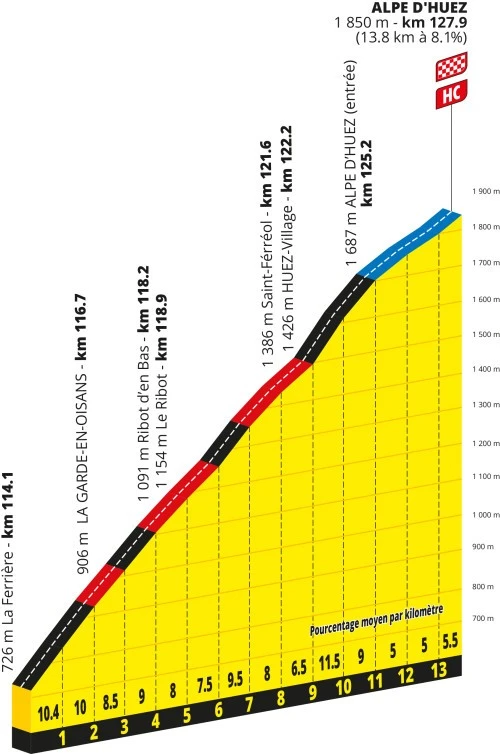
Category HC | 13.8km | 8.1% average | 1,120m elevation gain | finish altitude 1,850m
The climb that closes Stage 19 needs no introduction, but its shape is worth knowing precisely. The hardest sections don’t arrive at the summit the way they do on some mountains, they come in the first two kilometres out of Bourg-d’Oisans, and again around hairpins ten and eleven, roughly the midpoint of the climb. Riders who pace themselves for a climb that gets progressively harder toward the top are pacing for the wrong mountain. Alpe d’Huez front-loads its cruelty, then settles into something more rhythmic for the run to the ski resort.
Full climb profile
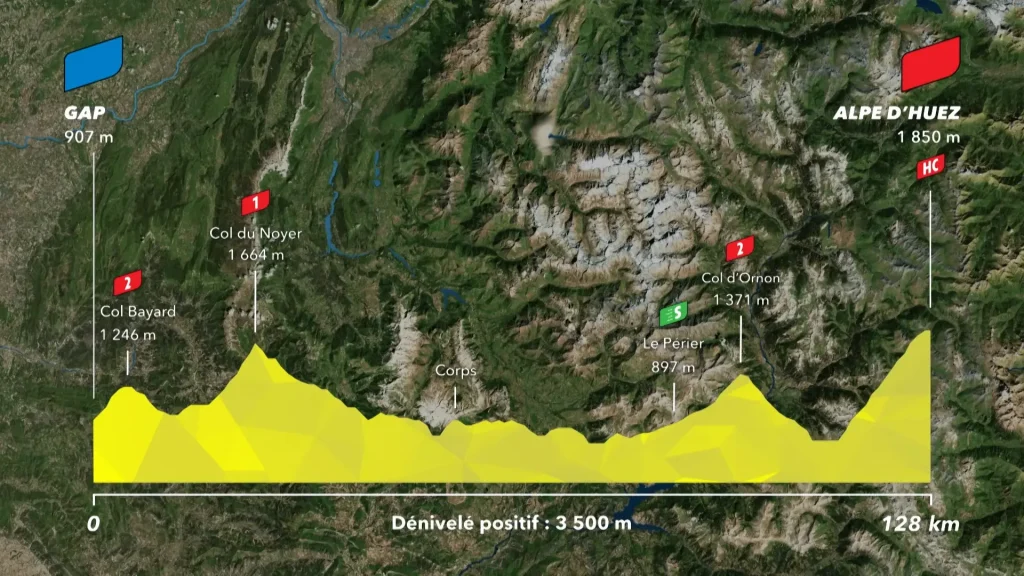
| Climb | Category | km marker | Distance | Avg gradient | Notes |
|---|---|---|---|---|---|
| Col Bayard | Cat. 2 | 4.8 | 4.7 km | 7.2% | Opens the stage immediately |
| Col du Noyer | Cat. 1 | 25.2 | 7.2 km | 8.5% | Straight off the Bayard descent |
| Lac du Sautet climb | Uncategorised | ~52 | 2.7 km | 6% | Missing from most route summaries entirely |
| Col d’Ornon | Cat. 2 | 99.2 | 5.4 km | 6.4% | Descends into Bourg-d’Oisans |
| Alpe d’Huez | Cat. HC | 127.9 | 13.8 km | 8.1% | 21 hairpins. Hardest sections: first 2km, then hairpins 10–11. Finish altitude 1,850m |
1952–1976: how Alpe d’Huez actually became legendary
Alpe d’Huez entered Tour history in 1952, on Stage 10 of that year’s race, a brutal 266-kilometre day from Lausanne that ended with the very first mountain-top finish the Tour had ever used. Fausto Coppi attacked six kilometres from the summit, extended his advantage to 1 minute 20 seconds by the line, and climbed the mountain in 45 minutes and 22 seconds, a time that would stand as the fastest ascent for decades, until Marco Pantani broke it in 1995 with 37:35. Coppi took the yellow jersey that day from teammate Andrea Carrea and never gave it back, going on to win by more than 28 minutes overall, his second Tour title, won in the same year as his fourth Giro d’Italia.
What happened next is often told wrong. The popular version says organisers were so unimpressed by how easily Coppi dominated that they simply didn’t bother returning to the mountain for a quarter of a century. The real reason is more specific: it wasn’t really about Coppi’s individual performance at all. Tour organiser Jacques Goddet judged the racing dull for most of the stage, with all the drama compressed into the final climb, and concluded there was, in his own words, “no reason to lobby for more stage finishes at altitude.” The mountain wasn’t punished for being too easy. The whole format of a summit finish was, for a while, judged not worth repeating.
Alpe d’Huez came back in 1976, and the gap was 24 years, not 25. That return produced its own split story that rarely gets told correctly: Joop Zoetemelk won the stage itself, but it was his rival that day, Lucien Van Impe, who took the yellow jersey. Two different achievements, two different riders, the same afternoon, the moment Alpe d’Huez proved it could produce drama on demand and earned its place as a permanent fixture of the race.
The hairpins, the Dutch Mountain, and the one record nobody’s matched
Each of Alpe d’Huez’s 21 hairpins carries the name of a past stage winner, a tradition that filled up by 2001 — at which point the naming simply restarted from the bottom of the mountain, with Lance Armstrong’s name replacing Coppi’s original 1952 plaque at the base. The climb’s identity as “the Dutch Mountain” comes from the run of Dutch winners through the 1970s and 80s that turned the roadside into a sea of orange, a reputation that still defines Dutch Corner, hairpin seven, as the wildest, loudest single spot on the entire route.
One record from this mountain’s history hasn’t been matched since. In 2018, Geraint Thomas became the only rider ever to win atop Alpe d’Huez while already wearing the yellow jersey, catching Steve Kruijswijk’s 70-kilometre solo breakaway attempt in the closing kilometres and beating him to the line. Every other rider who’s ever won here has done it from outside the race lead. Thomas remains the exception.
2022’s coming-out party, and 2024’s cruellest four seconds
The last men’s winner at Alpe d’Huez was Tom Pidcock, soloing away from the breakaway in 2022 for one of the most celebrated stage wins of his career. Two years ago, the mountain produced something even more dramatic on the women’s side: Demi Vollering won the Tour de France Femmes stage here, beating Katarzyna Niewiadoma by more than a minute in a gripping, prolonged tactical battle up the climb. It secured her the stage. It didn’t secure her the Tour, she lost the overall title by just four seconds, one of the narrowest margins in the sport’s recent history, on the very climb where she’d looked, for one afternoon, unbeatable.
First time in Tour history: two summit finishes, one mountain
This year is officially the first time the Tour de France has finished on Alpe d’Huez on consecutive days. Stage 19 is the opening act. Stage 20 follows a day later, arriving via the Col du Galibier at 2,642 metres before the peloton climbs Alpe d’Huez a second time to close out the race’s mountain business entirely. Nothing like this has been attempted on this mountain before — not in 1952, not through any of its returns since. Whatever happens today, it happens again tomorrow, on the same 21 hairpins, with even higher stakes attached.
Breakaway or GC war? UAE’s crisis changes the calculus
Italian media have described a stage like this as aperitivo prima dell’abbuffata, the aperitif before the feast, and in a normal year, that framing would hold: a hard but not decisive day, raced by a breakaway while the GC group polices the gap and saves its real efforts for tomorrow’s harder finale.
This isn’t a normal year for UAE. If Pogačar’s team can’t fully control the pace on Alpe d’Huez’s front-loaded steep sections, today stops being a controlled aperitif and starts being an opportunity. Remco Evenepoel, Isaac del Toro, and Paul Seixas all have reason to test what’s actually left in UAE’s tank rather than wait politely for Stage 20. A team missing McNulty, riding an under-cooked Yates, and unsure of Großschartner’s form is a team that can be probed, and probing it here, a day before the even harder finale, is exactly the kind of pressure that compounds.
Stage 19 winner prediction
Top tier: Tadej Pogačar remains the individual favourite regardless of his team’s health — his own form hasn’t wavered all race. Sepp Kuss and Richard Carapaz, fresh off his Stage 18 win from the breakaway, both carry real momentum into a stage built for exactly their kind of climbing.
Second tier: Remco Evenepoel, Matteo Jorgenson, and Valentin Paret-Peintre round out the next rank, all capable of a genuine result if the day breaks their way, and all with real motivation given UAE’s current state.
Third tier: Paul Seixas, Isaac del Toro, Juan Ayuso, Mattias Skjelmose, Tom Pidcock, Sergio Higuita, Harold Tejada, Davide Piganzoli, Thymen Arensman, Egan Bernal, and Quinn Simmons make up a deep field of riders who could all plausibly feature depending on how aggressively the day is raced.
The single biggest variable isn’t in that list at all — it’s whether UAE has the legs left to defend Pogačar the way they have all Tour, or whether today is the day someone finally finds out what happens when they can’t.
GC implications heading into the double
| Pos | Rider | Team | Gap |
|---|---|---|---|
| 1 | Tadej Pogačar | UAE Team Emirates-XRG | Leader |
| 2 | Remco Evenepoel | Red Bull-BORA-hansgrohe | +4:32 |
| 3 | Isaac del Toro | UAE Team Emirates-XRG | +6:51 |
| 4 | Paul Seixas | Decathlon CMA CGM | +7:11 |
| 5 | Juan Ayuso | Lidl-Trek | +9:22 |
The Seixas-del Toro battle for the final podium spot and the white jersey, still just twenty seconds apart, remains the tightest ongoing story in this Tour. But it’s no longer the only variable worth watching. UAE is also fighting to hold the team classification lead after losing ground to Lidl-Trek on Stage 17, meaning Pogačar’s team has multiple fronts to defend with fewer healthy riders than at any earlier point in the race.
World start times and how to watch
| Time zone | Region | Official start | Est. finish |
|---|---|---|---|
| CEST (UTC+2) | France, Germany, Italy | 14:15 | ~17:35 |
| BST (UTC+1) | United Kingdom, Ireland | 13:15 | ~16:35 |
| EDT (UTC-4) | New York, Miami | 08:15 | ~11:35 |
| CDT (UTC-5) | Chicago, Dallas | 07:15 | ~10:35 |
| PDT (UTC-7) | Los Angeles, Seattle | 05:15 | ~08:35 |
| IST (UTC+5:30) | India | 17:45 | ~21:05 |
| AEST (UTC+10) | Sydney, Melbourne | 22:15 | ~01:35 +1 |
How to watch: Eurosport 1 carries the stage across Europe from 13:45 CEST, with HBO Max offering a streaming alternative. Spanish viewers have Teledeporte and La 1 free via RTVE Play, with a dedicated Basque-language broadcast on ETB1 from 15:10.
Equipment for the legend climb
Alpe d’Huez’s reputation for brutal early ramps, the first two kilometres, then hairpins ten and eleven, shapes gearing choices more than the climb’s overall 8.1% average suggests. Riders set up for a steady grind risk being caught out by the steepest sections arriving before the legs have properly settled into rhythm, rather than building gradually toward a harder finish the way some HC climbs do.
Spectator guide — the chaos of Alpe d’Huez
Dutch Corner, hairpin seven, remains the undisputed epicentre of Alpe d’Huez’s roadside atmosphere, a wall of orange and noise that’s as much a part of the mountain’s identity as the climb itself. It’s also worth a genuine word of caution: this is one of the most densely packed, chaotic viewing spots anywhere on the Tour route, with the road narrowing right where the crowd is thickest. Arrive early, stay aware of your surroundings as riders pass, and don’t expect to move around easily once the crowds have settled in for the afternoon.
Hautes-Alpes and Isère — food and culture
Gap sits at the edge of the Écrins massif, gateway country to some of the highest terrain in the French Alps, with a food culture built around mountain simplicity, cured meats, mountain cheeses, and hearty fare suited to a region where winters are long and summers are for getting outside. Further along the route, as the race drops into Isère toward Bourg-d’Oisans, it briefly shares territory with the Chartreuse corridor already covered for Stage 17 and 18’s finish towns, a reminder that this run of Alpine stages, for all their difference in terrain, shares more culinary DNA than the mountains themselves might suggest.
FAQ — Tour de France 2026 Stage 19
What is happening with UAE Team Emirates-XRG’s health?
UAE Team Emirates-XRG has lost Brandon McNulty, who abandoned the race ill during Stage 18, and is managing an ongoing stomach illness in Adam Yates, who lost more than 26 minutes on Stage 17. Tim Wellens has also reported cold-like symptoms, and Felix Großschartner has not looked at full strength since crashing on Stage 15. The team has taken precautions including isolating sick riders at meals and on the team bus.
How many times has Alpe d’Huez hosted the Tour de France?
Alpe d’Huez first hosted the Tour in 1952, when Fausto Coppi won its debut summit finish. After a 24-year absence, it returned in 1976, and has been used regularly since, with 2026 marking the first time it has ever been used for two consecutive stage finishes.
Why did Alpe d’Huez disappear from the Tour for so long after 1952?
Contrary to the common explanation that Fausto Coppi’s dominant win discouraged organisers, the actual reason was that Tour organiser Jacques Goddet judged the day’s racing dull before the final climb and questioned the value of summit finishes generally, writing there was no reason to lobby for more of them. The climb’s absence lasted 24 years, until 1976.
Who won when Alpe d’Huez returned to the Tour in 1976?
Joop Zoetemelk won the 1976 stage at Alpe d’Huez, but it was his rival that day, Lucien Van Impe, who took the yellow jersey. The two achievements are often conflated, but they belonged to two different riders on the same afternoon.
How hard is the Alpe d’Huez climb?
Alpe d’Huez is 13.8 kilometres long with an average gradient of 8.1% and 1,120 metres of total elevation gain, spread across 21 numbered hairpin bends. Unlike some climbs that get progressively harder toward the summit, its toughest sections arrive early — in the first two kilometres and again around hairpins ten and eleven.
What is Dutch Corner at Alpe d’Huez?
Dutch Corner refers to hairpin seven of the Alpe d’Huez climb, famous for its dense crowds of orange-clad Dutch fans and its reputation as the loudest, most chaotic single viewing spot on the mountain. The nickname stems from a run of Dutch stage winners at Alpe d’Huez through the 1970s and 1980s.
Has any rider won at Alpe d’Huez while already wearing the yellow jersey?
Yes, only once. Geraint Thomas won atop Alpe d’Huez in 2018 while already the race leader, catching Steve Kruijswijk’s long solo breakaway attempt in the final kilometres. No other rider has won the stage while already wearing yellow.
Who won the last Tour de France stage at Alpe d’Huez?
Tom Pidcock won the last men’s Tour de France stage at Alpe d’Huez in 2022, soloing clear from the breakaway. Two years ago, Demi Vollering won the Tour de France Femmes stage there, beating Katarzyna Niewiadoma by over a minute on the stage but ultimately losing the overall title by just four seconds.
Is Stage 19 likely to be won by the breakaway or the GC group?
It’s genuinely uncertain given UAE Team Emirates-XRG’s current health situation. In a normal year, a stage positioned before an even harder finale would typically be conceded to the breakaway while GC teams conserve energy. With UAE potentially unable to fully control the pace, there’s a real chance a GC rival tests Pogačar directly rather than waiting for Stage 20.