Tour de France 2026 Stage 20: the Queen Stage That Could Crown a Fifth Champion
Last updated: 4:18 am CEST - Saturday, 25 July 2026
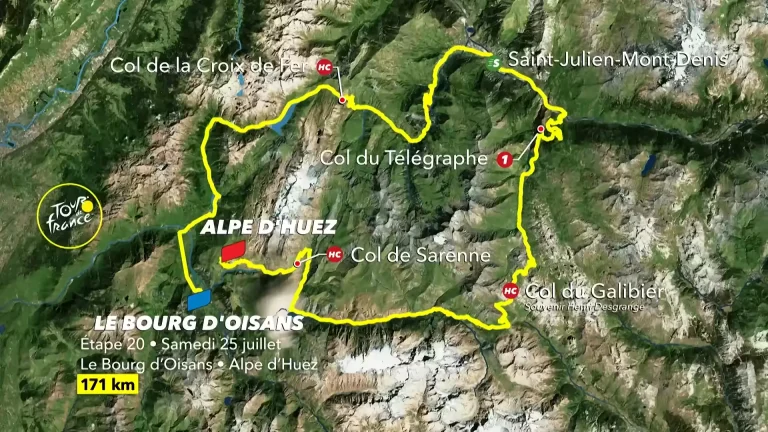
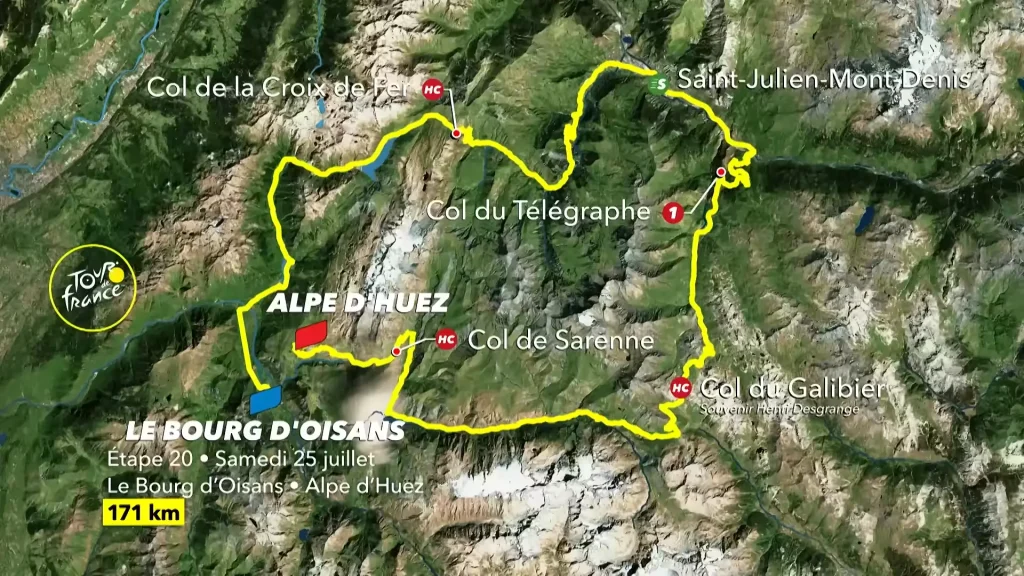
Stage 20 of the Tour de France 2026 is a 170.9-kilometre mountain stage from Le Bourg d’Oisans to Alpe d’Huez on Saturday 25 July, carrying roughly 5,450 metres of climbing across four major ascents, the Col de la Croix de Fer, Col du Télégraphe, Col du Galibier, and the newly introduced Col de Sarenne, before the second of this Tour’s back-to-back finishes atop cycling’s most famous mountain. Start is 11:20 CEST, with the finish expected around 16:29.
Today changed what this stage means. Tadej Pogačar didn’t just win Stage 19 to Alpe d’Huez, he attacked early, bridged alone to the survivors of the day’s breakaway, and soloed to the summit in 35 minutes and 27 seconds, shattering Marco Pantani’s 1995 climbing record by more than two minutes. It was his first-ever stage win on this specific mountain, after six years of dominating the sport. He now leads Remco Evenepoel by 7 minutes 11 seconds. Barring disaster, this Queen Stage isn’t deciding whether Pogačar wins a record-equalling fifth Tour de France. It’s deciding by how much, and who joins him on the final podium in Paris.
TL;DR
- What is Stage 20? A 170.9km mountain stage on Saturday 25 July, the Tour’s hardest day of 2026 with around 5,450 metres of climbing across the Croix de Fer, Télégraphe, Galibier, and the controversial Col de Sarenne, before a second finish atop Alpe d’Huez.
- Why does it matter now? Pogačar demolished the field on Stage 19, breaking Pantani’s 30-year Alpe d’Huez record and extending his lead to 7:11. The GC picture at the top is essentially settled — but Paul Seixas and Isaac del Toro remain locked in a 24-second battle for the final podium spot and the white jersey.
- The controversy: The Col de Sarenne makes its debut as a climb today, after an environmental petition against its use and two real mudslides on the route in the weeks before the race.
Stage 20 key facts
| Detail | Confirmed data |
|---|---|
| Stage number | 20 of 21 — Queen Stage, second Alpe d’Huez finish |
| Date | Saturday, 25 July 2026 |
| Start | Le Bourg d’Oisans (Isère) |
| Finish | Alpe d’Huez (Isère) |
| Distance | 170.9 km |
| Elevation gain | ~5,450–5,600m |
| Finish altitude | 1,850m |
| Start (neutral = official) | 11:20 CEST |
| Est. finish | ~16:29 CEST (range 16:11–16:50) |
| Intermediate sprint | Saint-Julien-Mont-Denis, km 66.5 |
| Weather | Start ~25°C, sunny. Finish ~29°C with rain forecast — treacherous descents likely |
What just happened on Alpe d’Huez — and why it changes today
Every Queen Stage preview eventually asks whether the leader can be caught. This year, that question was mostly answered a day early.
Tadej Pogačar didn’t wait for the final kilometres of Stage 19. He attacked early on the lower slopes of Alpe d’Huez, bridged across to the strongest survivors of a large early breakaway, and simply rode away from everyone else on the mountain. He crossed the line in 35 minutes and 27 seconds, a time that doesn’t just beat Marco Pantani’s legendary 1995 climbing record of 37:35, it demolishes it by more than two minutes. Lenny Martinez finished second, six seconds back. Richard Carapaz, fresh off his own solo win the day before, took third at nine seconds. It was Pogačar’s fifth stage win of this Tour, his 27th career Tour stage victory, and, remarkably, given how many times he’s raced through the Alps, his first ever stage win specifically atop Alpe d’Huez.
The gap this created is what makes Stage 20 a different conversation than it would otherwise be. Pogačar now leads Remco Evenepoel by 7 minutes 11 seconds, up from 4:32 before Stage 19 began. Isaac del Toro sits third at 9:42, with Paul Seixas fourth at 10:06, the top four unchanged in order, but the gap between first and fourth now stretching past ten minutes. Juan Ayuso and Tom Pidcock both cracked badly on the early switchbacks and lost significant time, dropping well down the standings. Pogačar is, in the words of one report from yesterday, now “within touching distance” of a fifth Tour de France title, a mark that would place him alongside Anquetil, Merckx, Hinault, and Induráin in the sport’s most exclusive club.
None of that makes today easy. It just changes what today is for.
The route: four giants before the legend, twice
Stage 20 doesn’t ease into its difficulty — it opens with 24 kilometres of climbing and doesn’t meaningfully let up until the finish, more than 170 kilometres later.
Col de la Croix de Fer — 24km of no rhythm
Category HC | 24km | 5.2% average | km 33.7
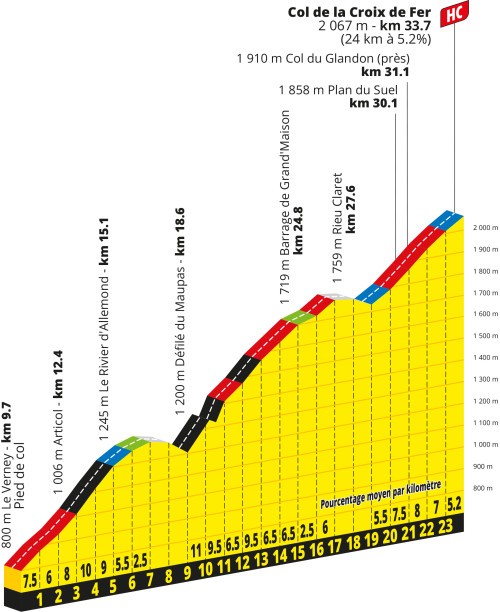
Le Bourg d’Oisans sits at the foot of both Alpe d’Huez and the Croix de Fer, and the stage heads straight up the latter almost from the flag. Steeper ramps alternate with short downhill stretches throughout the climb’s 24 kilometres, making it a genuinely difficult one to find rhythm on — riders can’t settle into a single gear and pace for half an hour the way a more consistent gradient would allow.
Col du Télégraphe into the Galibier — almost 30km of uphill torture
Col du Télégraphe: Category 1 | 11.9km | 7.1% | km 87.6 Col du Galibier: Category HC | 17.7km | 6.9% | summit 2,642m
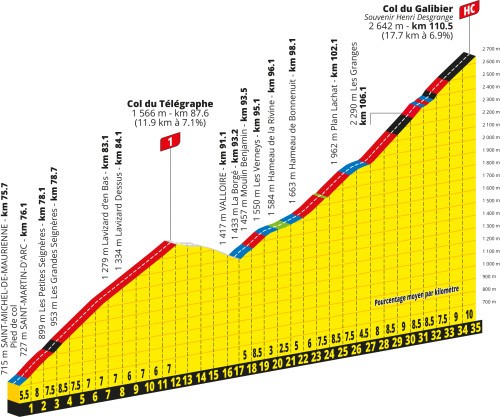
After the Croix de Fer descent toward Saint-Jean-de-Maurienne, the road turns back uphill at the Col du Télégraphe and essentially doesn’t stop for the next 30 kilometres. The Télégraphe runs almost directly into the base of the Galibier with barely a descent to separate them, riders crest one climb and are immediately climbing the next. The Galibier itself, cresting at 2,642 metres, is the highest point of the entire 2026 Tour de France and carries the Souvenir Henri Desgrange, a €5,000 prize awarded to the first rider over the race’s highest summit each year.
Col de Sarenne: the climb almost nobody wanted
Category HC | 12.8km | 7.3% average, kicking into double digits near the summit | km 156.5
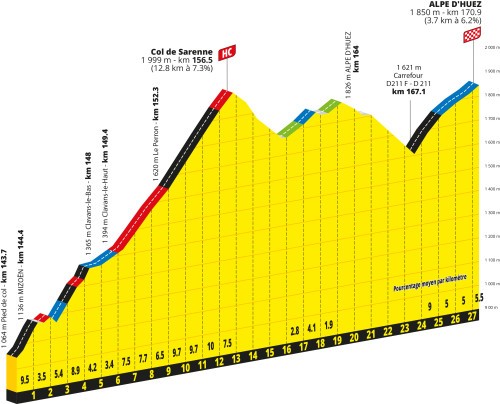
After a 30-kilometre descent toward Mizoën and the Lac du Chambon, Stage 20 tackles a climb that has never been raced this way before, and one that very nearly wasn’t raced at all.
Environmental campaigners, led by writer and activist Matthieu Stelvio, launched a petition months before the race calling for the Col de Sarenne to be removed from the route entirely. “The Col de Sarenne is one of those beautiful and rare places where you can still breathe pure air,” Stelvio wrote, arguing that ASO wanted to turn the mountain into “the world’s largest stadium.” His concerns centred on television helicopters disturbing nesting birds and delicate alpine flora being trampled by the hundreds of thousands of spectators an Alpe d’Huez stage typically draws. The petition gathered close to 6,000 signatures.
This wasn’t Stelvio’s first attempt. When the Tour last used the Sarenne in 2013, as a descent, not a climb, he ran an almost identical campaign that collected more than 12,000 signatures. ASO never responded to his open letter that time either.
Then the weather intervened. In late June, a severe heatwave with temperatures reaching 43°C across Western Europe sparked violent thunderstorms around Alpe d’Huez, and the Col de Sarenne was hit by two separate mudslides within the space of a single week. Crews cleared the road after the first slide, only for a second to strike days later, with the local weather service Météo Oisans sharing footage of mud and debris covering the mountain road. The incidents raised genuine questions about whether Stage 20 might need rerouting if the unstable weather continued. As it stands, the stage proceeds on its originally planned route, but the Sarenne arrives into this Tour carrying both an environmental controversy and a very real, very recent safety scare that most previews of this stage won’t mention at all.
There’s one more twist to the story: six days before the professional peloton tackles the Sarenne, roughly 16,000 amateur riders rode this exact route as part of L’Étape du Tour de France, the Tour’s flagship cyclosportive event — meaning the climb’s debut under real racing pressure was preceded by a dress rehearsal from thousands of recreational cyclists.
2013: the only precedent, and it wasn’t even a real climb
The Sarenne’s only prior Tour appearance came in 2013, and it doesn’t really compare to today. That year, the peloton climbed Alpe d’Huez itself first, then descended the Sarenne, approached from the opposite direction to today’s route, before climbing back up to Alpe d’Huez a second time, all within a single stage. Christophe Riblon produced the performance of his career that day, soloing to victory a full minute clear of Tejay van Garderen. Today’s stage reverses the whole sequence: the Sarenne is climbed, not descended, for the first time in Tour history, arriving as the last major obstacle before the finish rather than a mid-stage detour.
Full climb profile
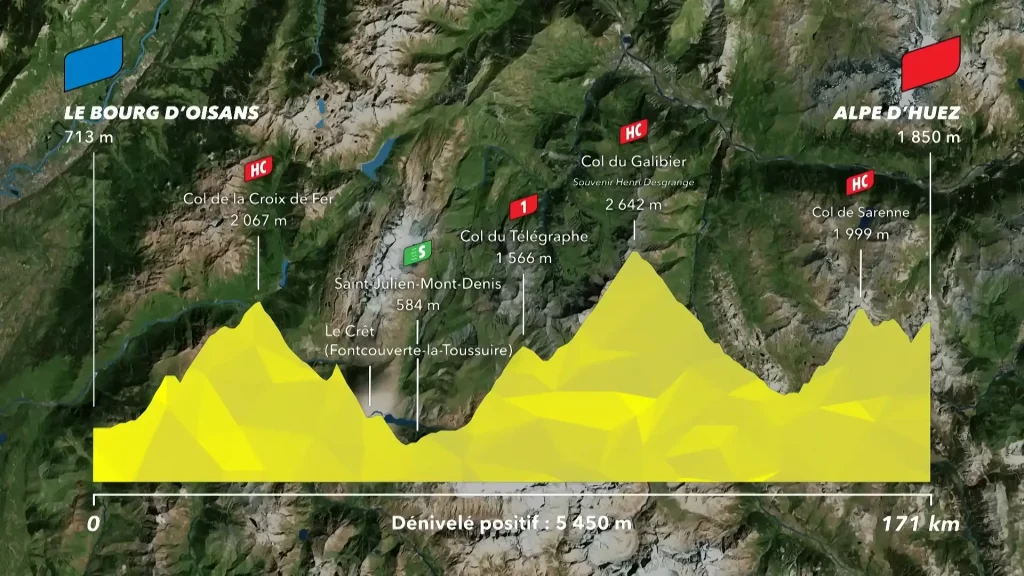
| Climb | Category | km marker | Distance | Avg gradient | Notes |
|---|---|---|---|---|---|
| Col de la Croix de Fer | Cat. HC | 33.7 | 24 km | 5.2% | Alternating steep ramps and short descents |
| Col du Télégraphe | Cat. 1 | 87.6 | 11.9 km | 7.1% | Runs almost directly into the Galibier |
| Col du Galibier | Cat. HC | 110.5 | 17.7 km | 6.9% | 2,642m — highest point of the 2026 Tour. Souvenir Henri Desgrange |
| Col de Sarenne | Cat. HC | 156.5 | 12.8 km | 7.3% | First time climbed (not descended) in Tour history. Gradient hits double digits near the top |
| Alpe d’Huez (final approach) | Cat. HC | 170.9 | Final 3.7km at 6.2% | 6.2% | Toughest ramps come early in the final section |
From the Sarenne’s summit, it’s 13 kilometres to the Alpe d’Huez finish, a downhill start, a rolling uphill section, a short drop, and then a final 3.7-kilometre climb averaging 6.2%, with the opening ramps the hardest part of that closing effort.
Alpe d’Huez, round two: can Pogačar do it again?
Today marks the 33rd time the Tour de France has finished on Alpe d’Huez, and the second time it’s happened in as many days — still, as of this Tour, the only occasion the race has ever used the mountain on consecutive stages. Whatever happens on the Croix de Fer, Télégraphe, Galibier, and Sarenne, the day’s biggest remaining question is what Pogačar does when the road tilts up toward Dutch Corner one more time. Does he go again, chasing another statement performance with the title all but sealed? Or does he ride within himself, protect the enormous gap he already holds, and let the stage go to whoever wants it more today? Both are entirely plausible. Neither changes what Saturday is already shaping up to mean for his place in the sport’s history.
The last live story: Seixas vs del Toro for the final podium spot
While the top of the general classification is largely decided, the battle for third place, and the white jersey that comes with it, remains genuinely open. Isaac del Toro holds it by just 24 seconds over Paul Seixas heading into the hardest stage of the entire Tour. Both riders cracked to some degree in yesterday’s early Alpe d’Huez ramps, finishing close together but clearly below their absolute best. A 24-second gap across 170.9 kilometres and over 5,000 metres of climbing is not a safe lead by any normal definition — it’s the one genuine GC story Stage 20 can still resolve, and it deserves as much attention today as the coronation happening above it.
Stage winner prediction
Top tier: Richard Carapaz enters in outstanding current form, having won Stage 18 outright and taken third on Stage 19; two podium-level rides in as many days is not a coincidence. Lenny Martinez, second yesterday, carries similar momentum. Tadej Pogačar himself can’t be ruled out of contesting the win, though with the title effectively secured, UAE may prefer he ride conservatively and protect the overall rather than chase another record.
Second tier: Riders from yesterday’s large early break, several of whom are legitimate GC names themselves, including Yanis Voisard and Davide Piganzoli, showed the legs to animate a hard stage and could do so again if the break is allowed real freedom today.
Third tier: Paul Seixas and Isaac del Toro are both more likely to be racing each other for seconds than for the stage win itself, given what’s actually at stake for them on this particular day.
World start times and how to watch
| Time zone | Region | Start | Est. finish |
|---|---|---|---|
| CEST (UTC+2) | France, Germany, Italy | 11:20 | ~16:29 |
| BST (UTC+1) | United Kingdom, Ireland | 10:20 | ~15:29 |
| EDT (UTC-4) | New York, Miami | 05:20 | ~10:29 |
| CDT (UTC-5) | Chicago, Dallas | 04:20 | ~09:29 |
| PDT (UTC-7) | Los Angeles, Seattle | 02:20 | ~07:29 |
| IST (UTC+5:30) | India | 14:50 | ~19:59 |
| AEST (UTC+10) | Sydney, Melbourne | 19:20 | ~00:29 +1 |
How to watch: France Télévisions carries the stage free in France. Eurosport 1 and HBO Max cover it across the rest of Europe. Spanish viewers have Teledeporte and RTVE Play free. UK coverage is on TNT Sports. In the US, NBC Sports and Peacock carry the stage, with FloSports covering Canada. See the complete live watching guide.
Rain, descents, and why this weather forecast matters more than usual
The forecast has Stage 20 starting dry at around 25°C before rain arrives by the finish, with temperatures still around 29°C despite the wet conditions. That’s a genuinely dangerous combination given the terrain: four major descents, including the technical drop off the Galibier and the entirely new, unfamiliar road surface of the Sarenne, all raced on tired legs on the final mountain day of the Tour. A dry, fast descent is one thing. The same road slick with rain, on a climb nobody has ever raced down before, is a different risk entirely — worth remembering given how many Tours have been shaped by a single crash on a wet mountain descent.
Equipment for the Tour’s hardest day
Between the sheer scale of climbing and the rain forecast for the finish, today is as much a test of descending setup as climbing gearing. Wider, more supple tyres and cautious brake-pad choices matter as much as any gearing decision on a day combining 5,450 metres of ascent with wet roads on unfamiliar tarmac.
Spectator guide and safety on the mountain
Dutch Corner, hairpin seven of the Alpe d’Huez climb, remains the epicentre of the crowd atmosphere for the second consecutive day, and the same caution applies as yesterday: arrive early, expect serious crowd density, and stay aware of your surroundings as riders pass through a narrowing road. With the Col de Sarenne now added to the route and carrying its own recent history of mudslides, anyone planning to view that section specifically should check for updated local access information before travelling, given the road’s unfamiliarity even to organisers.
Écrins National Park, the Maurienne Valley, and L’Étape du Tour
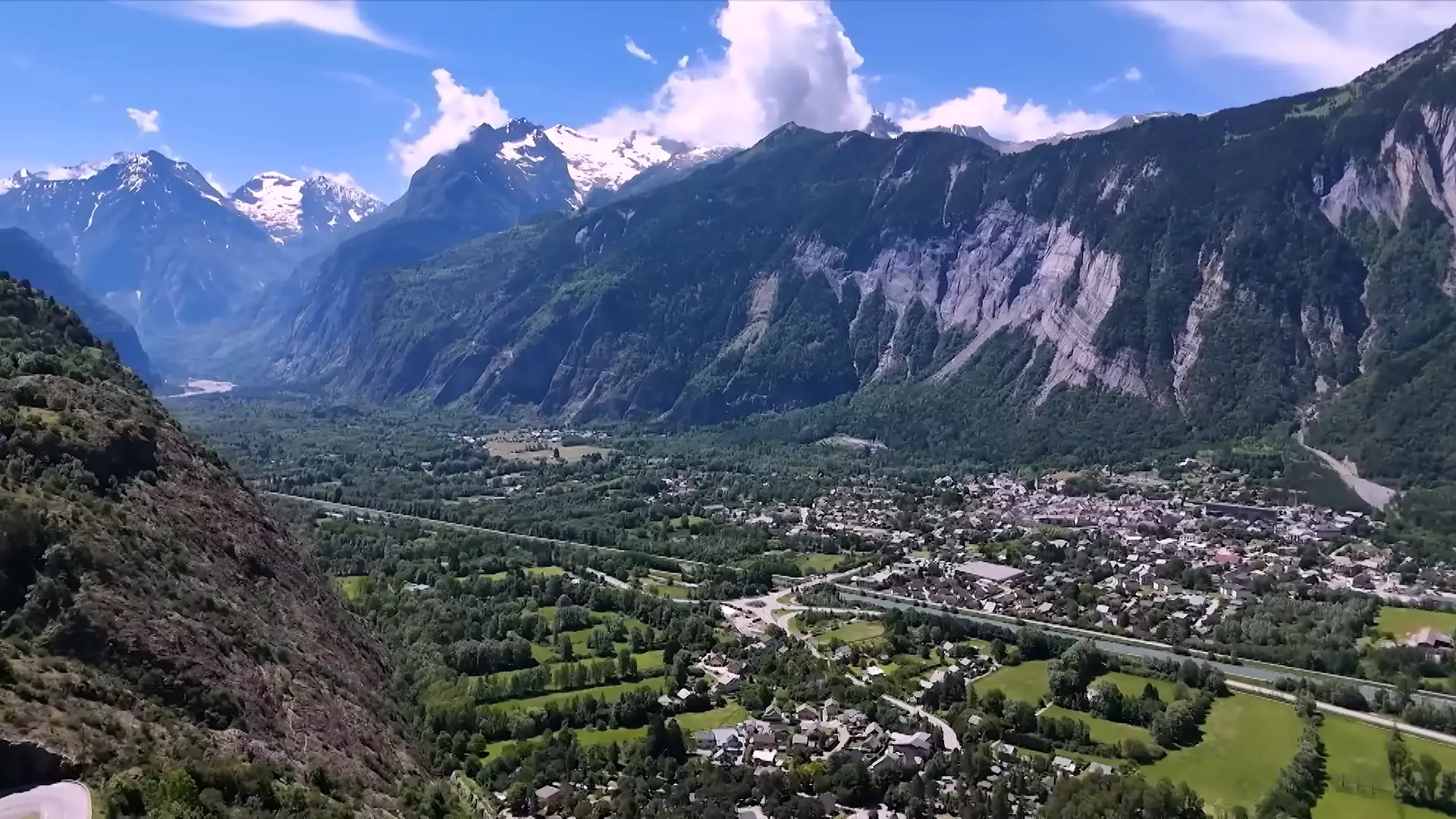
Stage 20 crosses some of the most dramatic high-altitude terrain in the French Alps, skirting the Écrins National Park and running the length of the Maurienne Valley beneath the Galibier. For anyone drawn to the route by today’s racing, it’s worth knowing the roads themselves are already a cycling pilgrimage independent of the Tour; the 16,000 amateur riders who tackled this exact course during L’Étape du Tour just six days earlier are proof the appeal extends well beyond professional racing.
FAQ — Tour de France 2026 Stage 20
What happened on Stage 19 and why does it matter for Stage 20?
Tadej Pogačar won Stage 19 to Alpe d’Huez by attacking early and soloing to the summit in 35 minutes 27 seconds, breaking Marco Pantani’s 1995 climbing record by more than two minutes. It was his first ever stage win on Alpe d’Huez and extended his overall lead to 7 minutes 11 seconds over Remco Evenepoel, making Stage 20 much less about who wins the Tour and more about the final podium places behind Pogačar.
What is the Col de Sarenne and why is it controversial?
The Col de Sarenne is a 12.8km climb making its debut as an ascent in Stage 20, having only previously featured as a descent in 2013. Environmental campaigners petitioned against its inclusion, citing concerns for nesting birds and fragile alpine flora, with the petition gathering close to 6,000 signatures. The climb was also hit by two separate mudslides in late June following a severe heatwave, though the route has proceeded as planned.
Who is leading the Tour de France 2026 heading into Stage 20?
Tadej Pogačar leads by 7 minutes 11 seconds over Remco Evenepoel heading into Stage 20, with Isaac del Toro third at 9:42 and Paul Seixas fourth at just 10:06, only 24 seconds behind del Toro. Pogačar is close to securing a fifth Tour de France title, which would tie the all-time record. See complete stage 19 rankings.
What is the highest point of the Tour de France 2026?
The highest point of the 2026 Tour de France is the summit of the Col du Galibier at 2,642 metres, reached during Stage 20. The first rider over the top wins the Souvenir Henri Desgrange, a prize traditionally awarded at the race’s highest point each year.
Has the Col de Sarenne featured in the Tour de France before?
The Col de Sarenne featured once before, in 2013, but only as a descent approached from Alpe d’Huez, between two same-day ascents of that mountain. Stage 20 in 2026 marks the first time the Sarenne has ever been climbed, rather than descended, in Tour de France history.
Is the podium still undecided in the Tour de France 2026?
The overall win is essentially decided, with Tadej Pogačar holding a 7:11 lead. However, the battle for third place and the white jersey remains genuinely open, with Isaac del Toro leading Paul Seixas by only 24 seconds heading into the hardest stage of the race.
What is the weather forecast for Stage 20?
The forecast has Stage 20 starting dry at around 25°C before rain arrives by the finish, with temperatures still near 29°C. Rain is expected to make the stage’s several technical descents, including the unfamiliar Col de Sarenne, considerably more hazardous than in dry conditions.
Did amateur cyclists ride the Col de Sarenne before the Tour de France?
Yes. Approximately 16,000 amateur riders tackled the same Col de Sarenne route during L’Étape du Tour de France, held six days before Stage 20 of the professional race, giving recreational cyclists a preview of the climb’s Tour debut.
How many times has Alpe d’Huez hosted a Tour de France finish?
Stage 20 marks the 33rd time Alpe d’Huez has hosted a Tour de France stage finish, and the second occasion in 2026 alone — the first time in the race’s history that the mountain has been used for finishes on consecutive days.