Tour de France Femmes 2026 Stage 7: La Voulte-sur-Rhône to Mont Ventoux — The Giant of Provence Meets Women’s Cycling for the First Time
Updated: 10:00 am CEST - Friday, 7 August 2026
Stage 7 of the Tour de France Femmes 2026 is a 146.8-kilometre stage from La Voulte-sur-Rhône to the summit of Mont Ventoux on Friday 7 August, carrying roughly 3,400 metres of elevation gain across three warm-up climbs before the mountain that gives the stage its entire meaning. The Bédoin ascent — 15.7 kilometres averaging 8.8%, rising to 1,910 metres- will host the first-ever women’s Tour summit finish on Mont Ventoux. The actual start rolls at 13:15 CEST, following a neutralised departure at 12:50, with the finish expected around 17:17.
Twelve seconds. That’s the entire gap between Marlen Reusser in yellow and Demi Vollering in second, heading into a mountain that has spent more than a century deciding races far more comfortably settled than this one. Kasia Niewiadoma-Phinney sits 1:17 back in an increasingly isolated third. Elisa Longo Borghini, who gambled on Thursday’s breakaway and won, has climbed to fourth at 2:28 with genuine momentum behind her. Every rider near the top of this general classification after stage 6 arrives at the foot of the Giant of Provence today knowing that whatever happens over the next 15.7 kilometres will very likely decide who wins this Tour in Nice two days from now.
TL;DR
- What is Stage 7? A 146.8km stage from La Voulte-sur-Rhône to a summit finish atop Mont Ventoux, the Tour de France Femmes’ first ever finish on the mountain. Three warm-up climbs precede the Bédoin ascent — 15.7km at 8.8% — before the finish at 1,910 metres.
- What just happened? Kim Le Court-Pienaar won a dramatic Stage 6 after overcoming a mechanical and being dropped, bridging back to the front group and winning the sprint. Reusser retained yellow, still leading Vollering by 12 seconds, with Niewiadoma-Phinney third and Longo Borghini rising to fourth after joining the winning breakaway.
- Why does today matter more than any stage so far? With just 12 seconds separating the top two overall, and a mountain notorious for producing decisive gaps, Stage 7 is realistically the last opportunity for the general classification to be settled before the race reaches Nice.
TDF Femmes Stage 7 key facts
| Detail | Confirmed data |
|---|---|
| Stage number | 7 of 9 — Queen Stage, first women’s Ventoux summit finish |
| Date | Friday, 7 August 2026 |
| Start | La Voulte-sur-Rhône (Ardèche) |
| Finish | Mont Ventoux summit (Vaucluse), 1,910m |
| Distance | 146.8 km |
| Elevation gain | ~3,400–3,565m |
| Neutralised start | 12:50 CEST |
| Actual start | 13:15 CEST |
| Est. finish | ~17:17 CEST (range 17:17–17:52 by pace) |
| Final climb | Bédoin ascent, 15.7km at 8.8% |
| Weather | Start ~30°C, sunny. Summit ~25°C with a sustained headwind forecast from Chalet Reynard onward |
How Stage 6 set the board for Ventoux
Kim Le Court-Pienaar’s Stage 6 victory is worth understanding properly before today, because it says something about the field’s current form heading into the mountain that matters most. She’d fallen from second overall to fifteenth after a difficult time trial, and Thursday didn’t start any better, a mechanical problem forced a bike change and left her briefly isolated behind the race. She fought back regardless, bridging to a six-woman breakaway inside the final ten kilometres, and launched a solo attack with five kilometres still to race. Elisa Longo Borghini hauled her back. Le Court-Pienaar then had to burn precious energy chasing down Riejanne Markus inside the final kilometre before still finding enough in the sprint to win outright. By her own account, the result “put a smile back on her face” after a rough week.
The overall standings tell a more measured story, but no less significant one. Reusser, Vollering, and Niewiadoma-Phinney raced Stage 6 together as a group, finishing 28 seconds behind the winning breakaway, meaning the gaps between them stayed exactly where they’d been after Stage 5. Reusser leads Vollering by 12 seconds and Niewiadoma-Phinney by 1:17. What changed was the picture beneath them: Longo Borghini’s decision to join Thursday’s breakaway paid off handsomely, lifting her from sixth to fourth overall at 2:28, ahead of Antonia Niedermaier in fifth at 2:40. Reusser’s own assessment after the stage was characteristically blunt: “I was really annoyed with myself, but I’m in yellow still.” That combination, mild self-criticism, genuine relief, captures a rider who knows exactly how thin her advantage is heading into today.
The route: three warm-ups, then the mountain that matters
The stage leaves La Voulte-sur-Rhône and heads into the Rhône valley before the first climb, the Col de la Grande Limite, arrives as a genuinely gentle introduction, 6.6 kilometres averaging 5%. After 41 kilometres in the saddle, the Col du Colombier adds a little more bite at 3.2 kilometres and 6.4%, though nothing here comes close to previewing what’s still to come. A long, largely uneventful stretch follows, dozens of kilometres where the road simply doesn’t tilt upward, before the terrain changes character again around the 100-kilometre mark.
The Dentelles de Montmirail closure
Before the Col de Suzette arrives, spectators need to know something important: the area from Suzette through the descent of the Col de la Chaine has been closed to fans entirely, due to wildfire risk in the Dentelles de Montmirail. The route itself hasn’t changed, the race still passes through exactly as planned, but anyone hoping to watch this specific stretch in person will need to find another vantage point elsewhere on the course.
Col de Suzette and the climbs nobody’s listing
Col de Suzette: Category 2 | 3.9km | 6.4%
Suzette itself is a genuine test, but it’s what follows that most previews of this stage skip entirely. The Col de la Chaine and the Col de la Madeleine both appear as named, timed points on the official route between Suzette and Bédoin, adding real additional climbing that the standard “three warm-up climbs” framing understates considerably. By the time the peloton reaches Bédoin and the foot of the main event, they’ve already covered far more accumulated elevation than a simple climb count would suggest.
Mont Ventoux – Explained
15.7km | 8.8% average | summit 1,910m
Here’s where a lot of coverage of this stage gets the shape of the climb slightly wrong, describing it as roughly fifteen kilometres at nearly ten percent throughout. That’s not how the Bédoin ascent actually rides, and the distinction matters enormously for understanding how the stage will unfold.
The climb opens with what every serious guide to this mountain describes as a deliberate trap: the first five to six kilometres out of Bédoin, through vineyards and orchards, average only around 4 to 4.4%. It feels easy. Riders who don’t respect that feeling and go out too hard here pay for it later, every single time. Then, right around the village of Saint-Estève, everything changes at once. The road plunges into dense forest and the gradient jumps immediately to a sustained 9 to 10%, with individual ramps touching 11 and 12%, and holds that brutal rhythm for roughly nine kilometres with essentially no recovery. This forest section, not the opening kilometres, and not quite the whole climb as a flat average, is the real heart of what makes Ventoux so feared.
At Chalet Reynard, roughly 1,420 metres above sea level and 6.2 kilometres from the summit, the trees disappear entirely and the road enters the pale limestone landscape that gives Mont Ventoux its lunar reputation. The gradient eases briefly here, but the fundamental character of the climb shifts rather than softens: exposure replaces gradient as the dominant threat. Wind, and this mountain’s mistral gusts are legendary for a reason, becomes as significant a factor as the road itself for the remaining kilometres to the transmitter mast at the top.
The Tom Simpson memorial
Roughly one kilometre from the summit, on the right-hand side of the road, stands a memorial to Tom Simpson, the British cyclist who died on this exact stretch of mountain during the 1967 Tour de France, one of the sport’s defining tragedies. Riders and cycling tourists alike traditionally stop here to pay their respects, even in the middle of a race; it remains one of the most solemn, significant sites in all of professional cycling, and its presence on today’s route is a reminder of exactly how much this mountain has always demanded of everyone who’s climbed it.
A mountain with a men’s Tour connection too
For anyone following both this race and the men’s Tour de France, Mont Ventoux carries a very recent record worth knowing. Tadej Pogačar currently holds the fastest recorded ascent from Bédoin — 54 minutes and 31 seconds, set during the 2025 men’s Tour de France, breaking a mark set by Iban Mayo in 2004 that had stood for more than two decades. The same brutal 15.7 kilometres the women’s peloton tackles today has already produced one of the most talked-about individual performances in recent men’s Tour history.
Full verified climb profile
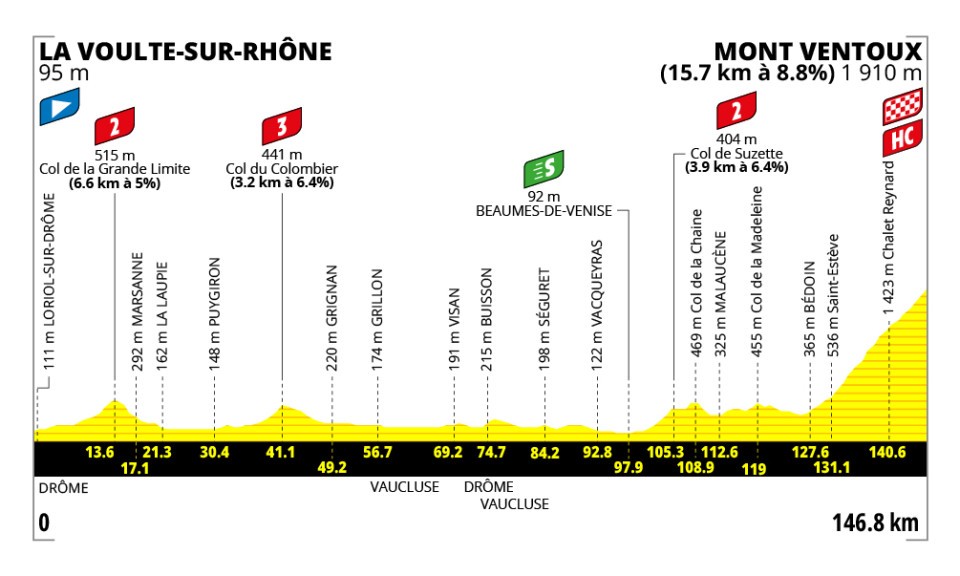
| Climb | Category | Distance | Avg gradient | Notes |
|---|---|---|---|---|
| Col de la Grande Limite | Cat. 2 | 6.6 km | 5% | Gentle opening test |
| Col du Colombier | Cat. 3 | 3.2 km | 6.4% | Arrives after 41km |
| Col de Suzette | Cat. 2 | 3.9 km | 6.4% | Dentelles de Montmirail — spectator area closed |
| Col de la Chaine | Uncategorised | — | — | Named route point, missing from most climb lists |
| Col de la Madeleine | Uncategorised | — | — | Named route point, missing from most climb lists |
| Mont Ventoux (Bédoin) | HC | 15.7 km | 8.8% | Opening 5-6km at ~4.4%, then 9km forest section at 9-10%, then exposed final 6km from Chalet Reynard |
Everyone has a Ventoux story
There’s a personal thread running through this stage that’s worth knowing before the racing starts. Demi Vollering has spoken about Mont Ventoux as the very first climb she ever rode as a cyclist — long before any of this, before the yellow jerseys and the Grand Tour ambitions, this exact mountain was where her cycling life effectively began. She returns to it today with a real chance to win the Tour de France Femmes on the same slopes. It’s the kind of full-circle story that doesn’t need embellishing, and it adds a layer of stakes to her ride today that goes beyond the 12 seconds separating her from yellow.
Stage winner and GC prediction
Demi Vollering enters as the rider with the most to gain and arguably the best profile for exactly this kind of sustained, brutal climb; she’s shown throughout this Tour that she can attack repeatedly on steep gradients, and Ventoux’s forest section is tailor-made for that kind of explosive, repeated effort. Marlen Reusser faces her hardest test of the race so far: a time trial specialist’s engine is built for sustained, even power output, not the kind of climbing where rivals can attack and force a response, which is precisely what Ventoux’s forest section invites. Kasia Niewiadoma-Phinney and Elisa Longo Borghini both carry genuine podium equity into today and have shown throughout the race that they belong in this conversation. Pauline Ferrand-Prévot, with her overall hopes already effectively gone, has every reason to attack from distance rather than ride conservatively — she has comparatively little left to protect and everything to gain from a bold, opportunistic ride.
World start times and how to watch
| Moment | CEST (France) | BST (UK) | EDT (USA) | AEST (Australia) |
|---|---|---|---|---|
| Actual start | 13:15 | 12:15 | 07:15 | 21:15 |
| Estimated finish | 17:17 | 16:17 | 11:17 | 01:17 +1 |
Schedule — France, UK, USA & Australia Time Zones
Times below use the official pace range (36 km/h fast, 32 km/h slow). UK is one hour behind CEST (BST); US Eastern is six hours behind (EDT); Australia is eight hours ahead (AEST).
| Point | Distance to Finish | CEST (France) | BST (UK) | EDT (USA East) | AEST (Australia) |
|---|---|---|---|---|---|
| Start — La Voulte-sur-Rhône | 146.8 km | 12:50 | 11:50 | 06:50 | 20:50 |
| Col de Suzette | 41.5 km | 15:17–16:06 | 14:17–15:06 | 09:17–10:06 | 23:17–00:06+1 |
| Bédoin (Ventoux ascent begins) | 21.8 km | 15:54–16:39 | 14:54–15:39 | 09:54–10:39 | 23:54–00:39+1 |
| Chalet Reynard | 6.2 km | 16:24–17:27 | 15:24–16:27 | 10:24–11:27 | 00:24–01:27+1 |
| Finish — Mont Ventoux | 0 km | 16:35–17:52 | 15:35–16:52 | 10:35–11:52 | 00:35–01:52+1 |
Most Crucial Viewing Window
Best join point: Bédoin, roughly 22 km to go (CEST 15:54–16:39 / BST 14:54–15:39 / EDT 09:54–10:39 / AEST 23:54–00:39+1). This is where the true 21.4 km Ventoux ascent begins — from here, every metre matters.
Do not miss Chalet Reynard onward (CEST 16:24 through the finish). The final 6 km strip away tree cover entirely, exposing riders to Ventoux’s infamous wind on the way to the Col des Tempêtes — this is where GC attacks land or die, and where a 12-second lead becomes almost meaningless in either direction.
Given the historic first-ever visit, the wildfire-related access restrictions, and a GC picture this tight, this is not a stage to join late — the entire broadcast from Bédoin onward is essential viewing.
How to watch: France Télévisions and France 2 carry the stage in France. Eurosport and HBO Max cover the race across the rest of Europe, with TNT Sports providing UK coverage.
Wind on the Giant of Provence
The forecast has a sustained headwind arriving from Chalet Reynard onward — precisely the section where riders leave the shelter of the forest and become fully exposed to Mont Ventoux’s notorious mistral gusts. That wind is not a minor detail on this mountain; it has shaped races here for decades, and a genuine headwind through the final six kilometres could meaningfully affect both pacing strategy and the timing of any decisive attack. Riders who go too early into a stiff headwind risk paying for it badly in the final kilometres, while a group that stays together longer than expected may simply be responding to conditions rather than tactics.
Spectator guide — Bédoin and the summit
With the Dentelles de Montmirail area closed to fans through Suzette and the Col de la Chaine descent, Bédoin becomes the practical hub for anyone watching this stage in person — both as a base town and as the starting point of the climb itself. The exposed final six kilometres from Chalet Reynard to the summit offer the most dramatic viewing of the entire stage, though spectators here should be prepared for the same wind and exposure the riders themselves will be contending with.