Tour de France Femmes 2026 Stage 5: Mâcon to Belleville-en-Beaujolais — Reusser’s 14 Seconds Meet the Beaujolais Wall
Updated: 4:29 am CEST - Wednesday, 5 August 2026
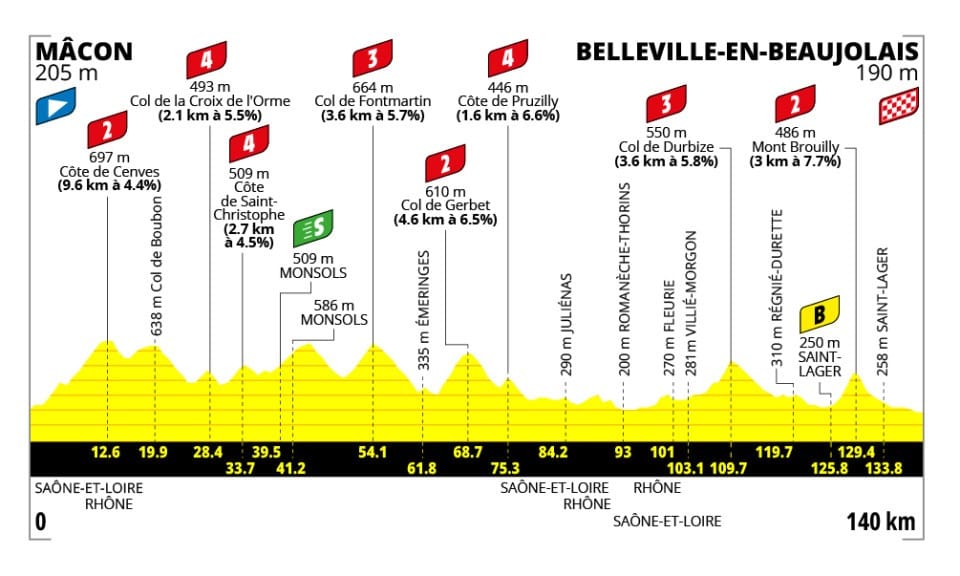
Stage 5 of the Tour de France Femmes 2026 is a 140-kilometre stage from Mâcon to Belleville-en-Beaujolais on Wednesday 5 August, carrying eight categorised climbs and roughly 2,850 metres of elevation gain through the vineyards of the Mâconnais and Beaujolais. The neutralised start rolls out at 13:45 CEST, with the finish expected around 17:41. Race director Marion Rousse has her own name for the stage’s final test: Mont Brouilly, 3 kilometres at 7.7%, cresting 11.6 kilometres from the line, which she’s called the day’s “juge de paix”, the judge of peace.
That framing lands differently than it would have a week ago. Marlen Reusser took the yellow jersey on Tuesday with a dominant time trial win, but her lead over Demi Vollering is just 14 seconds, thin enough that eight irregular Beaujolais climbs, capped by a genuine wall at Mont Brouilly, are fully capable of deciding the jersey all over again, one day after the clock already reshuffled the entire race.
TL;DR
- What is Stage 5? A 140km stage from Mâcon to Belleville-en-Beaujolais on Wednesday 5 August, with eight categorised climbs finishing atop Mont Brouilly, 11.6km from the line.
- What just happened? Marlen Reusser won Stage 4’s time trial outright and took the yellow jersey, with Demi Vollering just 14 seconds back in second. Sigrid Haugset, the previous race leader, lost her advantage entirely in the opening 10 kilometres of the TT.
- Why does today matter? Reusser’s lead is thin enough that this brutal, irregular stage, and Mont Brouilly specifically, could reshape the GC again before the race even reaches its hardest terrain later in the week.
Stage 5 Femmes key facts
| Detail | Confirmed data |
|---|---|
| Stage number | 5 of 9 |
| Date | Wednesday, 5 August 2026 |
| Start | Mâcon (Saône-et-Loire) |
| Finish | Belleville-en-Beaujolais — Avenue de l’Europe (Rhône) |
| Distance | 140 km |
| Elevation gain | ~2,850m |
| Neutralised start | 13:45 CEST |
| Est. finish | ~17:40–18:00 |
| TV coverage | Full flag-to-flag — one of only three stages with complete coverage this Tour |
| Weather | Start ~30°C, sunny. Finish ~32°C, sunny, light wind |
How Stage 4 reshaped everything
Marlen Reusser did exactly what a reigning world time trial champion is supposed to do. Her 27:30 over the 21-kilometre course between Gevrey-Chambertin and Dijon edged provisional leader Lieke Nooijen by roughly four seconds and delivered both the stage win and the yellow jersey. The bigger story, though, was what happened to the rider she took it from.
Sigrid Haugset arrived at Stage 4 with a 2-minute 10-second overnight lead, built on her stunning solo ride two days earlier. It didn’t survive the time trial’s opening act. By the 9.7-kilometre intermediate check, her advantage had shrunk to just five seconds, and she eventually finished 3 minutes 5 seconds down, a complete reversal that confirmed what most had suspected: the ability to suffer alone for 88 kilometres and the ability to pace a technical time trial are simply different skills.
Pauline Ferrand-Prévot’s day went almost as badly, though for different reasons. Racing her first serious time trial since returning to road competition, the defending champion lost 2 minutes 13 seconds to Reusser and dropped to 14th overall, a result that effectively ends her chances of defending her title outright, even with five stages still to race. The current standings tell the story clearly: Reusser leads, Vollering sits 14 seconds back, Cédrine Kerbaol holds third at 54 seconds, with Kasia Niewiadoma-Phinney around 1:08 back and Anna van der Breggen, who underperformed relative to expectations, at 1:17.
Vollering’s quiet act of resilience
One story from Stage 3 deserves more attention than it’s received. Demi Vollering crashed early in that stage, caught up in a fall that also involved Puck Pieterse, Noemi Rüegg, and Magdeleine Vallières, and she sat on the curb longer than anyone else involved before finally getting back on her bike. She continued through the finish in Poligny, but looked visibly stiff dismounting afterward, prompting her team to schedule a precautionary check-up rather than take any chances heading into the following day’s decisive time trial.
What she did next says plenty about her form and her mentality. Twenty-four hours after a crash serious enough to worry her own team, Vollering rode to second place in the Dijon time trial, finishing just 14 seconds behind Reusser, a result that would have been a strong ride on a good day, let alone one following a fall like that.
Today, you get to see all of it
There’s a broadcasting story running alongside this race worth knowing, and today happens to be the good news chapter of it. Only three stages of this Tour receive full flag-to-flag television coverage: Stages 1, 5, and 9. Every other day, live coverage begins partway through the race, typically around mid-afternoon, meaning entire sections of racing simply don’t get shown live. Stage 3 became the clearest example of the cost: both Vollering’s crash and Haugset’s race-winning, yellow-jersey-securing attack happened before cameras started rolling, forcing fans to rely on social media clips. TNT Sports presenter Orla Chennaoui called the situation “a disservice to women’s racing” and a “step backwards” for the sport.
None of that applies today. Stage 5 is one of the three complete-coverage days, meaning every climb, every attack, and everything Mont Brouilly produces will actually be shown as it happens, a rare full picture of a race that’s had to fight for exactly that kind of visibility.
The route: eight climbs, two sides of the same col, one brutal finale
The stage leaves Mâcon and immediately heads into the Mâconnais vineyards, Pouilly-Fuissé and Saint-Véran country, before the terrain turns properly hilly and stays that way for the rest of the day.
Côte de Cenves and the opening test
Category 2 | 9.6km | 4.4% average | km 12.6
The first categorised climb of the day arrives early and sets the tone: long rather than steep, the kind of climb that thins the peloton gradually rather than exploding it outright. A short descent leads into the uncategorised Col de Boubon (3.9km at 3%) before the road drops to the foot of the Col de la Croix de l’Orme.
Col de Gerbet — climbed twice, from two different sides
Category 2 | 4.6km | 6.5% average
This is a genuinely unusual feature of Stage 5 that almost nothing written about the stage mentions: the route crosses the Col de Gerbet twice, at kilometre 14 and again at kilometre 68.7, approached from two different directions each time. It’s not a repeated loop — it’s two entirely separate ascents of the same summit from opposite sides, adding a layer of terrain complexity to an already relentless day.
The middle stretch: Saint-Christophe, Fontmartin, Pruzilly
Between the two passages of the Gerbet, the route tackles the Côte de Saint-Christophe (2.7km at 4.5%), the uncategorised Col de Crie (4.3km at 4%), the Col de Fontmartin (3.6km at 5.7%), and the Côte de Pruzilly (1.6km at 6.6%), a stretch that, by the time riders reach the halfway point at Pruzilly, has already delivered the bulk of the day’s climbing without offering a single moment of genuine recovery.
Col de Durbize — deceptive on paper, brutal in reality
Category 3 | 3.6km | 5.8% average, ramps to 16% | km 109.7
After roughly 30 kilometres of relatively rolling respite, the Col de Durbize arrives as the stage’s most irregular test. Its 5.8% average sounds manageable. The reality is a climb that alternates flat sections with ramps touching 16%, building in progressive steps that make it feel considerably harder than the number suggests, race director Marion Rousse’s own route notes describe the approach through this section building difficulty in stages before the true test arrives.
Mont Brouilly — the judge of peace
Category 2 | 3km | 7.7% average | summit 11.6km from finish | km 129.4
Mont Brouilly closes the categorised climbing, and it does so brutally: three kilometres averaging 7.7%, with the second half offering little except double-digit gradients. Marion Rousse’s own description calls it the day’s juge de paix, the judge of peace, the climb that settles the argument. With the summit 11.6 kilometres from the finish and a descent followed by a false flat run-in, anyone who attacks here has real room to make it stick, but also real distance left for a chasing group to organise a response.
TDF Femmes stage 5 Full verified climb profile
| Climb | Category | km marker | Distance | Avg gradient |
|---|---|---|---|---|
| Côte de Cenves | Cat. 2 | 12.6 | 9.6 km | 4.4% |
| Col de Boubon | Uncategorised | ~20 | 3.9 km | 3% |
| Col de la Croix de l’Orme | Cat. 4 | 28.4 | 2.1 km | 5.5% |
| Côte de Saint-Christophe | Cat. 4 | 33.7 | 2.7 km | 4.5% |
| Col de Crie | Uncategorised | ~42 | 4.3 km | 4% |
| Col de Fontmartin | Cat. 3 | 54.1 | 3.6 km | 5.7% |
| Col de Gerbet (2nd side) | Cat. 2 | 68.7 | 4.6 km | 6.5% |
| Côte de Pruzilly | Cat. 4 | 75.3 | 1.6 km | 6.6% |
| Col de Durbize | Cat. 3 | 109.7 | 3.6 km | 5.8% (max 16%) |
| Mont Brouilly | Cat. 2 | 129.4 | 3 km | 7.7% |
Note: Col de Gerbet is also crossed earlier, around kilometre 14, from the opposite direction — the two ascents share a name and a summit but not a route.
Stage 5 winner and GC prediction
Demi Vollering enters as a genuine threat to the yellow jersey itself, explosive enough on terrain like this to test Reusser’s 14-second cushion directly, and clearly not diminished by her Stage 3 crash based on how she rode the time trial. Kim Le Court-Pienaar remains a strong stage-win candidate, with speculation about a possible tactical alliance with Vollering given their shared interest in distancing Reusser. Puck Pieterse, Noemi Rüegg, and Elisa Longo Borghini round out the strongest tier of climbers suited to this kind of irregular, punchy terrain.
Reusser herself is the rider under the most pressure today, not necessarily to win, but simply to limit her losses on terrain that suits pure climbers and puncheurs considerably more than it suits a rider built for sustained power efforts. Pauline Ferrand-Prévot, with her overall ambitions already damaged after Stage 4, has genuine incentive to attack rather than ride defensively, since she has comparatively little left to protect.
Belleville-en-Beaujolais: a finish town with real Tour history
Belleville-en-Beaujolais isn’t new to professional cycling, though its Tour de France connections are more recent than most Beaujolais wine towns can claim. The men’s Tour passed through in 2006, arriving after a stage out of the Alps, and used the town as a departure point in 2009, heading toward Saint-Étienne, and again in 2024, when the stage out of Belleville finished in Dijon and was won by Dylan Groenewegen. The town’s first Tour de France finish came only in 2023, when Jon Izagirre won there solo. Its very first professional cycling winner, however, predates all of that — Laurent Fignon won here in 1986, though that result came at the Critérium du Dauphiné rather than the Tour itself. Paris-Nice has also made stops in the town over the years.
World start times and how to watch
| Moment | CEST (France) | BST (UK) | EDT (USA) | AEST (Australia) |
|---|---|---|---|---|
| Neutralised start | 13:45 | 12:45 | 07:45 | 21:45 |
| Estimated finish | 17:41 | 16:41 | 11:41 | 01:41 +1 |
How to watch: France Télévisions and France 2 carry the stage free in France, with full flag-to-flag coverage today. Eurosport and HBO Max cover the race across the rest of Europe, with TNT Sports providing UK coverage.
Stage 5 Schedule — France, UK, USA & Australia Time Zones
Times below use the official pace range. UK is one hour behind CEST (BST); US Eastern is six hours behind (EDT); Australia is eight hours ahead (AEST).
| Point | Distance to Finish | CEST (France) | BST (UK) | EDT (USA East) | AEST (Australia) |
|---|---|---|---|---|---|
| Start — Mâcon | 140 km | 13:45 | 12:45 | 07:45 | 21:45 |
| Côte de Cenves | 127.4 km | 14:20–14:22 | 13:20–13:22 | 08:20–08:22 | 22:20–22:22 |
| Mont Brouilly summit | 10.6 km | 17:24–17:48 | 16:24–16:48 | 11:24–11:48 | 01:24–01:48+1 |
| Finish — Belleville-en-Beaujolais | 0 km | 17:41–18:07 | 16:41–17:07 | 11:41–12:07 | 01:41–02:07+1 |
Most Crucial Viewing Window
Best join point: Saint-Lager bonus sprint at the foot of Mont Brouilly, roughly 14 km to go (CEST ~16:27 onward). This is where the bonus seconds get contested right before the day’s decisive climb, a genuine early signal of who’s feeling strong.
If you can only catch one section, make it Mont Brouilly itself (CEST 17:24–17:48 / BST 16:24–16:48 / EDT 11:24–11:48 / AEST 01:24–01:48+1). The final kilometre averages 10% with ramps to 14%, exactly the kind of short, brutal ramp where a 14-second GC lead evaporates in under three minutes. Every preview agrees this is where the stage, and possibly the yellow jersey, gets decided.
Given how comprehensively this route is being described as the hardest of the race, don’t expect a quiet day anywhere after Cenves, but if your time is limited, Mont Brouilly is non-negotiable.
Spectator guide — Beaujolais wine country
Charnay-lès-Mâcon: The peloton passes through via the route de Bioux and route de Davayé, both closed to traffic from 11:00 to 14:30, with the race expected through around 13:53.
Romanèche-Thorins (Village 71): A genuine spectator destination in its own right, with all-day animations including a DJ, a BMX show, a giant screen, and local tastings. The caravan passes around 15:29, with riders following around 16:30.
Mont Brouilly: The premier late-stage viewing spot, given its role as the decisive climb of the day; expect a serious crowd for the stage’s defining moment.
Ride the route yourself: the amateur connection
Six days before the professional peloton tackles this route, an organised amateur ride covered the exact same course on 25 July, departing from the Place Saint-Germain in Fuissé and finishing at La Maison des Beaujolais in Belleville-en-Beaujolais — giving a group of recreational cyclists a preview of Stage 5’s demands under their own steam before the professionals ever arrived.
Mâconnais and Beaujolais — wine country start to finish
Stage 5 travels through two of Burgundy’s most celebrated wine regions in a single afternoon. It starts amid Mâconnais vineyards producing Pouilly-Fuissé and Saint-Véran, two of the region’s most respected white wine appellations, before climbing directly through Beaujolais Cru territory — Saint-Amour, Fleurie, and Villié-Morgon among the named appellations the route passes, each one a distinct, protected wine-growing area rather than a single generic “Beaujolais” designation. The Pierres Dorées, golden stone villages built from local limestone that glows amber in the afternoon light, add a distinctive visual character to this stretch of countryside that’s as much a regional landmark as the wine itself.