
Tour de France 2026 Stage 1: Complete Guide to the Barcelona Grand Départ Team Time Trial
Tour de France 2026 Stage 1 is a 19.7 km team time trial through the streets of Barcelona on Saturday, July 4, the opening shot of the 113th edition of the race. Watch live when Teams start from the Parc del Fòrum on the Mediterranean seafront, drive through the city core past the Sagrada Família, and finish on Montjuïc hill at the Lluís Companys Olympic Stadium. It is the first time the Tour has opened with a team time trial since 1971, and the new format, where each rider’s individual time is recorded rather than the traditional group time, turns this short opener into a genuine general classification event from the first evening.
TL;DR
- Stage 1 is a 19.7 km TTT in Barcelona on July 4, 2026 — first team off the ramp at 17:05 CEST, last team finishes around 19:15 CEST.
- Individual finish times replace the traditional group time — GC riders can go solo on Montjuïc and put time into rivals on day one.
- Route: Parc del Fòrum → seafront → Sagrada Família → Lluís Companys Olympic Stadium. Two ascents totalling ~200 m of elevation in the final 4 km.
- Montjuïc is the deciding factor: Côte de Montjuïc (1.1 km at 5.1%) → false‑flat descent → 800 m ramp at 7% to the line. Climbers versus rouleurs.
- First stage‑opening TTT since 1971 — when Eddy Merckx’s Molteni squad covered 11 km in Mulhouse to take the first yellow jersey of that edition.
What Is Tour de France 2026 Stage 1 Grand Départ?
Tour de France 2026 Stage 1 is the opening race of the 113th edition, a 19.7 km team time trial held entirely within the city of Barcelona on Saturday, July 4, 2026. It serves as the Grand Départ, the ceremonial and competitive start of the world’s most followed cycling race. Barcelona becomes only the third Spanish city to host a Grand Départ, after San Sebastián in 1992 and Bilbao in 2023, and the first time the Catalan capital has hosted an opening stage in the race’s 113-year history.
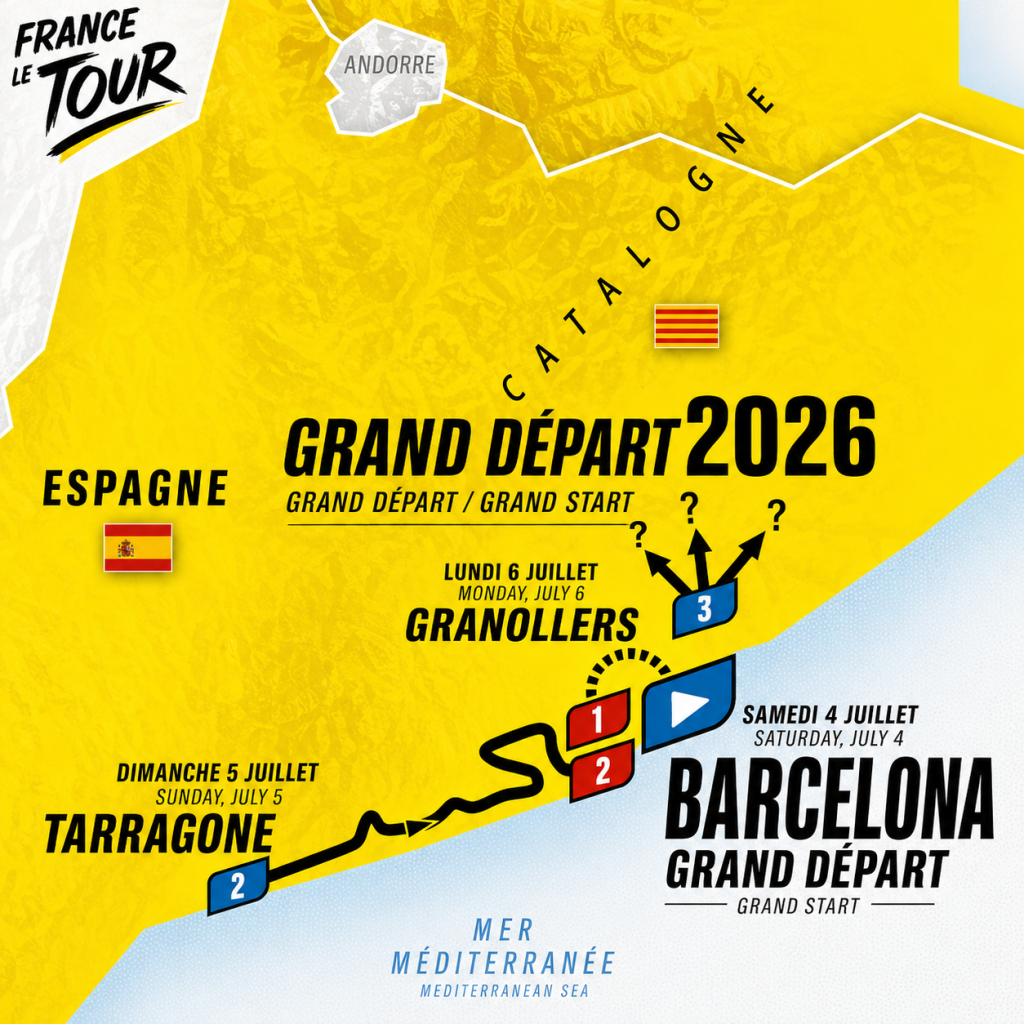
The format ASO chose for Stage 1, a team time trial, is a direct break from recent Tour tradition. It is the first time the race has opened with a TTT since 1971. But the mechanics go further than simple nostalgia. Rather than applying the traditional rule where the fourth or fifth rider’s time counts for the whole team, every rider in 2026 gets their own individual finish time. That single rule change turns a team event into a general classification test from minute one.
Stage 1 Date, Start Time, and Schedule: July 4, 2026
Stage 1 runs on Saturday, July 4, 2026. The first team leaves the ramp at Parc del Fòrum at 17:05 CEST. The last team is off at 18:55 CEST, and all riders are expected to have crossed the Montjuïc finish line by around 19:15 CEST. The evening start places the decisive Montjuïc finale in prime-time television across Europe — the BBC, Eurosport, and TNT Sport will have a full race window for UK viewers from around 16:05 BST, with the climax expected at 18:15 BST. North American viewers face a morning watch: 17:05 CEST is 11:05 EDT and 08:05 PDT. See the full Tour de France 2026 Stage-by-Stage Schedule.
Tour de France 2026 Stage 1 Route: Full Barcelona TTT Course Guide
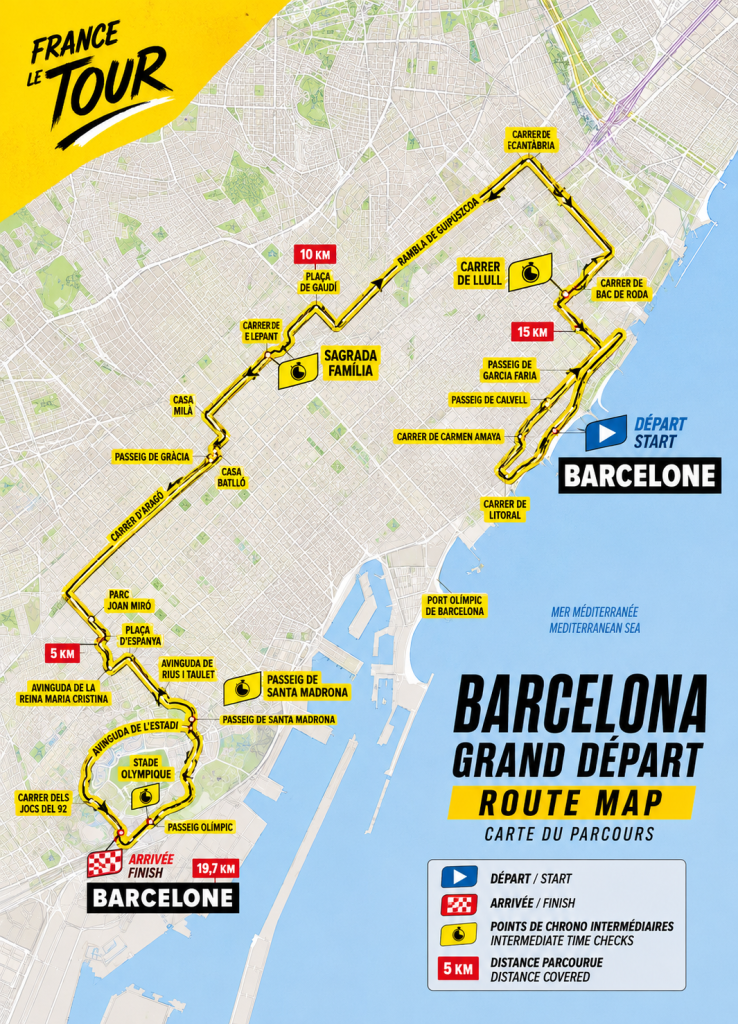
The Stage 1 route covers 19.7 km of Barcelona from northeast to southwest, from the open seafront of the Parc del Fòrum, through the grid of the Eixample district, and up to the hilltop stadium on Montjuïc. The course splits cleanly into two characters: a fast, flat coastal and urban section where teams will push near-maximum speed for the first 14 kilometres, then a hilly technical finale that breaks formations and tests individual climbing ability. Here is the Tour de France 2026 full route overview.
The Flat, Fast Opening: Parc del Fòrum to Port Olímpic
Teams roll off the start ramp at the Parc del Fòrum on the northeastern seafront. The first kilometres head southwest along the waterfront boulevard, passing the Port Olímpic, the marina built for the 1992 Barcelona Olympics. This stretch is fully exposed, wide, and arrow-straight. Teams will ride in tight echelon formation here, sharing the wind load, and speeds will peak above 60 km/h on the most aerodynamic outfits in the sport. For spectators, this is the easiest place to stand and see raw, unfiltered team speed at close range.
Through the City Core: Sagrada Família to Plaça d’Espanya
From the seafront, the route cuts inland along Carrer d’Aragó, one of the long diagonal streets that defines the Eixample grid. The teams pass directly in front of the Sagrada Família, Antoni Gaudí’s unfinished basilica, on one of cycling’s most visually striking backdrops. The route then follows Passeig de Gràcia south, alongside the façades of Casa Batlló and Casa Milà, before skirting Parc Joan Miró and arriving at Plaça d’Espanya.
This stretch is where teams manage their effort. The roads are still wide and largely flat, but the slight turns and intersections break the pure aerodynamic rhythm of the seafront. Sports directors in the team cars will be watching power data closely, too much here means nothing left for Montjuïc.
The Sting in the Tail: Montjuïc and the Olympic Finish
At Plaça d’Espanya, the route turns and rises. Everything changes.
The Côte de Montjuïc begins. It is 1.1 km at an average gradient of 5.1%. Not extreme by mountain stage standards. But these riders have just covered 14 km at maximum effort. The rouleurs, the flat-road specialists who dragged the GC leaders through the city, start to crack. The formation breaks. And the rule that makes 2026 different from every previous Tour TTT kicks in: each rider is on their own time.
A brief false-flat descent of around 1 km follows the first climb, offering a moment to recover before the road rises again for the final push. The Côte du Stade Olympique: 800 metres at 7%. This is the steepest sustained section of Stage 1. The finish line sits at the Lluís Companys Olympic Stadium, the venue that hosted the 1992 Olympic Games athletics, now framing the most dramatic moment of the Tour’s opening day.
Tour de France 2026 Stage 1 Elevation Profile
How Hard Is the Montjuïc Finish?
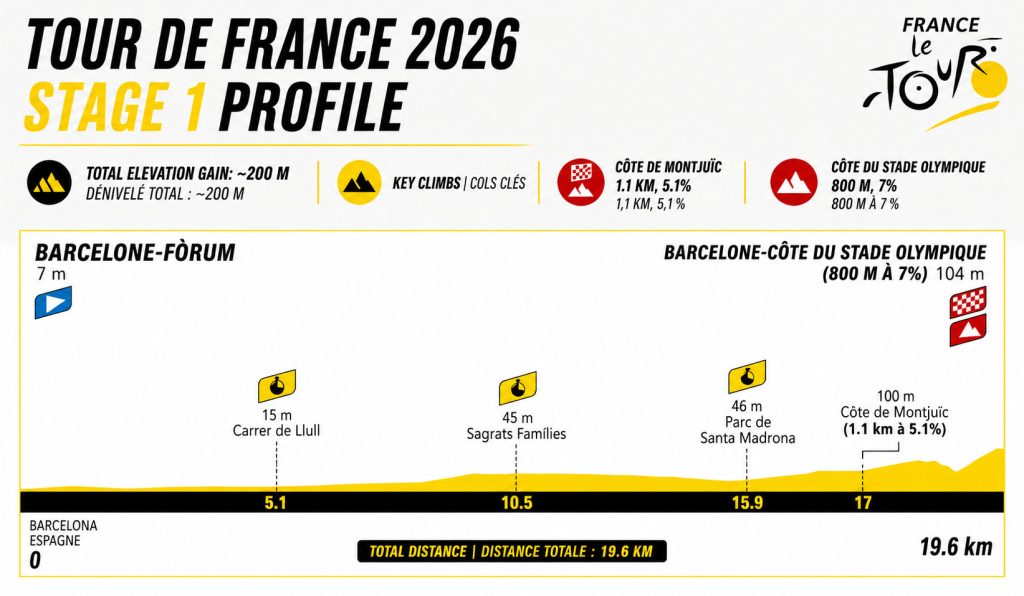
Stage 1’s elevation profile is largely flat for the first 14 km, a characteristic that makes the final 4 km all the more punishing in context. Total elevation gain across the full 19.7 km sits at approximately 200 metres, with virtually all of it concentrated in two successive climbs near the finish.
Climb-by-Climb Breakdown
| Climb | Length | Average gradient | Max gradient | Category |
|---|---|---|---|---|
| Côte de Montjuïc | 1.1 km | 5.1% | ~8% | Unclassified |
| False‑flat descent (not a climb) | ~1.0 km | slight negative | — | — |
| Côte du Stade Olympique | 0.8 km | 7.0% | ~10% | Unclassified |
For context: the final 800 metres at 7% average is steeper than the lower flanks of Alpe d’Huez (which averages 8.1% over its full 13.8 km length but has several easier sections). In an individual time trial, a 7% ramp for 800 metres at race pace demands around 6.0–6.5 W/kg from a WorldTour climber. After 14 km of TTT effort, even elite GC riders will be running on empty by the time they hit that final ramp.
For amateur cyclists: both Montjuïc climbs are accessible year-round and well-known among Barcelona’s cycling community. The full circuit, including the descent, is a popular training loop. The Côte du Stade Olympique is a standard Strava segment; the Stage 1 race times will be worth benchmarking against your own.
How Does the 2026 Tour de France Stage 1 TTT Work? The New Rules Explained
In Tour de France 2026 Stage 1, every rider receives their own individual finish time, recorded at the moment they personally cross the line on Montjuïc, not the time of the fourth or fifth rider as in a traditional team time trial. The stage winner is the first rider across the line from the winning team. The first yellow jersey goes to the individual rider who finishes fastest overall.
Traditional TTT vs. the 2026 Format
| Rule | Traditional TTT | 2026 Tour Stage 1 |
|---|---|---|
| How team time is recorded | Time of the 4th or 5th rider across the line | Not applicable — no group time |
| How GC time is recorded | All riders get the same time as the team | Each rider gets their own individual finish time |
| GC incentive to leave teammates | None — the team time is what matters | High — climbing faster earns a personal time gain |
| First yellow jersey goes to | Fastest team’s designated leader | Individual fastest rider overall |
| Format precedent | Standard Grand Tour TTT | First used at the Tour; trialled at Paris-Nice 2023 |
ASO trialled this format at Paris-Nice in 2023. It encourages more aggressive individual racing on the climbs while still rewarding team cohesion on the flat sections. A GC rider whose team is 10 seconds slower than the best team can still gain time on rivals if he attacks solo on the final ramp and crosses the line 15 seconds clear of his nearest competitor.
How the TTT Format Affects the General Classification on Day One
The implications are significant. In a traditional TTT, a GC rider has no incentive to separate from teammates; doing so saves a few seconds personally but potentially costs the team its group time. In 2026, the calculus reverses. On Montjuïc, the strongest climbers in the peloton face a genuine decision: stay with the team, or go.
Can Pogačar afford to sit up and wait for his UAE teammates on the final ramp? Probably not, Vingegaard’s team at Visma–Lease a Bike is one of the best TTT squads in the world, and Vingegaard himself is an excellent time trialist. If Visma goes faster as a team and Vingegaard also goes harder individually on the climb, Pogačar could find himself in yellow jersey deficit by evening on the very first day of racing.
That is the tension ASO has engineered. Three weeks of racing, and the GC battle begins within hours of the start flag.
Stage 1 Favourites: Which Team Takes the First Yellow Jersey?
The TTT format rewards teams with depth, aerodynamic cohesion, and at least one elite individual time trialist to send up the Montjuïc ramp alone. Three teams stand clearly above the rest.
Visma–Lease a Bike arrives as the most well-rounded TTT squad in the race. Their 2023 Tour prologue and various stage-race TTTs have shown a team that trains this discipline more systematically than any other. Jonas Vingegaard is a two-time Tour winner and a strong individual time trialist. On a course with two climbs at the finish, his ability to go deep on the final ramp while his teammates are still setting pace on the lower slopes is a substantial tactical weapon.
UAE Team Emirates-XRG will point their operation at Pogačar. The team has the raw power to match Visma on the flat sections, and Pogačar on the Montjuïc finale is arguably the fastest climber in the peloton. Whether the UAE’s support riders can hold the pace long enough on the 5.1% section before Pogačar goes solo is the question.
Red Bull–BORA–Hansgrohe has the deepest individual time trial roster of the three. Remco Evenepoel is arguably the best pure time trialist in the world — his individual effort up the 7% ramp could be faster than anyone else in the race. If Red Bull–BORA holds competitive pace on the flat sections, Evenepoel going full gas on the climb might be the fastest individual time of the evening.
What the Montjuïc Climb Means for Pogačar, Vingegaard, Evenepoel, and Seixas
Pogačar will likely detach from teammates at the bottom of the Côte de Montjuïc and race the final 4 km individually. His 2024 climbing numbers, 6.88 W/kg sustained on Plateau de Beille, suggest he can handle the short punchy finale at close to that output.
Vingegaard benefits from a stronger team around him. Visma will keep him sheltered and paced through the flat city sections, meaning he hits the first climb fresher than most GC rivals. He may ride the first climb at team pace, then judge the final 800 metres.
Evenepoel is the wildcard for the individual top time. He went under 20 minutes for the 2024 Olympic individual time trial. The Montjuïc ramps are precisely the kind of punchy, short climb where his engine is most dangerous.
Paul Seixas, the 19-year-old French debutant and the most talked-about name of the 2026 Tour, arrives at this stage without the TTT infrastructure of the three top GC teams. His team’s result matters less here than how he comes through the finale physically. Christian Prudhomme said before the race that Seixas will enter Tour de France legend. Stage 1 is not where that story starts — but how he climbs Montjuïc gives the first data point on what he can do.
Dark Horses: Which Teams Could Surprise?
Alpecin–Deceuninck have Mathieu van der Poel in their roster, a rider who can produce enormous power on a short punchy finish and whose individual time up the ramp could rival the GC riders. If their team cohesion holds on the flat sections, they are capable of a top-three team time.
INEOS Grenadiers were the definitive TTT team of the 2010s. Their collective culture around timed efforts has not disappeared, and on a course with a punchy climb, their roster of diesel-engine rouleurs and Geraint Thomas’s experience could produce a competitive result.
Lidl–Trek are worth watching for the individual time on Montjuïc. Their roster includes riders who can push hard up a short ramp, and in a format where individual times matter, their GC leader’s climb could be meaningful.
Why Barcelona? The History Behind the 2026 Grand Départ
Barcelona is only the third Spanish city to open the Tour de France, following San Sebastián in 1992, the same year Barcelona hosted the Summer Olympic Games, and Bilbao in 2023. The Tour had previously visited Barcelona in 1957, 1965, and 2009, but never as a race start. The 2026 edition makes that historic first.
Race director Christian Prudhomme described the choice as a natural progression. Barcelona is a world-class sporting city, a Mediterranean hub with cycling infrastructure, and a venue familiar to the professional peloton through the Volta a Catalunya and the Vuelta a España. Many of the roads used in Stage 1 and Stage 2 will be recognisable to riders who have raced in Catalonia before.
The finish at the Lluís Companys Olympic Stadium on Montjuïc adds a layer of symbolism. This is the exact site of the 1992 Olympic Games athletics — the venue where the world watched one of the most dramatic Olympic finales in history. Thirty-four years later, the Tour de France arrives at the same stadium to crown its first yellow jersey of 2026.
Barcelona’s mayor, Jaume Collboni, called the city a “world capital of sport” at the official announcement, and for three days in July 2026, the roads that normally carry six lanes of traffic will carry the fastest cyclists on the planet.
The Last Time the Tour Opened with a TTT: The 1971 Mulhouse Prologue
The last time the Tour de France began with a stage-opening team time trial was June 26, 1971. The prologue of the 58th edition ran 11 km in Mulhouse, starting and finishing in the same city. Eddy Merckx’s Molteni team won it, covering the distance in 1 hour 5 minutes 16 seconds. Merckx took the first yellow jersey. He went on to win the overall despite one of the most dramatic challenges ever mounted against him, by Luis Ocaña of Spain, who at one point held a lead of nearly nine minutes before crashing out in the mountains.
Fifty-five years separate that Molteni TTT and the 2026 Barcelona edition. The sport looks entirely different. The bikes, the aerodynamics, the power data, the tactical sophistication, all unrecognisable from 1971. But the basic question remains: which team controls the first hour, and which rider wears yellow when the sun sets on Barcelona?
Where to Watch Tour de France 2026 Stage 1 in Barcelona: Best Spectator Spots
Stage 1 is one of the most spectator-accessible openings in Tour history. Barcelona’s wide boulevards, open seafront, and compact urban layout mean there are multiple excellent viewing positions spread across the full 19.7 km route. All are free to access. The race passes through each point at high speed, teams take roughly 15–20 minutes from start to finish, so arriving early is essential.
Traditional TTT vs. the 2026 Format
| Rule | Traditional TTT | 2026 Tour Stage 1 |
|---|---|---|
| How team time is recorded | Time of the 4th or 5th rider across the line | Not applicable — no group time |
| How GC time is recorded | All riders get the same time as the team | Each rider gets their own individual finish time |
| GC incentive to leave teammates | None — the team time is what matters | High — climbing faster earns a personal time gain |
| First yellow jersey goes to | Fastest team’s designated leader | Individual fastest rider overall |
| Format precedent | Standard Grand Tour TTT | First used at the Tour; trialled at Paris-Nice 2023 |
Montjuïc is where the race is decided. If you can only pick one spot, stand on the Côte du Stade Olympique, the final 800 metres at 7%. This is where formations break, GC riders go solo, and the first gaps of the 2026 Tour appear. The atmosphere on a steep urban climb during a Grand Départ is unlike anything in road cycling.
Getting There: Public Transport, Road Closures, and Parking
The entire Stage 1 route will be closed to motor traffic from approximately 13:00 CEST on July 4. The closures affect major arteries including Carrer d’Aragó, Passeig de Gràcia, and the Montjuïc access roads. Do not attempt to drive to any spectator zone on race day.
Barcelona’s metro network connects directly to all four main viewing zones. Line 4 (yellow) serves the Parc del Fòrum at the Maresme–Fòrum stop. Line 1 (red) runs to Sagrada Família directly. The Montjuïc funicular departs from Paral·lel station (Lines 2 and 3) and puts you at the base of the climb in under 10 minutes.
Bikes can be ridden along the course once roads are closed to vehicles, which makes cycling to your viewing spot a practical and fitting option. Walking along the seafront from the Port Olímpic to the Fòrum is around 20 minutes on foot.
Road closure information for specific side streets will be published by the Barcelona city authority in the days before the race — we will update the road closure info here.
Where to Stay for Stage 1: Barcelona Neighbourhood Guide
Book accommodation early. Barcelona in July is peak season regardless of the Tour, and the race will push demand further. Three neighbourhoods offer the best combination of route access and price point.
Sant Martí (Poblenou / Rambla del Poblenou area) sits directly between the Parc del Fòrum start and Port Olímpic. You can walk to both key viewing zones in under 15 minutes. A practical first choice for anyone who wants to see the race start.
Eixample (central district) puts you on the route itself — teams pass along Carrer d’Aragó and Passeig de Gràcia through this neighbourhood. Walk out of your hotel and the race comes to you. Slightly more expensive but unbeatable for convenience.
Poble Sec (foot of Montjuïc) is the closest residential area to the final climb. Hotels and apartments here book up fastest of all. If the Montjuïc finale is your priority, this is where to stay.
Weather and Wind: What Conditions Will Stage 1 Riders Face in Barcelona?
Barcelona in early July is warm, largely dry, and usually calm. Average daytime temperatures on July 4 sit between 25°C and 28°C (77–82°F), with lows at night around 21°C. Rain is rare ,the city records an average of only 20mm of precipitation across the entire month of July. For a late-afternoon TTT starting at 17:05, temperatures at race time will likely be between 26°C and 29°C — warm but not extreme.
Wind is the variable that matters most for a team time trial. Barcelona’s July average wind speed is approximately 14–15 km/h, with the predominant direction influenced by the sea breeze off the Mediterranean. The coastal section from Parc del Fòrum to Port Olímpic runs roughly southwest, meaning a typical afternoon sea breeze could be a partial crosswind or light headwind on the opening kilometres. At 14 km/h, that wind is not sufficient to cause echelon splits in a TTT; teams can maintain tight formation without the kind of crosswind drama that appears on exposed roads in the north of France.
The Montjuïc climbs are relatively sheltered from wind, given their urban position and the topography of the hill. The main weather concern for teams is heat management. Starting a maximum-effort TTT at 17:05 in near-30°C conditions puts heat stress on every rider, particularly those who will be working at the front of the formation for extended periods.
Teams will pre-cool in the final two hours before their start time. Expect ice vests, cold towels, and pre-race hydration protocols at the team buses, standard Grand Tour TTT procedure in warm conditions.
How Does Stage 1 Set Up Stage 2? The Three-Day Barcelona Block Explained
Stages 1, 2, and 3 form a distinct tactical unit, three days of racing on Spanish and Catalan soil before the Tour crosses into France for good on Stage 3.
Stage 2 on July 5 runs from Tarragona north to Barcelona — a hilly, punchy stage that finishes on Montjuïc again, this time on the harder Côte du Château de Montjuïc (1.6 km at 9.3%), which is meaningfully steeper than Stage 1’s finale. This is where the sprinters are gone and the puncheurs take over. Mathieu van der Poel and Wout van Aert will target Stage 2; so will any GC rider who wants time gaps before the Pyrenees.
Stage 3 on July 6 departs from Granollers and heads northwest toward Les Angles, crossing the Pyrenees for the first mountain test of the race. The race enters France here, and the GC battle shifts from urban roads to high-altitude passes.
Any time lost on Stage 1 through a poor TTT or a mechanical problem cannot be recovered until Stage 3 at the earliest. For a GC contender, Stage 1 is not just an opening ceremony, it is the first number on the scoreboard that will be added to or subtracted from every day for the next three weeks. That is why the new individual timing rule matters so much. There is nowhere to hide on Montjuïc, and there is no team to protect you once you hit that 7% ramp.