
Tour de France 2026 Route: Complete Stage-by-Stage Guide, Elevation Profiles & Maps
Last updated: 10:09 pm CEST - Wednesday, 29 July 2026
This is the complete Tour de France 2026 route guide, all 21 stages with confirmed elevation profiles, climb gradients, week-by-week breakdown, new climbs, summit finish profiles, spectator access guide, and road closure information. The route runs from Barcelona on July 4 to the Champs-Élysées in Paris on July 26, crossing five mountain ranges, the Pyrenees, Massif Central, Jura, Vosges, and Alps, across 3,333 km.
Tour de France 2026 route Map
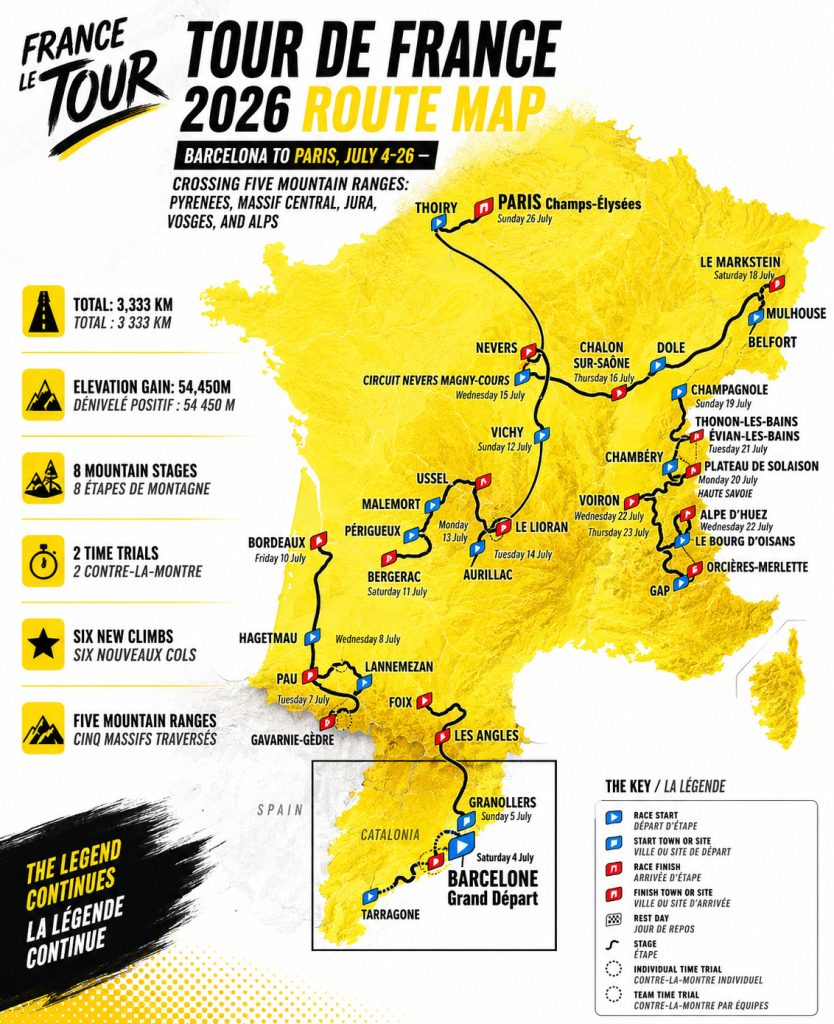
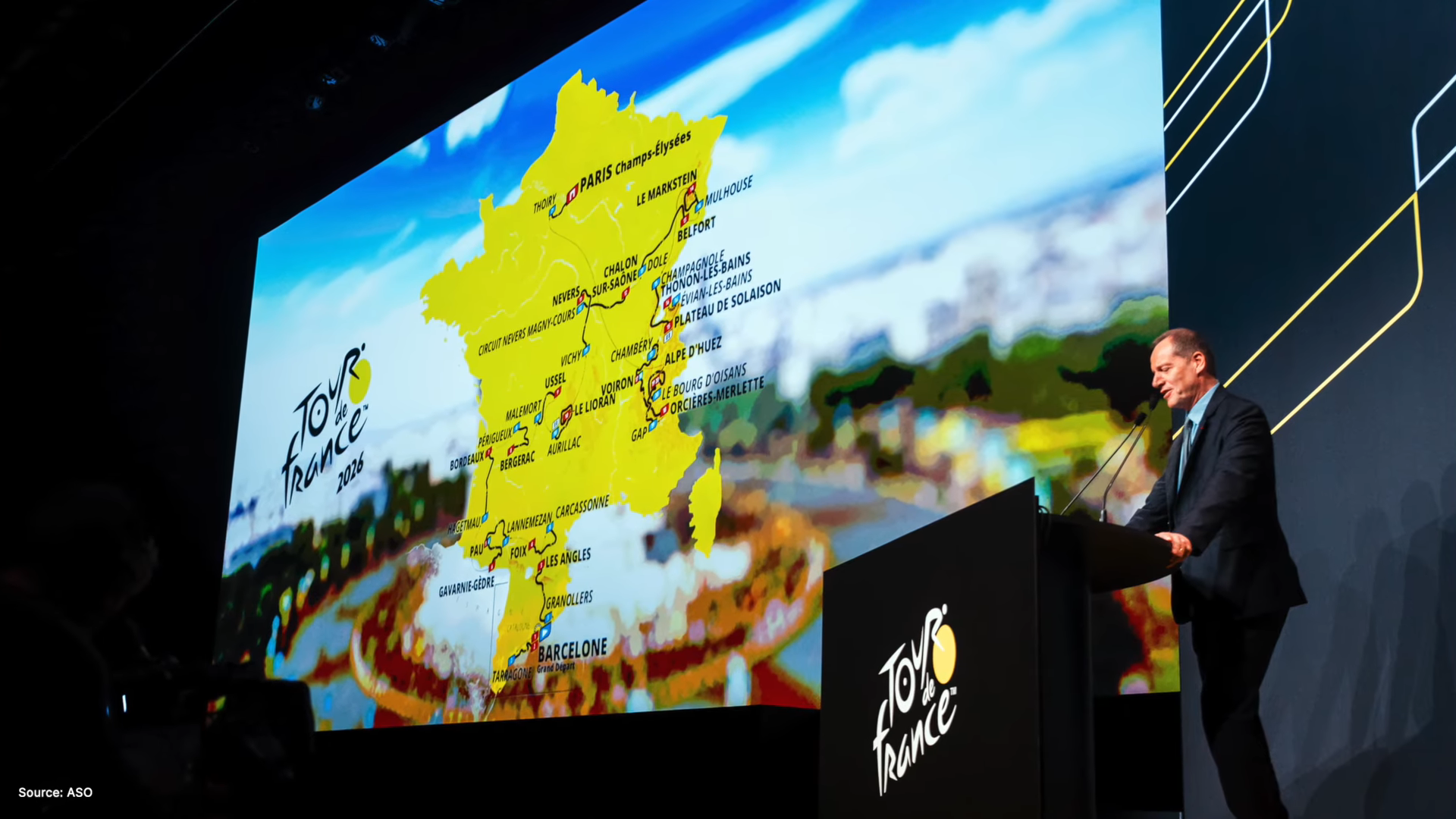
The 2026 route was revealed on October 23, 2025, at the Palais des Congrès de Paris. Race director Christian Prudhomme presented it to an audience of approximately 3,500. The architecture is deliberate: the hardest opening week in modern Tour history, a single short time trial placed deep in week three, and back-to-back Alpe d’Huez summit finishes on consecutive days that have never been attempted in 113 editions of the race. There are 30 major categorised climbs, the same total as the highly regarded 2023 edition, 6 of them new to the Tour route, and the highest point at the Col du Galibier summit at 2,642 metres.
Tour de France 2026 Route Overview — Regions, Departments & Map
The Tour de France 2026 route was designed to feel like a Grand Tour in the original sense: a race that physically crosses France rather than concentrating its stages in one or two regions. Starting on foreign soil in Catalonia, it sweeps across the southwest via the Pyrenees, cuts through the volcanic plateau of the Massif Central, rolls through Burgundy wine country, climbs the forested granite peaks of the Vosges, drops into the Jura, then finishes with a brutal Alpine week before the Paris finale.
Complete Tour de France 2026 Stage Schedule — All 21 Stages
Every stage confirmed by ASO at the October 23, 2025, route presentation and cross-referenced against the May 2026 technical guide. Key mountain stages highlighted. See the detailed Tour de France 2026 Stage-by-stage Schedule.
Tour de France 2026 – Full Stage Schedule
| # | Date | Type | Route | km | mi | Key Climbs / Notes |
|---|---|---|---|---|---|---|
| 1 | Jul 4 | TTT | Barcelona → Barcelona | 19.7 | 12.2 | Côte de Montjuïc ×2 · First Stage-1 TTT since 1971 |
| 2 | Jul 5 | Hilly | Tarragona → Barcelona | 178 | 111 | Côte de Begues (NEW) · Montjuïc circuit |
| 3 | Jul 6 | Mountain | Granollers → Les Angles | 196 | 122 | Toses 9.3km/6.5% · Calvaire 14.9km/4.1% · Les Angles summit |
| 4 | Jul 7 | Hilly | Carcassonne → Foix | 182 | 113 | Coudins 10.5km/5.5% · Montségur 6.9km/6.6% |
| 5 | Jul 8 | Flat | Lannemezan → Pau | 158 | 98 | Sprinters’ first clean opportunity |
| 6 | Jul 9 | Summit ⭐ | Pau → Gavarnie-Gèdre | 186 | 116 | Aspin 12km/6.5% · Tourmalet 17km/7.3% · Gavarnie 18.7km/4% (NEW) |
| 7 | Jul 10 | Flat | Hagetmau → Bordeaux | 175 | 109 | Fast run to Bordeaux · First Hagetmau start |
| 8 | Jul 11 | Flat | Périgueux → Bergerac | 182 | 113 | Dordogne valley flat |
| 9 | Jul 12 | Hilly | Malemort → Ussel | 185 | 115 | 3,400m climbing · No flat km · Pre-rest-day test |
| — | Jul 13 | REST DAY 1 | Cantal Region | — | — | — |
| 10 | Jul 14 | Summit ⭐ | Aurillac → Le Lioran (BASTILLE DAY) | 167 | 104 | Col de la Griffoul (NEW) · Puy Mary · Pas de Peyrol |
| 11 | Jul 15 | Flat | Vichy → Nevers | 161 | 100 | Loire Valley sprint |
| 12 | Jul 16 | Flat | Circuit Magny-Cours → Chalon-sur-Saône | 181 | 112 | F1 circuit start · Echelon wind risk in Burgundy |
| 13 | Jul 17 | Hilly | Dole → Belfort (Longest Stage) | 205 | 127 | Jura hills · Breakaway specialist stage |
| 14 | Jul 18 | Mountain | Mulhouse → Le Markstein Fellering | 155 | 96 | Col du Page (NEW) · Col du Haag (NEW) · Grand Ballon · Le Markstein |
| 15 | Jul 19 | Summit ⭐ | Champagnole → Plateau de Solaison | 184 | 114 | Solaison 11.3km/9.1% (NEW summit finish) · Steepest avg of race |
| — | Jul 20 | REST DAY 2 | Haute-Savoie | — | — | — |
| 16 | Jul 21 | ITT | Évian-les-Bains → Thonon-les-Bains | 26 | 16 | Lake Geneva · Only solo ITT of race · Start from 12:30 CET |
| 17 | Jul 22 | Flat | Chambéry → Voiron | 175 | 109 | Isère valley · Last sprint chance |
| 18 | Jul 23 | Summit ⭐ | Voiron → Orcières-Merlette | 185 | 115 | Col de Manse · Col du Festre · Orcières summit · 3,950m climbing |
| 19 | Jul 24 | Summit ⭐ | Gap → Alpe d’Huez (Day 1) | 128 | 80 | Bayard 5.1km/7.2% · Noyer 7.2km/8.5% · Ornon · Alpe 13.8km/8.1% |
| 20 | Jul 25 | QUEEN ⭐⭐ | Le Bourg-d’Oisans → Alpe d’Huez (Day 2) | 171 | 106 | Croix de Fer · Télégraphe · Galibier 2,642m · Sarenne (NEW) · Alpe 3.8km/6.1% |
| 21 | Jul 26 | Flat | Thoiry → Paris Champs-Élysées | 130 | 81 | Montmartre ×3 (15km from finish) · Champs-Élysées |
⭐ Summit finish | ⭐⭐ Queen stage | NEW first-time climb · Total distance: 3,333 km
The Grand Départ Barcelona — Spain’s Route
Barcelona is only the third Spanish city to host a Tour de France Grand Départ in 113 editions. San Sebastián opened the 1992 Tour; Bilbao started the 2023 edition; now Catalonia’s capital adds its name to a list that includes London, Brussels, and Copenhagen. Race director Christian Prudhomme told reporters at the October 2025 announcement: ‘Barcelona is a city of sport, a city that knows how to receive the world, a city of passion.’ The Tour de France 2026 route treats the city with genuine ambition: two stage finishes on Montjuïc in two days.
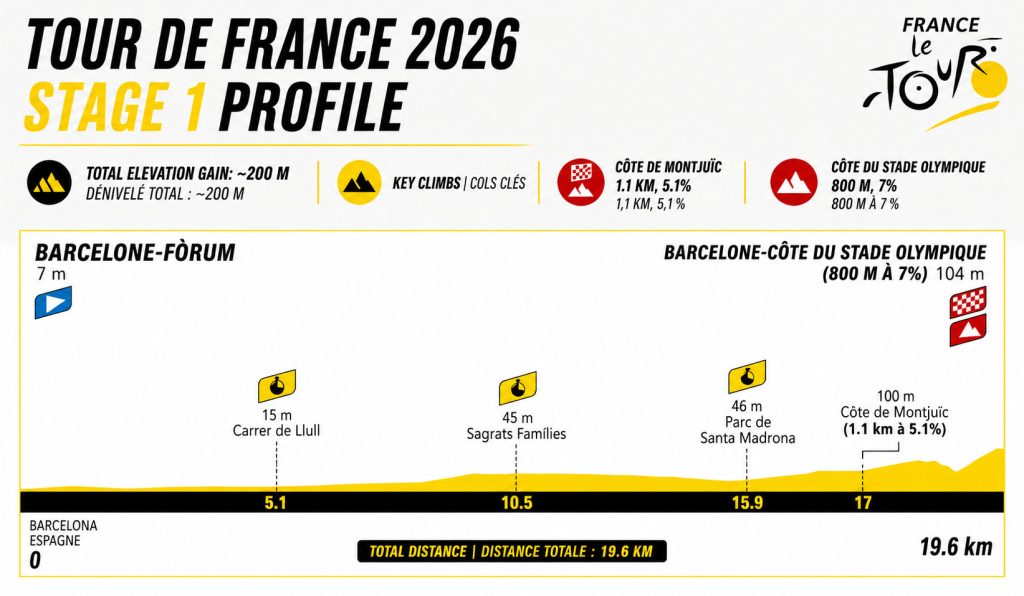
Stage 1 Route Profile — Barcelona TTT (July 4, 19.7 km)
The 2026 route starts near Barcelona’s seafront before the road sweeps past the Sagrada Família and climbs toward the Olympic complex on Montjuïc hill. The Côte de Montjuïc (1.1 km at 5.1%) and the Côte du Stade Olympique (1.1 km at 5.1%) define the final 4 km. Crucially, ASO uses the individual finish time format first trialled at Paris-Nice 2023 — each rider’s own time is recorded at the line, not the traditional fourth-rider team time. Teams will lead out their GC leaders into the two Montjuïc climbs for a de facto sprint. The first stage-1 TTT in the Tour since 1971. The first-ever stage finish adjacent to the 1992 Olympic venue.
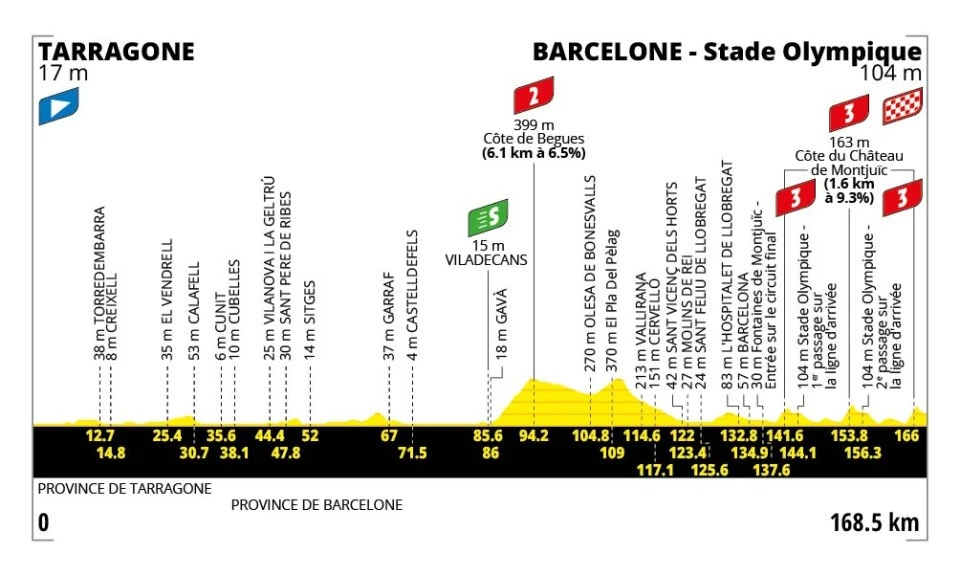
Stage 2 Route Profile — Tarragona to Barcelona (July 5, 178 km)
Tarragona’s UNESCO-listed Roman amphitheatre is the backdrop for the Stage 2 start. The coastal road runs north through Sitges before the new Côte de Begues mid-stage. The decisive section is the Montjuïc finishing circuit, where the Côte du Château de Montjuïc (1.6 km at 9.3%, including a 600m section that tops 7%) is significantly harder than Stage 1’s climbs. The race circuit loops twice. In 2023’s Bilbao Grand Départ, Pogačar, Vingegaard, and van der Poel ignited the Tour on less demanding terrain inside 48 hours. The Montjuïc circuit in 2026 is harder, expect the pattern to repeat.
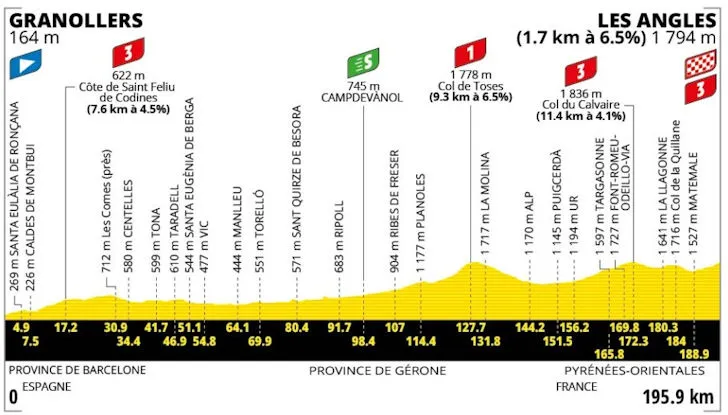
Stage 3 Route Profile — Granollers to Les Angles (July 6, 196 km, Cross-Border Pyrenees)
Stage 3 departs Granollers and immediately begins climbing. The Col de Sant Feliu de Codines is a gentle opener. The Collada de Toses (9.3 km at 6.5%) takes the race into the high pre-Pyrenean ridgeline. The Col du Calvaire (11.4 km at 4.1%) crosses the French border at 1,836 metres above sea level, a sustained climb despite its moderate average gradient. A 24 km rolling descent leads to the Les Angles ski station finish (1.7 km at 6.5%). Near 4,000 metres of total climbing on day three. The race leaves Spain permanently here. Any GC rider not fully prepared for this Tour pays the price before a mountain stage has officially been named.
tdf 2026 Week One Route — July 4–12
Spain & The Pyrenees — Stages 1–9
Approx. 22,000m climbing · Three sprint stages · Pyrenean queen stage on day 6 · Week 1 record for modern Tour elevation
Week 1 of the 2026 Tour de France is the most front-loaded opening week in modern Tour history by elevation. By the end of Stage 6, six days into the race, riders will have climbed approximately 16,200 metres. For comparison, the 2023 Basque Grand Départ produced 12,800 metres through Stage 6. The Pyrenees arrive on Stage 3. By Stage 6, the Tourmalet and a new summit finish at Gavarnie will have produced the first clear GC verdict of the race. Three sprint stages (5, 7, 8) and one breakaway hilly day (4) provide the sprinters with windows between mountain blocks.
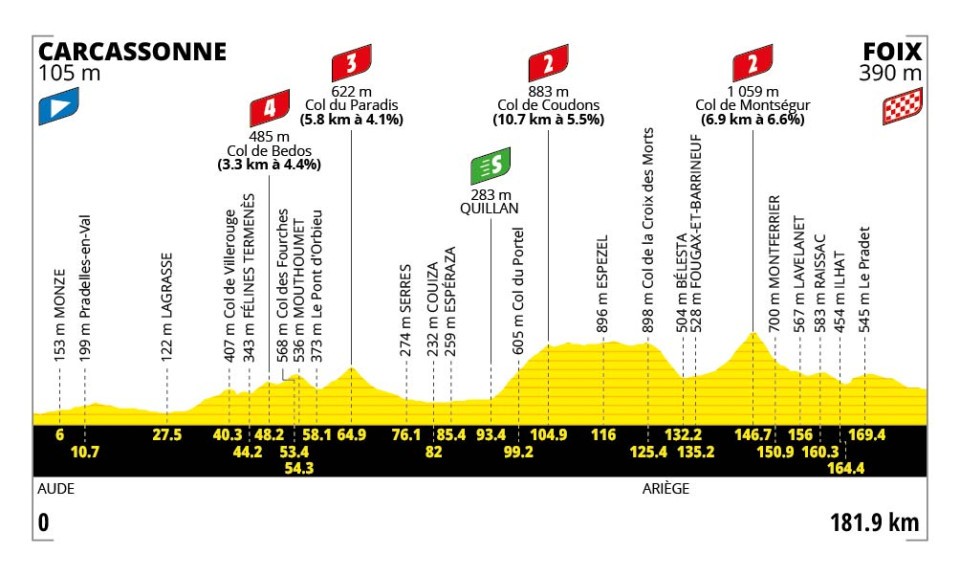
Stage 4 Route — Carcassonne to Foix (July 7, 182 km, Hilly)
Carcassonne’s 12th-century citadel, a double-walled UNESCO World Heritage fortress with 52 towers, is the stage start backdrop. The road heads east through Cathar country into the Ariège via Col de Villerouge (8.6 km/3%), Col de Bedos (3.4 km/4.3%), Col du Paradis (6.4 km/4.1%), Col de Coudins (10.5 km/5.5%), and Col de Montségur (6.9 km/6.6%). The final climb comes 35 km from the Foix finish, a long enough run-in for a sprint or for a small group to hold off the bunch. Classic breakaway-specialist terrain: heavy roads, rolling hills, multiple climbs in the first half, and enough distance between the last summit and the finish to create tactical uncertainty.
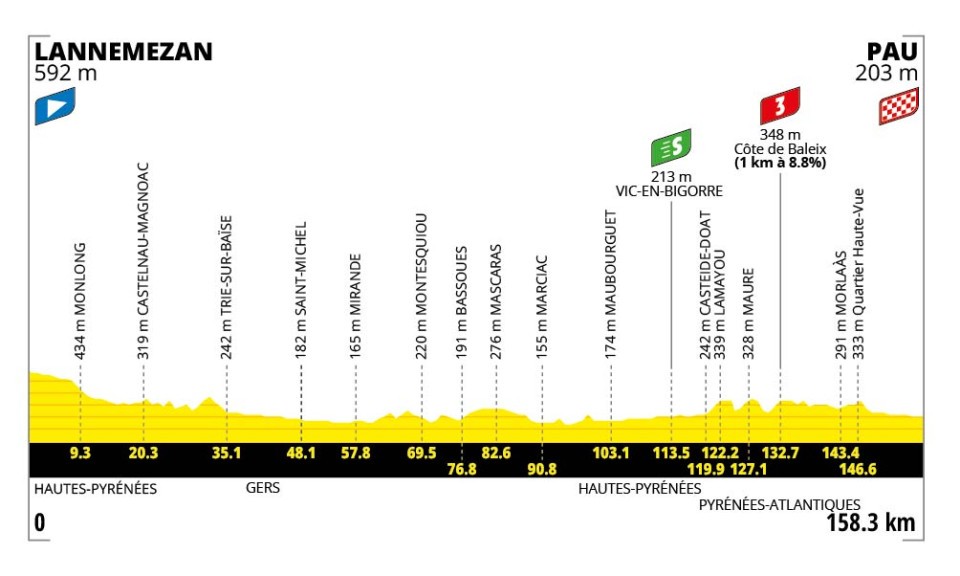
Stage 5 Route — Lannemezan to Pau (July 8, 158 km, Flat)
The sprinters’ first clean opportunity. Lannemezan to Pau at 158 km is the shortest road stage in Week 1 and finishes on the flat run into Pau, a familiar Tour sprint town. There is rolling terrain mid-stage but nothing to threaten a pure sprinter who has managed the early road section. Jasper Philipsen, Tim Merlier, Jonathan Milan, and Olav Kooij all come into this stage having burned minimal energy since Stage 3. The last flat road before the Pyrenean queen stage.
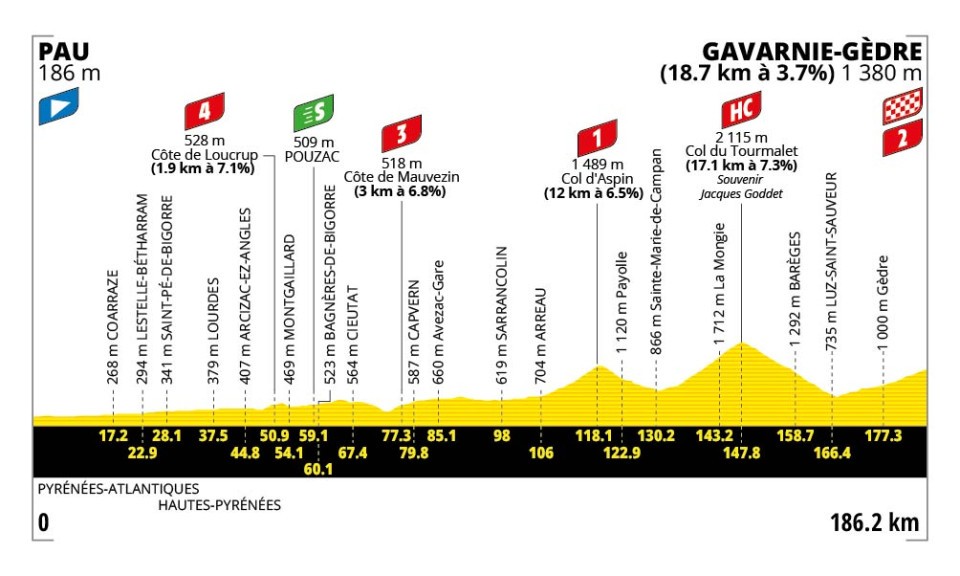
Stage 6 Route & Elevation Profile — Pau to Gavarnie-Gèdre (July 9, 186 km) ⭐ Summit Finish
Stage 6 is the first GC verdict of the 2026 Tour. Three mountain passes in the final 80 km. The Col d’Aspin (12 km at 6.5%, summit 1,490m) opens the mountain sequence. The Col du Tourmalet via the Sainte-Marie-de-Campan approach (17 km at 7.3%, summit 2,115m) makes its 91st Tour de France appearance — the most of any climb in Tour history — and brings the race above 2,000 metres for the first time in 2026. After a fast descent, the new Gavarnie-Gèdre summit finish climbs 18.7 km at 4% average through the Gave de Pau valley toward the Cirque de Gavarnie.
The Gavarnie deception: a 4% average sounds manageable. After 4,100 metres of previous climbing with the Tourmalet’s toll fully settled into the legs, that 18.7 km is anything but manageable. The Cirque de Gavarnie at the summit is a UNESCO World Heritage glacial amphitheatre — a vertical rock wall of 1,400 metres. It is one of the most dramatic natural backdrops in European sport. This stage will produce the first clear separation of 2026’s GC field. Evenepoel abandoned on the Tourmalet in 2025; how he handles these same slopes defines the early race narrative.
Stages 7 & 8 Route — Hagetmau to Bordeaux + Périgueux to Bergerac (Flat Sprints)
Stage 7 (175 km, Hagetmau to Bordeaux) gives the sprinters their second window. Hagetmau makes its first Tour de France appearance, and the town is a Camino Francés stop. The fast run to Bordeaux through the Landes forests is a classic sprint stage. Stage 8 (182 km, Périgueux to Bergerac) crosses Dordogne country between two of the region’s most recognisable names, on the flat valley roads that suit pure bunch sprint dynamics. Two intermediate sprint points are contested on each stage in 2026, the first time since 2010, making the points classification battle more active throughout each day.
Stage 9 Route — Malemort to Ussel (July 12, 185 km, Hilly)
Week 1 closes with 3,400 metres of climbing across the Corrèze without a single flat kilometre. Malemort to Ussel through the rolling volcanic Massif Central terrain is the most consistently demanding non-mountain stage of the entire race. No single climb is a GC threat, but the accumulated fatigue of 185 km without recovery is real. This stage reveals which squads have fresh domestiques heading into Week 2 and which have been grinding all week.
Rest Day 1 — Monday, July 13, Cantal
Transfer day: teams move from Ussel to Aurillac (~90 km). Race infrastructure relocates. Press conferences throughout the day. GC teams conduct physical assessments, tactical planning, and equipment preparation. The first genuine public interrogation of whether Vingegaard’s Giro–Tour double is showing fatigue. This rest day is not recovery — it is repositioning.
TDF 2026 Week Two Route — July 14–19
Massif Central, Jura, Vosges & Alps — Stages 10–15
Approx. 18,000m climbing · Bastille Day summit · Vosges dark horse · New Alpine summit at Solaison
Week 2 builds from Bastille Day’s volcanic Massif Central summit to the pre-rest-day ambush of a new Alpine summit finish that no rider has ever contested. Three distinct terrain phases: Massif Central (Stage 10), transitional plains through the Loire Valley and Burgundy (Stages 11–13), the Vosges dark horse (Stage 14), and the Alpine opener on the new Plateau de Solaison (Stage 15). A total of approximately 18,000 metres of climbing across six stages — fewer than Week 1, but concentrated in ways that expose second-week fatigue.
Stage 10 Route & Elevation Profile — Aurillac to Le Lioran (July 14, 167 km) ⭐ Bastille Day Summit
Stage 10 falls on July 14. That date has an effect on French cycling that no other calendar date replicates — ASO deliberately sequences its most aggressive GC racing on Bastille Day, and the crowd density on Puy Mary and Pas de Peyrol transforms the race into something closer to a football final.
The route from Aurillac crosses the new Col de la Griffoul before the iconic Puy Mary (1,589m) and Pas de Peyrol before a summit finish at the Le Lioran ski station. The Massif Central character is specific: no climb reaches alpine altitude, but the volcanic terrain creates repeated short sharp ramps rather than sustained gradients. Riders who excel at threshold-level power held for 8–15 minutes tend to perform better here than those who prefer 20–25 minute sustained alpine efforts.
Stages 11 & 12 Route — Vichy to Nevers + Magny-Cours to Chalon-sur-Saône (Flat)
Stage 11 (161 km, Vichy to Nevers) runs through the Loire Valley from the thermal spa city to Nevers. The shortest flat stage of the 2026 race. Stage 12 (181 km) starts from the Circuit de Nevers Magny-Cours, one of France’s Formula 1 venues, making its Tour debut, and runs through Burgundy wine country to Chalon-sur-Saône. Open Burgundy plains carry echelon risk if south-westerly winds develop: a crosswind split on Stage 12 could produce GC time gaps without a single climb. Sprinters’ teams need to control both stages.
Stage 13 Route — Dole to Belfort (July 17, 205 km, Hilly — Longest Stage)
Stage 13 is the longest stage of the 2026 Tour at 205 km, the only stage over 200 km in an edition deliberately skewed toward shorter, more explosive racing. The Jura hills between Dole and Belfort provide multiple attack points on rolling limestone terrain without the commitment of a full mountain stage. The Lion de Belfort statue — Frédéric Auguste Bartholdi’s 11-metre sandstone lion, the monumental precursor to his Statue of Liberty design — marks the finish. GC teams should be content to ride tempo here. Breakaway specialists who build careers on 200+ km days have the perfect canvas.
Stage 14 Route & Profile — Mulhouse to Le Markstein (July 18, 155 km, Vosges)
Stage 14 is the dark horse stage of the entire 2026 Tour. The Vosges Mountains are unlike the Pyrenees or Alps in almost every measurable way: no col above 1,424m, rounded granitic summits, narrow forested roads, and climbing profiles that produce repeated 4–6 minute threshold efforts rather than 20-minute sustained grinds. Two brand-new Tour climbs, Col du Page and Col du Haag, precede the Grand Ballon (1,424m) and Le Markstein Fellering summit finish. Total climbing for the stage: 3,800m across seven ascents. Stage 14 in 2023 was where Vingegaard cracked the field and confirmed his second yellow jersey on similar Markstein terrain. The 2026 version is harder with the two new climbs added earlier in the day.
Stage 15 Route & Elevation Profile — Champagnole to Plateau de Solaison (July 19, 184 km) ⭐ NEW Summit Finish
Plateau de Solaison has never hosted a Tour de France summit finish. At 11.3 km and 9.1% average gradient, with sections pushing above 12%, it is the steepest summit finish average in the 2026 race. The climb faces north, sitting in shadow for most of the afternoon. At altitude above 1,471 metres, temperatures at the summit can fall to 10°C even in late July. Multiple Jura hills precede the final ascent, building accumulated fatigue before the decisive climb. No rider has prior Tour de France data on Solaison: no split times from previous editions, no tactical reference from team archives.
Why this stage matters beyond the climb itself: it is the last stage before Rest Day 2, positioned immediately before the only ITT. History shows that riders in difficulty always crack hardest in the final summit before a rest day. Adrenaline masking fatigue is a finite resource. Solaison will produce the clearest picture of every GC contender’s actual condition before the final week begins.
Rest Day 2 — Monday, July 20, Haute-Savoie
The most tactically loaded rest day of the 2026 Tour. Stage 16 — the only individual time trial — follows directly on July 21. Teams spend the rest day reconnoitring the Évian-to-Thonon course (26 km, Lake Geneva), selecting equipment (disc wheels, aero helmets, superbikes), and finalising TT positioning. GC riders who want to ambush rivals on the ITT begin preparation here. The tactical decisions made on July 20 will determine who gains or loses minutes on July 21.
TDF 2026 Week Three Route — July 21–26
The Alpine Finale & Paris — Stages 16–21
~16,000m climbing · Three consecutive summit finishes · Back-to-back Alpe d’Huez · Paris July 26
Week 3 opens with the race’s only individual time trial, then delivers three consecutive Alpine summit finishes — Orcières-Merlette, Alpe d’Huez (Day 1), and the Queen Stage to Alpe d’Huez (Day 2), before the Paris parade. The structure is deliberate: the ITT reshapes the GC before a single Alpine climb, then three summit finishes in three days compress the decisive moments into 72 hours. The 2026 Tour winner is determined in Week 3.
Stage 16 Route & Profile — Évian-les-Bains to Thonon-les-Bains (July 21, 26 km, Individual Time Trial)
The only individual time trial of the 2026 Tour. The 26 km course runs along the southern shore of Lake Geneva from the thermal spa resort of Évian to Thonon-les-Bains, generally flat with one rolling climb section early in the stage and a fast finale. Expected winning time: approximately 28:30 at an average speed above 54 km/h. GC riders start in reverse order from 12:30 CET.
The ITT is critically short in the context of a GC race: Pogačar’s 2025 form projects to a 40–50 second advantage over Vingegaard across 26 km. Evenepoel, the reigning Olympic ITT champion, could potentially produce the fastest GC-rider time of the day. If the GC is within 1:30 before Stage 16, the yellow jersey could change hands on the Lake Geneva shore road.
Stage 17 Route — Chambéry to Voiron (July 22, 175 km, Flat)
Transition stage. The Isère valley runs from Chambéry to Voiron, with Voiron becoming the Stage 18 start town. The sprinters’ last realistic opportunity of the 2026 Tour before three consecutive summit finishes removes their window entirely. GCN teams manage watts. Sprint trains organise for the final mass sprint of the race. The stage is flat, fast, and unambiguous — exactly what GC leaders need 24 hours after the ITT.
Stage 18 Route & Profile — Voiron to Orcières-Merlette (July 23, 185 km) ⭐ Summit Finish
Stage 18 opens the decisive Alpine trilogy. The route heads south from Voiron toward Grenoble, then climbs to Engins (11.4 km at 5.4%) and continues over a sustained false flat to Saint-Nizier-du-Moucherotte before dropping to the banks of the Drac river. After roughly 10 km in the valley at 900 metres altitude, the Col de Manse and Col du Festre precede the final steady climb to Orcières-Merlette. The ski station at 1,850m sits at altitude where oxygen debt builds quickly, the final 7.1 km at 6.7% feels considerably harder than the gradient suggests.
Orcières-Merlette’s Tour history runs deep. Luis Ocaña won here alone in 1971, having ridden solo for 60 km and finished 9 minutes ahead of Eddy Merckx. Roglic won a similar-format stage here in 2020. The 2026 edition expects one of those days: a long, attritional approach followed by a summit finish where only the strongest climbers reach the front. The race generates 3,950 metres of total climbing — the warm-up before Alpe d’Huez. Who wins Stage 18 is largely irrelevant. How the GC leaders arrive at Orcières-Merlette predicts everything about Stage 19.
Stage 19 Route & Elevation Profile — Gap to Alpe d’Huez (July 24, 128 km) ⭐ Alpe d’Huez Day 1
Stage 19 is short, savage, and explosive. The 128 km from Gap to Alpe d’Huez produces 3,605 metres of climbing across four ascents: Col Bayard (5.1 km at 7.2%), Col du Noyer (7.2 km at 8.5% — the sharpest regular pass of the race), Col d’Ornon (5.6 km at 6.2%), then the final 13.8 km at 8.1% up Alpe d’Huez itself.
The Col du Noyer at 8.5% is the hardest numbered pass before the Alpe and represents the first serious point of selection on Stage 19. Strong climbers targeting a breakaway will attack here. GC teams arriving with weakened domestiques face immediate problems on a climb where the gradient leaves no shelter. Col d’Ornon serves as the final filter, a 5.6 km climb at 6.2% after the Noyer descent that arrives just 35 km from the Alpe d’Huez base. Only those with genuine resilience stay competitive to the foot of the final climb.
Alpe d’Huez profile: 13.8 km at 8.1% average from Le Bourg-d’Oisans at approximately 720m to the summit resort at 1,860m. The 21 numbered hairpins define this year route, hairpin 21 at the bottom, hairpin 1 at the top. The first two kilometres average close to 10%. Hairpins 10 and 11 in the middle section push into double digits. Hairpin 7, Dutch Corner, is the most densely packed spectator point in cycling. Short (128 km) means the peloton arrives at the Alpe base largely together. When Tom Pidcock announced himself to the world in 2022 on this same climb, he attacked from a small group and rode solo to the summit. In 2026, with three weeks of fatigue in their legs and the Queen Stage the following morning, every GC rider will race defensively here — except the one with something to prove.
Stage 20 Route & Elevation Profile — Queen Stage to Alpe d’Huez (July 25, 171 km) ⭐⭐
Stage 20 is the definitive stage of the Tour de France 2026. Le Bourg-d’Oisans to Alpe d’Huez, 171 km, via four mountain passes: the 2026 Tour produces its final answer here.
The Four Climbs of Stage 20 — Confirmed Gradient Data
| Climb | Length | Avg % | Summit | Notes |
|---|---|---|---|---|
| Col de la Croix de Fer | 24 km | 5.2% | 2,067 m | Long grinding opener — alternates steep ramps with recoveries. Harder than the average suggests |
| Col du Télégraphe | 11.9 km | 7.1% | 1,566 m | Barely descends after Croix de Fer before climbing directly onto Galibier. No real recovery |
| Col du Galibier — Roof of 2026 | 17.7 km | 6.9% | 2,642 m ⭐ | Highest point of the 2026 Tour. Final km exceed 9%. Above the snowline. Summit at 74% of sea-level air pressure |
| Col de Sarenne (NEW — SE flank) | 12.9 km | 7.3% | — | New direction. ASO specifically repaved this road for 2026. In 2013, the same descent was called ‘the most stupid in modern Tour history’ — now paved and widened |
| Alpe d’Huez — Final Section | 3.8 km | 6.1% | 1,850 m | After Sarenne descent, the final loop onto the classic Alpe d’Huez route. 2nd consecutive summit here |
Total Stage 20 climbing: 5,601 m
The Col de Sarenne’s backstory: ASO first routed the Tour de France over the Sarenne descent in 2013, using it as an innovative loop to create a double Alpe d’Huez stage. A French newspaper labelled the descent ‘la descente la plus stupide du Tour moderne’, the most stupid descent in the modern Tour, due to its narrow, partially unpaved surface. ASO listened. For 2026, the south-eastern flank of the Sarenne has been resurfaced and widened specifically to enable this stage design. The result is a climb that has genuinely never been raced at this level before.
The Galibier at 2,642 metres is the highest point of the 2026 Tour. At that altitude, air pressure is approximately 74% of sea level, meaning riders generate roughly 14% less aerobic power at the same perceived effort compared to sea level, even with altitude adaptation. Summit temperature on the Galibier in late July can reach 5–8°C with wind, requiring a lightweight rain cape that riders discard before the Sarenne descent. The tactical decision of when to attack on the Galibier and whether to risk a cold descent to Sarenne with an aggressive lead will define the stage.
Stage 21 Route — Thoiry to Paris Champs-Élysées (July 26, 130 km, Sprint Finale)
The final stage covers 130 km from Thoiry to Paris. The Montmartre section, three ascents of the cobbled Rue Lepic introduced in 2025 and confirmed for permanent inclusion by Prudhomme after its ‘wildly successful’ debut, arrives 15 km from the Champs-Élysées finish. In 2025, Wout van Aert dropped Pogačar on Montmartre in one of the most dramatic final-stage attacks in recent Tour history. The Rue Lepic is 1.8 km and averages 5.5%, but the cobblestones and the 15 km of flat road between Montmartre and the finish line mean the race typically returns to a bunch sprint on the Champs-Élysées, with the GC leader managing any breakaway. The yellow jersey is not threatened on Stage 21. The sprint is. Montmartre is the moment — Paris is the confirmation.
All 5 Summit Finish Elevation Profiles — Tour de France 2026
Five summit finishes define the 2026 GC battle. Three are new to the Tour de France. Here is every summit profile with confirmed gradient data.
The low average gradient is the trap. Gavarnie-Gèdre climbs a long Pyrenean valley after the Tourmalet’s full descent, the gradient never exceeds 7% for long, but it never relents, and legs that have already climbed Aspin and the Tourmalet will feel every kilometre of those 18.7 km. The Cirque de Gavarnie — a 1,400m vertical rock amphitheatre, a UNESCO site, one of the most dramatic landscapes in Europe — forms the backdrop to a finish that is both a GC test and a sensory spectacle.
The Puy Mary and Pas de Peyrol are the emotional core of this stage. The Massif Central’s volcanic terrain produces a different climbing experience from the Alps or Pyrenees: no single ramp is long enough to allow sustained power advantages, but the relentless rolling demands threshold power held repeatedly. Riders who respond best to short sharp accelerations rather than 20-minute sustained efforts tend to dominate Bastille Day in the Massif Central. The French crowd on July 14 is among the loudest in cycling.
Plateau de Solaison is the 2026 Tour’s wildcard summit. At 9.1% average over 11.3 km, it carries the steepest average gradient of any summit finish in the race — steeper than Alpe d’Huez (8.1%), steeper than Gavarnie (4%), steeper than Orcières-Merlette. No team has prior performance data on this climb from the Tour. Several sections exceed 12%. The north-facing aspect means the summit road sits in shadow for most of the afternoon. Temperatures at 1,471 metres drop rapidly after 16:00 even in July. Solaison is where ASO has hidden the biggest surprise of the Tour de France 2026 route.
Orcières-Merlette is steeped in Tour history. In 1971, Luis Ocaña attacked on this finish after riding solo for 60 kilometres, finishing 9 minutes ahead of Eddy Merckx. In 2020, Primoz Roglic won on Stage 4 as the race began. In 2026, the stage structure stair-steps through the Isère valley via Col de Manse and Col du Festre before the steady 7.1 km final ramp. At 1,850 metres altitude, the oxygen deficit builds quickly on the final climb regardless of gradient. Stage 18 opens the Alpine trilogy. How GC leaders arrive here determines the tactics of Stages 19 and 20.
Alpe d’Huez is 13.8 km at 8.1% from Le Bourg-d’Oisans to the summit resort. The 21 numbered hairpins are each named after a Tour de France winner, from Fausto Coppi at hairpin 21 to a blank awaiting the 2026 champion at hairpin 1. The first two kilometres average close to 10%. Hairpins 10 and 11 push into double digits. The Dutch Corner at hairpin 7 is typically the densest crowd point in professional cycling — tens of thousands of fans camped on the mountainside for days, the road barely wide enough for the riders to pass.
Stage 19 uses the classic approach: Col Bayard, Col du Noyer, Col d’Ornon, then the full 13.8 km Alpe ascent. Stage 20 attacks from a completely different direction — Col de la Croix de Fer, Col du Télégraphe, Col du Galibier, Col de Sarenne, then the final 3.8 km section at 6.1% onto the Alpe d’Huez resort road. Two consecutive days finishing on the same mountain for the first time in Tour de France history.
All Major Climbs — Confirmed Elevation Data
Every significant categorised climb confirmed from ASO official 2026 route descriptions, profile data, and stage files. New climbs highlighted.
Confirmed Key Climbs & Elevation Data
| Climb | Stage | Length | Avg % | Summit | Status / Context |
|---|---|---|---|---|---|
| Côte de Begues NEW | 2 | — | — | — | Mid-stage Tarragona→Barcelona. |
| Collada de Toses | 3 | 9.3 km | 6.5% | — | Cross-border climb from Spain into France. |
| Col du Calvaire | 3 | 14.9 km | 4.1% | 1,836 m | Cross-border pass to Les Angles. Longest climb of Stage 3. |
| Col de Coudins | 4 | 10.5 km | 5.5% | — | Penultimate climb, Stage 4. Cathar country. |
| Col de Montségur | 4 | 6.9 km | 6.6% | — | Final climb, Stage 4, 35km from Foix finish. |
| Col d’Aspin | 6 | 12 km | 6.5% | 1,490 m | 74th Tour appearance. Pyrenean classic. Stage 6 opener. |
| Col du Tourmalet (via Campan) | 6 | 17 km | 7.3% | 2,115 m | 91st Tour appearance — most in Tour history. Via Sainte-Marie-de-Campan. |
| Montée de Gavarnie-Gèdre NEW | 6 | 18.7 km | 4% | ~1,350 m | NEW summit finish. UNESCO Cirque de Gavarnie backdrop. |
| Col de la Griffoul NEW | 10 | — | — | — | Stage 10 approach to Puy Mary. |
| Puy Mary / Pas de Peyrol | 10 | — | — | 1,589 m | Massif Central summit. Bastille Day stage centrepiece. |
| Col du Page NEW | 14 | — | — | — | Vosges Stage 14. |
| Col du Haag NEW | 14 | — | — | — | Vosges Stage 14. |
| Grand Ballon | 14 | — | — | 1,424 m | Highest Vosges summit. Familiar Tour climb. |
| Plateau de Solaison NEW | 15 | 11.3 km | 9.1% | 1,471 m | NEW summit finish. Steepest avg of race. North-facing, cold. |
| Col du Manse | 18 | — | — | — | Stage 18 approach to Orcières. Cat 1. |
| Col du Festre | 18 | — | — | — | Stage 18 penultimate climb before Orcières. |
| Orcières-Merlette (final climb) | 18 | 7.1 km | 6.7% | 1,850 m | Altitude finish. Ocaña legend (1971). Roglic won here 2020. |
| Col Bayard | 19 | 5.1 km | 7.2% | — | Stage 19 opener. Breakaway platform. |
| Col du Noyer | 19 | 7.2 km | 8.5% | — | Sharpest regular pass of Stage 19. First major GC selection point. |
| Col d’Ornon | 19 | 5.6 km | 6.2% | — | Penultimate climb, Stage 19. 35km from Alpe d’Huez base. |
| Alpe d’Huez — Classic Ascent | 19+20 | 13.8 km | 8.1% | 1,860 m | 21 hairpins. First ×2 consecutive in Grand Tour history. Dutch Corner at hairpin 7. |
| Col de la Croix de Fer | 20 | 24 km | 5.2% | 2,067 m | Queen Stage opener. Long grinding approach. |
| Col du Télégraphe | 20 | 11.9 km | 7.1% | 1,566 m | Flows directly onto Galibier with minimal descent. |
| Col du Galibier — Roof of 2026 | 20 | 17.7 km | 6.9% | 2,642 m ⭐ | Highest point of 2026 Tour. 74% air pressure. Final km above 9%. |
| Col de Sarenne — SE flank (NEW direction) NEW | 20 | 12.9 km | 7.3% | — | Specifically repaved by ASO for 2026. Summit 15km from Alpe d’Huez finish. |
| Alpe d’Huez — Sarenne finale | 20 | 3.8 km | 6.1% | 1,860 m | Post-Sarenne final section. Total Stage 20: 5,601m climbing. |
Five Mountain Ranges — TOUR DE FRANCE 2026 Route Guide by Range
Tour de France 2026 is the first edition in recent years to cross all five major French mountain ranges. Each range has a distinct character that demands different physical and tactical responses from riders.
The Pyrenees — Week 1 Route (Stages 3 & 6)
The Pyrenees appear twice. Stage 3 crosses the eastern range via the Collada de Toses and Col du Calvaire — relatively accessible, high-altitude passes that introduce Pyrenean climbing on day three. Stage 6 is the full Central Pyrenees experience: Aspin, Tourmalet, and the new Gavarnie summit over 186 km. Pyrenean climbing character: sustained high-altitude ascents above 1,800m, exposed ridgeline passes with strong winds, and long climbs from relatively low bases. The Tourmalet’s eastern Sainte-Marie-de-Campan approach (17 km at 7.3%) is considered harder than the western Barèges approach by most climbers; the gradient is sustained rather than variable.
The Massif Central — Week 1/2 Route (Stages 9 & 10)
The ancient volcanic plateau of the Massif Central dominates Stages 9 and 10. No col reaches alpine altitude; the Puy Mary tops at 1,589m, but the terrain never allows recovery. Stage 9’s 3,400m of climbing without a flat kilometre is a textbook Massif Central day. Stage 10’s Bastille Day summit at Le Lioran arrives via the Puy Mary volcanic landscape. Massif Central character: repeated short, sharp efforts at 4–8 minute power rather than sustained 20-minute alpine grinds. The volcanic rock creates a distinctive riding surface and the landscape is dramatically different from the more familiar Tour mountain settings.
The Jura — Week 2 Route (Stage 13)
Stage 13’s 205 km from Dole to Belfort crosses the Jura limestone plateau, the longest stage of the race and the best breakaway terrain. The Jura character is rolling rather than mountainous: no single col stands out as a GC threat, but the accumulated fatigue of 205 km on undulating terrain is genuine. The Lion de Belfort statue at the finish, Bartholdi’s sandstone lion, predecessor to the Statue of Liberty, is one of the most striking stage finishes in the Tour de France 2026 route.
The Vosges — Week 2 Route (Stage 14)
The Vosges Mountains are the Tour’s dark horse terrain. Rounded granitic summits, narrow forested roads, and climbing profiles that top out below 1,424m define Stage 14. Col du Page and Col du Haag are new to the Tour route. Grand Ballon and Le Markstein are familiar returns. Vosges character: repeated sub-5-minute explosive efforts rather than sustained gradient. Puncheurs and riders with explosive 4–6 minute power output perform disproportionately well here compared to their general Alpine performances. Stage 14 is the 2026 Tour’s hidden selection stage; its difficulty is underrated by the average gradient and summit altitude.
The Alps — Week 2/3 Route (Stages 15, 18, 19, 20)
The Alps deliver the 2026 Tour’s most decisive four stages. Stage 15’s Plateau de Solaison opens the Alpine block, a new summit finish at 9.1% average, the steepest in the race. Stage 18 approaches from the Isère valley via Col de Manse and Col du Festre to Orcières-Merlette. Stage 19 delivers Alpe d’Huez for the first time via Col Bayard, Col du Noyer, and Col d’Ornon. Stage 20, the Queen Stage, crosses the Croix de Fer, Télégraphe, Galibier, and Sarenne before a second consecutive Alpe d’Huez summit. Alpine character: extreme altitude (Galibier at 2,642m), sustained 15–25 minute efforts, technical high-speed descents, and weather conditions that can change from 30°C at valley level to 5°C at the Galibier summit within a single stage.
Spectators’ Route Guide — Road Closures & Access
Watching the Tour de France costs nothing. There are no tickets for roadside viewing, no barriers between spectators and riders. It is one of the last great free sporting spectacles on earth, and the 2026 edition provides exceptional in-person opportunities at both the Barcelona Grand Départ and the historic Alpe d’Huez double finish.
When Will the Riders Pass Through Your Area?
The peloton’s passing time can be calculated with reasonable accuracy from the stage rollout time and the average speed for the terrain. Use this guide:
- Flat road at full race speed: approximately 42–46 km/h average. A stage starting at 12:30 CET covers 42 km in roughly 60 minutes.
- Mountain ascent: approximately 20–22 km/h on a Cat 1 or HC climb. The Tourmalet at 17 km takes roughly 50 minutes from the foot of the climb.
- Mountain descent: 65–80+ km/h on open descents. The Galibier to Sarenne descent covers 30 km in approximately 25 minutes.
- To find the official passing time for your specific town: search ‘Tour de France 2026 horaire passage [your town name]’ on Google. Local mairies and tourist offices publish confirmed passing times 4–6 weeks before the race.
Road Closure Rules — What You Need to Know
Tour de France roads are closed to all motorised traffic (cars, motorcycles, campervans) but remain open to cyclists and pedestrians throughout. Key rules:
- Mountain passes (Tourmalet, Alpe d’Huez, Galibier): typically close 24–48 hours before the stage for the most popular ascents. Early arrival is essential. The Alpe d’Huez road closes the afternoon before for both Stages 19 and 20, no vehicles above Le Bourg-d’Oisans after approximately 17:00 on July 23 and July 24.
- Flat stage routes: roads close the morning of the stage, typically 4–6 hours before the peloton passes. Local police manage junctions and crossings.
- You can cycle the TDF route on the day of the race, right up until the Tour caravan (approximately 2 hours before riders) approaches your position — the gendarmerie will direct you off the road at that point.
- Parking: approach roads close first. Arrive early and park outside the closure zone, then cycle or walk the final distance.
Best Viewing Spots on the 2026 Route
Alpe d’Huez — Hairpin 7 (Dutch Corner)S19 + S20
The most famous spectator point in cycling. Tens of thousands of Dutch fans camp here for days. The road disappears under people. Riders pass within arm’s reach at the point where the stage is typically decided.
Col du Tourmalet — Sainte-Marie-de-Campan approach S6
91st Tour appearance — the most celebrated climb in cycling history. The Campan approach gives early access before the road closes. Riders are visible for the full final hour of climbing.
Barcelona Montjuïc Olympic Circuit S1 + S2
The TTT launch is the most accessible Grand Départ format — teams launch every 2–4 minutes and you can see every squad. Stage 2 circuit provides multiple viewing opportunities on the same lap.
Puy Mary Summit — Bastille Day (Stage 10) S10
The most emotionally charged stage of the race. French national holiday + Massif Central volcanic landscape + summit finish. Arrive July 13 (rest day) to secure a good position.
Paris Montmartre — Rue Lepic S21
The cobbled Rue Lepic in a holiday atmosphere — Paris bistros open, crowds lining the street. Three ascents in the final 15 km before the Champs-Élysées. Free access from anywhere in Montmartre.
Can You Ride the 2026 Tour de France Route Yourself?
L’Étape du Tour de France 2026 gives amateur cyclists the chance to ride Stage 20, Bourg-d’Oisans to Alpe d’Huez via the Croix de Fer, Télégraphe, Galibier, and Sarenne, covering 170 km and 5,400 metres of climbing. The event is limited to approximately 16,000 riders and takes place on closed roads several weeks before the Tour. Registration at letapedutourdefrance.com. For those who want to ride the route informally. The Alpe d’Huez, Tourmalet, and Galibier are all publicly accessible climbs year-round when weather permits.
Is Your City on the Tour de France 2026 Route?
The full city list above covers every stage start and finish town. For towns between stages, search your commune name + ‘Tour de France 2026 horaire passage’ on your local mairie (town hall) website, local authorities publish confirmed peloton passing times 4–6 weeks before the race.
What the 2026 Route Means for the General Classification
The architecture of the Tour de France 2026 route was designed to favour a complete rider, one who can team time trial, resist on short ITTs, and excel on explosive summit finishes. Pure rouleurs cannot win this Tour: 26 km of time trial is too short to recover minutes lost in the mountains. Pure climbers face the same problem: five summit finishes over three weeks is not enough to overcome a 30-second TTT deficit from a strong squad, and the Vosges stage will punish those without explosive short-power capacity.
Why the Route Favours Pogačar — and Where Vingegaard Can Win
Tadej Pogačar’s profile aligns with this route in every significant dimension. The TTT opener plays to UAE Team Emirates-XRG’s collective strength; they have not lost a WorldTour team time trial in over 18 months heading into this race. The short ITT removes the scenario where Vingegaard opens a 3-minute gap on flat ground. Five summit finishes give Pogačar repeated opportunities to take bonus seconds at stages others concede. The Vosges stage suits his explosive short-power capacity. Nothing about the 2026 route is designed to disadvantage him.
Vingegaard’s path to yellow: win Stage 6 (Tourmalet-Gavarnie), limit ITT losses to under 45 seconds, and deliver a Stage 20 Galibier-Sarenne-Alpe performance that decisively exceeds Pogačar. That is possible. The Giro-Tour double is the primary risk variable; five weeks between the Rome finale and the Barcelona start is short for recovery and peak re-preparation, but Vingegaard’s training team have been building his fitness specifically for this timeline since December.
The Evenepoel Equation
Remco Evenepoel’s route to Tour victory requires four simultaneous conditions: limit TTT deficit to under 35 seconds, limit Stage 6 Tourmalet losses to under 1 minute, win Stage 16’s ITT outright, and then produce Stage 20 climbing that matches either Pogačar or Vingegaard. The ITT advantage is the clearest pathway. If Evenepoel wins Stage 16 and the GC is within 90 seconds going into the Alpine finale, the 2026 Tour is genuinely three-way unpredictable. He would be the first Belgian to wear yellow since Lucien Van Impe in 1976.
Route Records Set in 2026
- Highest opening week climbing total in modern Tour history: ~16,200m by the end of Stage 6 (previous record: ~12,800m in 2023 Basque Grand Départ edition)
- First back-to-back summit finishes on the same mountain in Tour de France or Grand Tour history: Alpe d’Huez, Stages 19 + 20
- First stage-1 team time trial since 1971: Stage 1 Barcelona
- Col de Sarenne was used in new (south-eastern) direction for the first time in a professional race
- Six new climbs in a single edition — the highest count since 2019, according to ASO route analysis
Tour de France Femmes 2026 Route
The Tour de France Femmes avec Zwift 2026 route, it runs August 1–9, starting in Switzerland and finishing in Nice after 9 stages. The decisive stage is Stage 7 on August 7, a summit finish on Mont Ventoux via the Bedoin approach.
Route Overview — Tour de France Femmes 2026
Dates: August 1–9, 2026. Start: Switzerland. Finish: Nice (August 9). Stage 4: individual time trial into Dijon (21 km). Stage 7 (August 7): Mont Ventoux summit finish via Bedoin — 16 km at 8.8% average, climbing to 1,912 metres. This is the first time Ventoux has appeared in the Tour de France Femmes. The Bedoin approach is the hardest of the three possible Ventoux routes, gaining 1,650 metres from bottom to summit.
Broadcasters: Peacock (USA), SBS On Demand (Australia), TNT Sports/Discovery+ (UK), France TV (France) — same rights holders as the men’s race in most markets. The same Peacock subscription covering the men’s Tour runs through the women’s finale on August 9.
The 2026 Tour de France Route Is Set. July 4, Barcelona.
3,333 km. 54,450 metres of climbing. Five mountain ranges. Thirty categorised climbs. Six first appearances. Alpe d’Huez twice. The TDF 2026 route was built to produce one answer: who is the best rider in the world. Barcelona gives us the first clue on July 4. Alpe d’Huez gives us the last one on July 25.