Tour de France 2026 Stage 2 Preview: Complete Guide to the Tarragona to Barcelona Road Race
Tour de France 2026 Stage 2 is a 168.5 km hilly road race from Tarragona to Barcelona on Sunday, July 5, 2026. Riders start from the Rambla Francesc Macià in the shadow of a 2,000-year-old Roman amphitheatre, ride 85 km along the golden beaches of the Costa Daurada, turn inland through the Penedès hills, and climb back into Barcelona for three punishing laps of the Montjuïc finishing circuit.
Total elevation gain: approximately 2,400 metres, almost all of it packed into the final 93 km. The stage ends on the same finish line as the previous day’s team time trial. But nothing else is the same. Stage 1 is a test of team speed. Stage 2 is a test of nerve.
TL;DR
- Stage 2 is a 168.5 km hilly road race on July 5 from Tarragona to Barcelona — start approximately 12:15 CEST, expected finish around 17:00 CEST.
- The Montjuïc finishing circuit runs three laps with six climbs — two ascents of the Côte du Château de Montjuïc (1.6 km, 9.3%, max 13%) and three ascents of the Côte du Stade Olympique (600 m, 7%), with the finish line on the Olympic Stadium ramp.
- The Côte du Château de Montjuïc is the race-defining climb — harder than any finish in Stage 1, harder than most Spring Classic finales, and coming after 165 km of cumulative racing effort.
- GC time gaps are likely here — sprinters are eliminated at the Château climb, puncheurs go on the attack, and GC leaders who struggled in Stage 1’s TTT arrive at Catalonia’s Pyrenees already in deficit.
- Tarragona is a UNESCO World Heritage city — ancient Roman Tarraco, the oldest Roman settlement on the Iberian Peninsula, sets the stage start against a backdrop of amphitheatres, circus walls, and Mediterranean sea cliffs.
Montjuïc Awaits as Vingegaard Defends Yellow
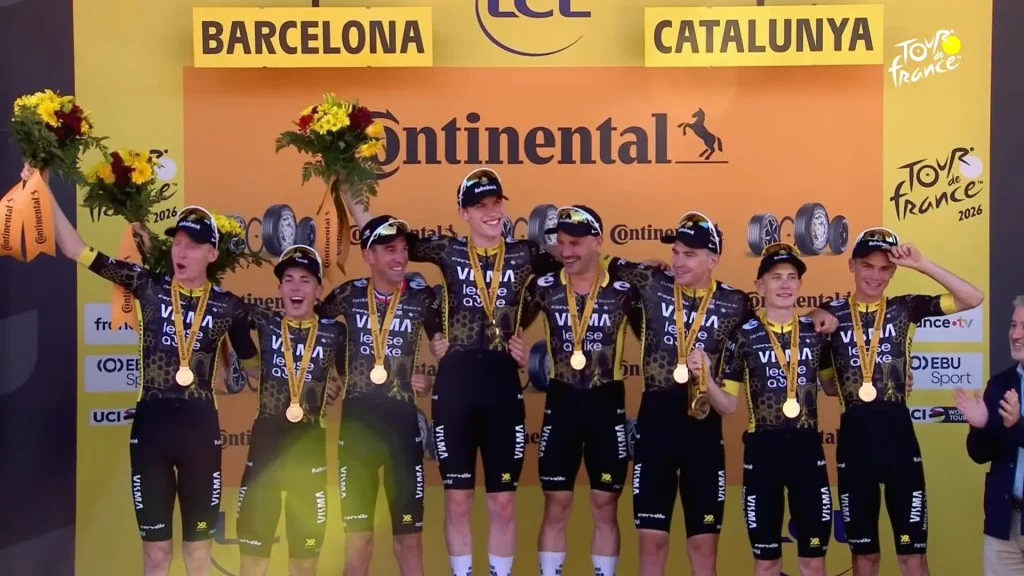
Jonas Vingegaard made a powerful statement on Saturday, winning the Barcelona team time trial and reclaiming the yellow jersey for the first time since his 2023 Tour victory. His Visma-Lease a Bike squad finished eight seconds ahead of Filippo Ganna’s Ineos team, while two-time defending champion Tadej Pogačar could only manage third, 11 seconds behind the Dane. “Just wearing the Yellow Jersey is special,” said Vingegaard, who will now face his first major test of the 2026 Tour on the steep slopes of Montjuïc.
Stage 2 offers 168.5 km of racing from Tarragona to Barcelona, with three ascents of Montjuïc Castle in the final 30 kilometres. The decisive clim, 1.6 km at 9.3% with sections exceeding 14, favors explosive puncheurs and GC contenders alike. The final 700-meter uphill sprint to the Olympic Stadium is expected to shed pure sprinters and set up a showdown among the race’s elite. Pogačar has already warned that “things could get complicated” before the finish, while Remco Evenepoel,third-fastest on Saturday’s hilly section, has previously conquered Montjuïc at the Volta a Catalunya. Mathieu van der Poel, who famously beat Pogačar on a similar ascent in 2024, is another major threat.
General Classification Heading into Stage 2
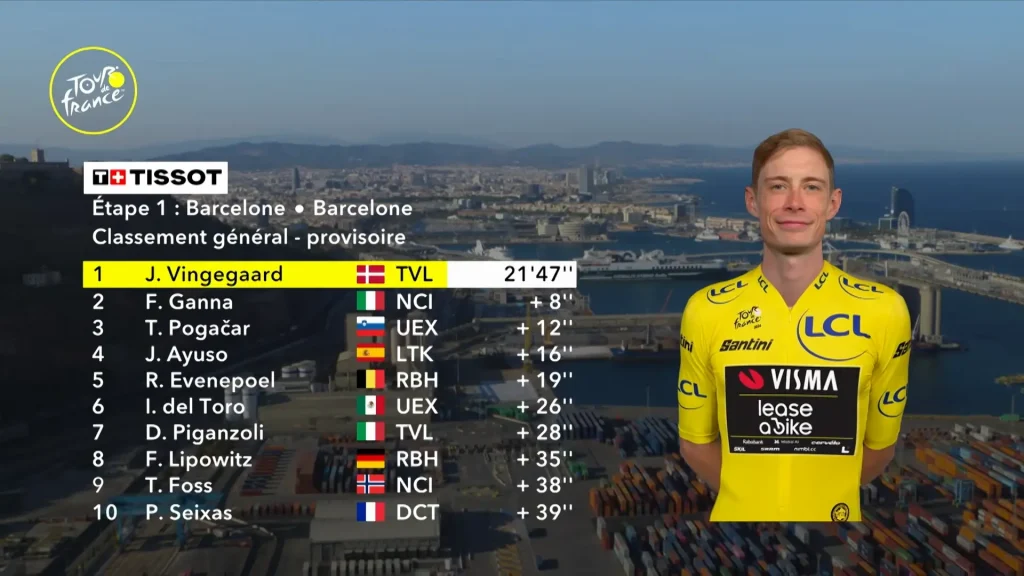
French hopes rest on Romain Grégoire (fifth-fastest on stage one) and young prodigy Paul Seixas, while Kévin Vauquelin seeks redemption after a puncture ruined his opening day. White Jersey wearer Juan Ayuso, racing in his hometown, could also be inspired by the second and final finish in Barcelona. With the yellow jersey on the line and time gaps still tight, Stage 2 promises the first explosive GC battle of the 2026 Tour.
What Is Tour de France 2026 Stage 2?
Tour de France 2026 Stage 2 is the first mass-start road stage of the 113th edition, a 168.5 km hilly race from Tarragona to Barcelona on Sunday, July 5. After the previous day’s team time trial handed out individual time gaps from a standing start, Stage 2 throws all 184 riders into one group for the first full road race of July. The stage is classified as hilly rather than mountainous, but the Montjuïc finishing circuit makes that label misleading. Three laps, six climbs, and a wall of 13% gradient on the penultimate ascent, this is where the Tour’s first road battles happen.
The stage is significant in another sense. It gives the puncheurs and one-day Classics specialists their first genuine target of the race, while simultaneously forcing GC contenders to compete in terrain that suits attackers. In the mountains, a GC leader can rely on a domestique train to control the pace. On a punchy urban circuit with repeated short climbs, that control is far harder to maintain.
Stage 2 Date, Distance, and Start Times: July 5, 2026
Stage 2 starts from Tarragona’s Rambla Francesc Macià at approximately 13:45 CEST on Sunday, July 5. The flag drops around 13:50 CEST after the standard neutralised section through the city. Expected finish time on Montjuïc: approximately 19:15 CEST, with the precise timing depending on weather, peloton speed, and how aggressively the race is ridden on the coastal section. For UK viewers, the stage starts at approximately 12:45 BST and finishes around 18:15 BST. US viewers face a morning watch: 07:45 EDT and 04:45 PDT.
For Live coverage, bookmark our all stages live coverage guide page, which updates regularly during the live event.
Tour de France 2026 Stage 2 Route: Full Tarragona to Barcelona Course Guide
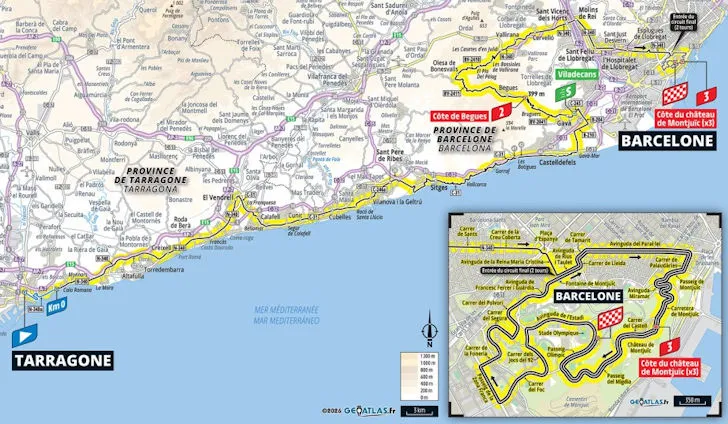
The Stage 2 route divides into two completely different races separated by the inland turn at km 85. The first half is a coastal sprint along the Mediterranean on open, fast roads where positioning matters but the climbing does not. The second half is a grinding, selective test through the Catalan hills and into the Montjuïc circuit that bears no resemblance to what came before it. Teams that arrive disorganised at the inland turn after a chaotic coastal section will spend the rest of the day paying for it.
The Opening Flat: Tarragona and the Costa Daurada
The stage rolls off the Rambla Francesc Macià, Tarragona’s elegant central boulevard lined with palm trees and modernist architecture. Within the first two kilometres, the route passes within touching distance of two of the most important Roman monuments in the Western world: the Tarraco Amphitheatre and the Roman Circus. The amphitheatre, built in the 2nd century AD, faces the Mediterranean Sea from a dramatic clifftop position. The circus, where chariot races once drew crowds of 30,000, now lies embedded in the city’s medieval core. Two thousand years of history watch the Tour de France start its second day.
From the city, the route joins the coastal road northwest and stays there for 85 kilometres. This is the Costa Daurada, the Golden Coast, named for the pale sand beaches that run almost uninterrupted from Tarragona toward Barcelona. The road passes through Altafulla, Torredembarra, Vendrell, and eventually Sitges. Sitges deserves a sentence of its own: a white-washed resort town built on a rocky headland, often compared to Saint-Tropez for its mixture of old-world charm and contemporary cultural energy. It is one of the most scenic stretches of any Grand Tour opening week.
On this section, the peloton will move at 44–48 km/h in a compact, nervous group. Sprint teams are active at the front, keeping things controlled but watching constantly for riders attacking early. The first 85 km are, in the language of professional cycling, a transfer with high consequence. Nobody wants to crash here. Nobody wants to lose a minute to a split in the crosswind. But nothing decisive happens either — that waits for the hills.
The Inland Turn: Begues and the Penedès Hills
At around km 85, the road leaves the coast and turns sharply inland toward Begues. The landscape changes immediately. The flat coastal plain gives way to the hills of the Garraf massif. dry, scrubby Mediterranean hillside dotted with vineyards and coastal pines. This is the outer edge of the Penedès wine region, the heartland of Spanish Cava production. Codorníu and Freixenet, the two most recognised Cava houses in the world, sit within 20 km of the road the Tour is riding. The riders are unlikely to appreciate the irony.
The Côte de Begues begins at km 87: 6.1 km at an average gradient of 6.5%. This is the first real selection of Stage 2 — the moment the peloton starts to stretch and then splinter. Pure sprinters with no climbing ability begin to struggle within the first two kilometres. The GC teams move to the front. Domestiques start their protective work. The comfortable group of 150+ riders that left Tarragona becomes something smaller, more tense, and more purposeful by the summit.
After Begues, the road drops for approximately 10 kilometres before a second, gentler rise of 4.7 km at 3.4% precedes the descent into the Llobregat river valley. The valley carries the A-2 and B-23 motorways, the main road arteries between Barcelona and central Spain. The riders cross this corridor and immediately face the next obstacle.
Santa Creu d’Olorda: The Climb That Shapes the Finale
The Côte de Santa Creu d’Olorda is the longest climb of Stage 2: 8.4 km at an average gradient of 4.5%. The road rises through the Collserola Natural Park — the forested ridge that forms the northwestern boundary of Barcelona. The Ermita de Santa Creu d’Olorda, a hermitage dating to the 9th century, marks the upper section of the climb. From the summit at the Puig d’Olorda, the entire city of Barcelona unfolds below. The Mediterranean is visible in the distance. On a clear July day, riders can see from the Montjuïc hill where they finished yesterday to the glass towers of the Diagonal district to the cranes of the port.
This is where the race begins to be won. The Collserola climb is not savage enough to produce major GC time gaps on its own, but it filters the peloton down to its competitive core. Riders who are not good enough to finish in the top 20 today are already losing ground by the time the summit arrives. The descent from Santa Creu d’Olorda drops into the northern suburbs of Barcelona. With 38.5 km remaining, the peloton enters the Montjuïc finishing circuit. The city crowds start to build. The noise rises. The race within the race is about to begin.
Barcelona Re-Entry: Three Laps, Six Climbs, No Rest
The Montjuïc circuit is announced by the first barrier crowds of the day. spectators packed four and five deep on the urban streets leading to the hill. Riders who were comfortable 20 seconds off the front on the open roads are now fighting for position through tight corners and cheering fans. Teams that lost their cohesion on the descent have 38 km to regain it, or they do not finish this stage in the front group.
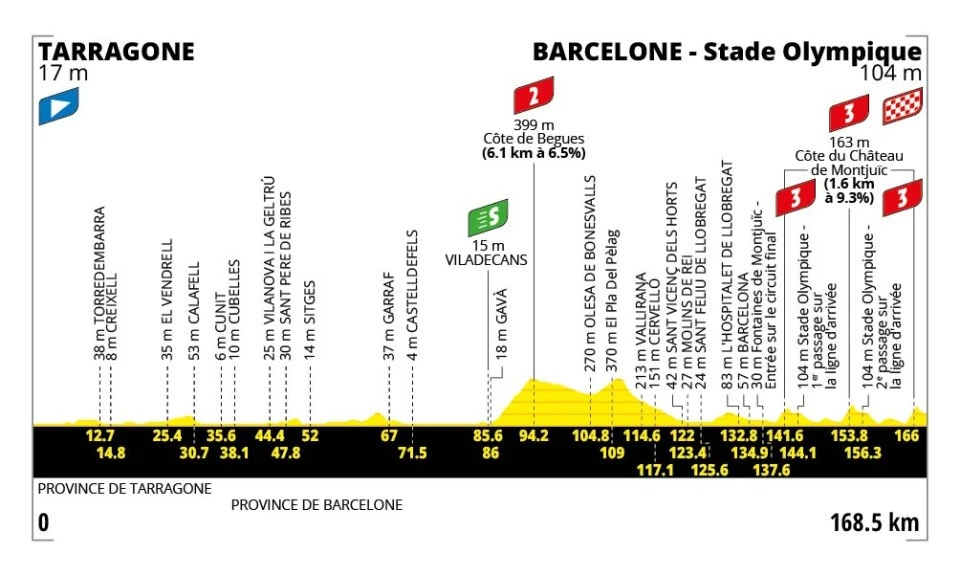
Tour de France 2026 Stage 2 Elevation Profile: Four Climbs and a Brutal Montjuïc Circuit
Stage 2’s elevation profile looks deceptively manageable on a small screen: a flat first half, then a series of manageable rises. Look closer at the final 30 km, and the picture changes entirely. Three laps of the Montjuïc circuit generate six distinct ascents, including the Côte du Château de Montjuïc — the hardest climb of any of Barcelona’s three days of racing, ridden three times in the final 30 km on legs already carrying 148 km of fatigue.
All Four Categorised Climbs: Data Table
| Climb | Length | Avg Gradient | Max Gradient | Dist. from Finish |
|---|---|---|---|---|
| Côte de Begues | 6.1 km | 6.5% | ~9% | ~91 km |
| Côte de Santa Creu d’Olorda | 8.4 km | 4.5% | ~7% | ~38.5 km |
| Côte du Château de Montjuïc | 1.6 km | 9.3% | 13% | ~4.8 km (each lap) |
| Côte du Stade Olympique | 600 m | 7% | ~8% | Finish |
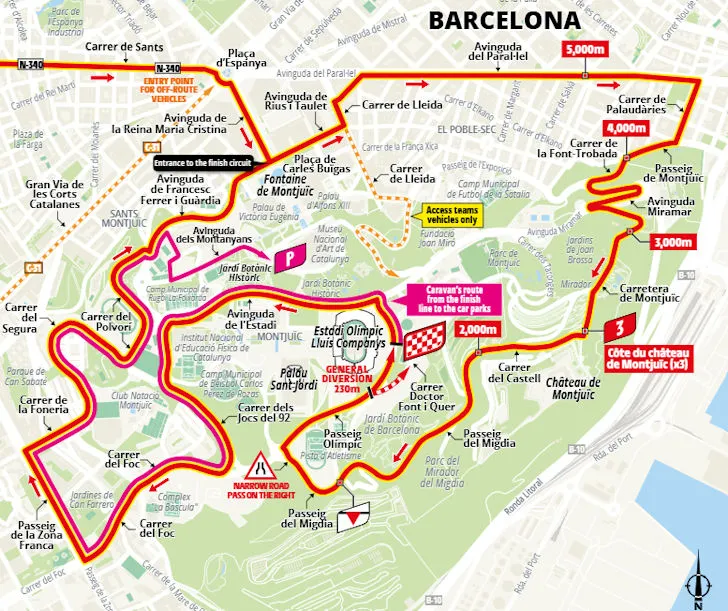
Each lap of the Montjuïc circuit contains both the Château de Montjuïc and the Stade Olympique climbs. Three laps means three ascents of each, six total. The cumulative climbing from the circuit alone, ignoring Begues and Santa Creu d’Olorda, is approximately 600 metres.
Why the Côte du Château de Montjuïc Changes Everything
The Château de Montjuïc is the hardest climb in the 2026 Tour’s opening week and one of the hardest urban climbs in Grand Tour history. At 1.6 km with an average gradient of 9.3%, including a 600m section that hits 13%, it demands everything a rider has at the moment it is encountered. The first time it appears, riders have already covered 149 km and climbed the Begues and Santa Creu d’Olorda. By the third appearance, they have covered 168.5 km and climbed this same wall twice before.
At 9.3% average with a 13% maximum, the W/kg requirement for the front group on the third ascent is approximately 6.0–6.5 W/kg for a 65-70 kg GC contender, sustained for around four minutes at race pace. A rider who loses two seconds per lap to the front group in the first two laps is already six seconds down with one lap remaining. That is a significant deficit to recover on a 600m finish climb at 7%.
For amateur cyclists: this is the hardest Strava segment in Barcelona. The circuit is accessible year-round through the Parc de Montjuïc. Riding the Château de Montjuïc after 80 km of legs gives a direct physical sense of what the Tour peloton will experience on lap three.
The Montjuïc Circuit: How Three Laps and Six Climbs Decide Stage 2
With 38.5 km remaining, riders enter the Montjuïc finishing circuit. Three laps of approximately 10 km each. Each lap runs: descent from the upper park → rolling section through the lower circuit → Côte du Château de Montjuïc (1.6 km, 9.3%) → 1 km descent → Côte du Stade Olympique (600m, 7%) → back to the descent for the next lap (or, on the final lap, the finish line).
This is the most technically demanding finishing circuit in the 2026 Tour’s first week and one of the most demanding in any Grand Tour since the 2017 Giro d’Italia’s finishing circuits in Sardinia.
Lap 1 — The First Selection (km 143.5 to ~153.5)
The peloton hits the circuit for the first time with 38.5 km remaining. The group that arrives here is already reduced from the original 184; Begues and Santa Creu d’Olorda have done their work. But it is still not small enough to be a clean fight. Sprint teams are trying to keep their protected riders near the front. GC teams are moving their leaders forward. The first ascent of the Château de Montjuïc is an information-gathering exercise as much as a race: teams watch who is in difficulty, who is sitting comfortably, and where the dangerous riders are positioned.
The 600m at 13% maximum gradient tells the truth immediately. Riders who are not ready for this stage are gone on the first lap. Their race becomes one of survival. The first intermediate sprint — if the race commissaires award a bonus on the circuit, it likely falls on this lap. After the summit, the descent is fast and technical. Position at the base of the Stade Olympique ramp is crucial. The riders who take the descent without losing contact have a direct line to the finish. Those who hesitate pay in bike lengths.
Lap 2 — The Selection Intensifies (~km 153.5 to ~163.5)
Second time up the Château de Montjuïc with approximately 24 km remaining. This is when the racing changes character. The group is smaller now — perhaps 30 to 50 riders. Sprint teams have largely dissolved or retreated. What remains is the race’s punching class: puncheurs, climbers, and the GC leaders who have protected themselves through three weeks of tactical positioning.
On the second ascent of the Château, attacks become viable. A rider who goes at the base of the 13% section with enough power to hold 20 metres through the steepest part is genuinely difficult to bring back. The descent following the summit gives attackers a chance to consolidate a gap before the Stade Olympique ramp. This lap is where the stage is set up. The decision to attack or wait is made here. The wrong choice on lap two is the wrong finish position.
Lap 3 — The Finish (km 163.5 to 168.5 km)
Third and final ascent of the Château de Montjuïc with approximately 14 km to the finish. This is where the 2026 Tour de France has its first genuine road stage battle. Whoever is strongest here is strongest in Barcelona. The peloton by this point is likely 15–25 riders, the exact climbing elite of the race. Pogačar, Vingegaard, Evenepoel, van der Poel, van Aert, Pidcock, Seixas. All of them arrived in Barcelona four days ago. All of them are now at their physical limit on a 13% gradient with a finish line 14 km away.
The last 600m of Stage 2, the Côte du Stade Olympique at 7%, mirrors Stage 1’s finish exactly. Same road, same finish line, same hill. But this is not the same race. Stage 1 is a controlled team effort. Stage 2 is a war.
Stage 2 GC Implications: How Much Time Changes Hands Before the Pyrenees?
Stage 2 is the first test of individual road race fitness in the 2026 Tour. The Montjuïc circuit, with its 9.3% Château climb repeated three times, can produce GC time gaps of 20–60 seconds between the best riders and those slightly below top form. On a steep, punchy circuit where sustained climbing power matters, the difference between a rider at 6.5 W/kg and one at 6.1 W/kg is visible and measurable.
The cumulative picture matters most. A rider who loses 25 seconds in Stage 1’s individual TTT format and then loses a further 30 seconds in Stage 2’s punchy circuit arrives at Stage 3’s Pyrenean crossing already 55 seconds behind the leader. That is a meaningful deficit to carry into the mountains, not race-ending, but the kind of gap that changes tactical options for the next two weeks.
Stage 2 Favourites: Who Wins on Montjuïc the Second Time?
Three categories of riders can win Stage 2, and the order of probability runs roughly in reverse of public attention.
The puncheurs and Classics specialists have the clearest path to victory. Mathieu van der Poel, Wout van Aert, and Tom Pidcock of Pinarello–Q36.5 are precisely designed for this kind of stage, a long road race with a short, explosive finish that eliminates sprinters and rewards punching power over sustained climbing ability. They will not have been working on the coastal section. They arrive at the Montjuïc circuit with fresher legs than the GC leaders, who have been protecting their position all day. Van der Poel, in particular, has won major races on finishes structurally similar to the Château de Montjuïc, short, violent, and decided in a matter of seconds.
The GC contenders going for the stage are the second path. Pogačar is the obvious name. His Strade Bianche 2026 solo of 79 km confirmed he is willing to attack from distance on technical roads, and the Château de Montjuïc’s punchy gradient suits a rider who can push 6.5+ W/kg for four-minute efforts. If Pogačar wants this stage, he can likely have it, the question is whether he expends the energy at this point in the race.
The breakaway specialist is the wild card. At 168.5 km with a flat opening of 85 km, a well-timed early move could survive if the peloton is distracted by Stage 1 fatigue and intra-team politics. Any rider with strong time trial ability, someone like a Lidl–Trek or Intermarché–Wanty domestique who gets a 5-minute gap early, can make this dangerous. The circuit kills pure escapees eventually, but it has happened at harder stages.
Paul Seixas faces his first real road test here. Stage 2 is the first time the peloton sees what he can do in a mass-start race. Every observer in Barcelona will be watching him on the Château de Montjuïc’s 13% section.
Is Stage 2 the “Catalan Liège–Bastogne–Liège”?
The comparison is earned. Liège–Bastogne–Liège, the oldest of cycling’s Spring Classics, is defined by a long flat-ish opening, multiple punchy climbs in the final 100 km, and a short explosive hilltop finish that eliminates all but the best climber-puncheurs. Stage 2 of the 2026 Tour follows exactly that structure: 85 km of coastal road, then the Begues and Santa Creu d’Olorda as the Ardennes equivalents, then the Montjuïc circuit as the Liège finale.
The key difference is that the Château de Montjuïc at 9.3% average with 13% sections is harder than any single Liège climb in the modern era; La Redoute averages 8.9% and La Roche-aux-Faucons 6.4% over longer distances. Stage 2 rides three ascents of something steeper. In a fresh Spring Classic, that would produce one of the most selective days of the season. On the third day of a Grand Tour, on legs that have already raced a 19.7 km TTT the previous afternoon, it produces something even more revealing.
Tarragona: The Stage 2 Start City and Its Roman Soul
Tarragona is where the ancient world meets the Mediterranean at full volume. The city sits on a high promontory above the Costa Daurada, its old town still wrapped in 3rd-century BC Roman walls that remain among the best-preserved in Europe. In 2000, UNESCO declared the Archaeological Ensemble of Tárraco, comprising twelve distinct sites across the city, a World Heritage Site. Tarragona has received UNESCO recognition three times in total: for the Roman archaeological legacy in 2000, for the castells human tower tradition in 2010, and for the Mediterranean diet in 2013. No other Spanish city carries that breadth of recognition.
The stage starts on the Rambla Francesc Macià runs directly past two of those sites. The Roman Amphitheatre was built in the 2nd century AD, measures 130 metres by 102 metres, and sits at the cliff edge directly facing the sea. its ruined stone arches framing the Mediterranean behind the riders as they pass. The Roman Circus, where chariot races once drew 30,000 spectators, lies embedded in the city’s old town, a short walk away. The starting gun for Stage 2 of the 2026 Tour de France fires within sight of monuments from the year 150 AD. That is what makes this Grand Départ genuinely different from anything the Tour has done before.
Tarragona’s population of 141,000 is preparing its biggest sporting day in living memory. The city has invested in public fan zones, big screens, and a Stage Village on the Rambla for the July 5 start. Arrive early, the caravane publicitaire (the Tour’s sponsor parade) passes through Tarragona in the morning before the race starts, and the atmosphere in the old Roman city is unlike anything a standard cycling start town can offer.
What to Eat and Drink in Tarragona on Stage 2 Day
Tarragona has one of the strongest food identities of any stage start city in the 2026 Tour. The defining condiment of the region is romesco sauce, a roasted paste of nyora peppers, almonds, hazelnuts, dried bread, garlic, olive oil, and aged vinegar, blended into something earthy, slightly smoky, and completely distinct from anything found north of the Ebro. It is served on grilled fish, on escalivada (roasted aubergines and peppers), and on calçots, the long spring onions that are Catalonia’s most famous communal food ritual. Calçot season technically ends in spring, but good restaurants in Tarragona serve them preserved or frozen through summer.
The El Serrallo fishing district sits at the foot of the port, five minutes from the Rambla start. Every seafood restaurant here receives fish direct from the trawlers docked outside, fideuà (a paella-style dish made with short noodles rather than rice), grilled suquet de peix (fisherman’s stew), and whole sea bream roasted in salt are the ordering defaults. The local ritual before any substantial meal is a glass of vermut — Catalan-style vermouth served on ice with an olive, a spray of soda, and a slice of orange. The bars around the Rambla and the Plaça de la Font serve it from mid-morning.
The Penedès wine country that the Stage 2 route rides through after Begues is the production home of Spain’s finest Cava, the traditional-method sparkling wine made with Xarel·lo, Macabeo, and Parellada grapes. Codorníu and Freixenet are the internationally known names, but smaller artisan producers dot the hills around Sant Sadurní d’Anoia. A bottle of Cava at the Tarragona start, watching the teams warm up on the Rambla, is the correct way to begin Stage 2 day.
The Costa Daurada: What Riders See in the First 85 km
The coastal road northwest of Tarragona runs through a series of small towns that collectively define the character of Catalunya’s summer coast. Altafulla sits on a cliff above the road, its medieval castle visible from the N-340. Torredembarra is a working fishing port with a Baroque church and a seafront that still catches the day’s small-boat catch before noon. Vendrell, inland from the coast, is the birthplace of cellist Pablo Casals, one of the defining musicians of the 20th century and a man whose political conscience about Franco’s Spain made him a symbol of Catalan cultural resistance.
Sitges arrives at around km 70: the town the official letour.barcelona site calls “the Spanish Saint-Tropez.” Its white-washed houses, the clifftop church of Sant Bartomeu i Santa Tecla, and the waterfront promenade are among the most photographed scenes on the Costa Daurada. The Tour de France passing Sitges at 48 km/h in full formation is a visual that will appear on every broadcaster’s highlights package. For spectators choosing a roadside spot on the coastal section, Sitges offers the combination of spectacular backdrop, accessible transport, and reasonable crowd levels that the Sagrada Família stretch in Barcelona cannot match.
Where to Watch Tour de France 2026 Stage 2: Best Spectator Spots
Stage 2 offers five distinct spectator zones across two cities and 168.5 km of course. Unlike Stage 1, which was concentrated entirely within Barcelona, Stage 2 gives fans the choice of following the race from its historic start in Tarragona all the way to the Montjuïc circuit finale.
Best Viewing Zones — Arrive Early
| Zone | What you see | Access | Best arrival | Crowd level |
|---|---|---|---|---|
| Rambla Francesc Macià, Tarragona | Team roll-out, Stage Village, Roman amphitheatre backdrop | Walk from Tarragona station | 10:00 CEST | Very high |
| Costa Daurada roadside near Sitges | Peloton at 46 km/h past golden coast backdrop | Rodalies train to Sitges station | 13:30 CEST | Moderate |
| Côte de Begues summit | First climbing selection, groups breaking up | Car/coach from Barcelona | 13:45 CEST | Low to moderate |
| Côte du Château de Montjuïc | Race’s decisive climb, 13% gradient, GC gaps here | Metro + Montjuïc funicular from Paral·lel | 15:30 CEST | Extremely high |
| Côte du Stade Olympique (finish) | Finish line, winner crosses here, full GC drama | Same as above, earlier arrival | 15:00 CEST | Packed |
The Côte du Château de Montjuïc on the second or third lap is the single best viewing spot in the entire 2026 Tour’s opening weekend. Three ascents of a 13% climb, each one more decisive than the last, with the race’s GC narrative visibly unfolding in front of you. Stand at the 600m-to-summit marker, where the gradient briefly hits double figures, and you will see who is winning Stage 2 before the finish line confirms it.
Getting There: Transport Between Tarragona and Barcelona on Stage 2 Day
The most elegant way to follow Stage 2 is to take the Rodalies regional train from Barcelona Sants to Tarragona for the start, then return by the same service for the Montjuïc circuit finale. The R16 and R17 lines connect Barcelona Sants to Tarragona Camp station in approximately 35–40 minutes. Trains run every 30 minutes on Sunday mornings. The journey costs approximately €4.80 each way. Book in advance, demand on July 5 will be high.
Road closures in Tarragona begin at approximately 10:00 CEST in the city centre and around the start area. In Barcelona, Montjuïc road closures begin at approximately 14:00 CEST on the circuit route. Do not attempt to drive to either city centre on Stage 2 day. Barcelona’s Low Emission Zone (ZBE) adds a further restriction on older or higher-emission vehicles within the ring road.
The Metro and Montjuïc funicular are the correct tools for the Barcelona finish. Line 2 or Line 3 to Paral·lel station, then the funicular to the park, arrival at the base of the Château de Montjuïc in under 15 minutes from central Barcelona.
Where to Stay for Stage 2: Tarragona or Barcelona?
The question splits on priority. Tarragona offers the start atmosphere, Roman city, sea cliffs, Stage Village, morning race culture, but requires a return journey to Barcelona for the Montjuïc finale. Barcelona offers Montjuïc access within walking distance of the Poble Sec neighbourhood but misses the Tarragona experience.
The best answer: stay in Barcelona both nights, take the morning train to Tarragona for the start and atmosphere, return by early afternoon for the circuit. The Rodalies service makes this straightforward. Alternatively, stay in Tarragona on July 4–5 and take the late train back after the stage; many visitors do exactly this, spending two nights in the old Roman city and making the final day’s train journey part of the experience.
Wherever you stay, book immediately. July 5 is a summer Sunday in peak season. Tarragona hotels near the Rambla and Barcelona hotels in Poble Sec and Eixample are filling rapidly.
Weather and Wind on Stage 2: Coastal Exposure and the Crosswind Risk
Stage 2 is the longest day of the Tour’s Barcelona block and the one most exposed to weather variables. A 168.5 km race starting at 12:15 CEST on a summer Sunday runs through the warmest part of the day, temperatures on the Costa Daurada coast reach 27–29°C by mid-afternoon in early July, with the Montjuïc circuit finishing in full sun.
The weather risk that most analysts overlook is the coastal wind. The first 85 km runs roughly northwest along the Mediterranean shore, and a typical July afternoon sea breeze on the Costa Daurada comes from the northeast, putting the peloton in a direct crosswind or partial headwind on the most exposed section of the stage. At Barcelona’s average July wind speed of 14–15 km/h, crosswind echelons are possible but not guaranteed. If the wind strengthens above 20 km/h on the coast, not unusual in July, and the peloton loses cohesion after the fatigue of Stage 1, the coastal section becomes dangerous.
The standard GC team tactic on a day with crosswind potential is to keep the group controlled and save energy for the climbs. A peloton split in the first 85 km means the stage arrives at the Montjuïc circuit with GC leaders potentially already in deficit before a single Montjuïc ascent has been climbed. Teams that neglect the coastal section entirely to save energy can find themselves in serious trouble.
The Montjuïc climbs themselves are largely sheltered from wind; the urban park setting breaks the sea breeze. Heat is the bigger factor in the circuit: the 13% maximum gradient on the Château de Montjuïc in 28°C temperatures places significant thermal stress on riders already working at maximum cardiac output.
How Does Stage 2 Set Up Stage 3? The Last Day in Spain
After two days on Montjuïc, the Tour leaves Barcelona on Monday, July 6. Stage 3 departs Granollers, a market town 30 km northeast of Barcelona, and heads directly into the Pyrenees, finishing with a summit at Les Angles in the French Cerdanya. It is the first mountain stage of the 2026 Tour and the race’s first day on French soil.
The GC standings entering Stage 3 could already carry meaningful time gaps. A rider who lost 25 seconds in Stage 1’s individual TTT format and then dropped 35 seconds on Stage 2’s Montjuïc circuit is starting the Pyrenees one minute behind the leader. That gap is not terminal; three weeks of racing remain, but it changes everything about how Stage 3 and Stage 6’s Gavarnie-Gèdre summit finish are approached. A GC contender who arrives at Les Angles in deficit will attack rather than wait. The race accelerates rather than builds.
Stage 2, for all its accessibility as a second-day road stage, is where the Tour’s first strategic calculus is completed. Stage 1 gave preliminary data. Stage 2 confirms it. By the time the peloton rolls into Granollers on Monday morning for the Stage 3 départ, the hierarchy is visible, even if the full picture will not emerge until the high mountains.
For the full Stage 1 guide — including the team time trial rules, route, and Montjuïc profiles from Saturday — see our Tour de France 2026 Stage 1 complete guide.
Stage 3 — Granollers to Les Angles, the Tour’s first mountain crossing.