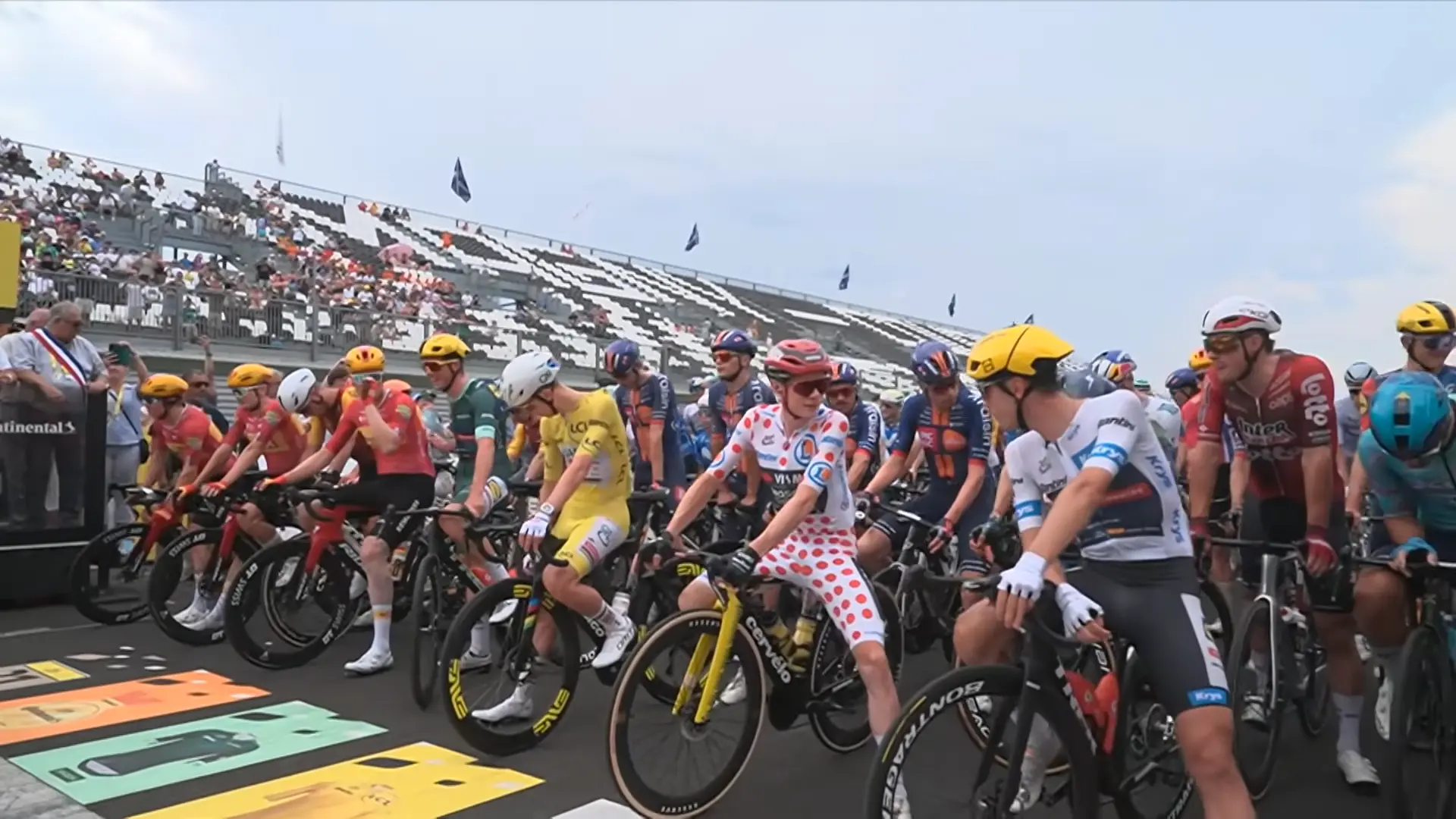
Tour de France 2026 Stage 15: Champagnole to Plateau de Solaison — 184 km, No Margin, No Rest
Last Updated: 10:04 am CEST - Sunday, 19 July 2026
Stage 15 of the Tour de France 2026 is a 183.9 km mountain stage from Champagnole in the Jura to the Plateau de Solaison in Haute-Savoie, scheduled for Sunday 19 July 2026 at 13:10 CEST. It is the hardest climbing day of the entire 2026 race with approximately 4,700 metres of elevation gain, finishing on an HC summit the Tour de France has never used before. The Plateau de Solaison averages 9.1% over 11.3 kilometres with almost no respite in the first six kilometres and maximum ramps touching 14%.
Stage 15 decides who arrives at Rest Day 2 in control of the race and who arrives in crisis. The stage after it, Stage 16, is a 26 km individual time trial along Lake Geneva, which redistributes time in favour of the strongest time trialists. Pure climbers with TT weaknesses need to use the Plateau de Solaison to build gaps they can survive on Monday. Riders with strong time trial ability, Vingegaard, Evenepoel, and Pogačar, can hold back, absorb whatever happens, and recover lost ground in the clock race. Every GC rider on Stage 15 is doing the same mental arithmetic. It makes the final climb genuinely explosive.
TL;DR
- What is Stage 15? A 183.9 km mountain stage on Sunday, 19 July 2026, from Champagnole to the Plateau de Solaison. Approximately 4,700 metres of elevation gain across multiple climbs, culminating in an 11.3 km HC summit finish averaging 9.1%. The Plateau de Solaison makes its first-ever Tour de France appearance. Start time: 13:10 CEST.
- Why does it matter? Stage 15 is the last hard GC day before Rest Day 2 and the Stage 16 individual time trial. Riders who finish Solaison with a lead know the ITT is next — the remaining climbing opportunities before Paris are the Alps in Week 3. This is the moment pure climbers must act or accept that time trialists will close the gap on Monday.
- When to watch? Start 13:10 CEST / 12:10 BST / 07:10 EDT. Estimated finish ~17:55 CEST. Full world time zone table further below.
Stage 15 key facts
| Detail | Confirmed data |
|---|---|
| Stage number | 15 of 21 |
| Date | Sunday, 19 July 2026 |
| Start | Champagnole (Jura) — 4th Tour visit |
| Finish | Plateau de Solaison — Tour debut |
| Distance | 183.9 km |
| Stage type | Mountain / HC summit finish |
| Total climbing | ~4,700m |
| Categorised climbs | 3 (+ 1 HC final climb) |
| Start time | 13:10 CEST |
| Est. finish time | ~17:55 CEST (range: 17:41–17:55) |
| Intermediate sprint | Saint-Laurent-en-Grandvaux, km 17.3 |
| Context | Eve of Rest Day 2 (Monday 20 July) |
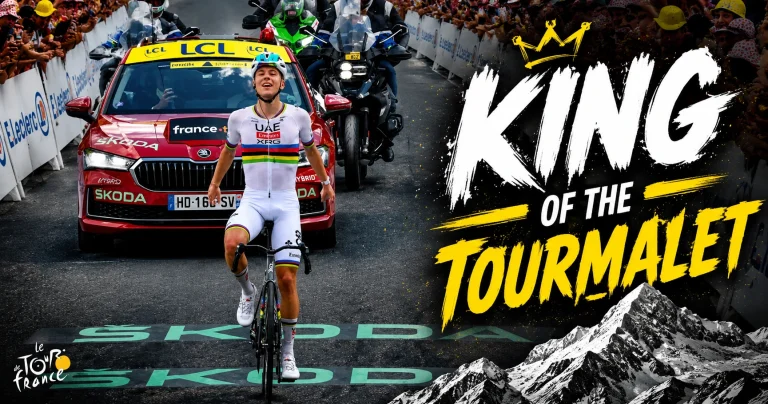
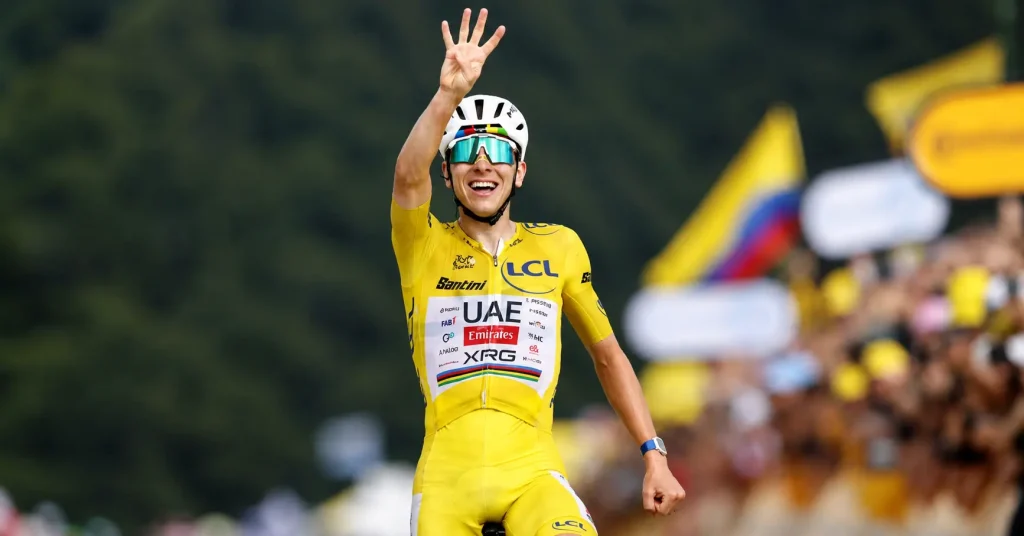
Pogačar didn’t need the whole Col du Haag — just the last 1.5 km of it. He waited out Lipowitz’s early dig and Seixas’s follow-up move, let Vingegaard’s group do the chasing work, then exploded through the crowds near the summit and rode solo to his fourth stage win of this Tour. Del Toro held on for second, Seixas took third and the white jersey, and Vingegaard crossed fourth, 38 seconds down, the kind of gap that sounds small until you realise it’s now his fifth straight mountain stage losing time to the same rival. Pogačar’s overall lead swells to 4:30. Evenepoel stays third. The podium picture, for the first time all Tour, is starting to look settled rather than contested.
Stage 15 is the last word before the second rest day, and ASO has built something genuinely new: a summit finish at Plateau de Solaison that the Tour has never used before, though Vingegaard has, he won there in 2022 at the Critérium du Dauphiné, dropping his own team leader, Primož Roglič in the process. The road to it isn’t a gentle preparation either. Le Salève arrives via the brutal Col de la Croisette, 4.6 km at 11%, roughly 135 km in, before 36 km of rolling terrain sets up an 11.3 km climb averaging 9% with ramps past 12%. No descent to hide on, no flat to recover. If Vingegaard needed a stage built for him specifically, ASO just handed him one.
Why Stage 15 is the race’s defining day before Paris
Christian Prudhomme announced the 2026 Tour route, speaking of a race designed to be “in crescendo.” Stage 15 is where that crescendo hits its loudest note before the Alps. Three weeks of racing, 4,700 metres of climbing in a single day, an HC summit the peloton has never contested under Tour conditions, and every GC contender knowing that the clock ticks against certain rider profiles on Monday.
The positioning is surgical. Stage 14 through the Vosges runs Saturday, hitting the GC contenders with explosive short-effort climbing on unknown terrain. Stage 15 follows Sunday with sustained steep climbing to a new summit. Rest Day 2 lands on Monday. Stage 16’s individual time trial, 26.1 kilometres from Évian-les-Bains to Thonon-les-Bains along Lake Geneva, arrives Tuesday. That four-day sequence is the most tactically compressed period of the 2026 Tour. Stage 15 is the pivot point.
Here’s the specific pressure it creates. Jonas Vingegaard won on the Plateau de Solaison at the 2022 Critérium du Dauphiné and is also one of the strongest time trialists in the field. If he finishes Stage 15 in yellow with even thirty seconds on Pogačar, the ITT on Tuesday adds to that lead rather than reducing it. For a rider like Paul Seixas, nineteen years old in his first Grand Tour, profile built for explosive climbing, Solaison is simultaneously his best remaining weapon and the moment the three-week fatigue bill comes due. The decisions made on the Solaison’s opening six kilometres on Sunday afternoon will echo through to Paris.
Champagnole: where Stage 15 begins
Stage 15 departs Champagnole at 13:10 CEST on Sunday, 19 July. This is the Jura town’s fourth visit from the Tour de France, it last hosted a stage in 2020, when Søren Kragh Andersen broke clear of the break and held his lead to the line. This time the stage leaves rather than finishes here, and the parcours couldn’t be more different. The 2020 visit was a medium-mountain stage built for breakaway racing. Stage 15 is a different animal from the first kilometre.
Champagnole sits on the River Ain at the foot of Mont Rivel. The town itself is quiet, a working Jura market town, not a tourist destination, but it sits inside one of France’s most rewarding food and landscape regions, which matters for anyone arriving the evening before to watch the race village and the stage start.
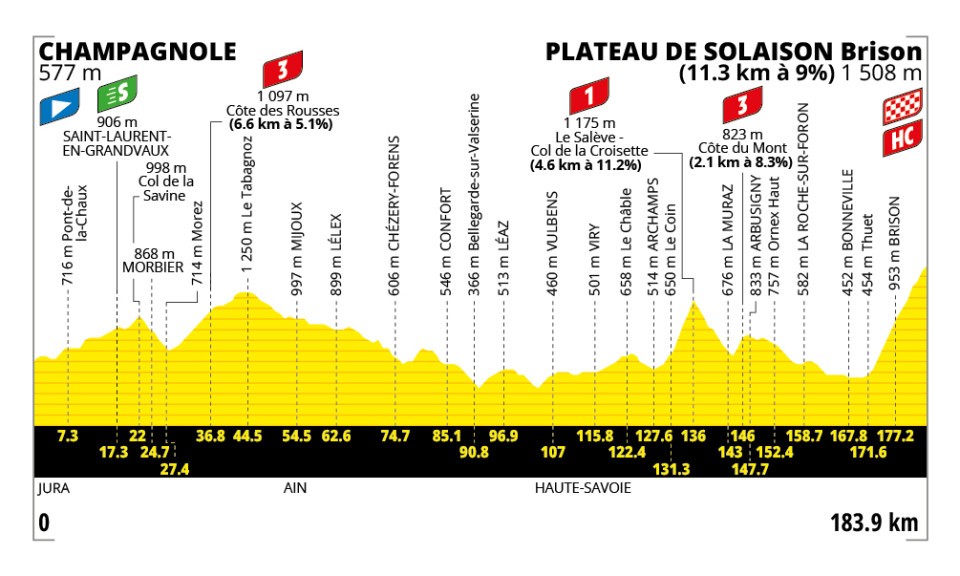
The road tilts uphill from virtually the flag drop. For the first 22 kilometres, the gradient hovers around 2.1%, negligible, but the stage never truly flattens before the Côte des Rousses arrives at kilometre 36.8.
Intermediate sprint: Saint-Laurent-en-Grandvaux (km 17.3)
The intermediate sprint sits at Saint-Laurent-en-Grandvaux, seventeen kilometres in, during the false-flat opening section. This is points-classification territory, not GC territory. The sprinters and puncheurs fighting for green jersey points will put in their effort here. For GC riders, it’s noise. The race’s actual character doesn’t announce itself until the road tilts seriously upward later in the stage.
The 123 km prologue: Jura, descent, and the long road south
Stage 15 has an unusual structure. Of its 183.9 kilometres, the first 123 are largely manageable, a series of Jura climbs, a long descent, and rolling terrain that wouldn’t look out of place on a transition stage. The final 61 kilometres are something else entirely. That front-loaded deception is part of what makes Stage 15 dangerous. Riders have to be disciplined across 123 kilometres of racing that doesn’t feel decisive before confronting two of the most demanding obstacles of the entire race in a row.
Côte des Rousses (km 36.8) — where the breakaway goes
Category 3 | 6.6 km | 5.1% | km 36.8
The Côte des Rousses is the first categorised climb of Stage 15, and the moment the race stops being neutral. At 6.6 kilometres and 5.1%, it’s not a selection climb for GC riders. It is the launchpad for the day’s breakaway, and Stage 15’s parcours makes a successful break here tactically obvious for both the peloton and any rider trying to win the stage.
After the Côte des Rousses, the race navigates through Morez and then the Côte de Doppes, 15.2 kilometres at 3.6%, uncategorised, not hard enough to split the race, before a descent that runs for nearly fifty kilometres through the Valserine valley. That descent is broken only by the Côte de la Mulaz (3.6 km at 4.2%), another rhythm disruption rather than a real climb. The peloton reaches the valley floor at Bellegarde-sur-Valserine.
Bellegarde-sur-Valserine — the race’s lowest point
At the confluence of the Valserine and Rhône rivers, Stage 15 touches its lowest altitude. The Pays de Gex district surrounds this section, the strip of French territory wedged between the Jura and Switzerland, Geneva just twelve kilometres northeast. After crossing the Rhône, the road climbs the modest Côte de Vulbens (4.3 km at 3.1%) and then rises on a gentle false flat toward the day’s real obstacles.
The geography here is striking. Riders descend from the Jura highlands, cross the Rhône in the shadow of the Jura escarpment, and begin climbing toward the subalpine foothills of Haute-Savoie. The transition from the Jura plateau to the Alps pre-alpine is visible from the road, the terrain physically changes character, the gradients sharpen, and the mountains ahead are no longer rounded. The racing follows the terrain.
Col de la Croisette (km 136) — the wall that opens the finale
Category 1 | Full climb: 7.6 km at 8.8% | Classified section: 4.6 km at 11.2% | km 136
The Col de la Croisette, on the slopes of Le Salève in Haute-Savoie, is the climb that ends the controllable phase of Stage 15. Christian Prudhomme used one word to describe it when the 2026 route was presented: intraitable. Untameable. Relentless. Both translations work.
The full ascent is 7.6 kilometres at 8.8% average. The Tour classifies only the upper 4.6 kilometres, which average 11.2% — a number that removes any ambiguity about what this climb feels like. For comparison, Alpe d’Huez averages 8.1% across its full 13.8 kilometres. The Croisette’s classified section is harder per metre than the most famous climb in the sport, and it arrives at kilometre 136 on legs that have already processed 36.8 kilometres of Jura climbing and a 50-kilometre descent.
Valentin Paret-Peintre of Soudal Quick-Step laid out the tactical logic before the race: the opening roads are wide enough that a breakaway is difficult to establish cleanly, but the Col de la Croisette is where the sorting begins. “The Col de la Croisette will be a good place to try to reduce the number of riders present at the front and accelerate,” he said. For a non-GC rider capable of holding 11.2% gradients, the Croisette offers the last realistic chance to detach from a fracturing group and build a lead before the Solaison’s final reckoning. For GC teams, the calculus is different: the summit still has 47 kilometres to the finish. Nobody wins Stage 15 on the Croisette. They get damaged here, or they don’t.
From the Croisette summit, just under 50 kilometres remain and a long descent into the Arve valley before the Plateau de Solaison begins.
Côte du Mont, Côte de la Moussière, and the 47 km bridge
Between the Col de la Croisette summit and the foot of the Plateau de Solaison sits 47 kilometres of hilly terrain, two more climbs, and the long drop into the Arve valley. Neither the Côte du Mont nor the Côte de la Moussière will fracture the GC race. Both contribute to what arrives at the Solaison base.
The Côte du Mont (2.1 km at 8.3%, km 146) comes immediately out of the Croisette descent. It’s punchy, short, and feels hard on legs already taxed by 11.2%. The Côte de la Moussière (2.5 km at 7.3%) follows soon after. Then the road drops into the Arve valley — the broad, flat valley floor that links Chamonix and Mont Blanc in the east with Lake Geneva in the west. Bonneville sits at the bottom, just above where the final climb starts. On the approach to Bonneville, riders can see the Plateau de Solaison on the hillside to the south. The cliff road section, a visible vertical scar on the mountainside, is identifiable from the motorway. By the time a rider reaches it, they have spent roughly four and a half hours racing.
Plateau de Solaison — the Tour’s hardest new summit finish
Hors Catégorie | 11.3 km | 9.1% average | first 4 km at ~10%+ | max ramps 12–14% | summit 1,508m | km 183.9
The Plateau de Solaison is making its first appearance in Tour de France history. That isn’t an accident of geography or oversight. ASO, the Tour’s organiser, deliberately avoided this climb until the 2026 edition could give it the stage it deserved, a top-ten race day, a split GC field, and national television at 17:55 on a Sunday in July.
The profile is unlike most HC Tour climbs. There is no extended plateau, no mid-climb respite, no switchback section where the gradient briefly relaxes to four or five percent for four consecutive kilometres. The Plateau de Solaison from Bonneville via Thuet is eleven-point-three kilometres of continuous difficulty, with the only breathing room arriving as small irregular sections after the village of Brison rather than as a sustained easier stretch.
Section one: the base to Brison (km 0–6)
The climb starts immediately. From the foot near Bonneville, the road rises at around ten percent from the first metre and holds that gradient, almost without interruption, for the six kilometres to the village of Brison. There are passages at twelve and fourteen percent. The road is narrow and forest-lined. In the first kilometre, every rider on the mountain already knows whether this is a good day or a bad one. At ten percent from a cold start at 183 kilometres into a stage, it quickly separates riders in a way a classic alpine climb beginning at 6–7% doesn’t.
Section two: Brison to the upper plateau (km 6.5–10)
After Brison the character shifts. Instead of an unbroken wall, the gradient becomes a staircase — sections above ten percent alternating with brief passages at four or five percent. It doesn’t feel easier. The brief respites last long enough to accelerate briefly but not long enough to genuinely recover, which makes them harder to pace than a steady gradient. This is where the decisive attacks happen. A rider who can absorb the staircase rhythm and accelerate on the steep sections while others are forced to manage — not sprint — will open the gaps that matter.
Section three: the plateau approach (km 10–11.3)
The final 1.3 kilometres ease slightly, to around eight percent, as the narrow forest road opens onto the alpine meadow. The Plateau de Solaison is not a sharp summit — it’s a wide, flat highland pasture in the Massif des Bornes, ringed by the Aravis peaks and, in clear conditions, with a direct sightline to the Mont Blanc massif to the southeast. The transition from forest darkness to open sky happens in the final kilometre of the race. For whoever arrives first, it’s one of the most visually dramatic finish lines of the 2026 Tour.
Prudhomme called it “a springboard to glory.” He wasn’t wrong about the setting.
Solaison’s history before the Tour
Professional cycling discovered the Plateau de Solaison via the Critérium du Dauphiné, the Tour’s principal warm-up race, also organised by ASO. Jakob Fuglsang won here when the Dauphiné used it in 2017. Jonas Vingegaard won the stage in 2022, crossing the finish line alongside his then-team leader Primoz Roglic, who secured the overall victory. Vingegaard’s win that day was widely reported as the moment the cycling world understood that the young Dane was already capable of beating anyone on any climb in the world. He clearly outclimbed Roglic at the finish but waited to cross together.
The 2026 Tour Auvergne-Rhône-Alpes, the new name for the Critérium du Dauphiné, also used the Plateau de Solaison as the final stage on 14 June 2026, five weeks before Stage 15. Any rider who contested that race has kilometre-by-kilometre data from a competitive climb up the same road. That information gap between riders who raced the Dauphiné and those who didn’t is real, and it’s larger than the equivalent gap on more familiar Tour climbs.
Five things to know about the Plateau de Solaison
1. The summit temperature can be extreme. In January 2025, the Plateau de Solaison recorded -33.1°C overnight — colder that night than the Aiguille du Midi at 3,845 metres altitude. In July, summit temperatures are typically between 12–18°C, often ten degrees cooler than the Arve valley below. Spectators at the finish in July should bring layers.
2. The cliff road is visible from the motorway. The A41 autoroute running below Brison gives a clear view of the climb’s most dramatic section — a narrow road carved across a limestone cliff face between the tree line and the open pasture. The road appears almost vertical from below. It isn’t — but it’s close.
3. Vingegaard holds a psychological edge here that no other GC rider does. He has won on this finish. He knows where the gradient changes. He knows which section opens for an attack and which section looks like an opportunity but isn’t. That kind of climb-specific knowledge matters more on an irregular staircase profile than on a steady grind like Alpe d’Huez.
4. The summit restaurant is famous for one thing. The Bruyère restaurant at the Solaison plateau serves beignets de pommes de terre — potato fritters — as its signature dish. Local cyclists treat them as a post-climb reward. For spectators arriving the evening before, this is dinner.
5. Mont Blanc is visible from the finish on a clear day. The Aravis chain (Grand-Bornand, La Clusaz) lines the immediate horizon. Behind it, on a clear July afternoon, the Mont Blanc massif is visible to the southeast — the highest peak in the Alps, 4,807 metres, approximately 45 kilometres from the finish line.
Stage 15 climb-by-climb profile
| Climb | Category | km marker | Distance | Avg gradient | Notes | Summit |
|---|---|---|---|---|---|---|
| Côte des Rousses | Cat. 3 | 36.8 | 6.6 km | 5.1% | Breakaway launchpad | ~1,100m |
| Côte de Doppes | Uncategorised | ~45 | 15.2 km | 3.6% | Long Jura approach | — |
| Côte de la Mulaz | Uncategorised | ~63 | 3.6 km | 4.2% | Mid-descent disruption | — |
| Côte de Vulbens | Uncategorised | ~90 | 4.3 km | 3.1% | Post-Rhône rhythm | — |
| Col de la Croisette | Cat. 1 | 136 | Full: 7.6 km / Classified: 4.6 km | Full: 8.8% / Upper: 11.2% | Prudhomme: “intraitable.” 47 km to finish after summit | — |
| Côte du Mont | Cat. 3 | 146 | 2.1 km | 8.3% | Immediately after Croisette descent | — |
| Côte de la Moussière | Uncategorised | ~156 | 2.5 km | 7.3% | Before Arve valley drop | — |
| Plateau de Solaison | HC | 183.9 | 11.3 km | 9.1% | Tour debut. First 4 km at ~10%+. Max 12–14%. Narrow road. Summit views: Aravis + Mont Blanc | 1,508m |
Total categorised climbs: 3 + 1 HC finish. Approximate total climbing: 4,700m.
GC implications — the last hard day before Rest Day 2
Stage 15 arrives on race day, twelve of twenty-one. By Sunday, 19 July, the GC riders have already survived Stage 6 (Tourmalet approach to Gavarnie-Gèdre), the Massif Central on Bastille Day, the longest stage of the race (Stage 13, 205 km), the Vosges explosion of Stage 14 (Col du Haag), and now the hardest elevation day in the entire 2026 Tour. Whatever each rider’s GC position entering the Plateau de Solaison base, they’ve earned it.
The ITT dynamic is the most important tactical variable on Stage 15. Stage 16, the individual time trial from Évian-les-Bains to Thonon-les-Bains, is 26.1 kilometres with 500 metres of climbing and the Côte de Larringes as the key obstacle. It’s not a flat aero test. But it rewards time-trialling ability, and three of the GC’s top four riders have strong TT engines.
Vingegaard (Visma-Lease a Bike). Won on the Plateau de Solaison in 2022. Knows the climb’s three-section character. Also, one of the most dangerous time trialists at this level. If Vingegaard arrives at the foot of the Solaison in yellow or within striking distance, he has the best card set of anyone in the race; he can absorb an attack on the climb, lose ten seconds, and recover twelve seconds in the ITT. That arithmetic gives him more tactical freedom than his rivals, and experienced GC riders exploit that freedom by riding defensively when they can.
Evenepoel (Red Bull-BORA-hansgrohe). The best time trialist in the GC group. A sustained 9.1% gradient over eleven kilometres suits his consistent power profile better than the irregular staircase demands of the Col du Haag the day before. The Croisette’s upper section, 4.6 km at a steady 11.2%, is exactly the kind of effort Evenepoel can hold at threshold. If he arrives at the Solaison in contention, he’s dangerous, and he knows the ITT is his to win.
Pogačar (UAE Team Emirates-XRG). The defending champion doesn’t have a specific weakness across any terrain on this stage. What he has is a complete picture: explosive enough for the Croisette, sustainable enough for the Solaison, and a capable time trialist for Tuesday. The question on Stage 15 is whether he attacks to build time before the ITT or waits to see what others do. Pogačar’s record suggests he attacks when the race gives him a clear signal, and Solaison’s section two, where the staircase gradient punishes riders with inconsistent power, is exactly that signal.
Seixas (Decathlon CMA CGM). Nineteen years old, first Grand Tour, three weeks of racing in his legs when the Solaison begins. His W/kg profile maps almost perfectly to sustained steep climbing, but the question nobody can fully answer until the climb starts is how much fatigue accumulates after Stage 14’s Vosges explosion the day before. If Seixas’s legs come back overnight, as young climbers’ legs sometimes do, Stage 15 is the moment he forces the race onto a new script. If they don’t, the ITT on Tuesday will be a damage-limitation exercise.
Stage 15 winner prediction — who takes Solaison?
The Plateau de Solaison’s profile makes a solo GC victory the most likely outcome. This isn’t a climb for sprint finishes in a reduced group — section one removes the sprinters in the first two kilometres and section two removes all but the very best climbers by kilometre eight. What arrives at the finish will be one rider, or a group so small that the winner is decided by pure form.
Scenario A: Breakaway sticks to the Croisette, dies on Solaison. A break of six to ten riders, including stage-hungry non-GC climbers, goes on the Côte des Rousses and manages its advantage through the long Jura-to-Haute-Savoie transition. The Col de la Croisette destroys it to two or three survivors. Solaison section one destroys it to one. A solo rider wins by two to four minutes over the GC group. This is the best result for stage hunters and the outcome ASO designed the parcours to enable.
Scenario B: GC attack on Solaison. The break is absorbed or never went clear. The GC group enters the Solaison together. The Col de la Croisette has already been carved for five or six riders. Section one of the Solaison removes the weaker GC contenders. The attack comes in section two — kilometre seven to nine — from whoever has the most to gain and the least faith in their ITT legs. Seixas or Pogačar attacks. Vingegaard follows or responds. Evenepoel watches and measures.
The prediction: A break survives to the Croisette and produces a stage winner. The GC group finishes fifteen to twenty-five seconds down on one another, with the biggest gaps opening in the Solaison section two. The yellow jersey situation entering Rest Day 2 may be unchanged from Stage 14, or it may be completely reordered.
Stage 15 start times around the world
| Time zone | Region | Start time | Est. finish |
|---|---|---|---|
| CEST (UTC+2) | France, Germany, Italy | 13:10 | ~17:55 |
| BST (UTC+1) | United Kingdom, Ireland | 12:10 | ~16:55 |
| EDT (UTC-4) | New York, Miami | 07:10 | ~11:55 |
| CDT (UTC-5) | Chicago, Dallas | 06:10 | ~10:55 |
| MDT (UTC-6) | Denver, Phoenix | 05:10 | ~09:55 |
| PDT (UTC-7) | Los Angeles, Seattle | 04:10 | ~08:55 |
| IST (UTC+5:30) | India | 16:40 | ~21:25 |
| JST (UTC+9) | Japan | 20:10 | ~01:25 +1 |
| AEST (UTC+10) | Sydney, Melbourne | 21:10 | ~02:55 +1 |
Finish time is estimated. HC summit finishes vary by ten to twenty minutes depending on race pace, weather, and attacks. The official ASO estimate is approximately 17:55 CEST. SBS On Demand in Australia makes the replay available by approximately 07:00 AEST the morning of Monday 20 July — which is Rest Day 2, the ideal day to watch a replay if you missed the live broadcast.
How to watch Stage 15 live
| Region | Free option | Paid / full coverage |
|---|---|---|
| France | France Télévisions (France 2 / France 3) — all stages, free | France.tv stream, L’Équipe TV |
| United Kingdom | Channel 5 — free daily highlights only, from 7pm | TNT Sports / HBO Max — live every stage (£30.99/month). ITV no longer holds rights from 2026. |
| Australia | SBS — all 21 stages live, free, full English commentary | SBS On Demand — free, register online, live and replay |
| USA | NBC — Grand Départ and Paris finale only | Peacock Premium — live every stage ($10.99/month) |
| Canada | — | FloBikes / FloSports — live every stage |
| Germany | ARD — select stages, free | Eurosport |
| Belgium | RTBF / Sporza — free | — |
| Italy | RAI Sport — free | — |
| Spain | RTVE Play — free | — |
| Netherlands | NOS — free | — |
| Rest of world | Eurosport (check local availability) | Discovery+ / Max in select markets |
Sunday timing advantage: Stage 15 starts and finishes on a Sunday afternoon European time, which is the most viewer-friendly slot of the week for British, Irish, Australian, and Southeast Asian audiences. The Sunday 12:10 BST start means UK viewers on TNT Sports or Channel 5 can watch without setting an alarm. Australian SBS viewers get the live broadcast at 21:10 AEST on Sunday evening. See full regional live streaming guide.
When to Watch TDF Stage 15
| Key Point | Distance | France (CEST) | UK (BST) | US EDT | US PDT | Australia AEST |
|---|---|---|---|---|---|---|
| 🚩 Stage Start – Champagnole | 0 km | 13:10 | 12:10 | 07:10 | 04:10 | 21:10 |
| ⛰️ Col de la Savine | 22.0 km | 13:49 | 12:49 | 07:49 | 04:49 | 21:49 |
| ⛰️ Côte des Rousses | 36.8 km | 14:13 | 13:13 | 08:13 | 05:13 | 22:13 |
| 📍 Mijoux | 54.5 km | 14:33 | 13:33 | 08:33 | 05:33 | 22:33 |
| 📍 Chézery-Forens | 74.7 km | 14:57 | 13:57 | 08:57 | 05:57 | 22:57 |
| 📍 Bellegarde-sur-Valserine | 90.8 km | 15:16 | 14:16 | 09:16 | 06:16 | 23:16 |
| ⛰️ Col de la Croisette (Le Salève) | 136.0 km | 16:23 | 15:23 | 10:23 | 07:23 | 00:23 (+1) |
| ⛰️ Côte du Mont | 146.0 km | 16:36 | 15:36 | 10:36 | 07:36 | 00:36 (+1) |
| 📍 La Roche-sur-Foron | 158.7 km | 16:54 | 15:54 | 10:54 | 07:54 | 00:54 (+1) |
| 📍 Bonneville | 167.8 km | 17:07 | 16:07 | 11:07 | 08:07 | 01:07 (+1) |
| ⛰️ Final Climb – Plateau de Solaison | 177.2 km | 17:25 | 16:25 | 11:25 | 08:25 | 01:25 (+1) |
| 🏁 Finish – Plateau de Solaison | 183.9 km | 17:41 | 16:41 | 11:41 | 08:41 | 01:41 (+1) |
Key moments for viewers
- Start: 12:10 BST
- First major climb (Col de la Savine): 12:49 BST
- Côte des Rousses: 13:13 BST
- Le Salève (Col de la Croisette): 15:23 BST
- Côte du Mont: 15:36 BST
- Final climb begins: 16:25 BST
- Expected finish: 16:41 BST
Spectator guide — watching Stage 15 in person
Best viewing spots along the route
Col de la Croisette — upper section (km 136): The classified 4.6 kilometres at 11.2% is where Stage 15 first becomes violent. Riders going up an 11.2% average climb at competitive pace look visibly different from riders on a seven-percent alpine grind, they’re slower, more upright, breathing harder. This section also carries decisive tactical value: teams will be fighting for position and some riders will be losing contact visibly. Arrive by 10:00 CEST, roads close progressively from mid-morning. Parking in Lélex or Mijoux, then walk or cycle to the climb.
Plateau de Solaison summit — finish area: The most atmospherically stunning spectator spot of Stage 15. The open alpine meadow at 1,508 metres, ringed by the Aravis peaks, is where the stage is decided and where whoever wins Stage 15 will raise their hands. No vehicles reach the finish on race day, access is on foot or bicycle from Bonneville/Thuet, roughly 11 kilometres up the road the riders race on. If you want the finish, arrive the evening before or very early Sunday morning. Crowds build through the morning.
The cliff road section (km 4–6 of the climb): For pure spectating experience, the cliff road between the tree line and Brison is the place to see ten-plus-percent cycling up close. The road is narrow enough that spectators standing beside it are genuinely close to the riders, not behind barriers fifty metres from the action. The views down toward the Arve valley from this section are spectacular.
Road closures and access
The Plateau de Solaison road closes to motor vehicles from early Sunday morning. Check the Haute-Savoie department authority’s official race-day access map, typically published during the week before the stage. The Col de la Croisette access roads in the Lélex / Mijoux area follow similar progressive closures.
Spectators parking in Bonneville and cycling to the finish have approximately 11.3 kilometres of the same climb the riders race. The road is open for cyclists on foot and by bike during the closure period. Take water, there is one fountain in Brison on the climb. The summit restaurant (La Bruyère) is open on race day.
Where to stay and how to get there
Annecy: The most practical base for Stage 15’s finish area. Approximately 30 minutes from Bonneville by road. Good rail connections from Geneva, Lyon, and Paris. Full hotel availability. The old town on the lake is one of the most attractive bases for any Tour de France stage in the Alps.
Geneva: 45 minutes from Bonneville by road. International airport with direct connections from the UK, USA, Middle East, and Asia. The cross-border Geneva–Haute-Savoie region is the most logistically convenient international arrival point for Stage 15.
Bonneville: At the foot of the Solaison climb. Small town, limited accommodation, but the most convenient base for a dawn arrival on race day. The Arve valley has additional smaller towns, Cluses, Sallanches, with more options.
Champagnole (stage start): For those watching the start, Champagnole is serviced by Lons-le-Saunier rail connections. The race village opens to the public on the morning of the 19th.
Plateau de Solaison: why the Tour hadn’t been here before
The obvious question about any new Tour summit finish is: why now? The Plateau de Solaison sits in Haute-Savoie, France’s most concentrated cycling mountain region. The Tour has climbed almost everything in the vicinity — the Col de la Colombière, the Col des Aravis, Plateau des Glières, the approach roads to Chamonix. The Solaison was right there.
The answer is partly about road infrastructure. The Solaison road from Thuet was widened and resurfaced specifically to accommodate professional race convoys. The road had the gradients and the setting but not the width for the Tour’s support vehicles, follow cars, and television motorbikes to operate safely in a competitive race. Once the upgrade was complete, ASO moved quickly, the climb appeared in the Critérium du Dauphiné in 2022, then in the 2026 Dauphiné again, and now in the Tour itself. The 2026 Tour Auvergne-Rhône-Alpes used it as the final stage on 14 June 2026, five weeks before Stage 15, which gave race teams and riders the opportunity for competitive reconnaissance under race conditions.
The design principle is one ASO has been pursuing consciously: finding new summit finishes that are genuinely difficult without resorting to altitude above 2,000 metres. The Solaison crests at 1,508 metres. That’s below Alpe d’Huez (1,815m) and far below the Galibier (2,642m). What it lacks in altitude, it compensates with gradient. The first six kilometres at ten-plus-percent from a base at roughly 450 metres altitude — the gradient does the work that altitude does on higher cols. This is the same logic behind the 2026 Tour’s other new summit, the Col du Haag in the Vosges: climbs chosen for difficulty and character rather than altitude records.
Champagnole and the Jura — food, culture, and what to explore
Champagnole sits inside one of France’s most underrated food regions. The Jura produces two of the country’s most distinctive and difficult-to-replicate agricultural products, both protected under French AOC law, and both worth finding before the race if you’re basing here for the stage start.
Comté: The most consumed AOC cheese in France and one of the most complex. Made from the unpasteurised milk of Montbéliarde or Simmental cows, pressed into large wheels and aged for a minimum of four months in dedicated affineurs, the best Comté is aged twenty-four months or longer, developing a granular texture and a flavour that ranges from fruity and sweet to nutty and savoury as it ages. The milk comes from this exact region, from cows that graze the Jura highland pastures visible from Stage 15’s opening kilometres.
Vin Jaune: Jura’s most singular wine, made from the Savagnin grape and aged for a minimum of six years and three months in small oak barrels that are deliberately not topped up. An oxidative film called the voile, similar to sherry’s flor, develops on the wine’s surface, producing a nutty, complex, aged character unlike any other still wine in France. It’s not easy wine and it’s not for everyone, but there is nothing else like it. Château-Chalon produces the best. Arbois, the Jura wine capital, Louis Pasteur’s hometown, where he owned vineyards and worked on fermentation, is fifteen minutes from Champagnole.
Louis Pasteur connection: Pasteur was born in Dole, thirty kilometres from Champagnole, and lived and worked in Arbois. His house in Arbois is a museum. His work on fermentation grew directly from his attempts to understand what was happening in the Jura wine barrels around him. The Arbois wine region and the Pasteur legacy are one of France’s stranger and more rewarding travel combinations.
Other Jura essentials: Morbier cheese (distinctive ash line through the middle, washed rind, mild), Morteau sausage (smoked over pine and juniper in a traditional fumoir), Bleu de Gex (the blue cheese of the Pays de Gex, through which Stage 15 passes near Bellegarde). The Jura also has a lake district, Lac de Chalain, Lac de Vouglans, worth a detour on the day before or after the race.
Haute-Savoie near the finish — Aravis, Arve valley, and Mont Blanc
The Stage 15 finish area sits in the most touristically celebrated mountain region in France. Haute-Savoie covers the territory between Geneva and Chamonix, including Annecy (often ranked the most beautiful town in France), the Aravis range (La Clusaz, Grand-Bornand), the Arve valley from Bonneville to Chamonix, and the full western face of the Mont Blanc massif.
For spectators basing near the Solaison finish, Haute-Savoie cuisine is the relevant context.
Tartiflette: Potatoes, lardons, onion, white wine, and Reblochon cheese — a thick-crusted soft cheese from the Aravis valleys — baked until the top bubbles and browns. A deliberately indulgent post-climbing meal that every cycling visitor to this region orders at least once.
Fondue Savoyarde: Melted Beaufort, Emmental, and Comté, with white wine and garlic, served in a communal pot. Different from Swiss fondue. Beaufort is the local variety — made from Tarentaise cattle milk in the high Alpine pastures above Bonneville and Bourg-Saint-Maurice.
Beaufort: The third AOC cheese of the region, after Comté and Reblochon. Made at altitude in mountain chalets, pressed into large wheels, and aged with a concave bottom edge that makes it visually distinct. Rich, slightly sweet, and substantially more complex than the Emmental it resembles from a distance.
Génépy: The local herbal Alpine liqueur, distilled from Artemisia plants gathered above 2,000 metres in late summer. Clear or pale green, intensely herbal, served as a digestif after a Savoie meal. The equivalent of the Massif Central’s Verveine du Velay or Alsace’s eau de vie — the drink that tells you exactly where you are.
FAQ — Tour de France 2026 Stage 15
What is the Plateau de Solaison?
The Plateau de Solaison is an HC summit finish in the Massif des Bornes subrange of the Haute-Savoie Alps, at 1,508 metres altitude above the Arve valley. The ascent from Bonneville via Thuet is 11.3 kilometres at a 9.1% average, with the first six kilometres consistently above ten percent. It is a former Critérium du Dauphiné summit — Jonas Vingegaard won here in 2022 — and makes its Tour de France debut in Stage 15 of the 2026 edition.
Has the Tour de France ever finished at the Plateau de Solaison before?
No. Stage 15 on 19 July 2026 is the first ever Tour de France summit finish at the Plateau de Solaison. The climb has appeared in other professional races — Jakob Fuglsang won here at the 2017 Critérium du Dauphiné, and Jonas Vingegaard won here at the 2022 edition. The 2026 Tour Auvergne-Rhône-Alpes also used it as a final stage in June 2026, giving some Tour riders competitive reconnaissance data ahead of Stage 15.
Why is Stage 15 considered the hardest stage of the 2026 Tour de France?
Stage 15 accumulates approximately 4,700 metres of elevation gain — more than any other stage in the 2026 race — across 183.9 kilometres. The final two climbs are the Col de la Croisette (4.6 km at 11.2% in its classified section) and the Plateau de Solaison (11.3 km at 9.1%), which together demand sustained climbing power after 123 kilometres of racing. The stage also arrives on the eve of Rest Day 2 and before the Stage 16 individual time trial, making it the last true GC battleground of Week 2.
What is the Col de la Croisette on Stage 15?
The Col de la Croisette on Stage 15 is a Category 1 climb near Le Salève in Haute-Savoie, at kilometre 136 of the stage. The full ascent is 7.6 kilometres at 8.8%, but the Tour classifies only the upper section: 4.6 kilometres at an average of 11.2%. Tour director Christian Prudhomme described it as “intraitable” (relentless) when presenting the 2026 route. The Croisette crests with just under 50 kilometres remaining and begins the stage’s decisive phase. Anyone unable to hold 11.2% gradients here will not contest the Plateau de Solaison finish.
Where does Stage 15 of the Tour de France 2026 start?
Stage 15 starts in Champagnole, a market town in the Jura department of eastern France on the River Ain. This is Champagnole’s fourth Tour de France appearance. The race last departed or finished here in 2020, when Søren Kragh Andersen won solo from a breakaway in what was a flat-to-medium mountain stage. Stage 15 departs at 13:10 CEST on Sunday, 19 July 2026.
Where does Stage 15 of the Tour de France 2026 finish?
Stage 15 finishes at the Plateau de Solaison in the Massif des Bornes, Haute-Savoie, at 1,508 metres altitude. The finish marks the Tour’s first-ever summit finish at this location. The plateau sits above Bonneville in the Arve valley and offers views of the Aravis range and, in clear conditions, the Mont Blanc massif. Access for spectators is on foot or by bicycle; no vehicles reach the summit on race day.
Why does Stage 15 come before Rest Day 2?
Stage 15 is deliberately positioned as the final hard stage of Week 2, immediately before the second rest day (Monday 20 July) and the Stage 16 individual time trial (Tuesday 21 July). This sequencing maximises the GC drama: riders attacking on the Plateau de Solaison must weigh their effort against the ITT the following day, where strong time trialists can recover or extend their advantage. The eve-of-rest-day positioning is a classic Tour de France route design choice for the race’s penultimate GC decision point before the Alps.
What are the best viewing spots for Stage 15?
The two best Stage 15 viewing spots are the Col de la Croisette’s upper 4.6 km section (where the 11.2% gradient forces riders visibly to their limits at kilometre 136) and the Plateau de Solaison summit (the finish line, on an open alpine meadow with views of the Aravis range and Mont Blanc). The cliff road section between the tree line and Brison village, visible from the autoroute below, is the most photographically dramatic viewing spot on the climb. For the finish area, arrive the evening before; the road closes to vehicles early on race morning.
What is the intermediate sprint location for Stage 15?
The intermediate sprint in Stage 15 is at Saint-Laurent-en-Grandvaux, kilometre 17.3. It falls during the false-flat opening section through the Jura and is primarily a points classification contest. The terrain at this point is gentle enough for sprint-trained riders to compete, though the uphill drag means pure flat-stage sprinters will be fighting against puncheur-type riders built for short climbs.
How does Stage 15 relate to Stage 14 in the 2026 Tour?
Stages 14 and 15 form the GC weekend of Week 2. Stage 14 (Saturday 18 July) is a Vosges mountain stage with seven climbs and the Col du Haag — a first-ever Tour ascent with irregular gradients. Stage 15 (Sunday 19 July) follows with the hardest elevation day of the race, including the Col de la Croisette and the Plateau de Solaison. Riders complete both stages back-to-back before Rest Day 2, making the combined physical and tactical demands of Saturday and Sunday the most concentrated GC test of the entire 2026 race outside the Alps.
What is typical July weather like on the Plateau de Solaison?
July temperatures at the Plateau de Solaison typically range from 12–18°C at the summit, around 10°C cooler than the Arve valley floor near Bonneville. Afternoon thunderstorms are possible in the Aravis region in mid-July, the Haute-Savoie Alps have unstable afternoon weather patterns during summer. Spectators at the summit finish should bring waterproof layers regardless of valley conditions at race start. In January 2025, the plateau recorded -33.1°C overnight, colder than the Aiguille du Midi at 3,845 metres, evidence that the summit’s weather is far more extreme than its modest 1,508-metre altitude suggests.