Last updated: 12 July 2026, 12:44 pm CEST | route, weather and GC sections reflect the shortened course confirmed 11 July | 40 minutes read time
Tour de France 2026 Stage 9: Malemort to Ussel — Cut Short by a Red Heat Alert, Still Built for a Breakaway Shootout
Stage 9 of the Tour de France 2026 has been shortened to 154.6 kilometres after Météo-France placed the Corrèze department on red heatwave alert, cutting roughly 30 kilometres from the original route between Malemort and Ussel. The revised stage still starts at 13:45 CEST and is now expected to finish around 17:30 CEST, with temperatures forecast at 39°C at the start and up to 41°C inland during the afternoon. Despite losing distance, the stage keeps its full punch: seven categorised and uncategorised climbs remain, and it’s still the last chance for a breakaway before the Tour’s first rest day.
This is not a mountain stage and it was never going to be a GC ambush day. But it is, on paper and now in practice, one of the purest breakaway stages of the opening week — a hilly, technical route that rewards patience and punishes anyone who misjudges the heat. Riders who go into the break today know exactly what’s at stake: get it right, and you’re racing into Ussel with a rest day to recover before anyone can chase you down again.
TL;DR
Red Heat Alert — Corrèze
Stage shortened by ~30 km due to extreme temperatures. Two opening climbs removed. Riders face a revised 154.6 km route with increased hydration and cooling protocols in effect.
- What changed? Stage 9 was cut from roughly 185 km to 154.6 km after a red heat alert was declared for Corrèze. The opening climbs of Puy Boubou and Côte de Lagleygeolle have been removed; the peloton now takes a direct road from Brive-la-Gaillarde to Lanteuil before rejoining the original route.
- Why does it matter? It’s the last stage before Rest Day 1 on Monday 13 July — breakaway riders have maximum incentive to go early, while GC riders have every reason to sit quiet, save energy, and survive the heat. With Pogačar leading Vingegaard by 2:42, there is no meaningful reason for the top of the GC to attack today.
- When to watch? Start 13:45 CEST / 12:45 BST / 07:45 EDT. Estimated finish around 17:30 CEST, though the range runs 17:22–17:41 depending on race pace. Full world time zone table below.
Why the route changed
Corrèze was placed under Météo-France’s red heat alert, the highest warning level in the French system, ahead of Sunday’s stage, part of a broader emergency covering 37 of France’s 101 departments. ASO’s response was to cut the opening 30 kilometres of the route rather than cancel or neutralise the stage entirely, removing two early climbs, Puy Boubou (2.8 km at 4.1%) and Côte de Lagleygeolle (5.2 km at 3.9%), and sending the peloton directly from Brive-la-Gaillarde to Lanteuil via the D921, rejoining the original course from there.
This is the first time in the 2026 Tour that a stage route has been physically altered because of heat, though it’s far from the first heat-related disruption of the race. Stage 3 saw spectators told to stay away from the finish due to nearby wildfires. Stage 4 into Foix was raced in temperatures riders openly called unprecedented for the Tour. Stage 6 over the Tourmalet entered the red zone of the UCI’s Extreme Weather Protocol, the same classification system now shaping Stage 9, and on the Saturday before this stage, the heat was severe enough to close the Eiffel Tower and the Louvre in Paris entirely.
The logic behind cutting the start rather than the finish is straightforward: temperatures are forecast to be at their most extreme in the lower-altitude opening section near Brive-la-Gaillarde, easing slightly as the route climbs into wooded, higher terrain toward Ussel. Removing the hottest, flattest kilometres rather than the technical finale keeps the stage’s competitive character intact while reducing rider exposure during the most dangerous window of the day.
ASO has confirmed the stage will proceed in its reduced form. Tim Merlier, fresh off back-to-back sprint wins, was among the riders who welcomed the shortening publicly, a rare moment of unanimity in a peloton that’s spent a week negotiating extra feed zones, relaxed feeding rules, and rising frustration over late start times that leave riders on the road during peak afternoon heat.
The revised route, climb by climb
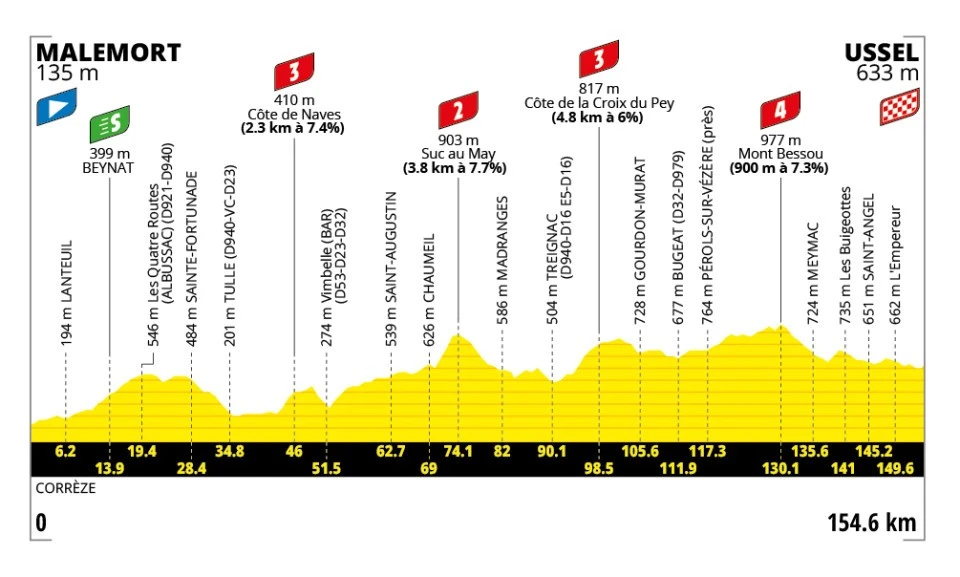
Malemort and the new opening (km 0–6.6)
Stage 9 now starts in Malemort, a suburb of Brive-la-Gaillarde, at 13:45 CEST. The riders no longer tackle Puy Boubou or the Côte de Lagleygeolle, both cut from the course, and instead take a direct road to Lanteuil, rejoining the original route with 148.4 kilometres still to race. From there, the Côte de Miel begins almost immediately: 6.6 kilometres averaging 3.9%, with the opening 2.6 kilometres ramping to 4.9%. It’s not a hard climb, but it sets the tempo straight into the day’s first flashpoint.
Intermediate sprint: Beynat (km 13.6–13.9)
The sprint at Beynat arrives on an uphill drag, roughly 2 kilometres at 5% into the line, which changes who can genuinely contest it. This isn’t a pure fast-man’s sprint; it favours a puncheur type who can hold power on a gradient, which tilts the points battle toward riders like Mads Pedersen rather than a pure sprinter forced to save everything for a flat finish that doesn’t exist today.
Côte des Naves and Puy de Lachaud — the warm-up pair
Côte des Naves: 2.3 km at 7.4%. The first climb that actually counts for the mountains classification, arriving around kilometre 46. Short, sharp, a genuine test rather than a formality.
Puy de Lachaud: 3 km at 5.6%. Softer than the Naves but still a genuine effort layered on top of it, without any real recovery in between. Together, these two climbs are the stage’s warm-up for what comes next, if “warm-up” is even the right word in 39-degree heat.
Suc au May (km ~74) — the hardest climb of the day
3.8 km at 7.7% average. This is Stage 9’s marquee obstacle and it has Tour history: Marc Hirschi rode away here in 2020 for a solo stage win, and the Suc au May remains the kind of short, brutal ascent that separates genuine climbers from riders just trying to survive the day. The descent starts on a narrow lane before widening onto a bigger road for most of the way down — a technical detail that matters when a group is trying to organise a chase or consolidate a gap.
Côte de la Croix du Pey (km ~98.5) — harder than the numbers suggest
Officially listed at 4.8 kilometres and 6%, the Croix du Pey is, in practice, considerably tougher than that figure implies. The road begins rising out of Treignac roughly 8 kilometres before the categorised summit, meaning riders are already climbing well before the “official” climb starts, and a brutal 2.5-kilometre section mid-ascent kicks up to 7–9%. This is the point in the stage where genuine climbers can make a real selection, well before the finish comes into view.
Mont Bessou (km 130.1) — the sting with 24.5km to go
Mont Bessou is mostly a long drag rather than a dramatic climb, but the final 900 metres average 7.3%, a proper kick right when legs are starting to feel the accumulated 130 kilometres in the heat. From the summit, there are 24.5 kilometres remaining to the finish in Ussel, almost all of it technical, rolling terrain rather than a clean run-in.
Meymac and the Côte des Gardes — the last sting (14km to go)
After descending into and out of Meymac, the Côte des Gardes provides one final test: 2.2 kilometres at 4.8%. It won’t decide the stage on its own, but for any rider whose sprint isn’t reliable, this is the last realistic launch point before the finish.
The finish in Ussel
With 1 kilometre to go, the route crosses a bridge over the Diège river, then climbs at 5% before easing into the finish line. It’s not a summit finish, but it’s not a flat sprint drag either — a rider arriving here in a small group with tired legs will find that final kilometre asks a genuine question.
Stage 9 Climb-by-Climb Profile
| # | Climb | Cat | Km | Dist | Avg |
|---|---|---|---|---|---|
| — | Puy Boubou | Cut | — | — | — |
| — | Côte de Lagleygeolle | Cut | — | — | — |
| 1 | Côte de Miel | Uncat | 0–6.6 | 6.6 km | 3.9% |
| 2 | Côte des Naves | Cat 4 | ~46 | 2.3 km | 7.4% |
| 3 | Puy de Lachaud | Uncat | ~50 | 3 km | 5.6% |
| 4 | Suc au May | Cat 3 | ~74 | 3.8 km | 7.7% |
| 5 | Côte de la Croix du Pey | Cat 4 | ~98.5 | 4.8 km | 6% |
| 6 | Mont Bessou | Uncat | 130.1 | 900m | 7.3% |
| 7 | Côte des Gardes | Uncat | ~140 | 2.2 km | 4.8% |
| 8 | Diège Bridge 🏁 | — | 153.6–154.6 | ~1 km | 5% |
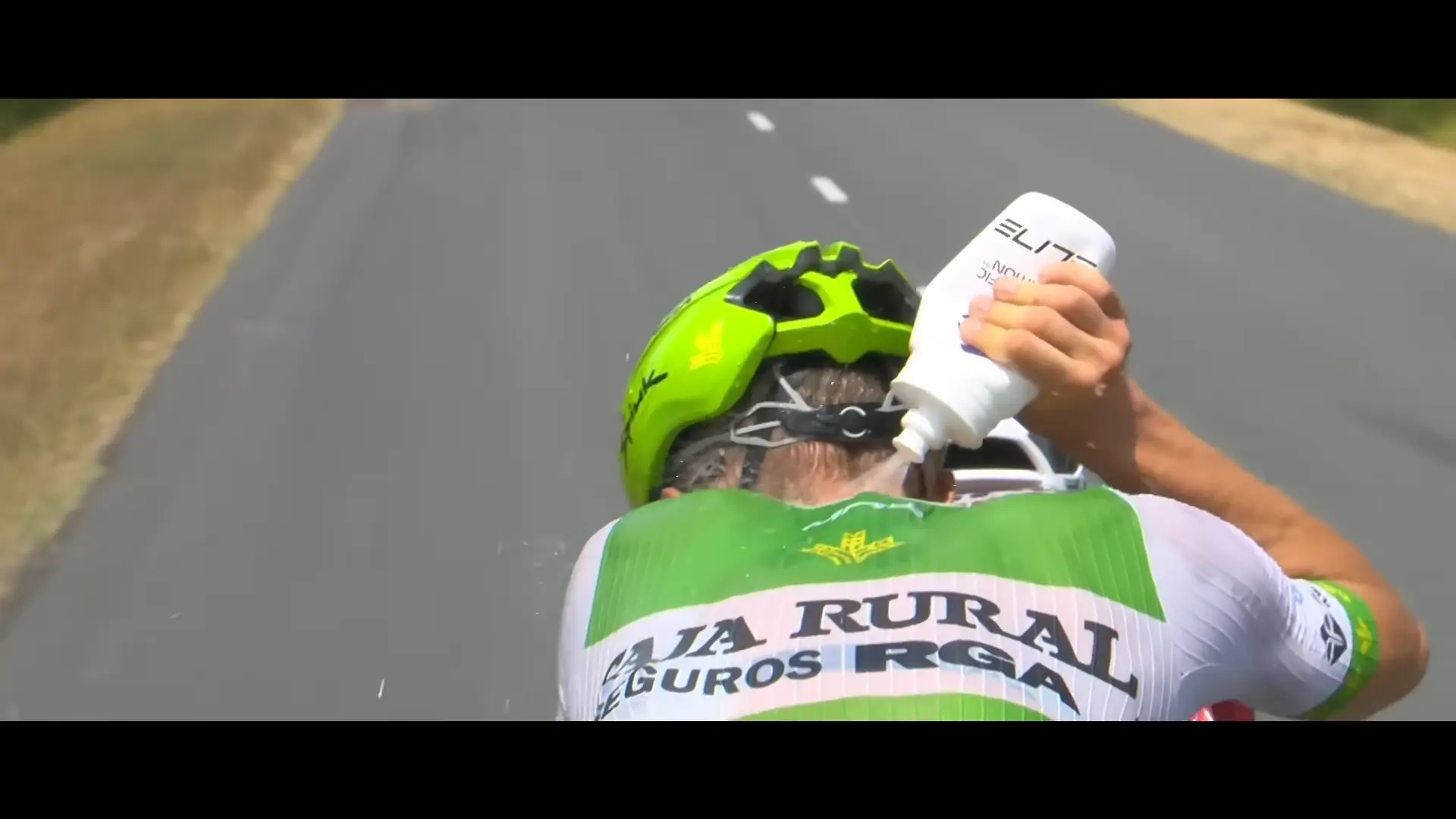
The temperature actually drops slightly as the stage progresses, the route gains altitude and moves into more wooded terrain toward Ussel, which is part of why ASO chose to cut the flatter, lower-altitude opening rather than the finale. That doesn’t make the day easy. Riders will spend nearly four hours racing in conditions that have already forced changes to feeding rules and additional cooling stops throughout the opening week, and Stage 6 over the Tourmalet already triggered the UCI’s Extreme Weather Protocol red zone before this stage did the same.
GC standings heading into Stage 9
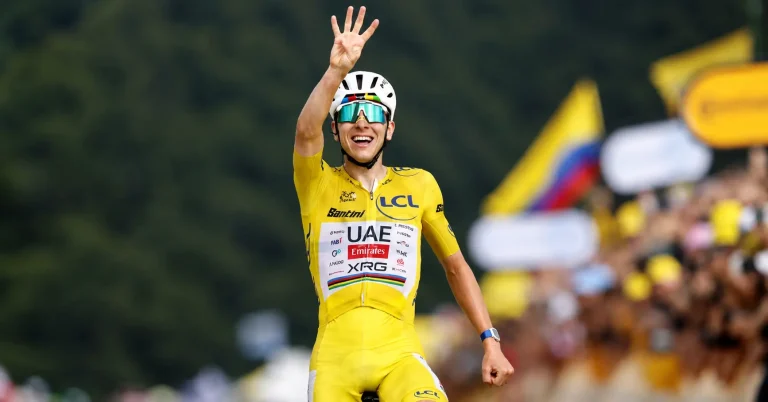
Tadej Pogačar (UAE Team Emirates-XRG) leads the race after retaking yellow with a long-range Tourmalet attack on Stage 6, four days after briefly losing it in the opening week. The gaps behind him are settled enough that Stage 9 carries almost no GC risk for the top of the standings — this is a day to survive, not attack.
Other jerseys: Mads Pedersen (Lidl-Trek) leads the points classification with 228, with Tim Merlier around 15 points back after his back-to-back sprint wins. Pogačar also leads the mountains classification with 28 points — a byproduct of his Tourmalet stage win rather than a dedicated climbing campaign. Isaac del Toro holds the white jersey as best young rider. Liam Slock (Lotto-Intermarché) was named most combative rider after Stage 8, where his 40-kilometre solo breakaway attempt fell agonisingly two kilometres short.
The story behind the gaps: Norway’s Torstein Træen briefly held the yellow jersey after a breakaway gained significant time earlier in the race, but he was forced to abandon following a crash on Stage 6 that left him with a concussion and other injuries — the same stage on which Pogačar’s Tourmalet attack reshuffled the entire GC picture. Paul Seixas, at 19 years old and racing his first Grand Tour, delivered a genuinely impressive mountain performance on that same Tourmalet stage, and has spent the days since firmly establishing himself as a top-ten GC rider rather than a curiosity. There’s also been a quieter subplot at Red Bull-BORA-hansgrohe, where Evenepoel and Lipowitz’s shared leadership produced visible tension after the Tourmalet stage — both riders have since said they’ve “worked it out,” though the situation remains one to watch as the race moves into its harder terrain.
None of this changes the calculus for Stage 9. With gaps between 2:42 and 7:10 inside the top ten, and a rest day tomorrow, there is no rational reason for any GC team to spend energy attacking today. The story of Stage 9 belongs to the breakaway.
Stage 9 favourites — who wins into Ussel?
This is, by consensus among those actually covering the race this week, the purest breakaway stage of the opening block. The terrain is too broken for a controlled sprint finish and not hard enough to force the GC group into a selection. That combination almost always means one thing: a large, well-negotiated breakaway gets the day, and the peloton — heat-managing, rest-day-minded — lets it go.
Top-tier picks:
Quinn Simmons (Lidl-Trek) enters as arguably the single strongest pick. He was a dominant force in the breakaway that delivered Mads Pedersen’s Stage 4 win and has shown he can finish as both a lead-out man and a winner in his own right. The open question is whether Lidl-Trek allow him room to ride for himself or ask him to again sacrifice for Pedersen’s green jersey push — and whether teammate Mathias Vacek gets similar freedom.
Richard Carapaz and Ben Healy (EF Education-EasyPost) bring real climbing pedigree to a stage that rewards exactly the kind of punchy, repeated efforts the Croix du Pey and Suc au May demand. Healy has form as a rider willing to go long and alone — he’s taken yellow that way before — and EF arrive with genuine strength in numbers behind him via Alex Baudin, Sean Quinn, and Giro stage winner Michael Valgren.
Mathieu van der Poel (Alpecin-Deceuninck) is, on paper, the best-suited rider in the race for exactly this kind of hilly, technical terrain. The complication is form: by his own admission this hasn’t been his Tour, and he’s spent the opening week working lead-out duty for Jasper Philipsen rather than chasing results himself. If a spark is coming, a stage like this — hilly, chaotic, breakaway-friendly — is precisely where it would show up. If not, Alpecin still have Ramses Debruyne, fifth on Stage 4, as an alternative card.
Wider contenders: Tom Pidcock (Pinarello-Q36.5), his GC ambitions faded and reportedly managing a saddle sore, but with full freedom now to hunt stages outright. Luke Plapp and Michael Matthews (Jayco AlUla). Alex Aranburu (Cofidis). Raúl García Pierna and Pablo Castrillo (Movistar), both suited by the terrain after featuring in the Foix stage. Lennert Van Eetvelt (Lotto-Intermarché). Marco Frigo (NSN). Romain Grégoire (Groupama-FDJ) — though he’s reportedly been struggling in the heat and may prioritise simply surviving to the rest day over an all-in attack.
Outsiders worth watching: Julian Alaphilippe (Tudor), 34 and without his old sparkle but still a rider capable of a long-range raid on the right day — he won a Giro stage last year exactly this way. Jonas Abrahamsen and Anthon Charmig (Uno-X Mobility). Dorian Godon and Kévin Vauquelin (INEOS Grenadiers). Maxim Van Gils (Red Bull-BORA-hansgrohe) and Jasper Stuyven (Soudal Quick-Step), if their GC-focused teams allow the leash. Pello Bilbao, Valentin Paret-Peintre, Matej Mohorič, Neilson Powless, and Marc Hirschi — the last of whom already has a Suc au May stage win to his name from 2020, on this exact climb.
GC riders: expect a quiet day at the front of the peloton. Pogačar and UAE have no reason to chase, and the same logic applies down the GC order — Vingegaard, Evenepoel, Seixas, and the rest are here to survive the heat, protect position, and arrive at Monday’s rest day intact. The real GC risk on a day like this isn’t a rival attack. It’s a crash, a heat-related fade, or a bad split at the wrong moment.
If I’m picking one name before the flag drops: Marc Hirschi, Tudor, for the win in Ussel.
Stage 9 start times around the world
⚠️ Later start: Stage 9 begins at 13:45 CEST — 35 minutes later than the standard 13:10 start — as part of the extreme heat protocol. Finish time is approximate; heat-affected stages can drift by 10–15 minutes depending on race pace and cooling stops.
| Time Zone | Region | Start | Est. Finish |
|---|---|---|---|
| CESTUTC+2 | France, Germany, Italy 🇫🇷 Later start | 13:45 | ~17:30 |
| BSTUTC+1 | UK, Ireland 🇬🇧 | 12:45 | ~16:30 |
| EDTUTC-4 | New York, Miami 🇺🇸 | 07:45 | ~11:30 |
| CDTUTC-5 | Chicago, Dallas 🇺🇸 | 06:45 | ~10:30 |
| MDTUTC-6 | Denver, Phoenix 🇺🇸 | 05:45 | ~09:30 |
| PDTUTC-7 | LA, Seattle 🇺🇸 | 04:45 | ~08:30 |
| ISTUTC+5:30 | India 🇮🇳 | 17:15 | ~21:00 |
| JSTUTC+9 | Japan 🇯🇵 | 20:45 | ~00:30+1 day |
| AESTUTC+10 | Sydney, Melbourne 🇦🇺 | 21:45 | ~01:30+1 day |
CEST row highlighted — race local time. Later start = 35 min delay due to extreme heat protocol. JST & AEST finishes spill into Monday 13 July.
Finish time is estimated at 17:22–17:41 CEST, depending on race pace, the wide range reflects genuine uncertainty in a breakaway-driven stage where the gap and chase dynamic can shift the finish by fifteen-plus minutes either way.
How to watch Stage 9 live
| Region | Free Option | Paid / Full Coverage |
|---|---|---|
| 🇫🇷France | France Télévisions — all stages, freeFree | France.tv stream, L’Équipe TV |
| 🇬🇧United Kingdom | Channel 5 — free highlights only, evening broadcastHighlights only | TNT Sports / HBO Max — live every stage ITV no longer holds rights from 2026. |
| 🇦🇺Australia | SBS — all 21 stages live, freeFree | SBS On Demand — free, live and replayFree |
| 🇺🇸USA | NBC — Grand Départ and Paris finale only2 stages only | Peacock Premium — live every stagePaid |
| 🇨🇦Canada | — | FloBikes / FloSports — live coverage from ~7am EasternPaid |
| 🇳🇱🇧🇪Netherlands/Belgium | NPO1 / VRT1 — freeFree | Eurosport, HBO Max |
| 🌍 Rest of World | Eurosport — check local availability | Discovery+ / Max in select markets |
Free = no subscription required. Free = full live coverage at no cost. Highlights/Select = partial free coverage. Paid = subscription required. Verify local listings closer to race day — schedules can shift.
Best free coverage: Australia (SBS — all stages live). Best value: France (France TV — all stages). UK viewers lose ITV coverage in 2026 — TNT Sports/HBO Max now the only live option. Netherlands/Belgium get free-to-air via NPO1/VRT1.
The best viewing windows for a breakaway day: Watch from the 13:45 CEST / 12:45 BST start if the early breakaway fight matters to you, on a stage this hilly, the move that goes clear in the first hour often shapes the entire day. If you only have time for the decisive phase, joining from around 16:15 CEST / 15:15 BST should catch the Mont Bessou selection, the Meymac climb, and the run into Ussel, the part of the stage most likely to actually decide the winner.
Corrèze and the Limousin — what to know about the region
Stage 9 passes through some of France’s least-hyped and most rewarding countryside, the Limousin, a region built on cattle, chestnuts, and a fierce, unpretentious food culture that rarely gets the international attention of Provence or Burgundy.
Limousin beef carries its own AOC protection and is considered among France’s finest; the cattle breed that gives the region its name grazes exactly the kind of rolling, green terrain Stage 9 crosses all afternoon. Clafoutis, the baked custard-and-black-cherry dessert now found across French bakeries everywhere, actually originated here in the Limousin, traditionally made with unpitted cherries for extra flavour.
Brive-la-Gaillarde, right by the start in Malemort, is known for its Saturday market, one of the most highly regarded in southwest France, along with a strong walnut and foie gras tradition shared with neighbouring Périgord. Tulle, a little further along the route, is France’s accordion-making capital and also known for its needle-lace tradition. None of it is on the direct race route today, but it’s worth knowing if a rest-day detour is on the cards.
Related Stage Guides: