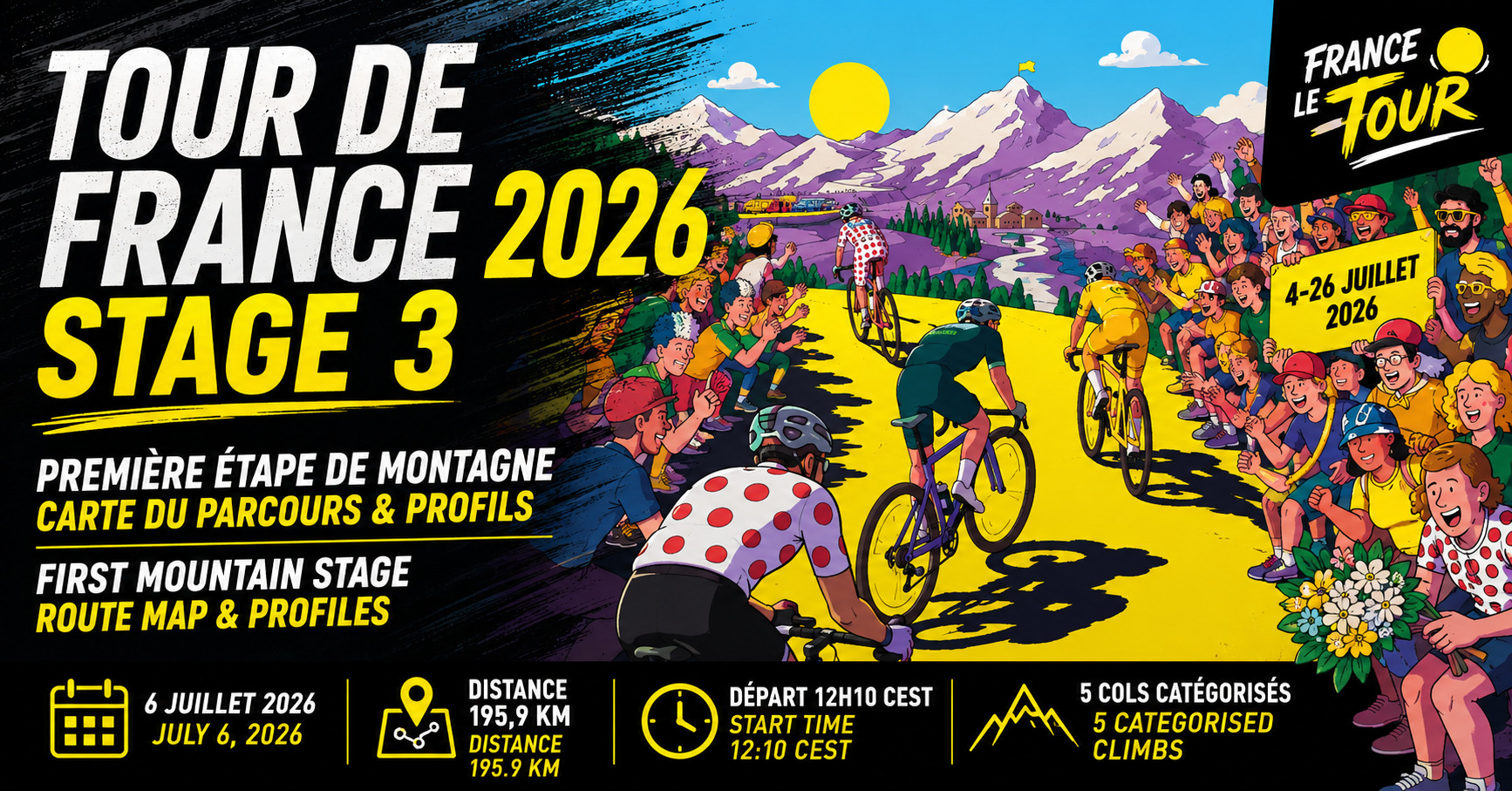
Tour de France 2026 Stage 3: Granollers to Les Angles Mountain Stage – The Pyrenees Strike First on the Road to Les Angles
Last Updated: 9:35 am CEST - Monday, 6 July 2026
Two stages of tight racing in and around Barcelona have already left their mark. Now the Tour heads for the hills and the numbers change the conversation. Stage 3 covers 195.9 km from Granollers to Les Angles, the last stage on Spanish soil before 18 straight days in France, and the first day where climbing legs matter more than positioning.
The route stays gentle for the opening 100 km before the Col de Toses arrives, 9.3 km at 6.5%, the Tour’s first Category 1 climb of 2026, with 68 km still to race. That distance rules out a GC shootout on the Toses itself, but it will thin the group heading toward the French border. The Col du Calvaire follows at 11.4 km and a deceptively gentle 4.1%, cresting at 1,836 m, the highest point of the week. From there it’s a long, rolling run down to Les Angles, where the road kicks up one final time, 1.7 km at 6.5%, for the finish.
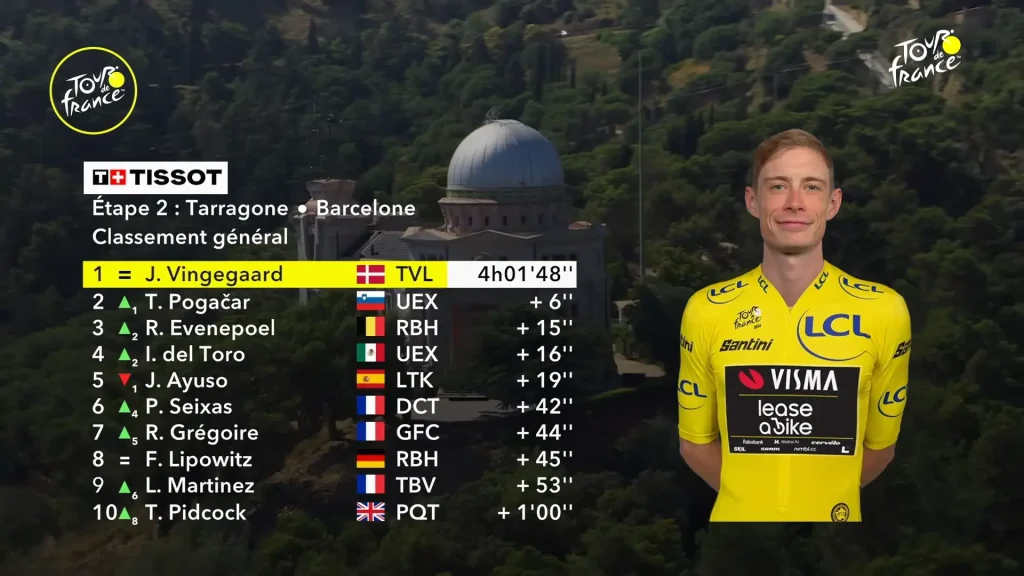
Jonas Vingegaard holds yellow after Visma’s team time trial win, with Tadej Pogačar six seconds back following Isaac del Toro’s Montjuïc victory. Remco Evenepoel sits 15 seconds down. Whether the gaps stay tight or start to stretch, Stage 3 will be the first stage where the mountains, not the legs of the sprint trains, decide who’s still smiling by the finish.
General Classification Heading into Stage 3
TL;DR
- Stage 3 is a 196 km mountain stage on July 6, 2026, from Granollers to Les Angles — neutralised start at ~12:10 CEST, expected finish ~16:54 CEST at the ski station.
- The Tour’s first Pyrenean summit finish of 2026 — 3,950 m of total climbing, five categorised ascents, and a high‑altitude finish at ~1,700 m on the Les Angles ramp.
- The Col du Calvaire at 1,836 m is the highest point of Stage 3 — 14.9 km at 4.1%, then a descent to Lac de Matemale before the decisive final push to Les Angles.
- The Les Angles finishing ramp delivers the sting — 4.7 km at 4.6% average, but the final 1.7 km lifts to 7.6% right to the line, raced at 1,700 m altitude after 194+ km of accumulated effort.
- Stage 3 is the last stage starting in Spain — after Puigcerdà, the Tour enters France for 18 consecutive days; the GC picture emerging from this stage shapes the tactical framework for the next three weeks.
Tour de France 2026 Stage 3 is a 196 km mountain stage from Granollers to Les Angles on Monday, July 6, the first Pyrenean summit finish of the 113th edition. Riders start from Carrer Ramon Llull in the Catalan city of Granollers, 30 km north of Barcelona, after a neutralised section of 4.74 km through the city streets.
The route heads northwest into the Pyrenean foothills, crosses five categorised climbs, passes through the high-altitude Cerdanya plain, crosses the Spanish-French border at Puigcerdà, crests the Col du Calvaire at 1,836 metres, the highest point of any stage in the Tour’s first week, and finishes at the Les Angles ski station at approximately 1,700 metres altitude. Total elevation gain: 3,950 metres. After three days under a Mediterranean sun, the Tour arrives in the mountains. The race changes today.
What Is Tour de France 2026 Stage 3?
Tour de France 2026 Stage 3 is the first mountain stage of the 113th edition, a 196 km road race from Granollers, Catalonia to Les Angles ski station in the French Pyrénées-Orientales on Monday, July 6. It carries 3,950 metres of total climbing across five categorised ascents and finishes at approximately 1,700 metres altitude on the steep ramp of the Les Angles ski resort. The stage represents the Tour’s crossing from Spain into France and the first time in three days of racing that pure climbing ability becomes the defining factor.
After the first Stage team time trial and Stage 2’s punchy urban circuit, Stage 3 is the race’s first sustained mountain examination. GC leaders who managed their effort carefully across the opening weekend now face a full day of high-altitude climbing. Those who left Montjuïc with a deficit face three weeks of racing with that number already on their backs. The stage is the last to start on Spanish soil in 2026, from the Puigcerdà border crossing onward, the Tour belongs to France.
Stage 3 Date, Distance, and Start Times: July 6, 2026
Stage 3 departs from Granollers at approximately 12:10 CEST on Monday, July 6, following a neutralised roll-out of 4.74 km from Carrer Ramon Llull through the city. The race proper begins at approximately 12:25 CEST. Estimated finish time at Les Angles: 16:55 CEST, though mountain stages at altitude can run 15–30 minutes later depending on peloton pace and weather.
For UK viewers: start approximately 11:10 BST, finish around 16:00 BST. For US viewers: 06:10 EDT and 05:10 PDT. Live coverage across all three stages runs on Eurosport, GCN, and TNT Sport throughout Europe, and on HBO Max in Spain and France. See the detailed regional live guide.
Tour de France 2026 Stage 3 Route: Full Granollers to Les Angles Course Guide
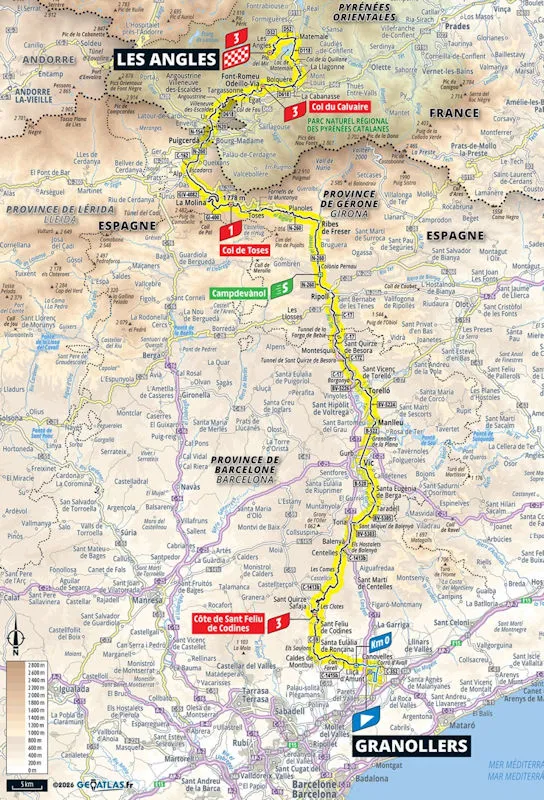
Stage 3 is divided into two completely different races across its 196 km. The first 96 km from Granollers to Ripoll is predominantly flat and rolling — manageable, tactical, and controlled. The second 100 km from Ripoll to Les Angles is one sustained mountain examination with only brief descents between its climbs. Teams that waste energy on the flat first half pay for it on the Collada de Toses. Riders who save themselves too carefully on the Toses may find the Col du Calvaire’s 14.9 km grinds through whatever reserve they thought they had.
The Catalan Start: Granollers and the Vallès Oriental Rolling Roads
Granollers sits in the Vallès Oriental, the broad agricultural plain between Barcelona’s coastal hills and the first Pyrenean ridges. At 145 metres altitude and 30 km northeast of the city, it is the last major urban centre before the mountains. The stage starts on Carrer Ramon Llull brings the peloton through the historic heart of the city before the neutralised section concludes.
The most prominent landmark in Granollers’ centre is the Porxada, a 16th-century Gothic covered market hall that still functions as a weekly market. Its stone arches and open sides have hosted commerce since the Middle Ages. The city has operated a market on this site for nearly 1,000 years: Granollers was a crossroads and trade hub since Roman times, the capital of Vallès Oriental connecting Barcelona to the Pyrenean towns of the interior. The Roca Umbert Fàbrica de les Arts tells the city’s industrial chapter, a textile factory built in 1904, now converted into a cultural centre housing a library, contemporary arts space, and performance venue. The old factory chimney still rises above the city skyline. Granollers was built on wool and cotton. It restarts on culture and connection.
From the city, the route heads northwest on generally rolling roads through the Vallès Oriental countryside. The Montseny Natural Park massif rises visibly to the northwest, a range of forested peaks reaching 1,700 metres, the ecological lung of the Barcelona province. The only categorised ascent in this first section is the Côte de Saint-Feliu de Codines: 7.6 km at 4.5%. It is enough to make riders work, not enough to split the peloton. Teams control the tempo. Breakaway candidates watch each other. The Pyrenees fill the northern horizon.
Ripoll: The Cradle of Catalonia
The road arrives at Ripoll at around km 80, where the Ter and Freser rivers meet at the base of the Pyrenean foothills. Ripoll is not just a waypoint; it is, by widespread agreement, the most historically significant town on the Stage 3 route.
The Monastery of Santa Maria de Ripoll was founded by Count Wilfred the Hairy in 879, and became a major religious and cultural centre, the cradle of Catalonia, with its 12th-century portalada considered one of the great sculptures of European Romanesque art. Wilfred is buried in the monastery’s transept. The Gesta Comitum Barcinonensium, the first written history of Catalonia, was composed by the monks of this scriptorium in the 13th century. This is where Catalonia began, historically and spiritually. The Tour de France 2026 passes through it on its way to France.
From Ripoll, the road begins rising in earnest. The foothills close in. The valley narrows. The Collada de Toses is now visible ahead as a wall of forested hillside above Ribes de Freser. The race is about to change character.
The Collada de Toses: Where the Pyrenees Arrive
The Collada de Toses is the first Category 1 climb of the 2026 Tour and the longest sustained ascent of Stage 3. From Ribes de Freser, the road rises for 36 km in total, but the decisive section is the final 9.3 km at 6.5%, which peels away the riders who managed the earlier climbing comfortably and reveals those who are already at their limit. The summit sits at 1,778 metres.
This is where the peloton makes its first real selection of the mountain stage. A group of 30–50 riders at the front. The remainder scattered across 10 minutes of racing below. Domestiques who completed their work now sit up and wait for the broom wagon. Only the climbers, the GC leaders, and the breakaway candidates remain.
The descent from the Collada de Toses is fast and technical, switchback roads dropping toward the Cerdanya plateau. The Cerdanya is one of the most unusual landscapes in the entire Pyrenean chain: a broad, flat-floored valley at approximately 1,000–1,200 metres altitude, 40 km long, running east to west and straddling the Spanish-French border. After the sharp, enclosed climb of the Toses, the sudden openness of the Cerdanya plain is visually striking. The Tour riders descend into it at speed, cross through Puigcerdà, and leave Spain.
Puigcerdà is the last Spanish town on the Stage 3 route. It sits practically on the French border, at the eastern end of the Cerdanya plain. From here, the Tour enters France. The language changes on the road signs. The architecture shifts from Catalan to southern French. But the mountains stay the same; they have never respected borders.
The Col du Calvaire: The Roof of Stage 3
The Col du Calvaire is the highest point of the 2026 Tour’s first week: 11.9 km at 4.1%, summit at 1,836 metres. It begins immediately after Puigcerdà, rising steadily through pine forest and open alpine meadow toward the Capcir plateau of the Pyrénées-Orientales.
The gradient is not savage. At 4.1% average, this is a diesel-engine climb rather than an explosive one. What makes it significant is its combination of length, altitude, and timing. Riders hit the Calvaire after 130+ km of racing, having already climbed the Côte de Saint Feliu de Codines and the Collada de Toses. The cumulative fatigue changes the character of a 4.1% gradient entirely. On fresh legs, it is manageable. In the context of Stage 3, it is relentless.
At 1,836 metres, the Calvaire summit is firmly in the altitude zone where the human body begins operating below sea-level capacity. Research on athletic performance at altitude consistently shows VO2 max decreasing approximately 1% per 100 metres above 1,000 metres. By the Col du Calvaire summit, a rider is working at around 91–92% of their sea-level physiological ceiling. For a 68 kg GC rider producing 380 watts at sea level, that translates to approximately 345–350 watts sustainable at 1,836 metres, and the climb is not over.
The Font-Romeu plateau is visible to the south from the upper Calvaire slopes. Font-Romeu sits at 1,850 metres altitude and houses France’s national high-altitude training centre, used by French Olympic teams since the preparation for the 1968 Mexico City Olympics. The Ethiopian and Kenyan distance running squads train there regularly. Every major cycling team conducts altitude camps on this exact plateau. The 2026 Tour’s GC leaders are, for many of them, finishing their first real mountain stage on terrain they specifically trained on weeks earlier.
The Lac de Matemale and the Final Ascent to Les Angles
After the Calvaire summit, the road descends approximately 7 km to the Lac de Matemale, an artificial reservoir at 1,541 metres surface elevation, created by damming the Aude river. Its surface area of 2.23 km² makes it the largest lake in the Capcir valley. Pine forest lines the northern shore; the ski slopes of Les Angles rise above the southern bank. The approaching Tour peloton will see their finish line from the water’s edge, the ski station buildings visible on the hillside before the road begins its final rise.
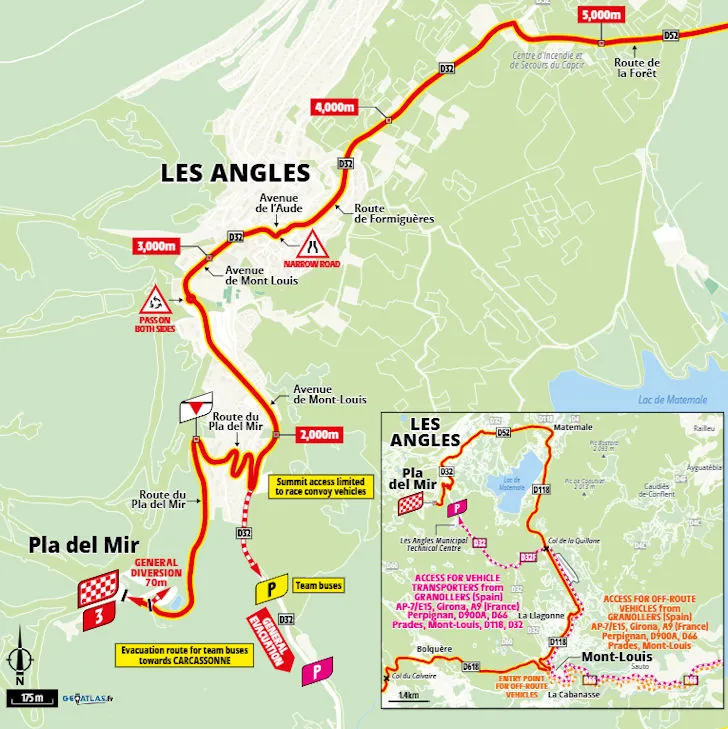
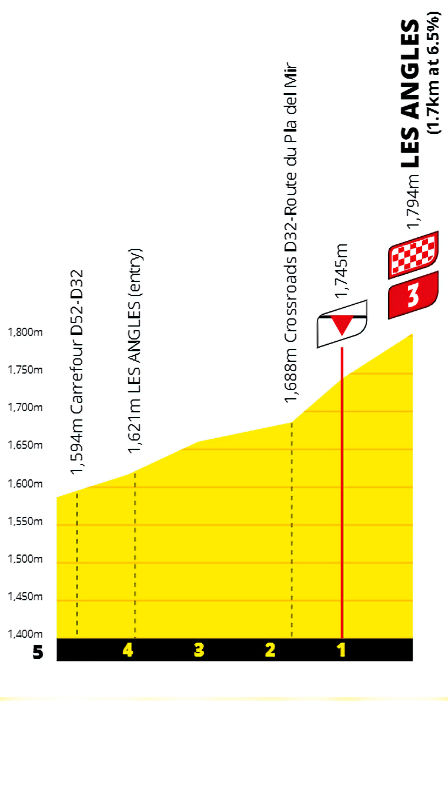
From the lake, a brief 1.9 km section at 4% precedes the descent into Les Angles village. Then the final climb begins. The full ascent is 4.7 km at 4.6% average, numbers that suggest something manageable. The average is deceptive. The final 1.7 km ramps to 7.6% and stays there all the way to the finish line at the ski station. At over 1,700 metres altitude, after 194 km of racing and 3,800 metres of prior climbing, a 7.6% ramp for 1.7 km is not a gentle conclusion. It is where Stage 3 is decided.
Tour de France 2026 Stage 3 Elevation Profile: 3,950 Metres Across Five Climbs
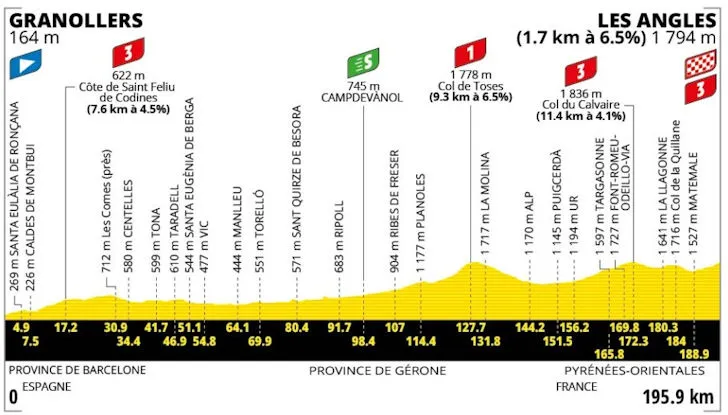
Stage 3’s elevation profile looks manageable in the first third and brutal in the second. The opening 60 km from Granollers to the base of the Côte de Saint Feliu de Codines is largely flat, sitting between 100 and 400 metres altitude. From Sant Feliu northward through Ripoll, the gradual valley floor rises without drama. Then the Collada de Toses begins, and from that point, the stage never really descends below 1,000 metres for the remaining 96 km.
All Five Categorised Climbs: Data Table
| Climb | Length | Avg gradient | Max gradient | Summit altitude | Dist. from finish |
|---|---|---|---|---|---|
| Côte de Saint Feliu de Codines | 7.6 km | 4.5% | ~6% | ~550 m | ~178 km |
| Collada de Toses (key section) | 9.3 km | 6.5% | ~9% | 1,778 m | ~96 km |
| Col du Calvaire | 14.9 km | 4.1% | ~6% | 1,836 m | ~24 km |
| Pre-Matemale rise | 1.9 km | 4.0% | ~5% | ~1,580 m | ~16 km |
| Les Angles final climb | 4.7 km | 4.6% | 7.6% | ~1,700 m | Finish |
The Collada de Toses total length from Ribes de Freser is 36 km, with only the critical final 9.3 km climbs at 6.5%. The earlier sections of the Toses are more gradual, rising through the valley and forest before the mountain proper begins.
Why 3,950 Metres Is Harder Than It Looks: Altitude and Accumulated Fatigue
Two compounding factors distinguish Stage 3 from a comparably graded stage earlier in a Grand Tour, and neither appears in any competitor’s Stage 3 preview.
The first is altitude. The Col du Calvaire at 1,836 metres and the Les Angles finish at approximately 1,700 metres mean the entire final third of Stage 3 is raced at genuine altitude. At 1,700 metres, a rider operates at roughly 91% of sea-level VO2 max. For a 68 kg GC contender who can sustain 5.8 W/kg at sea level, the sustainable power at Les Angles drops to approximately 5.3 W/kg. A gap of 0.5 W/kg in a climbing contest of 1.7 km at 7.6% translates directly into seconds lost per 100 metres. The rider who manages altitude acclimatisation best on Stage 3 gains a measurable physical advantage.
The second factor is accumulated fatigue across the opening three days. Stage 1 demanded a maximal TTT effort — anaerobic, high-heart-rate, full-body exertion over 20 minutes. Stage 2 followed with 168.5 km and 2,400 metres of climbing, including three laps of the Montjuïc circuit. Stage 3 arrives on day three. A rider who spent 100% in Stages 1 and 2 arrives at the Collada de Toses with muscle glycogen partially depleted and cumulative lactate load already elevated. Professional teams manage this through nutrition, recovery, and pacing strategy, but no amount of management fully neutralises three consecutive days of Grand Tour racing. The Les Angles final ramp is the first genuine test of who is actually in form for three weeks.
Stage 3 Tactics: The Breakaway’s Best Day vs. GC Shadow Boxing
Stage 3 has the structure of a classic Grand Tour breakaway stage — long, multiple categorised climbs, no single savage gradient over 8% until the very final kilometre. That profile creates a window for non-GC specialists to establish a meaningful advantage and potentially survive to the finish. It also creates a tactical dilemma for GC teams: chase every attack and burn domestiques on day three, or let a break go and risk ceding time to an opportunist who turns out to be stronger than expected.
The Breakaway Case: Why Stage 3 Is the Best Chance of the First Week
The Collada de Toses and Col du Calvaire are the breakaway’s allies. Their long gradients and moderate percentages reward sustained diesel output rather than explosive climbing, exactly the power profile of a strong rouleur-climber rather than a pure GC contender. A breakaway group of five to eight riders with a three-minute advantage at the Calvaire summit has a realistic chance of staying clear to Les Angles. The 7 km descent from Calvaire to the Lac de Matemale provides breathing space before the final climb begins.
Teams without GC ambitions have an obvious motivation to animate the stage. Arkéa–B&B Hotels, TotalEnergies, Tudor Pro Cycling, Cofidis, and Intermarché–Wanty all carry riders with the climbing ability to survive a long breakaway on this terrain and the team structure to send one of their best men up the road early. The polka-dot jersey, the King of the Mountains classification, is also at stake. With the Collada de Toses as a Category 1 climb, the first rider over its summit collects significant KOM points. Breakaway riders who are also KOM candidates will attack hard on the early slopes.
The GC Case: What Pogačar, Vingegaard, Evenepoel, and Seixas Risk on Stage 3
Stage 3 is too early for the GC battle to reach its decisive phase. Three weeks of racing remain after Les Angles. Attacking for 30 seconds on a stage like this, burning through glycogen reserves at 1,700 metres, and arriving at Stage 4 already compromised is not a calculation any team director endorses at this point in July.
What Stage 3 does is provide data. It is the first open-road mountain test where GC riders cannot hide behind TTT format or urban circuit tactics. The Col du Calvaire’s 11.9 km will expose anyone who arrived at Barcelona carrying a deficit in form, whether from illness, a sub-optimal training block, or simple bad legs on day three of a Grand Tour.
Pogačar’s team will watch for any GC rival who struggles on the Calvaire before the Les Angles finale. A rider who gets dropped on the long Calvaire grind and has to close a gap on the descent is a rider who is not at 100%. That information shapes the strategy for Stage 6’s Gavarnie-Gèdre summit and every mountain stage that follows.
Vingegaard faces a specific scrutiny. He rode the Giro d’Italia before the Tour, three weeks of racing already in his legs before Stage 1 in Barcelona. Stage 3’s 14.9 km Calvaire climb is the first real check on how that decision has affected his mountain legs. His Visma–Lease a Bike team will be watching his numbers on the climb.
Evenepoel is a fundamentally different climber from Pogačar and Vingegaard on sustained mountain gradients. His power curve favours shorter, punchier efforts over long steady inclines. The Calvaire, at 14.9 km, is precisely the terrain where the gap between a pure climber and a climber-time trialist becomes visible. Evenepoel arriving at Les Angles with a small deficit to the Pogačar-Vingegaard group is not a crisis on Stage 3, but it is a signal the rest of the peloton will read.
Paul Seixas faces his first Grand Tour mountain stage. The 19-year-old debutant who set Strava KOMs on the Tourmalet during recon and prompted Christian Prudhomme to say he will “enter into Tour de France legend” has now completed three days of the race. Stage 3 is his first test on a mountain where there is no urban circuit, no team time structure, and no urban crowd noise to carry him. Every watcher in France will be on the upper slopes of the Calvaire to see what he does.
Stage 3 Favourites: Who Wins at Les Angles?
Stage 3 suits three different rider types, and the order of probability runs roughly from the less famous to the most famous.
A breakaway specialist with strong sustained climbing ability is the most likely winner. Riders like Felix Gall (Decathlon AG2R La Mondiale), Giulio Ciccone (Lidl–Trek), Ben O’Connor (Jayco–AlUla), and Geoffrey Bouchard (Arkéa–B&B Hotels) fit the profile precisely, good enough to stay in a break over the Toses and Calvaire, strong enough to hold on for the 7.6% finale. Watch for attacks in the first 30 km as these riders fight for breakaway selection.
A GC rider who decides to send a message is the second scenario. Pogačar could win Stage 3 comfortably if he wanted to. The question is whether using that energy on day three serves a three-week racing strategy. It probably does not, but Pogačar does not always follow conventional strategy.
The complete outsider is the wildcard: a rider who had a quiet Stage 1 and Stage 2, arrived at Stage 3 fresher than everyone expected, and finds themselves in a break that turns out to be the winning move. Grand Tour stage 3s produce outsider winners more often than any other mountain stage. The field has not yet established its hierarchy. Anything is possible.
Granollers: The Stage 3 Start City and Its Industrial Catalan Soul
Granollers is where Barcelona’s metropolitan hinterland gives way to inland Catalonia, a city of 65,000 people that has always been a crossroads. Granollers is the capital of Vallès Oriental, strategically located between the coast and the Montseny Massif, and serves as a key connecting hub for the region, with a market history spanning nearly a thousand years and the iconic Porxada as its most prominent heritage landmark.
The Porxada, that Gothic covered market arcade at the heart of Plaça de la Porxada, is the visual soul of the city. Built in the 16th century, its open stone arches have sheltered merchants and buyers through every chapter of Catalan history: the War of Spanish Succession, the Napoleonic invasion, and the Civil War. The weekly Tuesday market has been held on this same ground, continuously, for somewhere near 900 years.
The Roca Umbert story tells the city’s industrial chapter. Building began on the Roca Umbert factory in 1904, where the first textile factories were installed. The factory unified the entire production process of spinning, warping, weaving, and dyeing under one roof, and its fabrics were renowned for their quality. The textile crisis of the late 20th century closed Roca Umbert as a factory. Its conversion into a cultural centre, library, arts space, rehearsal studios, university facilities, is one of the cleaner examples of industrial heritage transformation in Catalonia.
Granollers is the capital of Vallès Oriental, with an extensive transport network via Rodalies (R2 Nord, R8), urban and interurban buses; the city centre is ideal to explore on foot, with cycle lanes and good connections to Barcelona.
What to Eat in Granollers Before Stage 3
Stage 3 is a Monday, and Granollers’ food culture skews toward the inland Catalan tradition rather than the coastal seafood focus of Stage 2’s Tarragona.
The escudella i carn d’olla is the defining dish of inland Catalonia: a two-course meal where the chickpeas, vegetables, and meats cook together in a single pot, the broth served first as a soup with pasta, the solids as the main course. It is heavy, sustaining, built for people working physical labour in mountain climates. Restaurants around the Plaça de la Porxada serve it year-round, adjusting slightly for summer with lighter vegetable versions.
For something lighter: pa amb tomàquet (bread rubbed with tomato, garlic, and olive oil) is the Catalan staple that appears at every meal from breakfast to dinner, regardless of region. Granollers’ version uses local bread and tomatoes from the Vallès Oriental agricultural belt. The local cheese worth seeking out is Serrat, a semi-cured cheese from the Ripollès mountain farms further up the valley, with a firm paste and mild nutty flavour.
A note for Tour followers: Monday is the day many traditional restaurants in smaller Catalan towns close. Around the Carrer Ramon Llull start area, the Tour Village and the sponsor caravan will bring their own food operations. The Plaça de la Porxada area has reliable café and bar options that open on race-day Mondays for the Tour crowds.
Les Angles: The Pyrenean Finish Village Above Lac de Matemale
The village of Les Angles sits at 1,655 metres altitude in the Capcir valley of Pyrénées-Orientales, built on the foothills of the Llarets massif, with a history spanning more than ten centuries. The ski station that gives Les Angles its modern identity sits above the old village, the finish line is located in the ski resort area, with its lift towers and summer mountain bike trails forming the backdrop rather than the medieval core of the settlement.
Les Angles has changed hands more times than most European villages its size. It has been Spanish and French, Catalan and Occitan, part of the Cerdagne and the Capcir. The 1659 Treaty of the Pyrenees, the agreement that drew the modern France-Spain border, placed Les Angles on the French side of the line, though the village’s culture, language, and identity remained deeply rooted in the Catalan tradition. The old village, known locally as Les Iglesiettes, from the ruins of its medieval church and castle, sits above the ski station, its stone walls rising from the hillside. In summer, wildflowers grow through the ruins.
The Lac de Matemale lies below the village and is visible from almost every point on the final climb. At 1,541 metres, the reservoir’s surface reflects the summer sky in deep blue between its forested banks. In late July, the lake is open for swimming and kayaking, a fact that matters to the families of spectators who camp on the hillside for two or three days ahead of a mountain finish, which is exactly what happens at Les Angles on July 5–6.
Font-Romeu: The World’s Most Famous Altitude Training Base
Twelve kilometres from Les Angles, across the Capcir plateau, sits Font-Romeu, a name every serious cyclist and athletics fan knows. At 1,850 metres, Font-Romeu houses France’s Institut National du Sport, de l’Expertise et de la Performance (INSEP) altitude facility, the highest national sports preparation centre in France. Olympic teams from Ethiopia, Kenya, Morocco, and France use Font-Romeu routinely for pre-competition altitude camps. Multiple world records at distance events have been preceded by Font-Romeu preparation blocks.
Cycling’s relationship with Font-Romeu is long and deep. The plateau between Font-Romeu and Les Angles provides 30–40 km of training roads at altitude, with minimal traffic and gradients ranging from moderate valley roads to steep mountain cols. Every major Tour de France team conducts altitude training camps in this specific region. The GC contenders arriving at Les Angles on July 6 almost certainly rode these roads at some point in May or June, building the aerobic base for exactly this moment.
That connection, the finish line sitting in the backyard of the training ground, is a piece of context no competitor has written. It matters because altitude acclimatisation is not equal across the peloton. Riders who spent significant pre-race time at Font-Romeu or comparable altitude have adapted haemoglobin levels. Those who prioritised sea-level racing blocks through June arrive at Les Angles physiologically less prepared for 1,700m racing. Stage 3 will reveal the difference.
Where to Watch Tour de France 2026 Stage 3: Best Spectator Spots
Stage 3 presents the most logistically demanding spectator challenge of the Tour’s opening three days. The stage crosses two countries, includes two major mountain passes, and finishes at a ski resort with limited road access. But the rewards match the difficulty — mountain pass crowds in July have an atmosphere that no urban circuit can replicate.
Best Viewing Zones for Stage 3
| Zone | What you see | Access | Best arrival | Crowd level |
|---|---|---|---|---|
| Granollers Porxada start area | Stage roll-out, Tour Village, medieval city backdrop | Rodalies R2 Nord from Barcelona Sants (~30 min) | 11:00 CEST | High |
| Collada de Toses summit (Cat 1) | First major mountain selection, 9.3 km at 6.5%, dramatic Pyrenean scenery | Car/coach via N-260 from Ripoll or Barcelona (1h45 from BCN) | 14:00 CEST | Moderate |
| Col du Calvaire (1,836 m) | Highest point of Stage 3, longest climb, definitive climbing test | Car via N-20 through Puigcerdà into France, D618 to Matemale (3h from BCN) | 13:00 CEST | Low to moderate |
| Les Angles final ramp (finish) | 7.6% decisive gradient, GC splits visible here, stage winner crosses here | Car via Puigcerdà + D29 to Les Angles — road closes 06:00 CEST; arrive night before | Pre-race camp | Very high |
The Col du Calvaire on race day offers the most unusual spectator experience of the Tour’s opening week: a quiet mountain road at nearly 1,900 metres, pine trees and granite on both sides, and the entire peloton passing within arm’s reach at altitude. Numbers at the Calvaire will be low compared to Montjuïc, which makes the experience more personal.
Les Angles is where the racing decision happens. The 7.6% ramp to the ski station is where GC gaps form and breakaway riders either hold on or crack. To watch it in person requires commitment: the D29 road to Les Angles closes at approximately 06:00 CEST on race day, meaning spectators must arrive the night before and camp on the hillside. Tour veterans who have done this rate it among the best experiences in sports spectatorship.
Getting There: Transport Between Barcelona, Granollers, and Les Angles
Granollers is easy. The Rodalies R2 Nord line from Barcelona Sants station arrives at Granollers-Canovelles in approximately 30 minutes, running frequently on Monday mornings. Cost: approximately €3.50 each way. The stage start area is a 15-minute walk from the station.
Les Angles requires planning. There is no direct public transport from Barcelona. Options are: hire a car and drive north on the N-17 through Puigcerdà then the D618 through Font-Romeu — approximately 3 hours from Barcelona in normal conditions. Alternatively, take a high-speed AVE train to Perpignan (90 minutes from Barcelona) and hire a car at Perpignan for the 1h45 drive to Les Angles via Prades and the D29. For those travelling from France, the TGV from Paris Gare de Lyon reaches Perpignan in approximately 5 hours.
Mountain road closures on Stage 3 operate differently from the urban closures of Stages 1 and 2. The D29 approach road to Les Angles closes at approximately 06:00 CEST, meaning spectators planning to watch the finish must be in position by the previous evening. The climb roads to the Collada de Toses close at approximately 08:00 CEST on race day. Plan accordingly, or accept that access is limited.
Where to Stay for Stage 3: Granollers, Ripoll, or Les Angles?
Three base options, each serving a different priority.
Granollers suits anyone prioritising the start atmosphere combined with an easy return to Barcelona. The Rodalies connection means the commute is straightforward, the city has reasonable hotel availability at this time of year, and the Stage Village and caravane offer the full Grand Tour opening-day experience.
Ripoll, 60 km north of Granollers, directly on the Stage 3 route, is the best base for watching the Collada de Toses. The Monastery of Santa Maria is five minutes’ walk from any hotel in the town centre. The Pyrenees begin here. In terms of atmosphere for a Grand Tour stage, a mountain town the night before a Category 1 climb is one of the purest experiences in cycling tourism.
Les Angles itself has limited accommodation; the ski station operates at summer occupancy levels in July, and rooms fill immediately when Tour de France spectators begin booking. Formiguères, 10 km south, and Font-Romeu, 12 km west, offer more options. If watching the finish is the priority, book Les Angles or the surrounding villages immediately, these rooms were filling in spring 2026.
A logistical note for those following the race to Stage 4: Stage 4 departs from Carcassonne and finishes in Foix. The sensible overnight after Stage 3 at Les Angles is Perpignan (1h45 drive), then a 90-minute drive or train to Carcassonne the next morning.
Weather and Altitude: What Conditions Will Stage 3 Riders Face in the Pyrenees?
Stage 3 begins at 145 metres in Granollers at approximately 28–30°C. It finishes at 1,700 metres in Les Angles at approximately 14–18°C. The temperature drop across the stage is 10–16°C, the single largest environmental transition of any stage in the Tour’s first week. Riders who start in summer heat and bibs finish in mountain cold. Teams carry musette bags with gilets and arm warmers for the Calvaire descent.
The specific weather risk for Stage 3 is afternoon thunderstorms. The eastern Pyrenees, particularly the Capcir valley where the Col du Calvaire and Les Angles sit, are prone to convective afternoon storms in July, warm air rising from the Mediterranean plain, hitting the cool mountain plateau, and dropping heavy rain in 30–60 minute bursts. A wet Col du Calvaire changes the descent entirely. Fast, technical switchbacks on wet tarmac at 1,836 metres require a different risk calculation from the same descent on a dry day. The descent crashes that change Grand Tours, the kind that cost Egan Bernal the 2021 Vuelta or sent riders into barriers at the 2019 Tour, happen on wet mountain descents.
The Collada de Toses is also exposed to northwesterly winds on its upper section. A headwind on the 9.3 km at 6.5% makes an already challenging climb significantly harder. July wind data for the Toses area shows average speeds of 15–20 km/h from the NW, enough to add 1–2 minutes to climbing times on the key section.
Teams monitoring the July 6 weather forecast will make tactical decisions based on it. A forecast showing afternoon storms at the Calvaire may prompt GC teams to accelerate on the lower slopes to ensure the peloton reaches the summit before conditions deteriorate. That acceleration changes the breakaway dynamic entirely; a race into the Calvaire at full GC tempo eliminates the breakaway and turns Stage 3 into a summit finish showdown between the best climbers.
The Last Spanish Stage: What Stage 3 Means for the Rest of the Tour
Stage 3 is the final stage starting in Spain. After the Puigcerdà border crossing, the race enters France and remains there for the remaining 18 stages. The 2026 Tour has spent its entire first three days in Catalonia, a deliberate choice by ASO to honour the region and Barcelona’s Grand Départ hosting. From Stage 4 onward, the race is a French story.
Two complete stages and the start of Stage 3 take place in Catalonia, making 2026 the edition with the most Spanish road kilometres since the 2023 Bilbao Grand Départ. What happens at Les Angles sets the GC framework that carries into the Pyrenees proper.
Stage 4 on July 7 runs from Carcassonne to Foix, a hilly stage in the Ariège foothills of the Pyrenees, transitional but demanding, where breakaway candidates go again and GC riders watch the cumulative picture developing. Stage 6 on July 9 from Pau to Gavarnie-Gèdre is the marquee Pyrenean queen stage: 186 km, the Col d’Aspin, the Col du Tourmalet at 2,115 metres, and a summit finish in the Cirque de Gavarnie, the most dramatic natural amphitheatre in the Pyrenean chain. That is where the first GC verdict of the 2026 Tour will be delivered.
A rider who leaves Les Angles at Stage 3’s end with a one-minute deficit to the leader has three days before the Tourmalet. Three days and 490 km of riding to recover, conserve, and prepare. It is not enough to recover from a fundamental form problem. It is enough if the deficit came from a tactical miscalculation to regroup and attack on Stage 6 with full reserves. Stage 3 is not the end of the conversation. It is the first line.
For the full Tour de France 2026 route guide, including all 21 stage previews, see our Tour de France 2026 complete route overview.
The Stage 2 guide — Tarragona to Barcelona and the Montjuïc circuit.
Stage 4 — Carcassonne to Foix — preview