Tour de France Femmes 2026 Stage 6: Montbrison to Tournon-sur-Rhône — 12 Seconds and One Last Ambush Before Ventoux
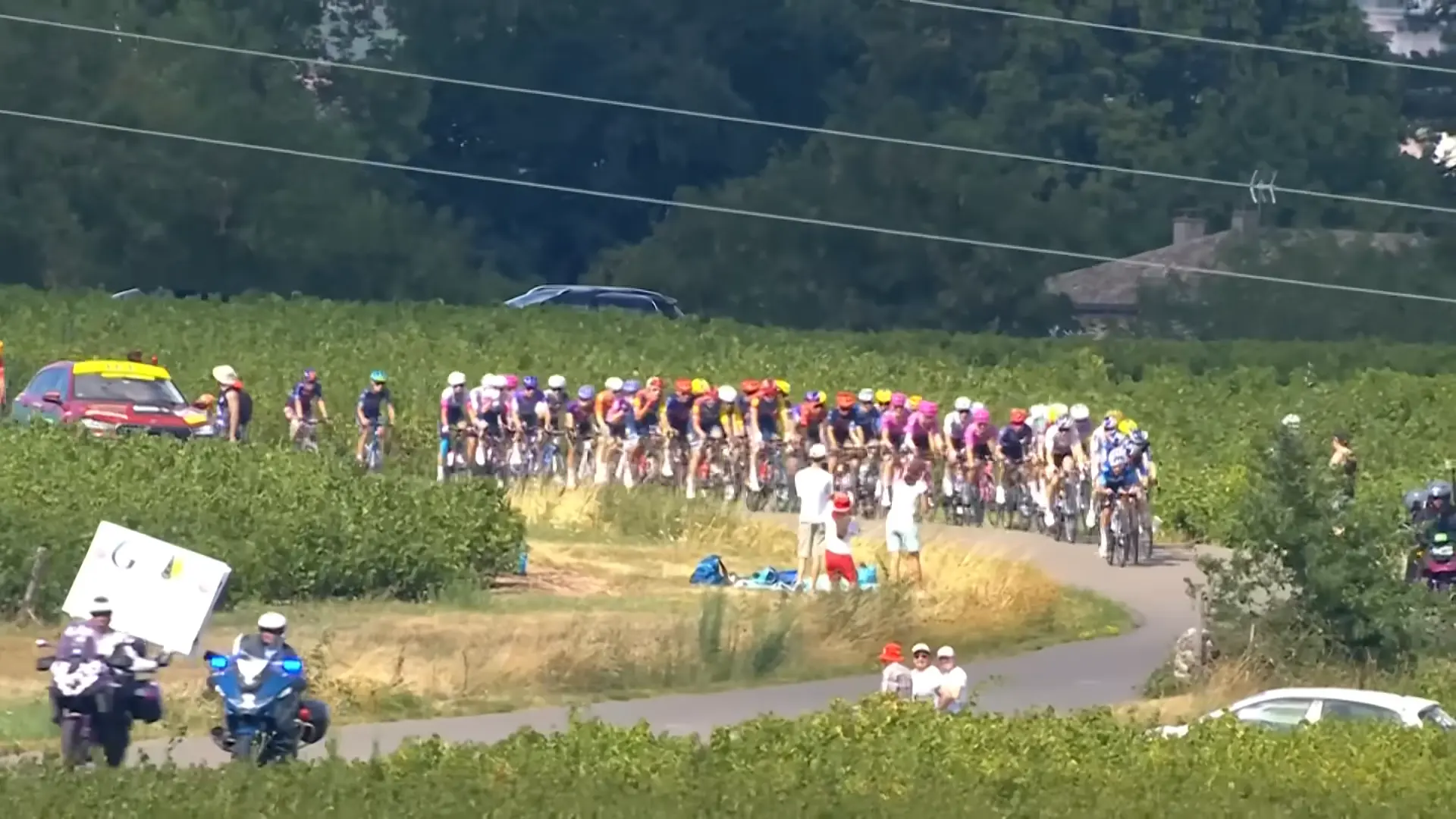
Stage 6 of the Tour de France Femmes 2026 is a 153.4-kilometre stage from Montbrison to Tournon-sur-Rhône on Thursday 6 August, crossing from the Loire into the Ardèche across six categorised climbs before a distinctive structural quirk defines the finale: forty of the final fifty kilometres are downhill. The neutralised start rolls out at 13:35 CEST, with the finish expected around 17:41.
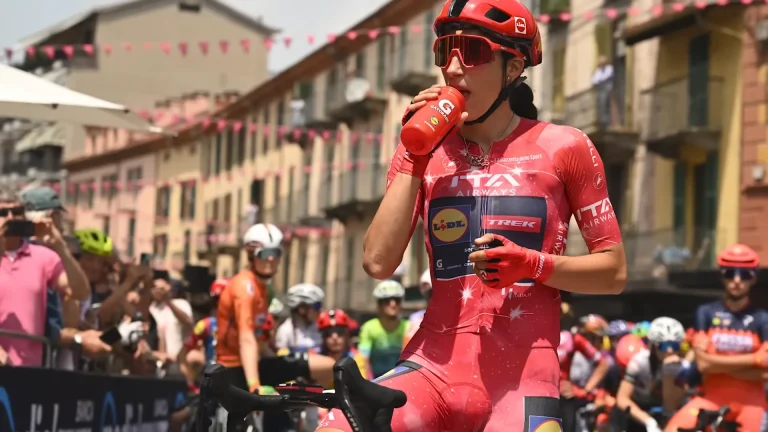
Marlen Reusser leads this race by twelve seconds. Not twelve minutes, twelve seconds, over Demi Vollering, after the Stage 5 results in which Vollering attacked repeatedly on Mont Brouilly’s steepest ramps and still couldn’t shake her. That margin is the thinnest anywhere near the top of a Grand Tour general classification, and it means Stage 6, the last hilly day before Mont Ventoux arrives today, carries far more weight than its billing as a transitional stage suggests. With that much downhill road in the finale, the smart move for anyone hoping to gain time isn’t to wait for the last kilometre. It’s to go early, while the group is still together and the descent still favours the bold.
TL;DR
- What is Stage 6? A 153.4km stage from Montbrison to Tournon-sur-Rhône on Thursday 6 August, crossing six categorised climbs through the Loire, Haute-Loire, and Ardèche, with the final 50km dominated by descent.
- What just happened? Demi Vollering won Stage 5 in a three-up sprint from Marlen Reusser and Kasia Niewiadoma-Phinney after attacking repeatedly on Mont Brouilly. Reusser held on to retain yellow, but her lead over Vollering shrank to just 12 seconds.
- Why does today matter? With 40 of the final 50 kilometres downhill, the finale is likely to ignite well before the finish — and with a margin this thin at the top of the GC, this is genuinely the last chance for an ambush before Mont Ventoux changes the calculation entirely.
TDF Femmes 2026 Stage 6 key facts
| Detail | Confirmed data |
|---|---|
| Stage number | 6 of 9 |
| Date | Thursday, 6 August 2026 |
| Start | Montbrison (Loire) |
| Finish | Tournon-sur-Rhône (Ardèche), near Quai Farconnet |
| Distance | 153.4 km |
| Elevation gain | ~2,500–2,600m |
| Neutralised start | 13:35 CEST |
| Est. finish | ~17:41 CEST (16:53–17:41) |
| Highest point | ~1,148m, reached roughly 46km into the stage |
| Weather | Start ~28°C, sunny. Finish ~33°C, sunny, light-to-moderate wind |
How Stage 5 became a genuine three-way duel
Marlen Reusser’s yellow jersey survived Wednesday, but only just. FDJ United-Suez controlled the pace through the Beaujolais climbs before the race exploded properly on the Col de Durbize, where the final 1.3 kilometres averaged close to 10% and dropped the field down to a handful of genuine contenders. Célia Gery delivered a huge final pull for her team before swinging aside, and Demi Vollering attacked immediately, the first of several surges she’d launch on the steep ramps of Mont Brouilly that followed.
None of them worked cleanly. Reusser, a rider built for the sustained power of a time trial rather than repeated accelerations on an 8% gradient, had to dig deep every time Vollering went, but she never let the gap open. Kasia Niewiadoma-Phinney matched both of them, and the trio descended together, still locked as a group entering the final kilometre. Niewiadoma tried one last surprise move before the line; it didn’t stick. Vollering took the sprint, with Reusser second and Niewiadoma third, and the bonus seconds attached to that finish (10 for Vollering, 6 for Reusser, 4 for Niewiadoma) cut Reusser’s overall lead from 14 seconds down to just 12.
The day’s other major story was considerably less dramatic to watch but just as significant for the overall race. Pauline Ferrand-Prévot, the defending champion, lost another 2 minutes 35 seconds on the decisive climbs, dropping to 17th overall and roughly 4 minutes 48 seconds behind Reusser. Combined with her rough time trial two days earlier, her title defence is now effectively over, even with Mont Ventoux and four further stages still to come.
Why today could ignite 50 kilometres from the finish
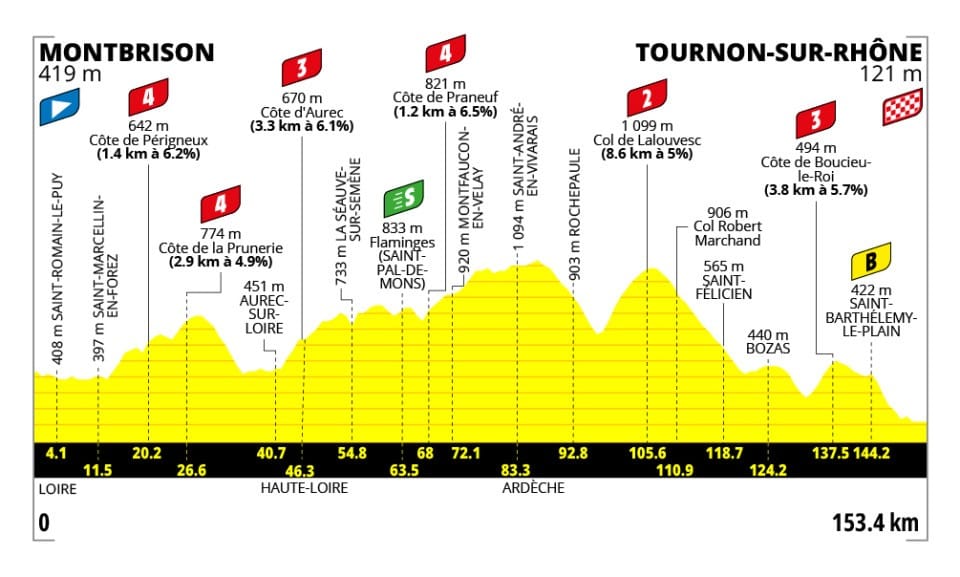
Stage 6 has an unusual shape. Rather than building toward a hard finishing climb the way Stage 5 did, the terrain flips the script: after a genuinely difficult opening 105 kilometres that includes the day’s highest point and the Col de Lalouvesc, the route spends the remaining 47.6 kilometres mostly heading downhill, broken only by one final categorised climb roughly two-thirds of the way through that stretch. Forty of the final fifty kilometres are pure descent.
That structure rewards aggression rather than patience. A rider or small group with a real gap heading into that long downhill run has genuine room to hold it, particularly a strong descender who can extend an advantage rather than just defend one. It’s exactly the kind of profile that tempts a rider like Cédrine Kerbaol, known for her descending ability, and it means the tactically smart move for anyone with ambitions today is to force the action on the Col de Lalouvesc or Boucieu-le-Roi rather than wait and hope the finale sorts itself out in the final kilometres.
The route: six climbs through the Loire, Haute-Loire, and Ardèche
The stage leaves Montbrison and climbs almost immediately, tackling the Côte de Périgneux (1.4km at 6.2%, summit 642m) and the Côte de la Prunerie (2.9km at 4.9%, summit 774m) inside the first 27 kilometres, with barely a proper descent separating them. After dropping into the Loire valley, the Côte d’Aurec (3.3km at 6.1%, summit 670m) follows, and the road continues rising, gently but persistently, through the Côte de Praneuf (1.2km at 6.5%, summit 821m) toward the highest point of the day at roughly 1,148 metres — reached only after nearly 20 kilometres of near-continuous gradual climbing beyond Praneuf’s summit.
Col de Lalouvesc — the last real summit
Category 2 | 8.6km | 5% average | summit 1,099m | 47.8km from the finish
Once the road finally turns downhill from the day’s high point, it doesn’t stay down for long. The Col de Lalouvesc arrives as the final genuine climbing test of the stage, and everything that follows it is fundamentally about managing a long descent rather than surviving another ascent.
Col Robert Marchand: the climb named for a 109-year-old world record holder
Between the Col de Lalouvesc and the town of Saint-Félicien, the route crosses a col named after a man whose story deserves to be told properly rather than passed over as a place name on a route sheet. Robert Marchand was born in Amiens in 1911. He worked as a Paris firefighter through the 1930s and took an active part in the 1936 general strikes that helped establish modern French employment law. During the Second World War, he was held as a prisoner of war.
None of that is why the Ardèche named a climb after him. Marchand became, later in life, one of the most remarkable athletes cycling has ever produced — a centenarian who set official world records for both the 100-kilometre distance and the one-hour distance, and did it twice over, holding separate records in the 100–104 and over-105 age categories. He remained a beloved fixture of L’Ardéchoise, the region’s famous amateur cycling event, celebrated there as its mascot right up to close to his death in 2021, at the age of 109. A man who survived a world war and set cycling records past his hundredth birthday has a real claim to having a mountain named after him, and this stage rides directly over it.
Côte de Boucieu-le-Roi — the last launch point
Category 3 | 3.8km | 5.7% average | cresting 15.9km from the finish
After a 28-kilometre descent from Lalouvesc, interrupted only by a brief false-flat section, the final climb of the day arrives at Boucieu-le-Roi. It’s not an extreme gradient, but arriving after more than 130 kilometres of racing, it’s more than capable of forcing one last genuine selection — whether that’s a shrinking breakaway finally reduced to its strongest riders, or a peloton attack from someone unwilling to leave the stage to a sprint.
Stage 6 Full verified climb profile
| Climb | Category | km marker | Distance | Avg gradient | Summit altitude |
|---|---|---|---|---|---|
| Côte de Périgneux | Cat. 4 | 20.2 | 1.4 km | 6.2% | 642m |
| Côte de la Prunerie | Cat. 4 | 26.6 | 2.9 km | 4.9% | 774m |
| Côte d’Aurec | Cat. 3 | 46.3 | 3.3 km | 6.1% | 670m |
| Côte de Praneuf | Cat. 4 | 68.0 | 1.2 km | 6.5% | 821m |
| Col de Lalouvesc | Cat. 2 | ~105.6 | 8.6 km | 5% | 1,099m |
| Côte de Boucieu-le-Roi | Cat. 3 | ~137.5 | 3.8 km | 5.7% | — |
The Saint-Barthélemy-le-Plain bonus sprint — closer to the finish than it looks
At kilometre 144.2, just 9 kilometres from the finish line, Saint-Barthélemy-le-Plain offers time bonuses of 6, 4, and 2 seconds to the first three riders through. On a day when the entire race lead sits at just 12 seconds, that’s not a minor detail; it’s a genuine, late-stage opportunity for the GC to shift again before Tournon-sur-Rhône, positioned deliberately close enough to the finish that it can’t simply be ignored by anyone with something to gain.
Stage winner and GC prediction
The Ardèche’s narrow, rugged roads and the day’s early-igniting finale favour breakaway specialists over a controlled bunch finish, and the sheer volume of downhill kilometres in the closing stretch specifically rewards a strong, confident descender — Cédrine Kerbaol’s name comes up repeatedly in this context for good reason. Among the GC contenders, expect Reusser, Vollering, and Niewiadoma-Phinney to continue marking each other closely rather than fully committing to an all-out effort, with Mont Ventoux looming the following day as a far higher-stakes opportunity to actually settle their duel.
World start times and how to watch
| Moment | CEST (France) | BST (UK) | EDT (USA) | AEST (Australia) |
|---|---|---|---|---|
| Neutralised start | 13:35 | 12:35 | 07:35 | 21:35 |
| Estimated finish | 17:41 | 16:41 | 11:41 | 01:41 +1 |
Schedule — France, UK, USA & Australia Time Zones
Times below use the official pace range (39 km/h fast, 35 km/h slow). UK is one hour behind CEST (BST); US Eastern is six hours behind (EDT); Australia is eight hours ahead (AEST).
| Point | Distance to Finish | CEST (France) | BST (UK) | EDT (USA East) | AEST (Australia) |
|---|---|---|---|---|---|
| Start — Montbrison | 153.4 km | 13:35 | 12:35 | 07:35 | 21:35 |
| Côte de Périgneux | 133.2 km | 14:16–14:20 | 13:16–13:20 | 08:16–08:20 | 22:16–22:20 |
| Col de Lalouvesc | 47.8 km | 16:27–16:46 | 15:27–15:46 | 10:27–10:46 | 00:27–00:46+1 |
| Col Robert Marchand | 42.5 km | 16:35–16:55 | 15:35–15:55 | 10:35–10:55 | 00:35–00:55+1 |
| Finish — Tournon-sur-Rhône | 0 km | 17:41–18:08 | 16:41–17:08 | 11:41–12:08 | 01:41–02:08+1 |
Most Crucial Viewing Window
Best join point: Col de Lalouvesc, roughly 48 km to go (CEST 16:27–16:46 / BST 15:27–15:46 / EDT 10:27–10:46 / AEST 00:27–00:46+1). With over 45 km still to race from the summit, any move made here has real time to either stick or unravel; this is where the day’s genuine GC threats will show their hand.
Stay through Col Robert Marchand immediately after — back-to-back climbs with barely a valley between them is exactly the kind of terrain that punishes a rider already carrying fatigue from yesterday’s Mont Brouilly sprint.
Given Reusser has now been tested twice and survived by inches both times, don’t assume today is calmer just because the profile spreads the difficulty out; if anything, an evenly hard stage after a physically brutal Beaujolais day is precisely when cumulative fatigue starts deciding races rather than single climbs.
How to watch: Today is a partial-coverage day rather than one of the Tour’s three full flag-to-flag broadcasts, with live television confirmed from around 15:50 CEST, including coverage from Boucieu-le-Roi’s giant screen. France Télévisions and France 2 carry the stage in France; Eurosport and HBO Max cover the rest of Europe, with TNT Sports providing UK coverage. See the regional full detailed coverage guide.
Spectator guide — Boucieu-le-Roi’s big day
Few villages on this Tour have prepared as elaborately as Boucieu-le-Roi. At the base of the day’s final climb sits a giant bicycle sculpture built entirely from straw bales, alongside a full day of activities: a guided gourmet tour of the village, a local producers’ market, a colouring fresco and photo booth for children, mini hot-air balloon and kite workshops, phone-charging bikes, slackline, and more. A special heritage train, the historic “Mastrou,” rebranded the “Train du Tour de France” for the occasion, runs visitors in from Lamastre, departing at 12:15. The caravan is expected around 16:20, with riders following between roughly 17:00 and 17:30.
Road closures across the Ardèche
The race enters the Ardèche department shortly before 15:00, crossing from west to east through Saint-André-en-Vivarais, Rochepaule, Lalouvesc, Satillieu, Pailharès, Saint-Félicien, Bozas, Colombier-le-Vieux, Arlebosc, Boucieu-le-Roi, Saint-Barthélemy-le-Plain, and Vaudevant before reaching Tournon-sur-Rhône. Standard closures apply from 1 hour 15 minutes before the first rider through to 1 hour after the last, with specific extended restrictions around Bozas running from 7:00 to 17:00 on race day.
Montbrison and Tournon-sur-Rhône — Loire meets Ardèche
Montbrison, the start town, sits in the Loire department at the edge of the Forez hills, a region better known for its agricultural heritage than for wine or dramatic cuisine, but a fitting quiet launch point for a stage that only reveals its real character once it crosses into the Ardèche. Tournon-sur-Rhône, on the river’s edge opposite Tain-l’Hermitage, sits in genuine wine country and carries a historic centre worth exploring beyond the finish line itself. Near the finish, the Vélorail des Gorges du Doux offers a distinctive local activity, a rail-bike experience through the same gorge country the peloton has just descended through, for anyone wanting to experience the terrain at a rather more leisurely pace than the professionals just did.