Tour de France 2026 Stage 11 PREVIEW: Vichy to Nevers — After Pogačar’s Statement, the Flattest Day of the Tour Arrives
Last Updated: 09:02 am CEST - Wednesday, 15 July 2026
Tour de France 2026 Stage 11 takes place on Wednesday, July 15, covering 161.3 km from Vichy to Nevers on largely flat terrain, with a bunch sprint finish considered close to certain. It’s the shortest flat stage of the entire 2026 race, arriving immediately after Stage 10’s brutal trip through the volcanic Massif Central, and it hands the race back to the sprinters at exactly the moment they need it most.
This is a stage built for recovery and speed in equal measure. Two minor categorised climbs interrupt an otherwise gentle profile, the peloton crosses both the Allier and Loire rivers along the way, and the finish in Nevers ends a wait that’s stretched on for 23 years, the city’s last Tour appearance came all the way back in 2003. After the drama of Bastille Day in the Cantal, Stage 11 offers something the race rarely provides this early: a day that’s exactly as simple as it looks.
Pogačar didn’t just win Bastille Day — he closed a two-year account. On the exact roads where Vingegaard beat him at Le Lioran in 2024, he waited longer this time, hit the Col de Pertus with 16 km to go, caught and dropped Richard Carapaz near the summit, and rode the rest alone. Evenepoel salvaged second at 32 seconds after looking finished on the climb; Paul Seixas took a Bastille Day podium in front of his home crowd. Vingegaard led the chase but paid for it in the closing metres, losing 44 seconds and, more importantly, ground in the overall standings — Pogačar’s lead is now 3:36, with del Toro cracking late to fall out of the top three. It was Pogačar’s third stage win of this Tour and, fittingly, his third-ever Bastille Day victory, a record nobody else holds.

Stage 11 offers almost the exact opposite proposition. At 161.3 km from Vichy to Nevers through the Allier and Nièvre countryside, this is the shortest flat stage of the entire race, no categorised climbs, nothing resembling Le Lioran’s jagged profile, just a long, calm cruise through French farmland before the sprint trains take over. After a Bastille Day that asked everything of the legs, Stage 11 asks almost nothing until the final half hour. Pedersen defends green, Merlier and Kanter want redemption, and the GC group gets a rare day to simply recover in the wheels.
What Is Tour de France 2026 Stage 11?
Stage 11 is a 161.3 km stage run on July 15, taking riders from Vichy to Nevers on largely flat terrain, with two minor categorised climbs and a bunch sprint finish considered close to certain. It’s officially the shortest flat stage of the entire 2026 Tour, and it arrives at exactly the right moment in the calendar, the first real sprinters’ opportunity since the Massif Central’s relentless climbing on Stage 9 and Stage 10.
What makes this stage worth genuine attention, despite its straightforward billing, is the calendar pressure building underneath it. With the 2026 route deliberately spreading sprint opportunities thin across three weeks, every flat stage carries real weight for teams that haven’t yet found the finish line first. Stage 11 isn’t a stage where nothing happens; it’s a stage where the stakes are simply different from the mountains that came before it.
How to Watch Stage 11 Live
Stage 11 Date, Distance, and Start Times
Stage 11 runs on Wednesday, July 15, 2026, covering 161.3 km. The race starts at 13:50 CEST from Vichy, with an estimated finish around 17:40 CEST in Nevers.
For viewers outside continental Europe: a 13:50 CEST start translates to roughly 12:50 BST in the UK, 07:50 EDT on the US East Coast, and 04:50 PDT on the West Coast. Coverage runs on Eurosport and HBO Max across most of Europe, with NBC Sports and Peacock carrying the race in the United States.
Tour de France 2026 Stage 11 Route: Full Vichy to Nevers Course Guide
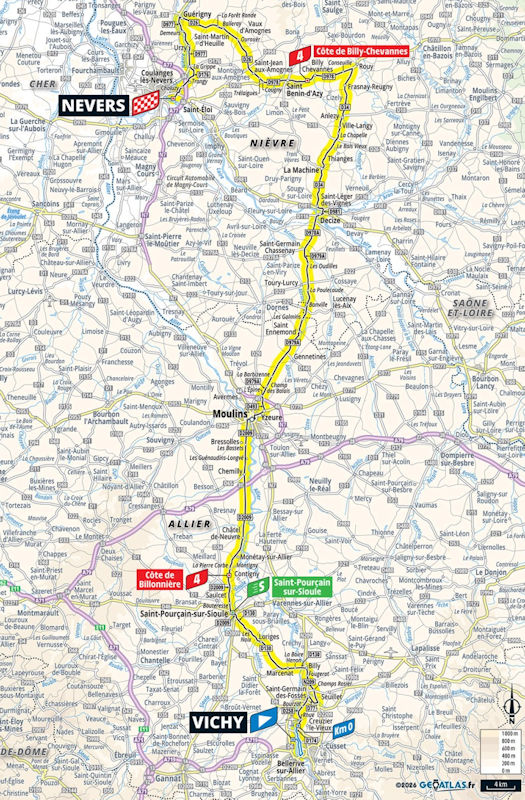
The route runs from Vichy north through Saint-Pourçain-sur-Sioule and Moulins, crossing the Allier river before continuing through the Nièvre department, passing through roughly 30 communes along the way, and crossing the Loire at Decize, before a late climb and a fast run into the finish at Nevers.
Vichy: A Thermal Spa Town With a Tour Pedigree Dating to 1952
Vichy carries genuine Tour history of its own, having hosted the race as far back as 1952, when Italian rider Fiorenzo Magni took the stage win. The town’s broader identity, though, has always been built around its thermal springs, a Belle Époque spa destination that drew French aristocracy and European visitors throughout the 19th and 20th centuries for treatments built around its mineral-rich waters. That spa heritage runs deeper into French culture than most race previews acknowledge, and it’s worth understanding before the peloton even leaves town.
The Côte de Billonnière and Crossing the Allier at Moulins
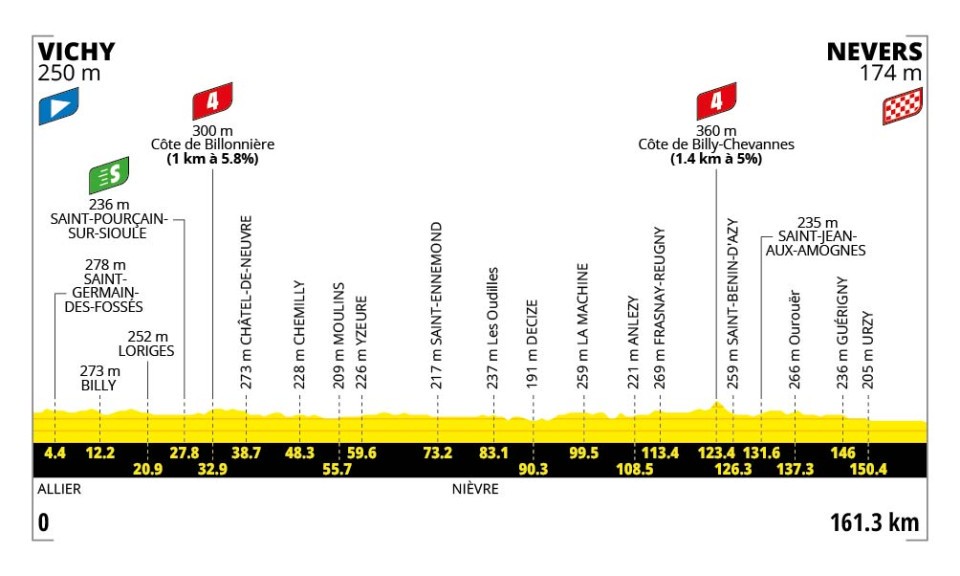
Early in the stage, at kilometre 32.9, the route tackles the Côte de Billonnière, a brief Category 4 climb of 1 km at an average gradient of 5.8%, more a formality than a genuine obstacle. Shortly after, the race crosses the Allier river at Moulins, a historic town in its own right and the administrative centre of the Allier department, before continuing north into new territory for the day’s middle section.
Through the Nièvre: 30 Communes and the Loire Crossing at Decize
The route’s middle section threads through roughly 30 separate communes across the Nièvre department — a detail easy to skip past, but one that captures something genuine about what the Tour means at the local level. For many of these small towns and villages, the few minutes the peloton spends passing through represent their entire moment of visibility on one of the largest sporting broadcasts in the world, a brief but real point of local pride repeated every July across hundreds of similarly small communities nationwide. Around the 90 km mark, the race crosses the Loire River at Decize, a notable geographic milestone roughly at the stage’s midpoint.
The Côte de Billy-Chévannes: The Day’s Only Real Test
With just under 40 km remaining, the route tackles its second and final climb, the Côte de Billy-Chévannes, 1.5 km at an average gradient of 6%, the toughest obstacle of the entire stage, though still firmly in Category 4 territory and unlikely to trouble a well-organised sprint team’s chase. Its main relevance is positional: anyone hoping to make a late, opportunistic move before the sprint finale will need to use this climb as their launching point, since nothing harder follows it.
The Final Run to Nevers
From the Côte de Billy-Chévannes, the route swings west and builds toward a high-speed finish in Nevers. The closing kilometres offer nothing technical or complicated, a straightforward run-in built for exactly the kind of bunch sprint this stage has been pointing toward since the start in Vichy.
Tour de France 2026 Stage 11 Elevation Profile: 1,800 Metres of Gentle Rolling Terrain
Stage 11 gains roughly 1,800 metres of total elevation across 161.3 km, genuinely modest by the standards of this Tour’s middle stretch, and considerably gentler than the accumulation-heavy stages the race has just come through in the Massif Central. Neither of the day’s two categorised climbs poses a real tactical threat; this is a profile built almost entirely around recovery and speed rather than selection.
Stage 11 Climb Data
| Climb | Category | Length | Avg. Gradient | KM Mark | Distance to Finish |
|---|---|---|---|---|---|
| Côte de Billonnière | Cat 4 | 1 km | 5.8% | 32.9 | ~128 km |
| Côte de Billy-Chévannes | Cat 4 | 1.5 km | 6% | ~123.4 | ~38 km |
Stage 11 Tactics: The Sprinters’ Reset After the Massif Central
Stage 11’s tactical picture is shaped less by its terrain than by its position in the calendar — a flat stage arriving precisely when the field’s fast finishers most need one.
Why Sprint Teams Can’t Afford to Waste This Chance
With genuine sprint opportunities spread thinly across this Tour’s 21 stages, any team still without a result by Stage 11 has real reason for urgency. The pure flat stages aren’t unlimited this year, and a sprinter who’s been close but not quite there in earlier opportunities, or whose team simply hasn’t executed a clean lead-out yet, faces mounting pressure with every missed chance. Stage 11’s straightforward profile removes excuses: there’s no major climb, no crosswind-heavy exposed terrain, nothing standing between a well-drilled team and the result they need.
The Saint-Pourçain-sur-Sioule Intermediate Sprint
The day’s single intermediate sprint comes early, at Saint-Pourçain-sur-Sioule, kilometre 27.8, well before either of the stage’s two climbs. Given how far this sits from the finish and the stage’s overall lack of difficulty, expect minimal tactical complication here, with green jersey contenders free to contest it without meaningfully compromising their team’s energy for the finale roughly 134 km later.
Could a Breakaway Survive on the Day’s Two Climbs?
Neither the Côte de Billonnière nor the Côte de Billy-Chévannes offers nearly enough difficulty to let a breakaway build a defensible gap against a motivated chase. On a stage this flat and this short, the mathematics of pursuit strongly favour the bunch, sprint teams with genuine ambitions for the stage have every incentive to control the race fully rather than gift a result to an early escape group.
GC Impact: A Genuine Rest Day in Racing Disguise
For the overall contenders, Stage 11 offers almost nothing to fight for and a meaningful amount to lose if positioning goes wrong in the inevitable bunch-sprint chaos. Expect the GC group to ride conservatively near the front, treating this as exactly the kind of low-risk, low-reward day to bank before the terrain demands attention again later in the route.
Nevers: Ending a 23-Year Wait for the Tour
Nevers’ Four Previous Tour Finishes: Leman to Petacchi
Nevers has hosted the Tour de France on four previous occasions: 1971, when Belgian rider Eric Leman took the win; 1986, won by Italian sprinter Guido Bontempi; 1995, taken by Francesco Casagrande; and 2003, when Alessandro Petacchi claimed the bunch sprint. That 2003 finish marks the last time the race passed through the city — meaning Stage 11 in 2026 ends a 23-year gap, long enough that an entire generation of local cycling fans in Nevers has grown up without ever seeing the Tour finish in their own city. Given Stage 11’s flat profile, the strong odds favour another sprinter’s name joining that list in 2026.
Food and Culture Along the Stage 11 Route
Stage 11 starts in a town whose most famous export has nothing to do with cycling at all. Vichy pastilles, small, octagonal mineral-flavoured sweets, have been produced in the town since 1825, when a local chemist discovered a method for extracting the bicarbonate of soda naturally present in Vichy’s thermal spring water and turning it into a digestive lozenge. The pastille gained its now-iconic eight-sided shape in 1856, and its popularity exploded in the 19th century once it became associated with Empress Eugénie, wife of Napoleon III, who was reportedly a devoted fan. The sweets remain in production today, still made using genuine mineral extracts from Vichy’s springs, available in mint, lemon, and aniseed flavours, a small but genuinely historic piece of French confectionery that predates the Tour de France itself by nearly eighty years.
Further along the route, Nevers carries its own distinct cultural identity, historically renowned for faïence, decorative tin-glazed earthenware pottery, with a tradition in the city dating back centuries and prized for its distinctive blue-and-white and polychrome designs. The wider region the stage crosses, spanning the Allier and Nièvre departments, is also known for quality beef cattle farming, contributing to the broader culinary identity of central France that this stage threads through on its way north.
Where to Watch Tour de France 2026 Stage 11: Best Spectator Spots from Vichy to Nevers
Stage 11 is one of the more straightforward logistics days of the Tour for spectators, with flat terrain, good road access, and two host cities well set up to handle crowds.
Stage 11 Best Viewing Zones
| Zone | What You’ll See | Access | Best Arrival | Crowd Level |
|---|---|---|---|---|
| Vichy start | Stage Village, départ atmosphere, spa-town architecture | Easy — city centre | Morning of | Light–moderate |
| Moulins (Allier crossing) | Historic town, river crossing | Easy — town centre roads | Early afternoon | Light |
| Côte de Billy-Chévannes | Day’s only real tactical moment | Easy — rural roads | Mid-afternoon | Light–moderate |
| Nevers finish | Sprint finish, first Tour visit in 23 years | Easy — central Nevers | Arrive early for a good spot | Heaviest of the stage, elevated by historic significance |
Getting There and Road Closures
Vichy has solid rail connectivity via SNCF, with direct services from Paris and Clermont-Ferrand. Nevers is similarly well connected, sitting on a main rail line with services to Paris and across central France, making both ends of the stage genuinely accessible without a car. Expect road closures along the route to begin several hours ahead of the peloton’s passage, with the most significant restrictions in central Nevers from early afternoon onward given the scale of crowds a historic first-in-23-years finish is likely to draw.
Where to Stay: Vichy, Moulins, or Nevers?
Vichy offers strong accommodation options given its established tourism infrastructure as a historic spa town. Moulins makes a practical, lower-key midway base for visitors wanting to combine the race with the Allier region more broadly. Nevers itself, given the genuine local excitement around ending its 23-year wait, is the obvious choice for anyone prioritising the finish-line atmosphere, though rooms may book up faster than usual given the milestone nature of this particular return.
Weather on Stage 11
Mid-July in the Allier and Nièvre regions typically brings warm, settled conditions, with daytime temperatures often reaching the high 20s°C. The terrain’s flat, open character means crosswind remains a background consideration, though less acute than on some of the Tour’s more exposed coastal or plains stages — riders and teams are more likely to be managing heat over the course of a long day than worrying about a single dramatic weather event.
How Stage 11 Connects to the Rest of the Tour
Stage 11 sits at the start of a brief sprinters’ pairing, Stage 12 immediately follows with another flat stage, starting from the Circuit de Nevers Magny-Cours, a former Formula 1 venue making its Tour debut, and running through Burgundy wine country to Chalon-sur-Saône. Together, these two consecutive flat days give the fast finishers their clearest back-to-back window of the entire race before the terrain begins ramping up again toward the Jura and, eventually, the Alps in the Tour’s final week.
Related Stage Guides: