

Tour de France 2026 Stage 4: Carcassonne to Foix — Pogačar’s in Yellow, Now the Breakaway Wants Its Turn
Last Updated: 11:14 am CEST - Tuesday, 7 July 2026
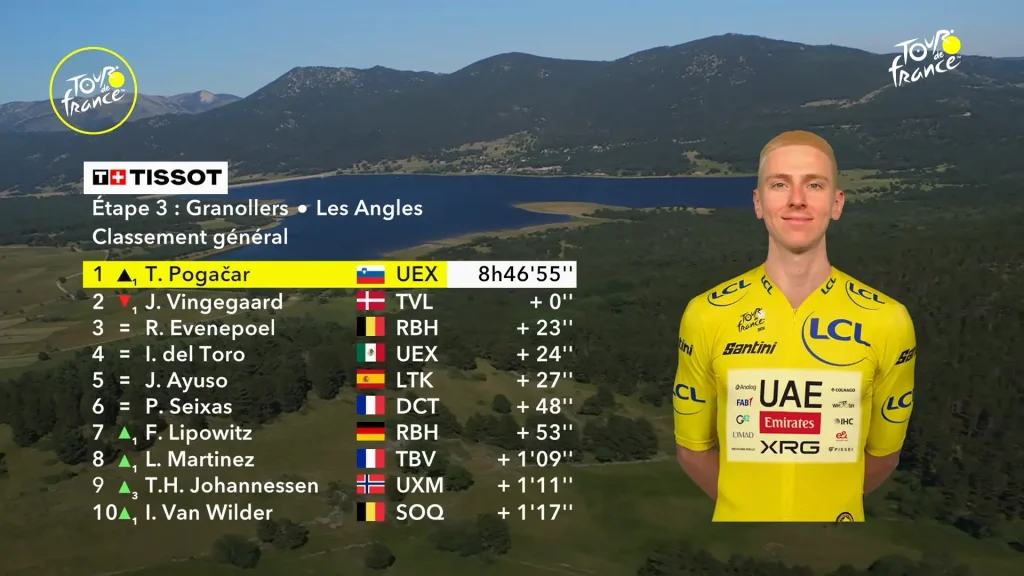
Tadej Pogačar and Jonas Vingegaard finished the Les Angles summit sprint level on time to the second, and it still changed everything. Isaac del Toro spent himself pacing the final kilometres so completely that Pogačar had nothing left to do but win the sprint, take the six-second bonus, and pull on yellow by countback alone. Remco Evenepoel sits third at 23 seconds, still short of the top-end sprint he needed. Alex Baudin turned a day in the early break into the polka dot jersey. Vingegaard, for the first time all week, was the one chasing a wheel instead of setting the pace.
Stage 4 hands the GC teams a reason to sit up and everyone else a reason to attack. At 182 km from Carcassonne to Foix, the terrain never flattens out and never turns into a real mountain either — five separate climbs break up the day without a single one long enough to hurt a GC leader who’s riding within himself. That’s exactly the profile breakaways are built for: hard enough to discourage the pure sprinters, soft enough that UAE and Visma have no obligation to chase. With Pogačar’s lead sitting on bonus seconds rather than banked time, don’t expect his team to spend a single watt controlling a move that poses no threat. Whoever gets into the right group in the first hour has a real shot at the finish beneath the Château de Foix.
General Classification Heading Into Stage 4
TL;DR
- Stage 4 is a 181.9 km hilly stage on July 7 from Carcassonne to Foix — start 13:10 CEST, expected finish 17:34 CEST at the castle city.
- Foix has a proven breakaway record: Luis León Sánchez (2012), Warren Barguil (2017), and Hugo Houle (2022 — 40 km solo) all won here from breaks. The 2026 route gives attackers 34.5 km from the Col de Montségur summit to the line.
- The Col de Montségur is the stage’s decisive climb — 6.9 km at 6.6%, the last summit of the day, named for the Cathar fortress where 220 believers chose death over conversion in 1244.
- GC teams will manage rather than race — after three crushing opening days totalling over 6,350 m of climbing, burning domestiques on a breakaway stage before Stage 6’s Tourmalet is poor arithmetic.
- This is the Tour’s most historically loaded stage backdrop — Carcassonne (largest fortress in Europe, UNESCO World Heritage), Cathar Country, Blanquette de Limoux (France’s oldest sparkling wine, predating Champagne by a century), and the Ariège department’s deep cycling culture all frame Stage 4’s 182 km.
Tour de France 2026 Stage 4 is a 181.9 km hilly stage from Carcassonne to Foix on Tuesday, July 7, the first all-French stage of the 113th edition. The peloton rolls out from the shadow of the largest medieval fortress in Europe, rides east through rugged Cathar Country, tackles four categorised climbs through the Pyrenean foothills, and finishes at the confluence of the Ariège and Arget rivers beneath the three towers of Foix castle.
Total elevation gain: approximately 2,750 metres. The last categorised summit, the Col de Montségur, crests 34.5 km from the finish, leaving a long, dangerous run-in that has already handed three breakaway riders stage victories in the past decade. The Tour leaves its mountain legs at the door for a day. Stage 4 belongs to the attackers.
What Is Tour de France 2026 Stage 4?
Tour de France 2026 Stage 4 is the first all-French stage of the 113th edition, a 181.9 km hilly road race from Carcassonne to Foix on Tuesday, July 7. After three days of Catalan roads, a Barcelona TTT, Montjuïc circuits, and a Pyrenean mountain crossing, Stage 4 delivers something different: a long, rugged day through southern French foothills where the road never truly relents but no single climb dominates. With 2,750 metres of total elevation spread across four categorised ascents, Stage 4 is the kind of stage that rewards riders willing to attack early, suffer alone, and hold on long enough to arrive before the peloton wakes up.
The stage is classified as hilly. That category understates what the Coudons and Montségur will feel like on day four of the race, when legs are already carrying the weight of three of the hardest opening stages in recent Tour history. On fresh legs, 2,750m is a moderate day. In context, it is anything but.
Stage 4 Date, Distance, and Start Times: July 7, 2026
Stage 4 starts at 13:10 CEST from Carcassonne on Tuesday, July 7. Expected finish in Foix: 17:34 CEST, making it one of the longer expected racing windows of the Tour’s first week. For UK viewers, racing begins at 12:10 BST with the finish around 16:34 BST, a full afternoon of coverage on Eurosport, GCN, and TNT Sport. US viewers: 07:10 EDT and 04:10 PDT at the start. The intermediate sprint at Quillan (km 93.4) gives a natural race checkpoint at approximately 15:30 CEST.
See the full TDF 2026 route and plan your schedule to watch all stages online with our complete live streaming guide.
Tour de France 2026 Stage 4 Route: Full Carcassonne to Foix Course Guide
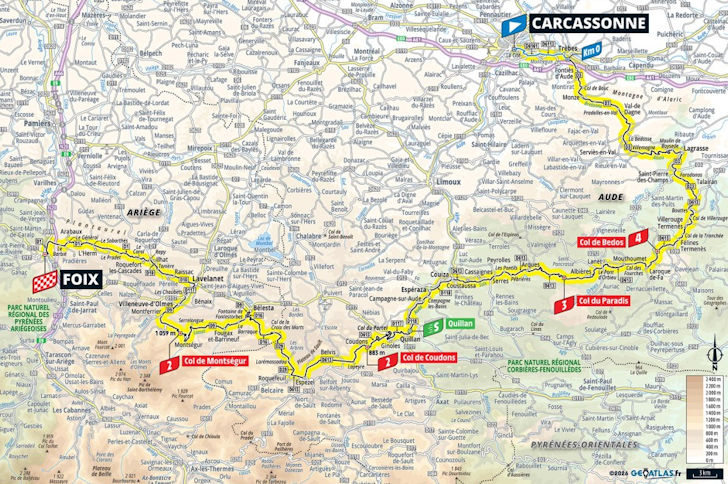
Stage 4 runs roughly east from Carcassonne then pivots south and southeast toward the Pyrenean foothills before the final run into Foix. The route has two distinct characters: a first half of 100 km that is hilly, relentless, and ideal for early break formation; and a second half of 82 km that contains both of the stage’s decisive climbs and the long, undulating run-in where the winner is decided.
The Opening Section: Carcassonne Into the Pyrenean Foothills
The peloton rolls out from the Cité de Carcassonne, the medieval fortress that has stood above the Aude river valley since Roman walls were first built here in 333 AD. The race heads east and southeast through hilly, rugged terrain that characterises the Corbières massif, the limestone hill country between the Languedoc plain and the Pyrenean foothills, planted with vineyards producing some of the most characterful reds in southern France.
Within 40 km, two uncategorised climbs arrive in sequence. The Col de Villerouge (8.6 km at 3%) is the first, passing through the kind of scrubby, sun-baked garrigue landscape that defines the Corbières, thin-soiled hillsides of rosemary, thyme, and dwarf oak separating vineyards from limestone outcrops. The Col de Bedos (3.3 km at 4.4%) follows shortly after. Neither climb is categorised. Neither is easy on day four of a Grand Tour. Breakaway candidates are watching each other on both ascents, testing legs and reading intentions.
The Col du Paradis arrives at km 64.9: 5.8 km at 4.1%. The name delivers the stage’s first piece of dark irony, Paradise Pass, in a landscape defined by medieval crusade and heresy trials. The views from the col across the Aude valley and toward the distant Pyrénées are genuinely striking; the racing through it is controlled but watchful.
The Road to Quillan: France’s Oldest Sparkling Wine Territory
The route descends toward Limoux, a small city on the Aude river, 30 km south of Carcassonne, that holds a distinction most visitors never know. In 1531, Benedictine monks at the Abbey of Saint-Hilaire, just south of Limoux, accidentally created what is documented as France’s first sparkling wine. They had bottled a partially fermented white wine too early; the secondary fermentation in the cork-stopped flask produced bubbles. Blanquette de Limoux was born more than a century before Dom Pérignon began his work in Champagne. The Stage 4 route passes through precisely this landscape. The cooling influence of the Atlantic on the Aude valley, which gives Mauzac grapes their characteristic acidity, surrounds the riders on either side.
Quillan arrives at km 93.4, a market town at the entrance to the dramatic Gorges de l’Aude, where the river cuts through deep limestone cliffs. The intermediate sprint here gives breakaway riders their first time bonus of the day and provides a race timing checkpoint: peloton groups passing Quillan on the television broadcast indicate approximately 15:30–15:45 CEST. From Quillan, the road begins rising more consistently. The flat and rolling first half is over.
The Col de Coudons: Where the Race Gets Serious
The Col de Coudons begins at km 94.1 and is the longest and most sustained climb of Stage 4: 10.7 km at an average gradient of 5.5%, Category 2. This is where the breakaway selection finalises. A rider who reaches the Coudons summit with a gap above three minutes has a realistic path to Foix. One who arrives with less than two minutes is in a race against the clock on every subsequent descent.
The Coudons is not flashy. Its 5.5% average is metronomic rather than brutal. But 10.7 km of consistent climbing on day four of a Grand Tour, after the first 94 km have already demanded sustained effort, reveals the true state of every rider’s form. Teams without GC ambitions who have been aggressive all day begin to lose riders here. The group that goes over the Coudons together is the group fighting for the stage win.
After the summit, the route stays on a high plateau for approximately 20 km before descending toward Bélesta — elevated, exposed scrubland with views south toward the full Pyrenean chain. In a Tramontane wind, this plateau is one of the most hostile stretches of road in southern France. On a calm July day, it is one of the most visually arresting.
The Col de Montségur: The Last Summit and Its Dark History
The Col de Montségur begins at km 139.8 and is the stage’s final categorised ascent: 6.9 km at 6.6%, Category 2, summit at approximately 900 metres. Its gradient is sharper than the Coudons, its length more manageable, but its position in the stage makes it the decisive moment. Riders reach the foot of the Montségur with 43 km left to race and whatever reserves they have built or squandered across the preceding 140 km.
The climb carries the name of one of the most significant sites in southern French history. The Château de Montségur, the ruined fortress that defined the last stand of the Cathar movement, sits approximately two kilometres from the road at the summit level, perched on a rocky outcrop called the pog at 1,207 metres altitude. From the upper slopes of the Col de Montségur, the castle ruins are visible to the south. Every cyclist climbing this road in the Tour de France is passing within sight of the place where, on 16 March 1244, over 220 Cathars chose to be burned alive at the Prat dels Cremats, the Field of the Burned, rather than renounce their faith.
That history is embedded in the landscape the Tour passes through. The Cathar Crusade ran from 1209 to 1229, systematically eliminating a religious movement that had taken deep root in Languedoc and the Ariège. Montségur was the Cathar church’s last headquarters, by 1232 it housed the centre of Cathar ecclesiastical administration and gave shelter to hundreds of refugees. The final siege lasted ten months, from May 1243 to March 1244. When the defenders surrendered, 205 Perfects who refused conversion were led down the mountain and burned in a mass pyre at its base. The event effectively ended organised Catharism in France.
From the Col de Montségur summit, 34.5 kilometres remain to the finish in Foix.
The Long Run-In to Foix: 34.5 km of Controlled Chaos
The descent from Montségur is fast and technical, switchbacks through pine forest, then a descent into the Ariège river valley. From Roquefixade, the road flattens and begins a long, undulating run toward Foix. It rises slightly at points. The overall trend is downhill. But the surface changes, the corners arrive unexpectedly, and the crosswinds in the valley can disrupt a breakaway rider’s pacing.
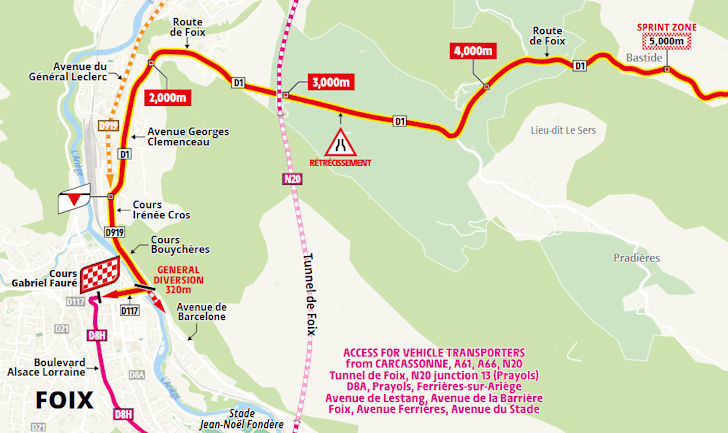
A break with two minutes at the Montségur summit has a genuine chance. The peloton’s motivation to chase and the available domestique resources after four days of racing determine whether those two minutes hold. In 2022, Hugo Houle began his winning solo move more than 40 km from the finish in Foix. His advantage at the Prat d’Albis summit was over five minutes, a different scale to what Stage 4’s profile produces. Stage 4’s 34.5 km run-in demands a smaller but more precise gap management.
The Château de Foix becomes visible from approximately five kilometres out, three medieval towers rising from a limestone rock above the river confluence. It is one of the most dramatic finish-line approaches in the Tour. Riders who have been alone for 30+ kilometres see it and know the race is almost won. Those behind know they are almost out of time.
Tour de France 2026 Stage 4 Elevation Profile: 2,750 Metres Across Four Climbs
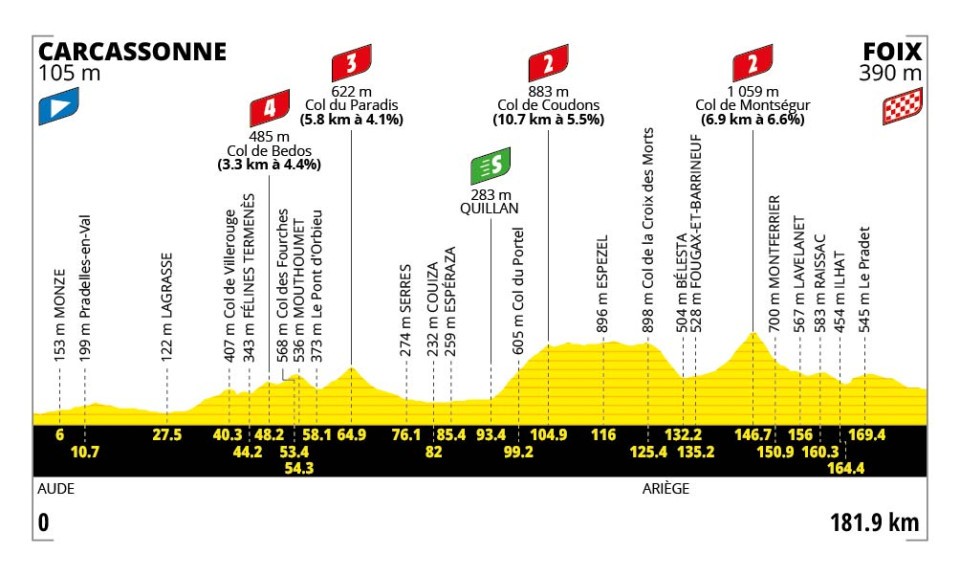
Stage 4’s elevation profile is modestly rolling for the first 40 km with two uncategorised climbs, then builds through four categorised ascents concentrated between km 48 and km 147, before the long run-in gives the legs nothing more to climb. The 2,750m total is the lowest of the Tour’s first four stages — but context changes that number entirely.
Stage 4 All Four Categorised Climbs: Data Table
| Climb | Category | Length | Avg gradient | Max gradient | Km mark |
|---|---|---|---|---|---|
| Col de Bedos | Cat 4 | 3.3 km | 4.4% | ~6% | km 48.2 |
| Col du Paradis | Cat 3 | 5.8 km | 4.1% | ~6% | km 64.9 |
| Col de Coudons | Cat 2 | 10.7 km | 5.5% | ~8% | km 104.9 |
| Col de Montségur | Cat 2 | 6.9 km | 6.6% | ~9% | km 146.7 |
The Col de Villerouge (8.6 km at 3%) and a second uncategorised Col de Bedos approach also feature in the opening 40 km. Neither earns KOM points, but both drain energy on a day where accumulation matters.
Why Stage 4 Is Harder Than Its Numbers Suggest: Day 4 Fatigue
The 2,750m figure stands alone. In context, it is one of the most deceptive numbers in the Tour’s opening week.
Riders arriving at Carcassonne for Stage 4’s start carry the following across their legs: Stage 1, a maximal 19.7 km TTT demanding full anaerobic effort. Stage 2, 178 km and 2,400m climbing, including three laps of the Montjuïc circuit with its 9.3% Château de Montjuïc ascent. Stage 3, 196 km and 3,950m of Pyrenean climbing to a 1,700m summit finish. Combined across Stages 1–3, riders have already climbed approximately 6,350 metres before Stage 4 begins. Adding Stage 4’s 2,750m means the cumulative elevation for the Tour’s opening four days exceeds 9,100 metres, more than the total climbing of most Grand Tour final weeks.
A rider operating at 85% of sea-level capacity after three hard days, asked to manage a 10.7 km climb at 5.5%, followed by a 6.9 km climb at 6.6%, is not experiencing a moderate day. They are experiencing a day where every mistake in pacing costs disproportionately. GC teams’ reluctance to chase a breakaway on Stage 4 is not passivity; it is arithmetic. The Tourmalet is two days away.
TDF Stage 4 Tactics: The Breakaway’s Day and Why GC Teams Let Them Go
4th stage is a classic Grand Tour breakaway stage. The last categorised summit crests 34.5 km from the line, far enough that a GC rider attacking there has no reliable path to the stage win, and close enough that a committed breakaway survivor can hold on. The gradient profile rewards sustained diesel-engine climbing over explosive punching power. The long run-in rewards riders who pace their effort and know the descents.
GC teams have no tactical incentive to spend energy today. A breakaway group of non-contenders 8+ minutes down on general classification is not a threat to the yellow jersey; letting them go costs nothing. Bringing them back requires committed domestique work across 34.5 km of undulating terrain, burning resources that matter more on Stage 6’s Tourmalet and Stage 3’s next mountain examination. The rational play for UAE, Visma, and Red Bull-BORA is to sit in, monitor, and save.
Foix’s Breakaway Record: Three Wins in the Last Decade
The data from Foix across recent Tour history makes the tactical case before the race even starts. Luis León Sánchez won here in 2012 from a breakaway that survived a long descent to the finish. Warren Barguil attacked and held on in 2017 on a course profile that rewarded punchy climbing followed by sustained effort. Hugo Houle sealed his moving solo ride in 2022, a 40 km breakaway that included a five-minute advantage at the summit and a perfectly judged run-in to the castle city.
Three different styles of winning moves. Three different course profiles. One consistent pattern: Foix rewards the attacker who commits early, manages the descent with precision, and refuses to look back.
The 2026 route has the Col de Montségur as its last summit at km 146.7 with 34.5 km remaining. That is less separation than Houle had in 2022 but comparable to the gap structures that produced the Sánchez and Barguil wins. A rider with two clean minutes at the Montségur summit and the aerobic capacity to hold 38 km/h on undulating roads for 34 km wins this stage.
Tour de France 2026 Stage 4 Favourites: Who Wins at Foix?
Tour de France Stage 4 suits three rider profiles, each with a different path to victory.
The diesel breakaway specialist is the most likely winner. A rider with strong sustained climbing ability across the Coudons and Montségur, good descending technique, and the mental discipline for long solo racing. Felix Gall / Paus Seixas (Decathlon AG2R La Mondiale) fits this profile precisely — his stage win on the 2023 Tour demonstrated exactly this combination of patient waiting, breakaway selection, and sustained execution. Magnus Cort (EF Education-EasyPost) (not confirmed by team yet) is consistently dangerous on this type of stage.
The puncheur from a reduced peloton is the second scenario, if the break is caught near Foix and the peloton arrives at the finish as a small, fatigued group, a fast finisher on a drag to the line wins. Tom Pidcock (Pinarello-Q36.5), who has noted his Tour de France goal is to enjoy racing and target opportunities rather than chase GC, is dangerous here if the race comes back together in the final kilometres.
The outsider is the rider nobody names before the stage who gets into the right move at 08:00 in the morning and is still there at km 180. Grand Tour Stage 4s produce more unknown winners than any other stage type, the peloton has not yet established its hierarchy, team discipline is imperfect after four hard days, and a well-timed move can catch everyone by surprise.
Carcassonne: The Stage 4 Start City and the Largest Fortress in Europe
Carcassonne is where the Tour de France starts its first French stage and it does so in the shadow of the most visually extraordinary start location in the race’s 2026 calendar. The Cité de Carcassonne, inscribed as a UNESCO World Heritage Site in 1997, is the largest intact medieval fortress in Europe. Its double ring of ramparts stretches 3 km, reinforced by 52 towers, enclosing a hilltop city of narrow cobbled streets, a 12th-century castle, and the Basilique Saint-Nazaire, a masterpiece of Romanesque and Gothic architecture built over three centuries.
The site began as Roman walls in 333 AD, when Roman forces built a fortification around a pre-existing Gaulish settlement above the Aude river. The current ramparts date primarily from the 12th to 14th centuries, modified under the Viscount families of Carcassonne and later the French royal government. In the mid-19th century, the fortress faced plans for demolition. A preservation campaign by architect Viollet-le-Duc, the same restorer responsible for Notre-Dame de Paris, saved and reconstructed the upper city between 1853 and 1879. The results are simultaneously extraordinary and controversial: Viollet-le-Duc added conical slate rooftops to the towers that did not exist in the medieval original, creating an image of a medieval fortress more perfect than any actual medieval fortress ever was.
Six million tourists visit Carcassonne annually, making it one of the most visited sites in France. The Tour de France has started and finished here multiple times across the past decade. Last year, Tim Wellens won a stage from Carcassonne from a breakaway. The peloton rolling out from the Cité’s gateway under its towers and onto the hilly roads of the Aude department is one of the stage race’s most cinematic openings.
The Cathar Country: What the Stage 4 Route Rides Through
Between Carcassonne and Foix, Stage 4 travels through the heartland of a religious and cultural movement that shaped southern French identity and left its ruins on every hilltop. Cathar Country, as the Ariège and Aude tourism boards call this region, is the territory where the Cathar movement flourished in the 12th and 13th centuries and where the Albigensian Crusade, launched by Pope Innocent III in 1209, systematically destroyed it.
The Cathars, from the Greek katharoi, “the pure“, held a dualist theology that rejected the material world as the creation of an evil demiurge. They lived austerely, refused Catholic sacraments, and were organised into two tiers: the Perfecti (parfaits), who had renounced all worldly goods and physical pleasures, and the credentes, ordinary believers. The Catholic Church considered them heretical. The Albigensian Crusade was the first military campaign in European history directed by the papacy against Christians.
Cathar castles dot every hilltop on the Stage 4 route. Villerouge-Termenès, near the first uncategorised climb, was where the last known Cathar Perfect was burned in 1321. Peyrepertuse and Quéribus are visible to the east on clear days. And Montségur, whose name the Col de Montségur carries, was the movement’s final stronghold, where its story ended in fire on a March morning in 1244.
What to Eat and Drink in Carcassonne Before Starting Stage 4 Day
Carcassonne’s food identity is built on cassoulet, one of the most disputed and passionately defended dishes in French gastronomy. The slow-cooked white bean and meat casserole exists in three canonical versions: the Castelnaudary version (duck confit, Toulouse sausage, white haricot beans, considered the original), the Carcassonne version (traditionally includes lamb shoulder or partridge, particularly in winter), and the Toulouse version (with its characteristic Toulouse sausage as the dominant protein). The three towns have argued about which is authentic for decades. The correct answer, as any local will tell you, is theirs.
Cassoulet in summer is served lighter than its winter version, the beans braised in duck fat with confit rather than the thick, baked crust version that appears in cold weather. Near the start area, the restaurants of the Bastide Saint-Louis (Carcassonne’s lower town) serve cassoulet alongside Corbières wines, the AOC appellation covering the Corbières massif the stage rides through, producing robust Grenache and Syrah blends that punch well above their price points.
The Blanquette de Limoux deserves its own sentence before the race starts. First produced by Benedictine monks at the Abbey of Saint-Hilaire in 1531, more than a century before Dom Pérignon’s work in Champagne, Blanquette de Limoux is France’s oldest sparkling wine, and the stage passes directly through Limoux. The wine is made primarily from the Mauzac grape, giving it a distinctly apple and floral profile quite different from Champagne’s Chardonnay character. At approximately €8–12 a bottle for the Sieur d’Arques cooperative version, it is the most undervalued aperitif in France.
Local lore holds that Dom Pérignon passed through the Aude valley on his way north from Spain, encountered the Saint-Hilaire monks, took the technique and claimed credit for it in Champagne. Champagne producers dispute this vigorously. The wine historians have found the Saint-Hilaire written records from 1531. The Tour riders pass through Limoux at approximately 14:30–14:45 CEST. Raise a glass before the Coudons.
The Canal du Midi: UNESCO Waterway Two Minutes from the Stage Start
One block south of the Cité de Carcassonne, the Canal du Midi passes under a medieval bridge. Built between 1666 and 1681 by Pierre-Paul Riquet, who spent his personal fortune on the project and died six months before its completion, the Canal du Midi connects the Atlantic at Toulouse to the Mediterranean at Sète, 240 km of navigable waterway lined with plane trees. It was inscribed as a UNESCO World Heritage Site in 1996. The towpath along the canal is one of France’s most beloved cycling routes.
Cycling tourists arriving in Carcassonne on July 6 or early July 7, before Stage 4’s start, should ride the Canal du Midi towpath west toward the Port de Carcassonne or east toward Trèbes. The combination of flat towpath, plane tree canopy over the water, and the Cité visible on the hill behind you is one of the more peaceful cycling experiences available anywhere near a Grand Tour start village.
Foix: The Stage 4 Finish City and Its Castle on a Rock
Foix sits at approximately 380 metres altitude at the point where the Arget river joins the Ariège, a confluence that has made this location strategically significant since Roman times. The city is the capital of the Ariège department and hosts approximately 10,000 permanent residents, with a medieval character that centres entirely on the Château de Foix, three towers of different heights rising from a limestone rock above the river, visible from every street in the lower town.
The Château de Foix appears in recorded history with its first written mention around 1002 AD, in the testament of Roger, first Count of Carcassonne, who bequeathed it to his eldest son. Bernard Roger became the first noble to carry the title Comte de Foix, establishing the county that would eventually extend through the Viscount of Béarn and the Kingdom of Navarre all the way to the French throne. The Count of Foix’s bloodline produced Henri IV of France, who issued the Edict of Nantes in 1598 and stands as one of the most consequential monarchs in French history.
The castle resisted a crusader siege by Simon de Montfort from 1212 to 1217 during the Albigensian Crusade, the same campaign that eventually destroyed Montségur. It remained the symbol of its lords’ power through Gaston Fébus (1343–1391), the most celebrated Count of Foix, who wrote a treatise on hunting that was one of the most-read books in 15th-century France and reportedly knew every pass in the Pyrenees by name. The castle became a prison under the Ancien Régime, was restored in the 19th century, and now houses the Ariège departmental museum within its keep.
The Tour de France has visited Foix ten times since 1933, when Ax-les-Thermes became the first Ariège stage finish. Foix’s record with breakaway wins, three in the last decade alone, makes it one of the Grand Tour’s most reliably compelling non-mountain finish towns.
Where to Watch Tour de France 2026 Stage 4: Best Spectator Spots
Stage 4 offers the Tour’s most accessible and culturally rich spectating day of the first week. Both cities are easily reached by rail, the climbs are in approachable foothill terrain rather than high-altitude passes, and the Montségur section combines the stage’s most decisive racing with one of the most historically significant detour opportunities in the region.
Stage 4 Best Viewing Zones
| Zone | What you see | Access | Best arrival | Crowd level |
|---|---|---|---|---|
| Carcassonne Cité start area | Race roll-out beneath UNESCO fortress walls — the most dramatic start backdrop of the Tour’s first week | TGV from Paris (4h30), Toulouse (45 min), Barcelona (2h) | 11:00 CEST | Very high |
| Limoux town centre | Peloton at full pace through France’s oldest sparkling wine town | Car from Carcassonne (30 min south on D118) | 14:30 CEST | Moderate |
| Col de Coudons summit | Cat 2 race-decisive climb, peloton stretching, 10.7 km at 5.5%, breakaway forming | Car via D109 from Quillan | 14:45 CEST | Moderate |
| Col de Montségur | Last categorised summit — race is decided here. Château de Montségur ruins 2 km detour | Car via D9 from Lavelanet | 15:30 CEST | High |
| Foix finish (castle backdrop) | Stage winner, Château de Foix above the line, breakaway verdict | SNCF train Toulouse→Foix (1h15) or car via N20 | 15:00 CEST | Very high |
The Col de Montségur is the single standout spectating recommendation for Stage 4. The racing is decisive here. The landscape is dramatic. And two kilometres from the summit, the Château de Montségur sits on its pog above the valley, one of the most loaded historical detours available anywhere on the entire 2026 Tour route. Watching the race pass, then walking 30 minutes up the pog to the castle ruins while the peloton descends to Foix, is the correct way to spend the afternoon of July 7.
Getting There: Transport Between Carcassonne and Foix on Stage 4 Day
Carcassonne is well-connected. Direct TGV services arrive from Paris Gare de Lyon (4h30), Toulouse (45 minutes on the frequent TER service), and Barcelona (approximately 2h on the cross-border service through Perpignan). The Carcassonne start area closes to vehicles from approximately 11:00 CEST. Arrive by train and walk up to the Cité.
Foix requires more planning. No direct TGV serves Foix. The SNCF Toulouse-Latour-de-Carol line stops at Foix station, approximately 1h15 from Toulouse Matabiau. From Carcassonne, the practical option is the A61 autoroute west to Pamiers junction (1h15), then the N20 south to Foix (20 minutes). Mountain road closures for the Col de Coudons and Montségur approaches begin at approximately 07:00 CEST on race day, arrive the night before or before 07:00 for these viewpoints.
A practical one-day spectating circuit from Toulouse: take the morning train to Carcassonne for the start (45 minutes), return to Toulouse and drive south to Foix for the finish (1h from Toulouse). This covers both cities without road closure complications.
Where to Stay for Stage 4: Carcassonne or Foix?
Carcassonne offers better accommodation volume and options. Hotels within the Cité itself are atmospheric and expensive; the Hôtel de la Cité is the prestige option. The lower town (Bastide Saint-Louis) provides better value with immediate access to restaurants, the Canal du Midi, and a 15-minute walk to the start area. Summer peak season combined with Tour de France demand means booking as far in advance as possible is non-negotiable.
Foix has limited accommodation for a stage finish city; fewer than 10,000 residents means hotel stock is thin. Book immediately. The most practical alternatives: Pamiers (20 km north on the N20, significantly more accommodation) and Tarascon-sur-Ariège (15 km south, a scenic Ariège river town with reasonable hotel options). Both offer easy driving access to the finish.
A logistics note for following the race forward: Stage 5 departs Lannemezan, approximately 1h45 west of Foix on the D117 through Saint-Girons. Staying in Foix and driving to Lannemezan the next morning is viable. Stage 6 departs Pau, 2h west of Foix. The logical base for Stages 5 and 6 is somewhere between Foix and Pau, with Saint-Girons or Tarbes as practical overnight options.
Weather on Stage 4: Occitanie Heat and the Tramontane Question
Stage 4 runs entirely through Occitanie, the warmest and most consistently sunny region of the Tour’s first week. July temperatures in Carcassonne average 30–32°C; Foix sits slightly cooler at approximately 26–28°C at 380m altitude. The stage runs through the hottest part of a summer afternoon, with temperatures at the 13:10 CEST start already at or above 28°C and peaking during the plateau section after the Col de Coudons.
The specific weather variable that matters most for Stage 4 is the Tramontane. This northwesterly wind, a cousin of the Mistral, channels between the Pyrenees and the Cévennes massif, accelerating through the Aude valley and across the Corbières hills. On its strongest days, the Tramontane gusts above 80–90 km/h. July Tramontane events are common across the Languedoc-Roussillon region. On a Stage 4 with 20 km of plateau terrain after the Coudons summit, exposed, open, with no natural windbreak, a Tramontane day changes the race entirely.
In a Tramontane, teams riding on the Col de Coudons plateau face genuine crosswind echelon risk. The peloton fragments sideways rather than backwards. A strong team with Tramontane experience, Groupama-FDJ, TotalEnergies, and Cofidis all have riders who race frequently in southern France and know this wind, can use the conditions to split the race without climbing a single metre.
Teams watching the July 7 forecast from Perpignan’s meteorological service are checking one specific data point: wind speed and direction on the D109 plateau between the Coudons summit and the Bélesta descent. If that number reads above 30 km/h from the NW, Stage 4 becomes a very different race.
How Stage 4 Sets Up Stage 5 and the Tourmalet: The Road to Gavarnie
Stage four closes the Tour’s transitional block before the Pyrenees deliver their verdict. Stage 5 on July 8 from Lannemezan to Pau (158 km flat) is the race’s first genuine sprint-stage opportunity, a recovery day designed as a buffer between Stage 4’s foothill punishing and Stage 6’s full Pyrenean examination. Stage 6 on July 9 from Pau to Gavarnie-Gèdre carries 4,650 metres of elevation gain, the Col d’Aspin, the Col du Tourmalet at 2,115 metres, and a summit finish in the Cirque de Gavarnie — the defining queen stage of the 2026 Tour’s first mountain week.
The cumulative GC picture entering Stage 6 will show exactly what the Tour’s first week has produced. A rider who managed Stages 1–4 carefully, no TTT disasters, no Montjuïc gaps, Les Angles controlled, Stage 4 sitting in, arrives at the Tourmalet with full teams and tactical freedom. A rider who lost time somewhere across the four opening days arrives at Stage 6 already in deficit, forced to attack on the road to Gavarnie before the optimal moment.
Every domestique burned chasing the Stage 4 break is one less domestique available to pace Vingegaard or Pogačar up the Tourmalet on Stage 6. That arithmetic is why breakaway stages exist and why experienced directeurs sportifs respect them, not because the racing is secondary, but because the consequences of misreading the day extend far beyond the finish line at Foix.
See our Tour de France 2026 Stage 3 complete guide for the Granollers to Les Angles mountain stage preview.
Stage 5 — Lannemezan to Pau, the Tour’s first sprint stage.
Stage 6 — Pau to Gavarnie-Gèdre and the Col du Tourmalet — the marquee Pyrenean queen stage.