Tour de France 2026 Stage 7: Hagetmau to Bordeaux — After Pogačar’s Tourmalet Statement, the Sprinters Finally Get Their Day
Last Updated: 10:46 am CEST - Friday, 10 July 2026
Pogačar didn’t just win Stage 6 — he ended the conversation about whether this Tour would be close. Isaac del Toro launched him five kilometres from the Tourmalet summit, and from there Pogačar rode 43 km alone, gaining time on the climb, more on the technical descent, and still more on the drag to Gavarnie-Gèdre. He crossed 2:42 clear of Vingegaard, who admitted flatly it “was not the day I wanted.” Del Toro took third and the white jersey; Torstein Træen’s brief spell in yellow ended not on the mountain but in a crash on the descent moments after being dropped. Five riders now sit within 33 seconds of each other for what’s left of the podium picture — everyone, that is, except the man in yellow.
Stage 7 asks nothing like the same questions. Hagetmau to Bordeaux is 175 km of almost uninterrupted flat, one modest fourth-category climb 38 km from the line, and a finish built for exactly the kind of sprint the Pyrenees have been withholding all week. The forecast adds its own subplot: mid-30s heat again, and the open Landes farmland offers zero shelter if any wind gets organised — the one live risk to an otherwise textbook bunch gallop. Kooij arrives with a stage already banked and genuine momentum; Merlier, Philipsen and Pedersen all have reasons to disagree with that plan. For Pogačar and Vingegaard, today is about staying upright and staying level. For everyone else, it’s the sprint the whole peloton has been waiting a week for.
TL;DR
- Stage 7 at a glance: July 10, Hagetmau to Bordeaux, 175.1 km, almost entirely flat — a clear day for the sprinters.
- Hagetmau makes Tour de France history as a stage town for the first time ever, sitting on the Camino Francés pilgrim route to Santiago de Compostela.
- The only obstacle is the Côte de Béguey, a minor climb roughly 40 km from the finish that won’t trouble the sprint teams.
- The route passes directly through named vineyards in the Cadillac Côtes de Bordeaux appellation — Château Reynon, Château Birot, and Château Carsin all sit along the road.
- Bordeaux’s place in Tour sprint history is contested between two widely cited figures — and we’ll show you both rather than guess.
A pure sprinters’ day — the first flat stage after the Pyrenean queen stage. Every fast man will target this one.
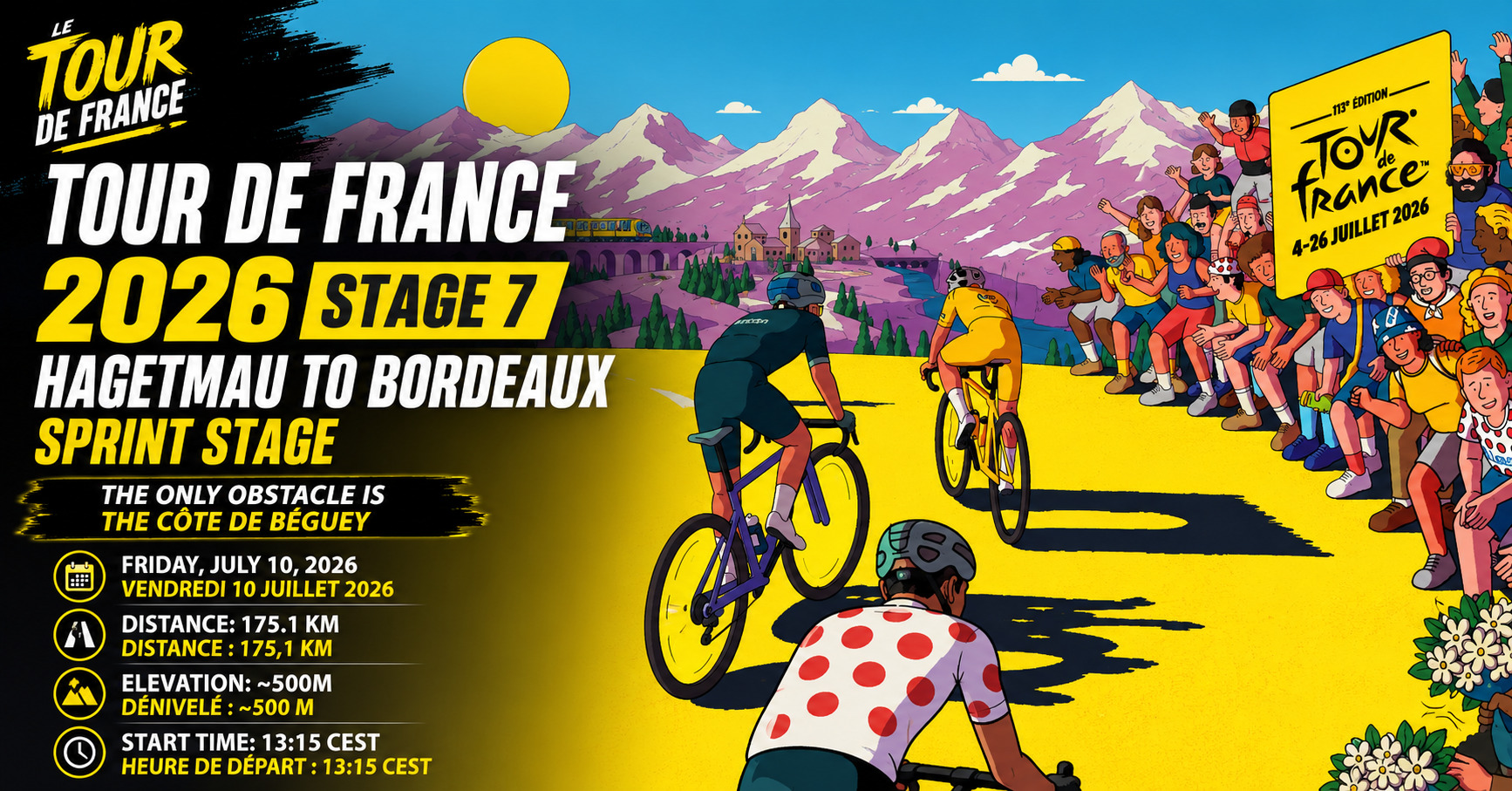
Tour de France 2026 Stage 7 takes place on Friday, July 10, covering 175.1 km from Hagetmau to Bordeaux on almost entirely flat terrain, with a mass sprint finish expected at Place des Quinconces. It is the first stage to make Hagetmau a Tour de France stage town in the race’s history, and it gives the sprinters their second real chance of the race after the brutal Pyrenean reckoning of Stage 6.
After two mountain crossings and a queen-stage Tourmalet double that delivered the Tour’s first genuine GC verdict, Stage 7 is racing’s version of an exhale. One minor climb, two intermediate sprints, and 175 km of largely flat roads through the pine forests of the Landes and the vineyards of the Gironde stand between Hagetmau and a finish line in one of the Tour’s most familiar sprint cities. For the GC contenders, this is recovery in racing disguise. For the fast men, it’s the day they’ve been waiting for since Pau.
What Is Tour de France 2026 Stage 7?
Stage 7 is a 175.1 km flat stage run on July 10, taking riders from Hagetmau, a Tour de France debut town, to Bordeaux, where a bunch sprint at Place des Quinconces is close to a certainty. After Stage 6’s brutal Aspin-Tourmalet double and the historic first finish at Gavarnie-Gèdre, this stage offers almost no elevation and a single minor climb, giving GC riders a genuine recovery day while handing the sprinters their second real opportunity of the race.
What makes Stage 7 worth covering properly, rather than dismissing as a non-event, is what happens beneath the surface of a “boring” flat stage. The route crosses through forests still recovering from the devastating 2023 Gironde wildfires, rolls directly past named vineyards in one of Bordeaux’s most respected wine appellations, and sets up a green jersey battle that genuinely matters even though the GC contenders are quietly saving their legs. Flat doesn’t mean uneventful, it means the drama moves from the mountainside to the sprint train.
Tour de France 2026 Stage 7 — Key Timings
The schedule below isn’t a single fixed clock — the organisers plan around three pace scenarios (46 km/h, 44 km/h, and 42 km/h), which is why the finish carries a 22-minute window rather than one arrival time. Both ends of that range are covered here.
| Location | Dist. | Fast | Slow | UK (BST) | US (EDT) | Australia (AEST) |
|---|---|---|---|---|---|---|
| Hagetmau (neutralised) | 175.1 | 13:15 | 13:15 | 12:15 | 07:15 | 21:15 |
| Hagetmau (route proper) | 175.1 | 13:25 | 13:25 | 12:25 | 07:25 | 21:25 |
| Saint-Sever | 166.0 | 13:37 | 13:38 | 12:37–12:38 | 07:37–07:38 | 21:37–21:38 |
| Mont-de-Marsan | 149.2 | 13:59 | 14:02 | 12:59–13:02 | 07:59–08:02 | 21:59–22:02 |
| Labrit | 118.9 | 14:38 | 14:45 | 13:38–13:45 | 08:38–08:45 | 22:38–22:45 |
| Luxey | 101.2 | 15:01 | 15:11 | 14:01–14:11 | 09:01–09:11 | 23:01–23:11 |
| Sore | 91.1 | 15:15 | 15:25 | 14:15–14:25 | 09:15–09:25 | 23:15–23:25 |
| Saint-Symphorien | 76.8 | 15:33 | 15:45 | 14:33–14:45 | 09:33–09:45 | 23:33–23:45 |
| Landiras (sprint) | 54.8 | 16:02 | 16:17 | 15:02–15:17 | 10:02–10:17 | 00:02–00:17next day |
| Cote de Beguey | 37.8 | 16:24 | 16:41 | 15:24–15:41 | 10:24–10:41 | 00:24–00:41next day |
| Pont Simone Veil | 4.5 | 17:07 | 17:29 | 16:07–16:29 | 11:07–11:29 | 01:07–01:29next day |
| Bordeaux finish | 0 | 17:13 | 17:35 | 16:13–16:35 | 11:13–11:35 | 01:13–01:35next day |
Fast = 42 km/h (green) · Slow = 38 km/h (red) · BST = UTC+1 · EDT = UTC-4 · AEST = UTC+10 (Sydney). Australian times roll into the following day after midnight.
Best Time to Tune In — By Viewer Type
Nobody needs four hours of Landes farmland to enjoy Stage 7. Here’s when to join, depending on how much of the day is actually worth your time.
| Viewer Type | UK (BST) | US (EDT) | Australia (AEST) | What You’ll Catch |
|---|---|---|---|---|
| Full-stage viewer | 12:15 | 07:15 | 21:15 | Roll-out, early break formation, the long chase |
| Green jersey watcher | 15:00 | 10:00 | 00:00next day | Landiras intermediate sprint and the final 55 km |
| Sprint build-up viewer | 15:30 | 10:30 | 00:30next day | Cote de Beguey, the positioning fight, final approach |
| Final-only viewer | 16:00 | 11:00 | 01:00next day | Last 30 km and sprint trains forming |
| Last-minute viewer | 16:10 | 11:10 | 01:10next day | Pont Simone Veil, Bordeaux entry, the sprint itself |
Tune-in times in local time zones. BST = UTC+1 · EDT = UTC-4 · AEST = UTC+10 (Sydney). Australian times after midnight roll into the following day.
For most fans, 15:30 BST/10:30 ET/00:30 AEST is the join point that earns its keep. It lands right as the Béguey climb starts setting the tone for the finale, then runs straight through the chase, the entry to Bordeaux, and the full sprint build-up without a wasted minute. If the early break builds a bigger cushion than usual, move that start forward to 15:00 BST instead, the Landiras sprint at 54.8 km out carries its own stakes for the green jersey race, and it’s worth being there before it’s already decided.
The Côte de Béguey — Sets the Tone, Doesn’t Set the Result
The Côte de Béguey won’t produce a stage winner. At 1.2 km and 4.4%, category 4, it isn’t built to. What it does is flip a switch. Thirty-seven point eight kilometres from the line, this is the point where a comfortable day for the breakaway turns into a fight for survival, and where the sprint teams stop managing pace and start managing position. A small group up the road might use the ramp to squeeze out a few extra seconds of cushion. A sprint team with something to lose might lift the tempo just enough to make the chase feel controlled rather than urgent. Nobody who matters on the results sheet today is a climber — but everybody who matters needs Béguey to go their way.
The Final Run Into Bordeaux
This is where four hours of managed racing collapses into ninety seconds that actually decide something. The peloton crosses the Pont Simone Veil with 4.5 km to go, the last natural marker before the run along the Garonne opens up completely and stays open all the way to the line. From there, it’s a straight contest for wheels: no corner sharp enough to hide behind, no gradient to create a gap, just sprint trains threading past each other at full speed with the finish already in sight. Whoever crosses that bridge in the cleanest position has already won half the argument before the sprint itself even starts.
For viewers outside continental Europe: a 13:15 CEST start translates to roughly 12:15 BST in the UK, 07:15 EDT on the US East Coast, and 04:15 PDT on the West Coast. Coverage runs on Eurosport and HBO Max across most of Europe, with NBC Sports and Peacock carrying the race in the United States. See the full detailed schedule by region.
Tour de France 2026 Stage 7 Route: Full Hagetmau to Bordeaux Course Guide

The route runs from Hagetmau through the pine forests and small towns of the Landes, Saint-Sever, Mont-de-Marsan, and beyond, before crossing into the Gironde through forest land still recovering from the 2023 wildfires, then on past Cadillac’s vineyards and the Côte de Béguey, finishing with a long, fast run along the Garonne into the heart of Bordeaux. It is a stage of two distinct halves: a scenic, largely uneventful approach, and a finale built entirely for speed.
Hagetmau: A First-Ever Tour Stage Town on the Camino Francés
Hagetmau has never hosted a Tour de France stage start or finish before Stage 7, a genuine first in the race’s history, even though the Tour passed through the town as recently as 2021 without stopping. The town sits on the Camino Francés, also known locally as the Voie du Vézelay, one of the historic pilgrim routes leading to Santiago de Compostela in Spain. For ASO, debut towns like Hagetmau matter strategically: the race director’s office has spoken in past years about wanting to bring the Tour to places that have never hosted it, spreading the event’s economic and cultural impact beyond the usual rotation of established stage towns. For a town built around centuries of pilgrim foot traffic, hosting one of the world’s largest cycling races for a single July morning is its own kind of pilgrimage story.
Through the Landes: Saint-Sever, Mont-de-Marsan, and the Pine Forests
The opening kilometres carry the peloton through the Landes region’s characteristic landscape — long, straight roads cut through dense pine forest, interrupted occasionally by small towns like Saint-Sever and Mont-de-Marsan. This terrain is about as breakaway-unfriendly as cycling gets: wide, exposed roads with few natural pinch points for an escape group to defend a gap, and nothing in the terrain itself to slow down a chasing peloton. Any rider hoping to make the day’s breakaway stick will need tactical patience rather than terrain on their side.
Crossing Into the Gironde: The 2023 Wildfire Forests of Guillos, Origne, and Landiras
As the route crosses from the Landes into the Gironde, it passes directly through the forests around Guillos, Origne, and Landiras, areas that were devastated by the wildfires that tore through this region in the summer of 2023, among the worst France had seen in decades. Three years on, these forests stand as a quiet symbol of regrowth rather than a memorial to disaster. For a stage built almost entirely around speed and sprinting tactics, this section offers something different: a brief, genuine reminder that this is real countryside with a real recent history, not just scenery for a bike race to pass through.
The Côte de Béguey and the Garonne Crossing at Cadillac
After crossing the Garonne at Cadillac, the riders face the stage’s only real test: the Côte de Béguey, a short climb of 1.6 km at an average gradient of 4.2%, summiting roughly 40 km from the finish. It is not the kind of climb that troubles a well-organised sprint team — too short, too gentle, too far from the finish to matter tactically — but it does mark the moment the route enters the Cadillac Côtes de Bordeaux wine appellation, and this is where the stage quietly becomes one of the most overlooked food-and-wine routes of the entire 2026 Tour. The peloton rides directly past Château Reynon and Château Birot in Béguey itself, and Château Carsin in nearby Rions — three recognised producers within the Cadillac Côtes de Bordeaux appellation, an area known for both red wines and the area’s historic sweet white wines made from late-harvested, botrytis-affected grapes. It’s a detail almost entirely absent from other race previews, and one any wine-curious spectator will want to know before standing roadside here.
The Final Kilometres: Pont Simone Veil to Place des Quinconces
From Cadillac, the route follows the Garonne for more than 40 km into the heart of Bordeaux. The finale is fast and entirely built for sprinting: riders cross the modern Pont Simone Veil before launching into a long, straight run along the river quays, finishing at the wide, open expanse of Place des Quinconces, one of the largest public squares in Europe and a fitting stage for a bunch sprint at full speed. There is nothing technical about this finish. No tight corners, no late direction changes, no surprises. It’s a pure test of who has the fastest legs and the best-organised lead-out train left in their tank.

Tour de France 2026 Stage 7 Elevation Profile: Why “Flat” Doesn’t Mean Easy
Stage 7 gains roughly 500 metres of total elevation across 175.1 km, about as flat as a Grand Tour stage gets, and a stark contrast to Stage 6’s 4,100m through the Pyrenees. The Côte de Béguey is the only categorised obstacle on the entire route, and at 1.6 km and 4.2% it barely qualifies as a climb in the context of a race that has already crossed the Tourmalet. But “flat” in cycling rarely means “uneventful.” A long, hot day in the saddle still drains energy reserves, two intermediate sprints still create genuine tactical stakes for the green jersey, and open, exposed roads through the Landes still carry a real risk of crosswind splitting the peloton apart before a single climb is even in play.
Stage 7 Climb Data
| Climb | Category | Length | Avg. Gradient | KM Mark | Distance to Finish |
|---|---|---|---|---|---|
| Côte de Béguey | Minor / uncategorised in most years | 1.6 km | 4.2% | ~135 km | ~40 km |
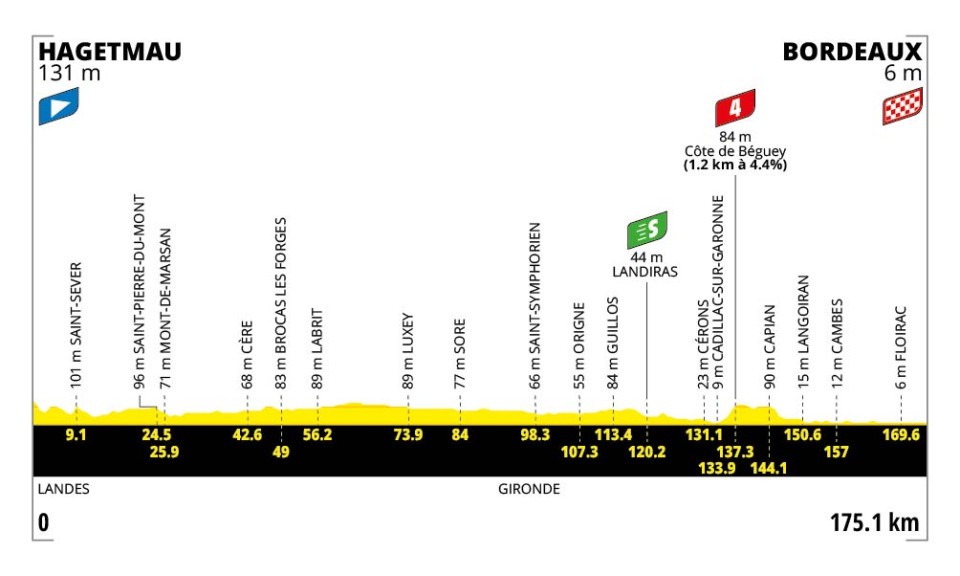
Stage 7 Tactics: Sprint Trains, Crosswinds, and the Green Jersey Battle
Stage 7 is built for one outcome, a bunch sprint, but the route to that outcome still rewards real tactical thinking, even on a day this flat.
Why a Breakaway Almost Certainly Won’t Survive
Sprint teams have a simple mathematical advantage on a stage like this: on flat, open roads, a well-organised chasing peloton can close a gap far faster than most breakaway groups can defend one. A six-to-eight-rider breakaway working together typically loses ground to a coordinated chase at a rate of roughly half a minute to a full minute per ten kilometres, once the sprinters’ teams commit to the chase in earnest. Over 175 km of largely flat terrain with little to disrupt the pace, that math almost always favours the bunch, which is exactly why escapees on stages like this tend to ride for visibility and sponsor airtime rather than any real hope of holding on to the finish.
Crosswind and Echelon Risk in the Landes
The flat, open roads through the Landes carry a real and frequently underrated danger: crosswind. When wind hits the peloton from the side rather than head-on or from behind, riders form diagonal lines called echelons to find shelter from the rider ahead and on a wide enough road, there’s only space for so many riders in the front echelon. Anyone caught behind it can lose significant time in a matter of minutes, with no climb required to do the damage. Flat Tour stages have produced some of the race’s most chaotic split-second GC disasters in past editions precisely because nobody was watching for danger on a day that looked safe on paper. Teams with GC ambitions will be watching the Landes forecast as closely as they watch any mountain weather report.
Two Intermediate Sprints and the Green Jersey Battle
Two intermediate sprints break up the route, and while they matter little to the GC contenders, they carry real weight for the green jersey race. Every point collected here adds up over three weeks, and a rider chasing the points classification has genuine incentive to contest these sprints hard, even on a stage they have no realistic chance of winning outright. The cost is fatigue: a lead-out train that commits hard to an intermediate sprint at the halfway point has measurably less left in the tank for the finale, a trade-off every green jersey contender’s team has to weigh carefully on a stage like this.
Who Wins Stage 7? The Sprinters’ Form Heading Into Bordeaux
The sprinters arriving in Bordeaux will largely be riders who have managed their effort carefully since the Pyrenees, having burned minimal unnecessary energy on Stage 5 and survived Stage 6 without major incident. The fastest finishers of the modern Tour — riders like Jasper Philipsen, Olav Kooij, Jonathan Milan, and Tim Merlier — typically treat mountain stages as pure survival days, conserving everything for exactly this kind of pure speed finish. This guide won’t predict a winner months out from race day, but the formula for who’s dangerous here is simple: whoever has the freshest legs and the best-drilled lead-out train left standing after the Pyrenees.
GC Impact: A Rest Day in Racing Disguise
For the overall contenders, Stage 7 is best understood as risk management rather than racing. There’s effectively nothing to gain here and everything to lose, a single bad-luck crash in the bunch, a wheel touched in a crosswind split, a moment of inattention in the finale chaos, and a GC campaign can take a hit on a stage that wasn’t supposed to matter at all. Expect Pogačar, Vingegaard, Evenepoel, and the rest of the GC group to ride near the front of the bunch, conserve energy, and treat this as exactly the kind of day where the smartest move is to do as little as possible.
Bordeaux: The Tour’s Great Sprint City
A Hosting History Second Only to Paris — and a Number Worth Checking
Bordeaux’s exact tally of Tour de France stage finishes is one of those small facts that different sources report differently, and rather than confidently repeat a number we can’t fully verify, we want to show you both. One widely cited figure puts Bordeaux’s stage-finish count at 133 times; another, equally widely cited, states it as the 82nd time the city has hosted a finish, “second only to Paris.” We haven’t been able to find an authoritative tie-breaker between these two figures. What both sources agree on, unambiguously, is that Bordeaux ranks among the most frequent host cities in Tour de France history — whichever exact number you trust, this is genuinely one of the race’s great recurring sprint venues.
The Cavendish-Philipsen Story: Bordeaux 2023 and the Long Road to Saint-Vulbas
Bordeaux’s most recent chapter in Tour sprint history carries real emotional weight. In 2023, Mark Cavendish arrived in Bordeaux chasing what would have been a record-breaking 35th career Tour stage win, surpassing Eddy Merckx’s long-standing mark. Jasper Philipsen beat him to the line. Cavendish’s next realistic chance that year never arrived — he crashed heavily the following stage and was forced to abandon in tears, a result that looked, in the moment, like it might be the end of the chase entirely. He chose to race one more season anyway, and in Saint-Vulbas in 2024, he finally claimed the record outright. That near-miss second-place finish in Bordeaux had kept the belief alive long enough to get there.
Bordeaux’s Sprint Winners Through History
| Year | Winner |
|---|---|
| 2023 | Jasper Philipsen |
| 2010 | Mark Cavendish |
| 1999 | Tom Steels |
| 1997 | Erik Zabel |
| 1996 | Frédérique Moncassin |
Food and Wine Culture Along the Stage 7 Route
Stage 7 quietly doubles as one of the richest food-and-wine routes of the entire 2026 Tour, even though almost no competitor preview gives it real attention. The Landes, in the stage’s opening half, is historically associated with duck farming and foie gras production; the region remains one of France’s most significant producers of both, a culinary identity as central to local life as wine is to the Gironde that follows it.
Once the race crosses into the Gironde near Cadillac, the route runs directly through the Cadillac Côtes de Bordeaux appellation, passing Château Reynon and Château Birot in Béguey and Château Carsin in Rions, producers known for both red Bordeaux blends and the area’s historic sweet white wines made from Sémillon, Sauvignon Blanc, and Muscadelle grapes affected by noble rot. And the finish itself sits in Bordeaux, a city whose name is functionally synonymous with wine on a global scale. Few stages in this Tour offer a more complete culinary cross-section of southwest France in a single day’s racing.
Where to Watch Tour de France 2026 Stage 7: Best Spectator Spots from Hagetmau to Bordeaux
Stage 7 is a far easier logistics day for spectators than the Pyrenean stages that preceded it — flat terrain, good road access throughout, and a finish in a major city with substantial infrastructure for crowds.
Stage 7 Best Viewing Zones
| Zone | What You’ll See | Access | Best Arrival | Crowd Level |
|---|---|---|---|---|
| Hagetmau start | Stage Village, historic first départ | Easy — town centre | Morning of | Light, but historic significance draws local crowds |
| Côte de Béguey / Cadillac vineyards | Minor climb, vineyard scenery | Easy, rural roads | Early afternoon | Light |
| Pont Simone Veil, Bordeaux | Fast approach to the finale | Moderate — riverside roads | 1–2 hours before finish | Moderate |
| Place des Quinconces | Sprint finish, largest crowds | Easy — central Bordeaux, full city infrastructure | Arrive early for a good viewing spot | Heaviest of the stage |
Getting There and Road Closures
Hagetmau has modest rail connectivity; most visitors will find driving or connecting through nearby Mont-de-Marsan or Dax more practical. Bordeaux, by contrast, is one of the best-connected cities in southwest France, with a major TGV station and an international airport, making the finish far more accessible than the start for visitors with limited time. Expect road closures along the racing route to begin several hours ahead of the peloton’s passage, with the heaviest restrictions in central Bordeaux around Place des Quinconces from early afternoon onward given the scale of crowds a guaranteed sprint finish typically draws.
Where to Stay: Hagetmau, Bordeaux, or Cadillac?
For most visitors, Bordeaux is the obvious base — outstanding transport links, a huge range of accommodation, and the ability to enjoy the city’s wine, food, and culture beyond just the finish line. Cadillac offers a charming, much smaller-scale alternative for anyone wanting to combine the stage with genuine wine tourism, sitting roughly 40 km from the finish with easy road access into Bordeaux on race day. Staying in Hagetmau itself only makes sense for visitors specifically prioritising the historic first départ over the finish-line spectacle.
Weather and Wind on Stage 7
Early-to-mid July in the Landes and Gironde typically brings warm, dry conditions, with daytime temperatures often reaching the high 20s°C and occasionally higher inland. The greater concern for this stage isn’t heat but wind — the open, agricultural terrain of the Landes offers little natural shelter, and any meaningful crosswind on race day raises genuine echelon risk in the way described above.
Riders and team directors will be watching the regional forecast in the days before the stage at least as closely as they’d watch conditions on a mountain stage, since the consequences of a poorly timed crosswind split can be just as costly to a GC campaign.
How Stage 7 Connects to the Rest of the Tour
Stage 7 sits in the middle of a rare three-sprint block in the 2026 route, sandwiched between the Pyrenean demands of Stage 6 and another flat stage to come on Stage 8, which runs 182 km from Périgueux to Bergerac through the Dordogne valley. Taken together, Stages 5, 7, and 8 give the sprinters three genuine chances across the Tour’s first ten days, even as the race’s overall difficulty in 2026 is concentrated more heavily into the first week than in most recent editions. For the GC contenders, surviving this entire opening block without a costly mistake on a “safe” stage matters just as much as anything they do in the mountains.
Related Stage Guides: