
Tour de France 2026 Stage 5: Lannemezan to Pau — Yellow Went to the Break, Now It’s the Sprinters’ Turn
Last Updated: 10:57 am CEST - Wednesday, 8 July 2026
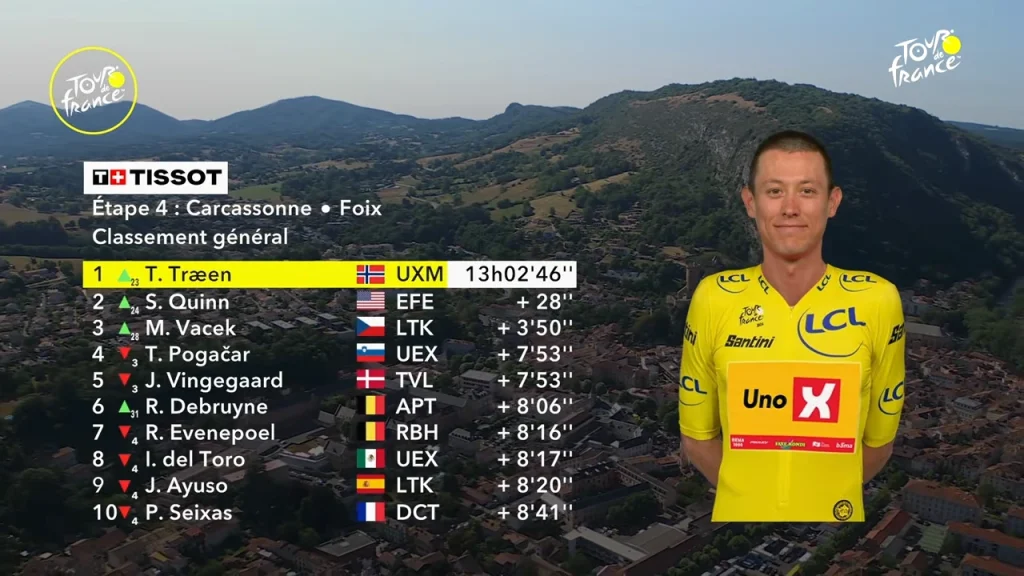
Stage 4 didn’t just hand out a stage win — it emptied the yellow jersey out of UAE’s hands entirely. A 34-man breakaway went clear early and nobody chased, so Pogačar simply let it go rather than burn his team in 40°C heat for a jersey he wasn’t defending anyway. Mads Pedersen won the reduced sprint at the front, his first stage win in three years, and picked up the green jersey lead in the same move. Torstein Træen crossed with the break and inherited yellow, a first for Uno-X Mobility. Pogačar and Vingegaard rolled in together 13 minutes down, still level with each other on time. Nobody lost the race yesterday. Several riders just stopped pretending to defend a jersey that wasn’t worth the effort yet.
Stage 5 is where that patience should finally pay off for someone. Lannemezan to Pau is the shortest road stage of the week, and after four days of mountains, heat, and one enormous breakaway, it’s built for a genuine bunch sprint, the first of the race. The finish won’t come easy: a cluster of short, punchy ramps outside Vic-en-Bigorre will thin the field before the last flat run to the line, and any sprinter who’s spent more than they should have already this week will feel it there. Pedersen arrives defending green. Philippen, Merlier, Girmay, and Kooij all arrive with something to prove.
TL;DR
- Stage 5 is a 158.3 km flat stage on July 8 from Lannemezan to Pau — start 14:05 CEST, expected finish 17:37–17:45 CEST on the Boulevard de l’Aviation.
- This is the first mass sprint of TdF 2026 — only twice in the last thirty years has the Tour reached Stage 5 without a bunch sprint; 2026 is one of those rare exceptions, making this the day every sprint team has been building toward since Barcelona.
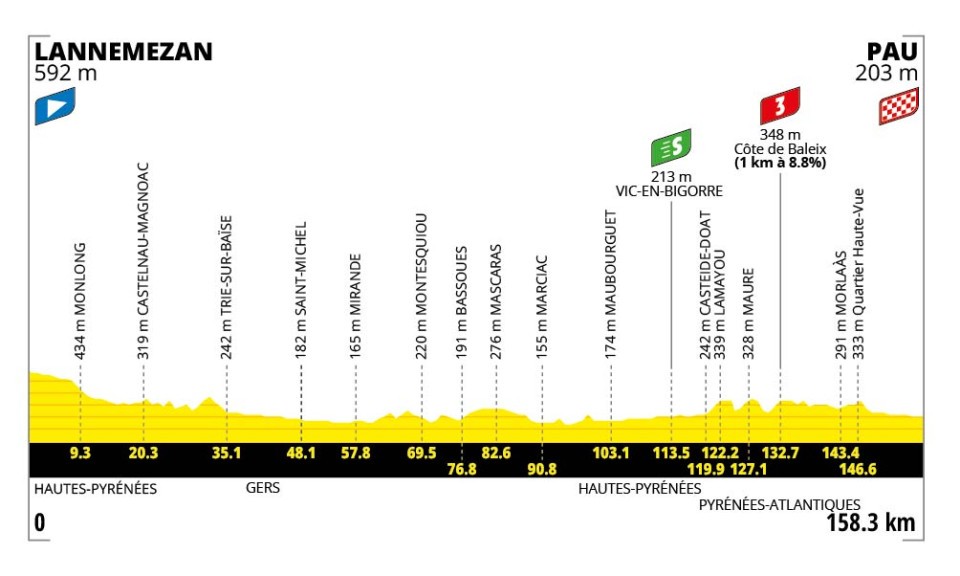
- Three short climbs arrive within 12 km near Vic‑en‑Bigorre — Côte de Casteide-Doat (1.5 km, 5.1%), Côte de Flancart (1 km, 6.4%), and Côte de Baleix (1 km, 8.8%) — enough to disrupt leadout trains, not enough to eliminate pure sprinters with any climbing ability.
- Pau is the Tour’s third-most visited city, hosting the race since 1930. Jasper Philipsen won the last Tour sprint here in 2024. The city’s Tour des Géants open-air museum, the Château de Pau birthplace of Henri IV, and the Boulevard des Pyrénées panoramic view make Stage 5 the Tour’s richest cultural stop outside Barcelona.
- Stage 5 and Stage 6 both use Pau — the sprint finish on July 8 and the Tourmalet queen stage start on July 9 are both in the same city. This is the only Tour stage that shares its finish city with the next morning’s departure.
Tour de France 2026 Stage 5 is a 158.3 km flat stage from Lannemezan to Pau on Wednesday, July 8, the first mass sprint opportunity of the 113th edition. Riders start from the plateau town of Lannemezan in the Hautes-Pyrénées, descend into the Valley of the Gers, roll northwest through the flat agricultural plains of Gascony, hit three short climbs near Vic-en-Bigorre, and finish in a mass sprint on the Boulevard de l’Aviation in Pau.
Total elevation gain: 1,883 metres, the lowest of any stage in the Tour’s opening five days. Pau is hosting the Tour for the 64th time, more than any French city except Paris and Bordeaux. After four days of team time trial, Montjuïc circuits, Pyrenean mountain crossings, and Cathar country breakaways, the sprinters finally get here what they came for. The peloton lines up. The leadout trains fire. Pau is ready.
General Classification Heading Into Stage 5
What Is Tour de France 2026 Stage 5?
Tour de France 2026 Stage 5 is the first flat stage of the 113th edition, a 158 km road race from Lannemezan to Pau on Wednesday, July 8, expected to finish in a mass sprint on the Boulevard de l’Aviation. After five days of technical demands including a team time trial, two urban climbing circuits, a Pyrenean mountain crossing, and a Cathar country breakaway stage, Stage 5 is the Tour’s first genuine opportunity for the pure sprint specialists who have been nursing their form through the opening week.
The stage exists for a specific structural reason: it is the recovery buffer between Stage 4’s punchy Ariège hills and Stage 6’s full Pyrenean queen stage, which includes the Col du Tourmalet at 2,115 metres. GC teams ride conservatively. Sprint teams race with everything they have. And Pau, cycling’s most beloved non-mountain finish town, receives the Tour for the 64th time.
Only twice in the last three decades, in 2015 and 1992, has the Tour reached Stage 5 without a bunch sprint. The 2026 edition joins that rare group, making the Stage 5 sprint in Pau the most anticipated mass finish of the Tour’s opening week.
TDF Stage 5 Date, Distance, and Start Times: July 8, 2026
Stage 5 departs Lannemezan at 14:05 CEST on Wednesday, July 8. The publicity caravan leaves at 11:50 CEST, arriving in Pau approximately three hours before the riders. Expected finish time on the Boulevard de l’Aviation: 17:37–17:45 CEST at 47 km/h average pace. For UK viewers: 13:05 BST start, finish approximately 16:37–16:45 BST on Eurosport and ITV Sport. US viewers: 08:05 EDT and 05:05 PDT. The intermediate sprint at Vic-en-Bigorre (km 113.5) passes at approximately 16:39–16:46 CEST, a useful viewer checkpoint indicating roughly 45 minutes of racing remain.
Sprint stages run to tighter time predictions than mountain stages. At 47 km/h average, the 26 km from Baleix to the finish line takes approximately 33 minutes after the last climb at ~17:04 CEST. The Boulevard de l’Aviation finish is expected between 17:37 and 17:45 CEST.
Tour de France 2026 Stage 5 Route: Full Lannemezan to Pau Course Guide
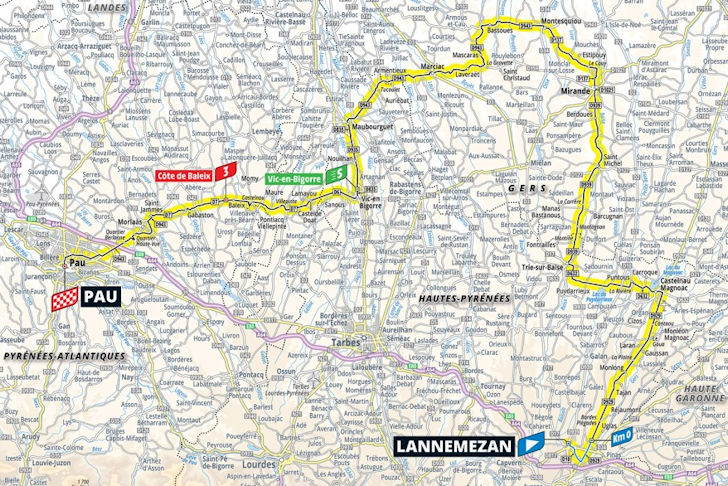
Stage 5 divides into two distinct sections. The first 113 km from Lannemezan through the Valley of the Gers to Vic-en-Bigorre is flat to gently rolling, a recovery and positioning stretch where sprint teams manage their protected riders, and the peloton moves as a controlled unit. The final 45 km from Vic-en-Bigorre to Pau introduces three short climbs, an intermediate sprint, and the long Boulevard de l’Aviation run-in where the day’s real racing begins.
The Opening Flat: Lannemezan and the Valley of the Gers
Lannemezan sits on a flat-topped plateau at approximately 600–650 metres altitude in the Hautes-Pyrénées, the highest point of Stage 5’s entire course. The town of approximately 6,000 people is known locally as the “plateau of the sources”: the Gers, Neste, Baïse, and Save rivers all begin their courses here, draining the Pyrenean snowmelt northwest toward the Atlantic plains of Gascony. Lannemezan marks the geographical transition between the mountains and the plain, the exact boundary where Pyrenean geology meets the agricultural lowlands of southwestern France.
The stage descends almost immediately from the plateau and enters the Valley of the Gers, the broad agricultural corridor running northwest through Gascony. For the next 113 kilometres, the road is flat to gently rolling, crossing small Gascon towns on arrow-straight departmental roads lined with maize fields, sunflower crops, and the occasional bastide village. The Pyrenees remain visible to the south as a long blue wall, the same mountains the riders spent three days crossing, now a backdrop rather than an obstacle.
In the Gers valley, the peloton moves at 44–48 km/h in a compact, controlled group. Sprint teams position their protected riders carefully in the bunch, avoiding the crashes and sidewind splits that flatten plans early. GC leaders sit in the middle of the peloton, sheltered and conserving energy. The race will not be decided here. But position in the closing kilometres is determined by decisions made long before Vic-en-Bigorre.
Marciac: Europe’s Jazz Capital Hidden in Gascony’s Sunflower Fields
At kilometre 90.8, the Tour passes through Marciac, a 13th-century bastide town of approximately 1,300 inhabitants in the heart of Gascony. Marciac’s medieval grid of streets, arcaded central square, and 14th-century church spire make it a typical Gascon bastide in appearance. In cultural terms, it is anything but typical.
Jazz in Marciac, founded in 1978 by a group of local enthusiasts led by Jean-Louis Guilhaumon, has grown from a small village celebration into one of Europe’s most prestigious music festivals, with a main tent seating 10,000, three weeks of programming, and over 200,000 visitors each August. Miles Davis played here. Dizzy Gillespie played here. Herbie Hancock, Diana Krall, Norah Jones, and Wynton Marsalis have all appeared under the Marciac big top. Marsalis has performed at the festival so many times since his debut in 1991 that he has his own statue in the village square, and composed a 13-part suite, The Marciac Suite, as his personal tribute to the town and its people.
The 48th edition of Jazz in Marciac in 2026 runs from July 20 to August 5, with Sting opening the festival on July 20. When the TDF peloton passes through Marciac on July 8, the festival setup is already underway, stages being built, sound equipment arriving, the posters for the August event covering the bastide walls. The riders pass at approximately 16:11 CEST at full racing pace, seeing nothing but the road ahead. The jazz will start in 12 days.
Vic-en-Bigorre and the Three Climbs: The Last Obstacle
Vic-en-Bigorre arrives at km 113.5, a market town of approximately 5,000 in the Hautes-Pyrénées, sitting at the point where the flat Gers plain meets the first undulations of the Pyrenean foothills. The intermediate sprint is held here. For the sprint contenders sitting quietly in the peloton for 113 km, Vic-en-Bigorre is the moment the day begins.
Within 13 km of Vic-en-Bigorre, three categorised climbs arrive in rapid sequence. The Côte de Casteide-Doat (1.5 km at 5.1%) at km 119.9. The Côte de Flancart (1 km at 6.4%) approximately 2 km later. The Côte de Baleix (1 km at 8.8%) at km 132.7. All three are Category 3. None is long enough to eliminate a pure sprinter with moderate climbing ability. Together they create a 13 km window of disruption that forces sprint teams to work early, disrupts leadout formation, and occasionally provides the opportunity for a puncheur to attack and try to stay away on the 26 km run-in.
The Côte de Baleix is the sharpest at 8.8% — short but steep enough to cause pain for riders who have been sitting protected all day and suddenly face a road that rises sharply. A sprinter who loses contact here faces 26 km of chasing at 50 km/h to rejoin the front group. Most manage it. Some do not.
The 26 km Run-In to Pau: Leadout Train Territory
From Baleix at km 132.7, the road is essentially flat all the way to the Boulevard de l’Aviation. Twenty-six kilometres of open, well-surfaced departmental roads through the gentle outskirts of Pau’s agglomeration. This is where sprint teams take complete control.
The leadout trains, the organised sequences of riders who pace a sprinter through the chaos of the final kilometres, take over from the peloton’s general order. Teams line up on the road, each rider following the wheel in front, the protected sprinter at the back of the train, conserving every joule for the final 200 metres.
The final kilometres into Pau are well known to every sprint team’s directeur sportif. The Boulevard de l’Aviation runs straight and wide into the finish. The last bend arrives at approximately 700 metres from the line. Position at that bend determines everything: a sprinter who enters the final straight in 10th position needs extraordinary power and good fortune to overcome the riders ahead. One who enters in third or fourth, launched by a well-timed leadout, wins.
Tour de France 2026 Stage 5 Elevation Profile: 1,883 Metres and Three Small Bumps
Stage 5’s elevation profile is the most benign of the Tour’s opening five stages, 1,883 metres total, predominantly coming from the Lannemezan plateau start and the gradual rolling of the Gers valley roads, with the three categorised climbs in the final 45 km contributing the only notable gradient changes.
5th Stage’s Three Categorised Climbs: Data Table
| Climb | Category | Length | Avg gradient | Max gradient | Km mark | Dist. from finish |
|---|---|---|---|---|---|---|
| Côte de Casteide-Doat | Cat 3 | 1.5 km | 5.1% | ~7% | km 119.9 | ~38 km |
| Côte de Flancart | Cat 3 | 1.0 km | 6.4% | ~9% | km ~121.9 | ~36 km |
| Côte de Baleix | Cat 3 | 1.0 km | 8.8% | ~10% | km 132.7 | ~26 km |
All three climbs together span approximately 13 km between km 120 and km 133. The Côte de Baleix at 8.8% average is the sharpest categorised climb of Stage 5, sharper than any climb in Stage 4’s Col du Paradis or the lower sections of the Montségur. In isolation, it is nothing. In context, after 132 km of racing, with 26 km flat still ahead, it matters to anyone on the limit of their climbing ability.
Why 1,883 Metres Over 158 km Is a Sprint Stage
For context: Stage 3’s 3,950m over 196 km delivered a high-altitude summit finish at 1,700m. Stage 5’s 1,883m over 158 km, with no summit above 400m and 26 km of flat run-in, is a sprint stage by every definition Grand Tour race directors use. The elevation that does exist in Stage 5 is almost entirely in the descent from Lannemezan’s 600m plateau through the first 20 km of racing. After that descent, the road sits consistently below 250m for the remaining 138 km.
The cumulative elevation context matters for GC teams: across Stages 1–5, riders will have climbed approximately 9,000+ metres total. Stage 5’s flat character is not an accident, it is a deliberate recovery buffer designed to give legs a chance before Stage 6’s Tourmalet.
tdf Stage 5 Sprint Tactics: How the First Mass Finish of TdF 2026 Gets Won
Stage 5 is a sprint stage. The race winner crosses the line at maximum velocity after a 1,400–1,800 watt effort lasting approximately 10–12 seconds from the final 200 metres. Everything before that moment is positioning, energy management, and team tactics designed to deliver the sprinter to that 200m mark with clear road and maximum remaining power.
How a Leadout Train Works: A Primer for New Fans
A leadout train is one of professional road cycling’s most sophisticated tactical formations and one of the least understood by first-time Tour viewers. Here is how it works in plain terms.
In the final 5–10 km of a sprint stage, a sprint team abandons its general placement in the peloton and forms a single-file line at the front. Each rider in the line, the “lead-out riders”, takes a turn at the very front of the race, riding at maximum sustainable pace (typically 50–55 km/h) to discourage rival teams from overtaking and to control the road ahead of their sprinter.
After pulling at the front for 30–60 seconds, each lead-out rider “swings off”, moves to the side of the road, exposing the next rider in the sequence. This continues until the final 200–300 metres, when the last lead-out rider, often the team’s strongest domestique, delivers the sprinter to the moment of maximum tactical advantage: clear road, high speed, and the sprint beginning from the correct lane position.
The sprinter, who has been sitting at the back of this train the entire time, saves their explosive power entirely for this moment. From zero to maximum in three pedal strokes. Peak output: 1,400–1,800 watts for a male WorldTour sprinter over 10 seconds, roughly six to eight times the average human’s maximum exertion capacity. The winner is often the rider with the best positioning entering the final bend, not necessarily the one with the highest raw peak power.
On the Boulevard de l’Aviation in Pau, with its straight final kilometre, positioning at the 700m mark is the critical variable.
The Green Jersey Picture: Stage 5 and the Points Classification The
5th stage is the most important single day for the green jersey, the maillot vert awarded to the leader of the points classification, in the Tour’s opening week. After four stages with minimal sprint points (Stage 1’s TTT, Stage 2’s Montjuïc circuit finish, Stage 3’s mountain summit, Stage 4’s breakaway finish), the Stage 5 mass sprint is the first time the green jersey competition becomes genuinely competitive.
The stage winner in Pau receives 50 points toward the green jersey. Second place earns 30, third earns 20, with points awarded down to 15th place. The intermediate sprint at Vic-en-Bigorre offers a further 20 points to the winner, 14 to second, and 8 to third. A sprinter who wins the stage in Pau and takes the intermediate sprint at Vic-en-Bigorre accumulates 70 classification points from Stage 5 alone, more than can be earned across Stages 1–4 combined for a typical sprint-capable rider.
The green jersey battle in the 2026 Tour has a defined shape by Stage 5’s end. Any sprinter who wins or podiums in Pau holds a structural points advantage that survives through the first Pyrenean week and carries into the second week’s flat stages (Stages 7, 8, 11, 12).
TDF Stage 5 Favourites: Who Wins the Sprint in Pau?
Tour de France 2026 Stage 5 has a clear sprint favourite hierarchy that reflects the same order of probability as most pre-mountain Tour sprints.
Jasper Philipsen (Alpecin-Premier Tech) arrives as the defending Pau victor, his 2024 sprint on this same boulevard confirmed him as the fastest finisher in the peloton on flat roads. His team’s lead-out infrastructure, built around Mathieu van der Poel’s road reading ability and dedicated lead-out specialists, is among the most polished in the race.
Olav Kooij (Decathlon-CMA CGM) is the fastest pure sprinter in the 2026 peloton in terms of raw sprint power. Young, improving rapidly, and with a team building specifically around him after his 2025 Vuelta stage victories.
Biniam Girmay (NSN Cycling Team) brings Tour de France sprint experience and the ability to handle moderate climbing, the three Casteide-Baleix climbs suit a rider with his combined sprint-climbing profile better than they suit a heavier pure sprinter.
Tim Merlier (Soudal Quick-Step), Mads Pedersen (Lidl-Trek), and Dylan Groenewegen (Jayco-AlUla) complete the tier of riders capable of winning if their leadout delivery is clean and the right wheels are in the right position at 200 metres.
The wild card: a reduced sprint from a peloton that does not fully regroup after the Côte de Baleix. If the sprint teams cannot bring back all dropped riders before Pau, a puncheur-sprinter like Arnaud De Lie (Lotto-Dstny) can win from a group of 30–40 rather than a full mass finish.
Pau: The Tour’s Third-Most Visited City and the Capital of Béarn
Pau is where the Tour de France comes to breathe. After four days of Mediterranean climates, high mountains, and medieval Cathar country, the peloton arrives in a civilised, prosperous city set on a terrace above the Gave de Pau river with one of the most spectacular views in France , the Pyrenean chain spread across the southern horizon from the Boulevard des Pyrénées, so clear on a July afternoon that the riders can see Stage 6’s mountains from the Stage 5 finish line.
Pau is the capital of the Pyrénées-Atlantiques department and the cultural capital of the Béarn, the former independent viscountcy and kingdom that controlled these Pyrenean approaches for centuries before formal French annexation in 1620. The city sits at approximately 200 metres altitude, elevated above the Gave de Pau river on a limestone terrace, with the southern face of the escarpment giving the Boulevard des Pyrénées its extraordinary panoramic position. On a clear July day, the Pic du Midi de Bigorre (2,877m) is visible to the east; the Pic d’Ossau and the Pyrenean crest toward Spain spreads to the southwest.
After only Paris and Bordeaux, Pau is the third city in Tour de France history to have hosted the race most often. 5th Stage marks the 64th Tour finish in the city, with the first recorded in 1930. That year, Italian Alfredo Binda was the first Tour de France stage winner in Pau, on the same day that Frenchman André Leducq won the yellow jersey for good. Bernard Hinault won stages here. Fausto Coppi raced these roads. Every great name in the Tour’s 113-year history has passed through Pau at some point and the city has built its cycling identity around that fact with characteristic Béarnaise solidity.
The Tour des Géants: Pau’s Open-Air Cycling Museum
In 2019, for the centenary of the yellow jersey, Pau inaugurated the Tour des Géants, an open-air museum in the Bois Louis park, built on the site of the city’s former velodrome. Yellow totems, each representing a Tour de France winner, line the park’s paths in the Bois Louis, a green space near the Philippe Tissié stadium. Eddy Merckx’s totem stands next to Bernard Hinault’s. Greg LeMond, Miguel Induráin, Alberto Contador, Lance Armstrong, the whole complicated, glorious, controversial history of the race in yellow plastic columns in a public park, free to visit, ten minutes’ walk from the Stage 5 finish line.
The museum is unique in the cycling world: a permanent, free, outdoor celebration of the Tour’s history in the city that has watched it pass 75 times. For anyone arriving in Pau on July 7 or the morning of July 8 before Stage 5’s 14:05 start, the Tour des Géants is the correct first stop. Allow 45 minutes.
The Château de Pau: Where Henri IV Was Born
A 10-minute walk from the Boulevard de l’Aviation finish, the Château de Pau sits on a terrace above the city on what remains of its original 11th-century defensive position. The Viscounts of Béarn built the first fortification here above the ford of the Gave de Pau. The Counts of Foix, who feature prominently in Stage 4’s Ariège history, reinforced and extended it in the 14th century. In the 16th century, as the seat of the Kings of Navarre, the castle was transformed into a royal residence.
Henri IV of France was born in the Château de Pau on December 13, 1553, the king who ended the French Wars of Religion, issued the Edict of Nantes in 1598, granting religious toleration, and is remembered in France with particular warmth for his supposed wish that every peasant should have “a chicken in their pot” on Sundays. He converted from Protestantism to Catholicism to secure the French throne, generating the famous, and apocryphal, quote “Paris is well worth a mass.” His turtle shell cradle, in which he was rocked as an infant in Béarnaise tradition, is still on display in the château.
The building is now a national museum, open daily except public holidays, with free entry for EU citizens under 26. Henri IV’s tapestries, period furniture, and portraits fill rooms that look unchanged since the 16th century. It is the most historically significant building within walking distance of any Tour de France sprint finish.
The Boulevard des Pyrénées: The Tour’s Most Spectacular Viewpoint
The Boulevard des Pyrénées is a 1.8 km clifftop promenade running along the southern escarpment of Pau’s upper city. The road is named not for its function but for its view: on a clear day, which July in Pau statistically provides most of the time, the entire Pyrenean chain is visible from the boulevard’s balustrade. The Pic du Midi de Bigorre to the east, the Pic d’Ossau and the Cirque de Gavarnie to the southwest, the Spanish border peaks to the south. The mountains where Stage 6 will race tomorrow are visible from the boulevard today.
The Stage 5 finish on the Boulevard de l’Aviation sits one kilometre east of the Boulevard des Pyrénées’ eastern end. After the sprint verdict, walking west along the boulevard in the evening light with the Pyrenees ahead, tomorrow’s mountain visible, today’s race done, is the correct way to end Stage 5 day in Pau.
What to Eat and Drink in Pau on Stage 5 Day
Pau and the Béarn carry one of France’s most distinctive and underappreciated food identities, grounded in the same Pyrenean-Atlantic climate that shaped the landscape the riders crossed in Stage 3.
Poule au pot béarnaise is the defining dish of the region and Pau’s most famous culinary symbol. A whole chicken slow-cooked in a pot with vegetables, bone marrow, and herbs, a dish associated directly with Henri IV, who expressed his wish that every French household should have access to it weekly. Pau’s restaurants serve it in its traditional braised form throughout the year, with the pot liquor drunk separately as a first-course broth before the chicken and vegetables are served. It is unhurried, sustaining, and completely unlike the cassoulet encountered the day before in Carcassonne.
Garbure is the everyday cooking of the Béarn and Gascony, a thick soup of preserved duck, cabbage, white beans, turnips, and vegetables cooked long and slow until the spoon stands up on its own. It is not a refined dish. It is the food of farmers working Pyrenean foothills, and in the right hands, in a Pau restaurant in July, it is deeply satisfying.
Jurançon wine is the discovery that most surprises visitors to Pau. The AOC appellation covers the steep south-facing terraces of the hills immediately south of the city, vineyards visible from the Boulevard des Pyrénées when the stage finishes. Made from Petit Manseng and Gros Manseng grapes, Jurançon comes in two forms: Jurançon sec (dry, mineral, with citrus and floral notes, the aperitif of choice in every Pau restaurant) and Jurançon moelleux (sweet, with apricot and dried fruit character, made from late-harvested Petit Manseng grapes shrivelled by the autumn sun). The moelleux is one of France’s great dessert wines. The sec is one of France’s most underrated whites. A Jurançon sec on the terrace of a Pau restaurant before Stage 5 starts, with the Pyrenees visible to the south, is the exact experience the Tour de France in Pau was designed to produce.
Armagnac, the brandy produced in the Gers department the stage rides through before reaching Pau, is the after-dinner constant. Unlike Cognac, Armagnac is distilled once rather than twice, a process that retains more of the grape’s character and gives the spirit its distinctive earthy, prune, and vanilla profile. The Gers valley, the peloton rides through in the first 100 km of Stage 5 produces the raw materials for France’s oldest brandy appellation.
Lannemezan: The Stage 5 Start City and Its Plateau of the Sources
Lannemezan is a small town of approximately 6,000 people on the flat-topped plateau at 600–650 metres altitude that marks the final gradient of the Pyrenean foothills before the Gascony plain begins. The town is known throughout the Hautes-Pyrénées as the “plateau des sources” — the plateau of the sources — because major rivers including the Gers, the Neste, the Baïse, and the Save all originate from the water table beneath the Lannemezan plateau, fed by Pyrenean snowmelt that percolates through the limestone strata. The town sits at a hydrological crossroads: northeast into the Gers, northwest into the Baïse valley, south into the Neste valley that connects directly to the high Pyrenees.
Lannemezan has appeared in Tour de France history as both a stage start and finish town. The surrounding roads, particularly south through the Neste valley toward the Col d’Aspin, which Stage 6 crosses tomorrow, are well-established training routes for Pyrenean cycling. Local cycling club VC Lannemezan provides the stage start committee. The town’s market hall near the départ area opens early on race day, offering local produce and the particular atmosphere of a small French town that receives the Tour de France as a once-a-generation honour.
Where to Watch Tour de France 2026 Stage 5: Best Spectator Spots
Stage five is the most accessible and logistically straightforward spectating day of the Tour’s first five stages. No mountain passes, no altitude logistics, no road closures starting at 06:00. Urban and suburban roads close in the afternoon, public transport runs normally until race passage, and Pau is a well-equipped city with full Tour de France infrastructure from previous hosting experience. Here is the complete live watching guide for the 2026 edition.
Stage 5 Best Viewing Zones
| Zone | What you see | Access | Best arrival | Crowd level |
|---|---|---|---|---|
| Lannemezan start area | Stage Village, caravane départ, small-town Tour atmosphere | Car or SNCF from Tarbes (25 min) | 12:00 CEST | Moderate |
| Côte de Baleix (km 132.7) | Last and sharpest climb — 8.8%, sprint teams disrupted, race opening up | Car from Pau (30 min) | 16:45 CEST | Low to moderate |
| Pau — final km approach (Morlaàs, km 143) | Leadout trains fully formed, peloton at maximum speed entering the city | Car or bus from Pau centre | 17:10 CEST | High |
| Boulevard de l’Aviation finish | Mass sprint verdict, green jersey picture confirmed, full finish infrastructure | SNCF from Bordeaux, Toulouse, or Paris TGV | 15:30 CEST | Very high |
The Boulevard de l’Aviation finish is the obvious choice for Stage 5 spectatorship. Pau has hosted the Tour 64 times, the infrastructure is established, the crowd knowledge is deep, and the atmosphere at a sprint finish on a straight boulevard with the Pyrenees visible in the background is unlike anything a flat northern stage can offer. Arrive by 15:30 CEST to secure a position on the finish straight.
Getting There: Transport Between Lannemezan and Pau
Pau is exceptionally well-connected for a city of its size. Direct TGV services from Paris Montparnasse (4h15), Bordeaux (1h30), Toulouse (1h15), and Tarbes (15 minutes). Lannemezan is served by SNCF from Pau via Tarbes — approximately 45 minutes total. The practical race-day circuit: take the morning train from Pau to Lannemezan for the Stage Village and caravane start (arriving before 11:50 CEST when the caravan departs), return by early afternoon train to Pau for the Boulevard de l’Aviation sprint finish.
Road closures in Lannemezan begin at approximately 12:00 CEST on July 8. Pau city centre approach roads close progressively from approximately 14:30 CEST, with the final kilometre on the Boulevard de l’Aviation closed from approximately 15:00 CEST. Use the Pau TGV station as your arrival point, a 15-minute walk or quick tram to the finish area.
Where to Stay for Stage 5: Pau Is the Obvious Answer
Pau is the correct base for Stage 5 and the strategically essential base for Stage 6. Stage 5 finishes in Pau. Stage 6 starts from Pau the next morning, the peloton rolls out from the same city for the Tourmalet queen stage on July 9. No other two-day window in the entire Tour offers this efficiency: one hotel, two consecutive racing days in the same location.
Pau’s hotel stock is substantial for its size, but Tour de France demand combined with summer peak season means booking well in advance is non-negotiable. The central Pau area near the train station and the Place de la République offers the best combination of transport access and restaurant proximity. Jurançon (2 km south across the Gave de Pau) and Bizanos (eastern suburb) offer alternatives with easy bus connections to the finish area.
A practical note on Stage 6 morning: the Stage 6 départ is from Pau city centre at approximately 12:30 CEST on July 9. Staying one night in Pau after Stage 5’s finish, watching the sprint, eating a poule au pot at one of the Boulevard des Pyrénées restaurants, waking up with the Pyrenees ahead and Stage 6’s Tourmalet already on the horizon, this is the best two-day Tour de France experience available anywhere in the first week of the 2026 race.
Weather on Stage 5: Pyrenean Views and the Gascon Wind Question
Stage 5 starts at 14:05 CEST in the warmest part of a July afternoon. Lannemezan’s plateau at 600m sits at approximately 24–26°C in early July. Pau at 200m is warmer, typically 27–29°C on a July afternoon, with the thermal mass of the urban area adding a degree or two above the surrounding countryside.
The specific weather risk for Stage 5 is the southwest Atlantic wind that affects the Gers valley in summer. The predominant July wind direction across the Gascon plain runs from the southwest — warm, moisture-laden air from the Bay of Biscay crossing flat terrain before meeting the Pyrenees. On the 113 km section from Lannemezan through the Valley of the Gers, the road runs northwest, putting this southwest wind as a partial crosswind on the open agricultural plains.
At average July wind speeds of 15–20 km/h, crosswind echelon splits in the Gers valley are possible but unlikely, the same wind risk that applied to Stage 4’s plateau section. If the wind strengthens above 25 km/h on the open Gers plain roads, sprint teams will attempt to keep the peloton together at all costs. A crosswind split before Vic-en-Bigorre that strands a top sprinter behind a gap would change the Stage 5 narrative entirely.
The Boulevard de l’Aviation finish in Pau is largely sheltered from wind by the urban setting. The sprint itself will not be significantly affected by weather. The tactical risk is in the first 100 km.
Stage 5 as the Last Rest Before the Tourmalet: How Pau Sets Up Stage 6
Stage 5 is the final recovery window before the Pyrenees deliver their definitive verdict. Stage 6 on July 9 departs from Pau, the same city where Stage 5 finishes the previous evening, and runs 186 km to Gavarnie-Gèdre, including the Col d’Aubisque (2,038m), Col du Tourmalet (2,115m — the highest mountain in the Tour’s Pyrenean itinerary and one of the most iconic climbs in cycling history), and a summit finish in the Cirque de Gavarnie.
GC teams manage Stage 5 with Stage 6 in mind at every moment. Every domestique preserved today is available tomorrow for the Tourmalet. Every GC leader who arrives at the Pau hotel on July 8 with full energy, no crashes, and no unnecessary efforts in the sprint chaos has an extra reserve for the 2,115m col.
The cumulative GC picture entering Stage 6 will show exactly what has happened across the first five days. A rider who managed Stages 1–5 cleanly, no TTT disasters, no Montjuïc gaps, Les Angles controlled, Stage 4 conserved, Stage 5 in the bunch, arrives at the Tourmalet with full teams and maximum tactical latitude. A rider who left time somewhere in the opening week faces Stage 6’s Tourmalet already in deficit, forced into decisions before the optimal moment.
The Tourmalet is not abstract from the Boulevard de l’Aviation. Standing at the Stage 5 finish line in Pau on July 8, the Col du Tourmalet is 75 km to the south. By midday tomorrow it will be under the riders’ wheels.
For the Stage 4 complete guide — Carcassonne to Foix through Cathar Country — see our Tour de France 2026 Stage 4 preview.
Stage 6 — Pau to Gavarnie-Gèdre and the Col du Tourmalet — the Pyrenean queen stage.