Tour de France 2026 — Team Jayco AlUla: Full Riders Breakdown & Complete Guide
This is the complete guide to Team Jayco AlUla at the Tour de France 2026, covering their confirmed 8-rider start list with stage-type role breakdown, Giant Propel, TCR, and Trinity bike specifications with Shimano Dura-Ace Di2 and Cadex wheels, the MAAP electric-green swap-out kit that debuted at Paris Fashion Week, the team’s 15-season backstory from GreenEDGE’s 2012 debut to their current Australian WorldTour institution, and why Michael Matthews’s comeback from two broken wrists is the most compelling individual story in the entire 184-rider peloton.
TL;DR
- Who are the three Australian leaders? Ben O’Connor won on Col de la Loze at the 2025 Tour and arrives with no GC ambitions — pure stage hunting. Michael Matthews returns for his ninth Tour after breaking both wrists in a training crash in March 2026, having also missed the 2025 edition through illness. Luke Plapp won a Giro d’Italia stage in 2025 and is hunting his first Tour win.
- Who’s in the full 8-rider squad? Pascal Ackermann (five Grand Tour stage wins, the sprint reference on flat days), Mauro Schmid (Swiss champion, narrowly lost a stage at the 2025 Tour), Luke Durbridge (road captain, 12th and final Tour before retirement), Kelland O’Brien (Olympic team pursuit gold medallist, Tour debutant), Felix Engelhardt (climber, Tour debutant).
- What is the team’s goal? Stage wins across all 21 days, across all terrain types. Head of Performance Gene Bates: “This line-up has riders capable of competing on every stage over the three weeks, from the flat sprint stages through to the high mountains.”
- What bikes and kit? Giant TCR Advanced SL Disc for climbing, Giant Propel Advanced SL Disc for flat and rolling stages, Giant Trinity Advanced Pro for time trials — all Shimano Dura-Ace Di2 R9270, Cadex 50 Ultra or 65 wheels, 28/30mm tubeless tyres. Special MAAP swap-out kit: purple with electric green accents, limited to 150 sets worldwide, debuted at Paris Fashion Week.
What Is Team Jayco AlUla? Australia’s 15-Season WorldTour Institution
There is only one Australian WorldTour team. There has only ever been one. And in 2026, it turns 15.
Andrew Ryan and Shayne Bannan launched it in Adelaide on 17 January 2011 under the name GreenEDGE Cycling — the first fully Australian-registered WorldTour licence in professional cycling history. Neil Stephens and Matt White joined as founding sport directors. The stated ambition on day one: compete on the cobbles, in the sprints, and at the Grand Tours, simultaneously, as an Australian team at the sport’s highest level.
That ambition has been tested more than once across fifteen years. The team has raced under six names — GreenEDGE, Orica-GreenEDGE, Orica-Scott, Mitchelton-Scott, BikeExchange-Jayco, Team Jayco AlUla — through sponsorship transitions that would have ended most squads. Financial guarantees threatened their WorldTour licence in a recent off-season. Owner Gerry Ryan secured continuity. The Australian licence never went dark.
In 2026, that same licence fields eight riders at the Tour de France for the 15th consecutive year. General Manager Brent Copeland captures the moment plainly: “As we hit our 15th season, we want to keep pushing the boundaries of what a professional cycling team looks like.” That statement applies as much to the MAAP kit debuting at Paris Fashion Week as to the racing strategy built around three former Tour stage winners.
The operational structure has also evolved. The team’s headquarters remains in Australia, with a European base in Varese, northern Italy, and a training hub in Denia on Spain’s Costa Blanca. The Giant partnership, running since the BikeExchange days, through 2027 minimum, gives the team a fully integrated equipment ecosystem that only Specialised rivals in the WorldTour for supply depth: frames, components, wheels, tyres, and computers, all from the same house. Their estimated 2026 budget sits at €20–22 million, mid-pack among WorldTeams, roughly half the firepower of UAE Team Emirates-XRG and Visma-Lease a Bike.
What Jayco AlUla has always done with mid-tier resources is build squads that are harder to predict than their budget suggests. In 2026, with three former Tour stage winners and two debutants whose profiles cover terrain neither Matthews nor O’Connor handles, this is the most versatile Tour squad they have assembled in years.
Team Jayco AlUla 2026 Tour de France Start List — All 8 Riders
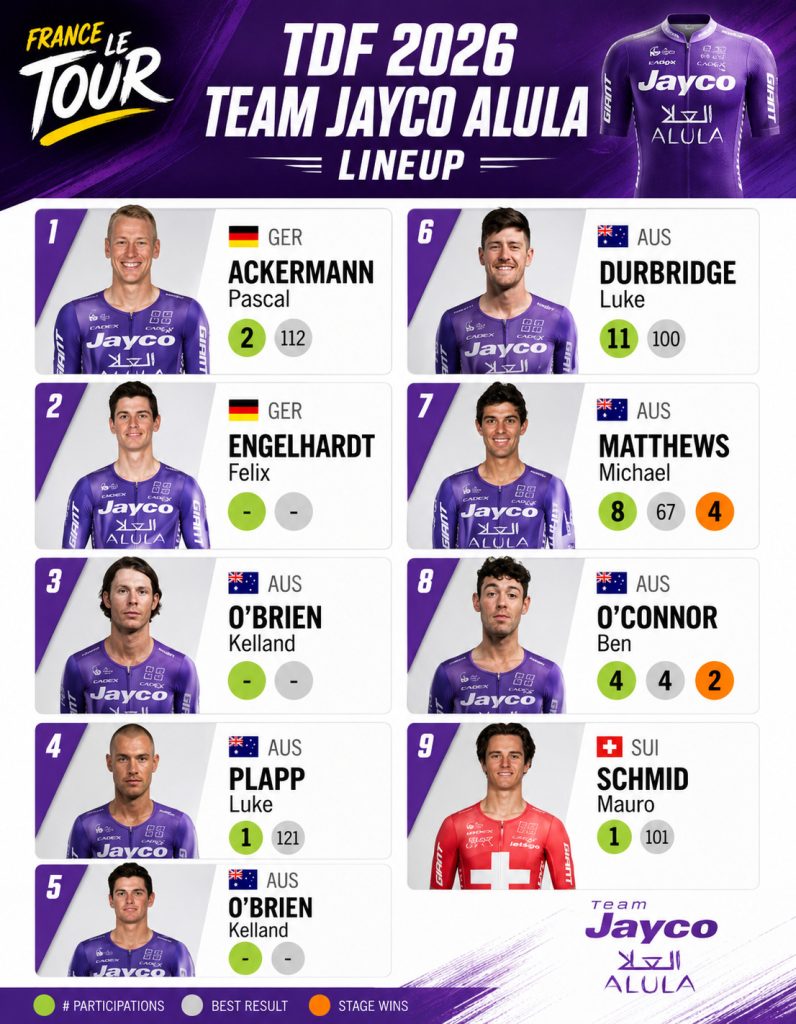
Jayco AlUla announced their Tour roster on June 26, the fourth team to confirm their lineup. Five Australians, two Germans, one Swiss. Three riders who have won Tour de France stages before. Two riders who have never started the race. One rider starting it for the last time.
Team Jayco AlUla — Rider by Rider
| Rider | Nat | Age | Role | Primary stage territory |
|---|---|---|---|---|
| Ben O’Connor | 🇦🇺 | 30 | Mountain Stage Hunter | Summit finishes · Mountain breakaways |
| Michael Matthews | 🇦🇺 | 35 | Puncheur / Hilly Sprint Hunter | Hilly reduced group finishes |
| Luke Plapp | 🇦🇺 | 24 | All-rounder / Breakaway / TT | Mountains · TTs · Breakaways |
| Pascal Ackermann | 🇩🇪 | 30 | Sprinter | Flat bunch sprints |
| Mauro Schmid | 🇨🇭 | 25 | Breakaway / Puncheur | Medium mountain stages · Hilly breakaways |
| Luke Durbridge | 🇦🇺 | 35 | Road Captain / TTT Specialist | Stage 1 TTT · Flat stages |
| Kelland O’Brien | 🇦🇺 | 26 | TTT Power / Leadout | Stage 1 TTT · Flat stages |
| Felix Engelhardt | 🇩🇪 | 23 | Climber / Reduced Group Finisher | Mountain stages · High altitude support |
Tour de France History by Rider
| Rider | Previous Tours | Tour Stage Wins | Best Tour Result |
|---|---|---|---|
| Michael Matthews | 8 | 4 | Green jersey 2017 |
| Ben O’Connor | 4 | 2 | 4th overall 2021 |
| Luke Durbridge | 11 | 0 | Domestique career |
| Pascal Ackermann | 2 | 0 | 4th Stage 8, 2025 |
| Luke Plapp | 1 | 0 | Tour debut 2025 |
| Mauro Schmid | 1 | 0 | 101st overall 2025 |
| Kelland O’Brien | 0 | 0 | Debutant |
| Felix Engelhardt | 0 | 0 | Debutant |
Michael Matthews — The Comeback Story of the Entire 2026 Tour
In March 2026, Michael Matthews fractured both wrists in a training crash. He missed the start of the 2025 Tour through illness. At 35, with two consecutive seasons of adversity, making the 2026 Tour de France start in Barcelona should not have been possible.
It is possible.
His record makes the selection automatic once he proved fitness: four Tour stage wins, the 2017 green points jersey, Milan-Sanremo 2017, Amstel Gold Race 2016, the 2022 World Championship road race. Nine Tour starts before this one. He knows this race from inside. He knows where the hilly stages break apart, where the sprint trains shatter on a false flat, and where the fastest puncheur wins rather than the fastest pure sprinter. That knowledge is what the selection is buying — not a rider at peak physical condition, but a rider at peak tactical intelligence, fighting to prove the physical condition is back.
“After missing last year’s race because of my illness, and then my crash earlier this year, it gives me even more motivation and drive. The Tour is the biggest race of the year. Even though this is my ninth time starting, making the cut is always a huge deal for every rider,” Matthews said.
The specific physiological stakes of bilateral wrist fractures for a Tour cyclist are worth understanding. Wrist strength affects grip force on climbs, brake control on high-speed descents, cockpit power transfer in sprint efforts, and the physical confidence to hold position in a compressed bunch at 60km/h. None of those capabilities are peripheral at the Tour de France. The two Alpe d’Huez descents on Stages 19 and 20 alone, 21 hairpin bends, sometimes in wet conditions, require wrist strength and descending nerve that fractures in March challenge directly. Matthews arriving in Barcelona with those capabilities restored is the individual comeback story no other team in this race carries.
Ben O’Connor — Stage Hunter, Not GC Contender
Ben O’Connor knows two things about himself at the Tour de France. He is not a realistic yellow jersey contender. He is one of the best opportunistic attackers at the race when the mountains arrive and the GC leaders are focused on each other.
His 2021 Tour fourth place overall was produced by exactly that calculus, a long solo attack on Stage 9 into Tignes that built a gap the peloton calculated was safe to give, then wasn’t. His two Tour stage wins came from the same instinct: identify the right moment, create the move before the GC teams respond, and stay away. His 2025 queen stage win on Col de la Loze repeated the formula on the hardest finish of that edition.
“Ben returns after winning a stage last year,” Mat Hayman said. He did not say O’Connor returns for GC. The distinction is deliberate. In 2026, with no GC ambitions, O’Connor has full tactical freedom across every mountain stage, the freedom to attack from distance rather than defending a GC position, to gamble on stages where a pure stage hunter outscores a GC rider playing it safe. The back-to-back Alpe d’Huez stages on days 19 and 20 are his primary targets. So is every hilly transition stage in weeks one and two where a small group can form, survive, and arrive at the line with enough gap to hold.
His 2026 Giro d’Italia produced 16th overall, not the number that targets yellow, but not a form crisis either. He raced the Giro as a preparation exercise, not a leadership mission. The Tour is where the motivation returns to its peak.
Luke Plapp — The All-Rounder Who Can Win Three Different Ways
Luke Plapp is 24 and has already won a Grand Tour stage, Stage 16 at the 2025 Giro d’Italia, from a breakaway. He also finished fifth in the 2025 Tour Stage 16 individual time trial to Peyragudes. Those two results, a breakaway mountain stage win and a top-5 TT result, are the profile of a rider who can genuinely contribute on multiple terrain types rather than being reserved for one specific stage category.
“Altitude camp with the boys went amazing. We are super motivated and excited to start this TTT project at the Tour Auvergne-Rhône-Alpes and building towards the Tour! It’s the best discipline in cycling and one that the team has a rich history in!” he said before the Tour Auvergne-Rhône-Alpes dress rehearsal. His obsession with the team time trial format is genuine, he tracked the TTT preparation specifically as a pre-Tour building block, not just a box to tick.
Sports director Mat Hayman added: “Plapp’s won a stage in the Giro and would love to add one in the Tour de France.” The target is singular and clear, a first Tour stage win. The route gives him three realistic pathways to get there: Stage 1 TTT where his individual contribution could produce the day’s best team time, a breakaway stage in the mountains following the Giro template, or a good individual TT result on Stage 16 near Lake Geneva.
Pascal Ackermann — Five Grand Tour Wins, Still Waiting on the Tour
Pascal Ackermann has claimed three stages at the Giro d’Italia, the ciclamino points jersey, two stages at the Vuelta a España. Five Grand Tour stage wins total, spread across his career. He has never won a Tour de France stage. His best result at the race is a fourth place on Stage 8 in 2025.
That gap, between his Grand Tour record elsewhere and his Tour de France record specifically, is what the 2026 campaign is designed to close. The Tour’s flat stages suit his profile: a pure sprinter with enough tactical intelligence to position himself without a dedicated eight-rider lead-out train around him. Mat Hayman’s framing is simple: “We have Pascal for the sprints.” Six to seven genuine flat bunch sprint stages across 21 days. Any one of them is his.
Mauro Schmid — The Swiss Champion Who Almost Won Last Year
Mauro Schmid finished second on Stage 11 of the 2025 Tour de France, beaten by Jonas Abrahamsen of Uno-X Mobility in a stage that came down to a sprint between two breakaway riders. How close is second in that context? The difference between a stage win and a stage loss in a two-up sprint is a bike length and a tactical read in the final 200 metres.
Mat Hayman left the jersey question deliberately open before the Tour: “It’s yet to be seen whether he will be back in his Swiss champions colours or maybe he’s flying under the radar this year!” The choice between racing in the Swiss national champion’s jersey, white with a red cross, or reverting to standard Jayco AlUla purple is a genuine tactical decision. A distinctive jersey marks you as a threat. Standard team colours provide anonymity. For a rider whose primary value is breakaway ambush, that choice matters.
Luke Durbridge — Twelve Tours, One Final Race
Luke Durbridge is making his 12th Tour de France. In January, he retires.
Known as “Turbo Durbo” across a career that spans the GreenEDGE founding era to the current squad, his first Tour was in 2013, back when the team was still finding its identity at the sport’s highest level. His role has evolved from a rider who won the opening prologue of the 2012 Critérium du Dauphiné into the team’s most trusted road captain and time trial specialist.
“Luke Durbridge will be returning for his 12th Tour, a real stalwart of the team and someone we can always rely on,” Hayman said. That reliability is what twelve Tours builds, the ability to make the right decision in the final kilometre of a stage that determines whether the sprint train is positioned or fractured, whether the GC rider is protected or exposed, whether the team’s stage-win opportunity is maximised or missed. Durbridge brings all of that experience to his farewell race.
His Stage 1 TTT contribution in Barcelona is also specific: alongside O’Brien’s Olympic power, Plapp’s TT obsession, and Durbridge’s decade of time trial pedigree, Jayco AlUla may field the strongest TTT sub-group of any stage-hunting squad at this Tour.
Kelland O’Brien — Olympic Gold on the Road
Kelland O’Brien won Olympic gold in the team pursuit at the 2024 Paris Olympics. That event, four riders on a track, four kilometres of raw endurance power, timed to the thousandth of a second, is the purest expression of sustained power output in cycling. His transition to road brings that track engine to a race format where sustained output over 200km matters as much as the final kilometre sprint.
At the Tour, his primary value is the Stage 1 team time trial — 19.7km in Barcelona, where individual times count. In a race that separates O’Brien’s raw wattage from Ackermann’s sprint mechanics, O’Brien delivers for the opening stage. His leadout capabilities on flat road stages provide additional flat-stage value that supplements Ackermann’s finishing kick.
“It’s really exciting to have Kell and Felix at their first Tour de France. It’s a huge step in their careers,” Hayman said. The scale of that step, Tour debut at the world’s most followed race, is not lost on either debutant. What O’Brien brings that veterans often cannot is the uncomplicated motivation of a first attempt.
Felix Engelhardt — The German Debutant Built for the Alps
Felix Engelhardt is 23, German, and arrives at his first Tour de France after showcasing climbing versatility at the Tour Auvergne-Rhône-Alpes and demonstrating a turn of speed in reduced groups. His profile sits between a pure climber and a reduced-group sprint finisher, the kind of rider who becomes dangerous on mountain stages where the GC teams have burned their domestiques before the final 5km.
His specific value in this squad emerges on the mountain stages where O’Connor and Plapp are the primary attacking options. Engelhardt provides depth, a third offensive card on days where Jayco AlUla wants to apply pressure from multiple directions simultaneously rather than committing all resources to one attack. At 23, making a Tour debut on a route with 54,540 metres of climbing is not a gentle introduction. It is a baptism.
The Racing Plan — Stage Wins Across All 21 Days
The mandate Gene Bates set, riders capable of competing on every stage, from flat sprints to high mountains, is not rhetorical. It maps directly to eight riders with eight distinct capabilities covering the full terrain spectrum of 21 stages.
The structure works as follows: Ackermann is the reference for flat bunch sprint days. Matthews and Schmid are the reference on hilly reduced-group sprint finishes. O’Connor is the reference on summit finish stages and mountain breakaways. Plapp covers breakaways, TTs, and mountain stages interchangeably. Engelhardt provides mountain depth. O’Brien and Durbridge cover TTT power on Stage 1 and road captain function through the three weeks.
Mat Hayman described the logic plainly: “We have Pascal for the sprints and several very solid riders to chase opportunities in medium- and high-mountain stages.”
Stage 1 TTT in Barcelona is Jayco AlUla’s opening statement. With three legitimate time trial specialists, Durbridge (TTT career specialist), Plapp (TTT-obsessed, altitude camp preparation specific to Barcelona), and O’Brien (Olympic team pursuit power), plus Matthews and O’Connor contributing solid TTT output, the team’s Stage 1 result could establish Plapp inside the top five individually before any mountain has been climbed.
Flat sprint stages (6-7 across the Tour) belong to Ackermann. Leadout support from O’Brien on the key flat days. The goal is simple: finally get Ackermann to step from fourth place to first place at the Tour, a result his Grand Tour record elsewhere has shown is within his capability.
Hilly reduced-group finishes (3-4 stages) are Matthews’s primary target. The stages where GC teams control the race through the mountain sections, the sprint trains fracture on the climbs, and the fastest puncheur in the final 500 metres wins. Matthews has won four Tour stages this way. The wrists may have healed. The instinct never left.
Mountain stages and breakaways (5-6 stages) are where the race gets interesting for this team. O’Connor on summit finishes. Plapp and Schmid in medium-mountain breakaways. Engelhardt as the surprise card when the final 10km of a mountain stage produces a small group that nobody expects to include a Jayco AlUla rider.
Stages 19 and 20 — the back-to-back Alpe d’Huez are O’Connor’s most significant opportunities. He does not need to outsprint Pogačar or Vingegaard. He needs to attack from a group of 20 riders at 7km to go on a summit where chaos is guaranteed, and stay away. He has done it before. He has done it on harder terrain.
The Matthews Comeback — What Two Broken Wrists Actually Mean for a Tour Cyclist
The headline, two broken wrists in March, Tour de France start in July, deserves the context behind it.
Wrist fractures in a road cyclist carry consequences that leg injuries or collarbone fractures do not. Grip force on climbs, the ability to maintain bar contact and leverage position under sustained high wattage, depends on wrist stability. Brake control on high-speed Tour descents, including the two Alpe d’Huez descents on Stages 19 and 20, sometimes in wet conditions on a gradient of up to 13%, requires both wrist strength and the psychological confidence to commit weight to the front wheel without hesitation. Power transfer in sprint efforts runs through the cockpit and into the bars, a compromise in wrist strength changes the rider’s ability to hold position when accelerating from depth.
Matthews fractured both. Not one, both. Sixteen weeks before the biggest race of his season.
“It hasn’t been easy,” he said before the Tour Auvergne-Rhône-Alpes, confirming that recovery was his primary concern through April and May. He made the Tour Auvergne-Rhône-Alpes start, his return to racing. He made the Tour de France start. The progression required not just physical healing but the reconstruction of confidence that a crash at training speed removes alongside the bone damage.
What restores that confidence is racing. Descending in peloton conditions. Sprinting in a field that includes physical contact. Arriving at the Tour de France having done those things successfully is the evidence, not the medical report.
“After missing last year’s race because of my illness, and then my crash earlier this year, it gives me even more motivation and drive. The Tour is the biggest race of the year. Even though this is my ninth time starting, making the cut is always a huge deal for every rider,” Matthews said.
Nine Tours. Four stage wins. One green jersey. Two consecutive seasons of adversity. The motivation arriving in Barcelona on July 4 is not manufactured. It is accumulated. Stage hunters with that accumulation behind them are the most dangerous riders in the peloton, not because they are at peak form, but because they have nothing to protect and everything to prove.
The MAAP Kit — Purple, Electric Green, and a Paris Fashion Week Debut
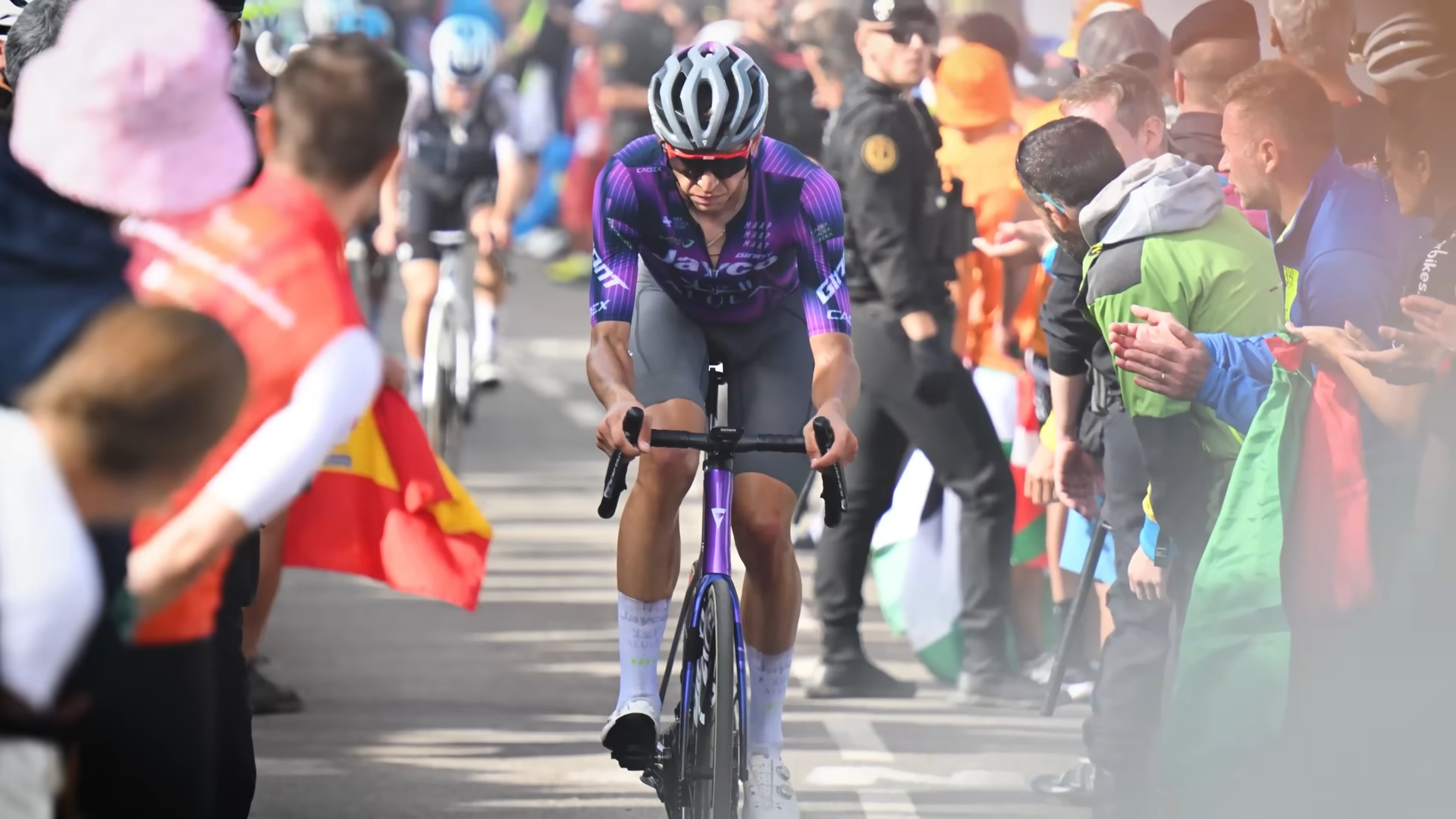
Team Jayco AlUla’s standard 2026 kit, a deep purple base unveiled in January at the Tour Down Under, MAAP’s third year with the team, is already among the most distinctive in the WorldTour. The swap-out Tour de France kit pushes that further.
Electric green accents on purple. Purple flames cutting across the design. The jersey that will line up in Barcelona on July 4 was shown first not at a team press conference but at a Paris Fashion Week installation, HYPERPERFORMANCE, running June 26–28 at 36 Rue Étienne Marcel in Paris, three days before the race starts.
MAAP’s chief creative officer Misha Glisovic explained the philosophy: “In professional cycling, you’ll often only see change when a rule enforces it. Our goal was to turn that on its head and bring a fresh energy to the peloton through a release that felt unexpected and exclusive.”
There is no UCI rule requiring a swap-out kit. No mandatory change. No commercial obligation triggering a different design for the Tour. Jayco AlUla and MAAP chose to produce one anyway, specifically to create visual disruption in a peloton where team kits rarely change during the season and the surprise itself becomes the story.
HYPERPERFORMANCE’s stated aim was to explore “the intersection of WorldTour performance, material innovation and contemporary design” — “bringing elite cycling technology into a cultural setting rarely occupied by professional sport.” Cycling kits have always been technical objects. MAAP has positioned this one also as a cultural object. Paris Fashion Week, alongside Louis Vuitton’s Pinarello Dogma F collaboration and Colnago’s La Scala C72 launch, is how the sport’s equipment makers are signalling that professional cycling’s aesthetics have arrived in rooms where they were previously absent.
The electric green is not arbitrary. It creates maximum television visibility, a distinctive accent in a compressed sprint bunch where individual riders are distinguished by color in a three-second broadcast cut. It also creates social media thumbnails where the jersey reads as immediately identifiable. That is a media strategy embedded in the design brief.
Production: 150 sets worldwide. The scarcity is not marketing theatre. It is the mechanism that makes the shirt a collector’s object rather than a mass-market product, while the riders wear it at maximum broadcast exposure across 21 Tour stages.
The MAAP x Jayco AlUla 2026 Tour de France swap-out jersey — limited to 150 sets globally — is available via MAAP’s official website.
What Bikes Does Team Jayco AlUla Ride at the 2026 Tour de France?
Giant has been the team’s bike supplier since the BikeExchange days. The 2026 partnership runs through 2027 minimum. At the Tour de France, three models rotate depending on stage terrain, the choice is not preference, it is data-driven by gradient profiles, expected bunch speed, and each rider’s optimal power-to-weight tradeoff on the day’s specific parcours.
Giant TCR Advanced SL Disc — The Climbing Platform
The TCR Advanced SL Disc is the mountain stage bike. Sub-6.8 kg in race trim, sitting at the UCI minimum weight threshold, meaning the team arrives at the scale without adding ballast. For O’Connor on summit finishes and Plapp in mountain breakaways, the frame combines low weight with the torsional stiffness required for sustained high-wattage climbing. The geometry is all-rounder rather than pure climber, the handling on technical Tour descents matters as much as the ascending weight savings, and on a route with two Alpe d’Huez stages involving the Col de Sarenne descent, that distinction is not academic.
Giant Propel Advanced SL Disc — The Aero Sprint Machine
The Propel Advanced SL Disc 4th generation comes in at 6.56 kg in top trim, heavier than the TCR, but with significantly superior aerodynamic returns above 45km/h where bunch speeds on flat stages require aerodynamic advantage over weight advantage. Shimano Dura-Ace Di2 12-speed with custom shifting maps tailored specifically for the team’s sprint scenarios — Ackermann’s sprint gear sequence is not the same as O’Brien’s leadout sequence. Cadex wheels in 42mm, 50mm, or 65mm profiles by stage: shallower for rolling terrain with crosswind exposure, deeper for fully flat high-speed days. Hubs with ceramic bearings for minimum rotational resistance across three hours of bunch racing before a sprint finish.
Giant Trinity Advanced Pro — The Barcelona Stage 1 Machine
The Trinity Advanced Pro is purpose-built for the two time trial stages: Stage 1’s 19.7km team time trial in Barcelona where individual times count, and Stage 16’s 26km individual TT near Lake Geneva in week three. For Jayco AlUla, those two stages are not GC opportunities; they are damage limitation for the GC positions of O’Connor and Plapp, and a genuine platform for Plapp himself to bank individual time in the Stage 16 standings.
Full Component Specification
Consistent across all three platforms and all eight riders:
- Groupset: Shimano Dura-Ace Di2 R9270 12-speed wireless electronic
- Power meters: Shimano Dura-Ace (integrated into crankset)
- Wheels: Cadex 50 Ultra (allround/rolling stages) or Cadex 65 (flat sprint stages) — shallower rim profiles on the TCR for climbing days, deeper profiles on the Propel for sprint days
- Tyres: Cadex Race tubeless, 28mm front and 30mm rear standard specification
- Clothing: MAAP (standard season kit and Tour de France swap-out)
- Helmets: Giant
- Computers: Wahoo (data feeding to team radio tactical decisions in real time)
- Trainers: Elite
The integrated Giant/Cadex supply chain covers frames, components, wheels, tyres, and computers from two brands within the same corporate house. Only MAAP (clothing), Giant-branded helmets, Wahoo computers, and Elite trainers sit outside that supply relationship, creating a near-complete vertical integration that Specialised is the only other WorldTour supplier to approach.
The Giant Propel Advanced SL — the same aero platform Ackermann and Matthews race on flat and hilly Tour stages — and the Giant TCR Advanced SL climbing platform used by O’Connor and Plapp are available through Giant’s official retail network.
Team Jayco AlUla Sponsors & Commercial Partners 2026
Title sponsors: Jayco — the Australian caravan and recreational vehicle manufacturer that joined the team in 2022, giving the squad the “Jayco” name it has carried through to its 15th Tour appearance. AlUla — the Saudi Arabia tourism authority promoting the UNESCO heritage site in the Al Madina region of northwest Saudi Arabia. The AlUla partnership brings Saudi tourism investment into cycling’s most broadcast-rich event; daily exposure across Eurosport, GCN, and 190+ global broadcast markets during July delivers the cultural awareness that Saudi tourism authorities are building through sport.
The AlUla relationship also produces a race. The Tour de France AlUla Momen, a winter stage race in Saudi Arabia, gives the team home-race status in the partner’s territory each January, creating a genuine geographic connection rather than a logo placement.
Technical partners: Giant (frames, through 2027+), Cadex — Giant’s performance sister brand — (wheels, tyres, components, computers), Shimano (groupsets, power meters), MAAP (clothing and Tour de France swap-out kit), Wahoo (computers), Elite (trainers and bidons).
Development pathway: The Hagens Berman Jayco Continental development team is the squad’s talent pipelin,— the programme that feeds riders into the WorldTour roster rather than requiring permanent dependence on the transfer market. Luke Plapp is the most prominent recent graduate. The development structure gives Jayco AlUla a competitive advantage that their mid-tier budget would not otherwise support: internal talent identification and development at a cost significantly below the transfer market equivalent.
Team Management & Staff
Brent Copeland — General Manager runs the operational and commercial strategy from the team’s European infrastructure. His 15th anniversary framing — “we want to keep pushing the boundaries of what a professional cycling team looks like” — covers both the MAAP Fashion Week collaboration and the Hagens Berman development investment. Both are boundaries being pushed simultaneously.
Mat Hayman — Sports Director is the race tactician on team radio across most Tour de France stages. Hayman is a former professional cyclist who won Paris-Roubaix in 2016, the longest-priced winner in the race’s modern history, at 200-to-1 odds. That result, achieved by a rider who had spent most of his career as a classics domestique before winning the Monument he had spent years supporting others through, gives Hayman a specific credibility with stage hunters. He has been the beneficiary of exactly the race reading and opportunity creation he now deploys from the team car.
Gene Bates — Head of Performance oversees training periodisation and physical preparation across the squad. His pre-Tour statement about stage-hunting capability across all terrain reflects rider power data and performance metrics, not aspirational language. When Bates says a squad can compete from flat stages to high mountains, he is reporting what the numbers show.
Matt White — Head Sports Director provides the institutional knowledge that spans the GreenEDGE founding era to the current sponsor configuration. Fifteen years of Tour de France operations, managing logistics, staff rotations, sponsor commitments, and race-day decisions at the world’s most complex cycling event, is stored organisational knowledge that no single season can replicate.
Team Jayco AlUla at the Tour de France — 15 Years of Australian Racing
The history of Team Jayco AlUla at the Tour de France is the history of Australian professional cycling’s ambition testing itself against European tradition, year after year.
2012: GreenEDGE debuts. The Tour peloton includes its first fully Australian WorldTour team. They are not there for GC contention. They are there to prove Australian cycling can operate at the sport’s highest level across all terrain types.
The name progression: GreenEDGE → Orica-GreenEDGE → Orica-Scott → Mitchelton-Scott → BikeExchange → BikeExchange-Jayco → Team Jayco AlUla. Six names. One licence. One unbroken run of Tour de France starts.
The milestones: Simon Gerrans in the early Monument wins. Adam Yates consistently in GC top 10. Esteban Chaves and Michael Matthews as stage winners across multiple Grand Tours. Ben O’Connor’s 4th place overall in 2021, the best Tour GC result in the team’s history. Matthews winning the 2017 green jersey. O’Connor’s queen stage win in 2025 on Col de la Loze.
2026: The 15th edition. Luke Durbridge starts his 12th Tour, his last. Michael Matthews starts his ninth, fighting his way back from bilateral wrist fractures sustained four months earlier. Ben O’Connor returns having won last year’s hardest stage. Luke Plapp starts his second Tour, having won a Giro stage in between. Two German debutants who have never seen a Tour peloton from the inside.
Fifteen years of the same Australian licence. The riders and sponsors change. The ambition — find the stage wins, compete on every terrain, prove an Australian team belongs at the sport’s highest level — has not changed since January 2011.
Related Content
- → [2026 Tour de France Stage 1: Team Time Trial in Barcelona — Full Preview]
- → [2026 Tour de France Route: All 21 Stages Explained]
- → [2026 Tour de France Complete Start List: All 23 Teams & 184 Riders]
- → [Team Visma | Lease a Bike: Tour de France 2026 Complete Guide]
- → [Uno-X Mobility: Tour de France 2026 Complete Guide]
- → [NSN Cycling Team: Tour de France 2026 Complete Guide]
Last updated: July 23, 2026. Start list confirmed. Pre-race information current as of publication. Live stage results, GC standings, and breaking news updated throughout the race.