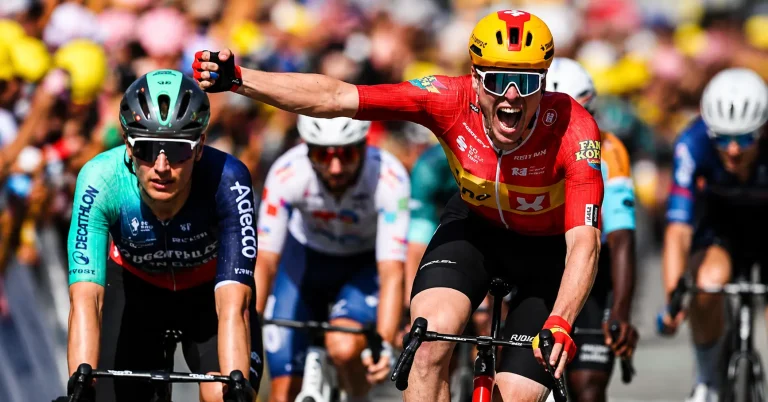
Tour de France 2026 Uno-X Mobility: Complete Team Guide
⚠ Breaking — June 26, 2026: Andreas Kron has been withdrawn from the Tour de France despite being named in the initial line-up on Tuesday. A minor setback in his recovery from illness, confirmed by team assessment on Thursday, ruled him out, with both rider and team agreeing he would not be ready for the demands of three weeks of racing. He will now target the Vuelta a España, where he won a stage in 2023. Anders Halland Johannessen, one of two reserves, replaces him — selected for his high-mountain support as Tobias Foss targets GC.
This is the complete guide to Uno-X Mobility at the Tour de France 2026, covering their confirmed 8-rider start list with individual roles by stage type, Ridley Noah Fast and Falcn RS bike specifications, the Union-X Scandinavian identity concept, the team’s history from Continental outfit to Norway’s first-ever WorldTour squad, sponsors and staff, and how far Tobias Halland Johannessen can realistically go in a GC battle stacked with Pogačar, Vingegaard, and Evenepoel.
TL;DR
- Who leads Uno-X at the 2026 Tour? Tobias Halland Johannessen — 26 years old, 6th overall at the 2025 Tour de France (the best Tour result by a Norwegian rider in history), targeting top-5 in 2026 after arriving in better form than any previous season. His 2026 results: 4th Tirreno, 2nd Milano-Torino, 3rd Itzulia Basque Country, 5th Tour Auvergne-Rhône-Alpes.
- Who is in the 8-rider squad? Magnus Cort and Jonas Abrahamsen (stage hunters), Søren Wærenskjold (sprinter), Anders Skaarseth (road captain), Anthon Charmig and Anders Halland Johannessen (Mountain support for Johannessen), Torstein Træen (climbing support for Johannessen).
- What is Union-X? The team’s internal concept for the 2026 Tour — five Norwegians and three Danes racing together under one Scandinavian identity, referencing the historical Danish-Norwegian union that lasted 434 years until 1814.
- What bikes do they ride? Ridley Noah Fast (aero/flat), Ridley Falcn RS (climbing/mountain stages) — both with SRAM Red AXS groupset, DT Swiss wheels, and Continental tyres, in a matte black base with red front and white detail 2026 livery.
What Is Uno-X Mobility? From a Norwegian Garage to the WorldTour
This is not a team that arrived at the Tour de France by buying a licence. They earned it.
What began in 2010 as a modest Norwegian continental outfit, first racing under the name Team Ringeriks-Kraft, backed by a regional renewable energy company, grew steadily for sixteen years into Norway’s first-ever UCI WorldTeam. The promotion to the WorldTour for the 2026–2028 seasons was confirmed in late 2025 through sporting merit: they accumulated enough UCI ranking points to force their way into cycling’s top tier, racing their way up from Continental to ProTeam to WorldTeam across a decade without a shortcut.
The formal founding came in 2016 as a continuation of that earlier Ringeriks-Kraft project, establishing the Uno-X Norwegian Development Team with UCI Continental status in 2017. In 2018, the team launched a development program that became a UCI Continental team in 2021. By 2020, the men’s squad had reached ProTeam status. In 2023 and 2024, they earned wildcard invitations to the Tour de France, then made the step they had been targeting for years: full WorldTour membership starting January 2026.
The WorldTour promotion made them the first Scandinavian cycling organisation with WorldTour status for both women and men, the women’s team having secured theirs in 2022. That dual status is part of a deliberate organizational mission, not a secondary achievement.
The team is owned by Reitan Retail, one of Scandinavia’s largest retail conglomerates, with Uno-X Mobility as one of four business areas alongside REMA 1000 Norway, REMA 1000 Denmark, and Reitan Convenience. Their mission, stated on the team’s own website, is to develop sustainable mobility solutions across Norway and Denmark. The cycling team is not a vanity sponsorship. It is the sporting arm of a corporate identity built around sustainability, equal opportunity, and Nordic talent development.
The men’s squad is composed exclusively of Norwegian and Danish riders. That is not an accident of recruitment. It is a founding principle.
The 2026 pressure: WorldTour status brings automatic entry to every Grand Tour and every Monument, but it also brings mandatory participation. Uno-X must now field teams at all three Grand Tours and all five Monument Classics across a full season, every year of their 2026–2028 licence. Managing that depth, that budget, and that calendar while simultaneously targeting a top-5 GC result at the Tour de France is the real test of whether this organization belongs at cycling’s top table. Winning a wildcard invitation Tour stage is one thing. Sustaining WorldTour-level performance across 12 months of compulsory high-level racing is something entirely different.
Union-X — The Concept That Defines This Tour Campaign
Denmark and Norway once shared a union. For 434 years, from 1380 until 1814, when the Napoleonic settlement granted Norway its independence, the two countries operated under a unified crown. The language roots overlap. The culture shares geography, outdoor values, and a particular Scandinavian disposition toward understatement and collective effort over individual spectacle.
This summer, Uno-X brings it back in their own way. They call it Union-X.
The team’s internal concept for the 2026 Tour de France frames the campaign as a yellow and red Danish-Norwegian push — five Norwegians (Johannessen brothers, Abrahamsen, Skaarseth, Wærenskjold, Træen) and two Danes (Cort, Charmig,) racing together under one Scandinavian identity on the sport’s biggest stage. Gabriel Rasch put it plainly in the team announcement: “Union-X is a reminder of who we are: a Danish-Norwegian team with riders from both nations, built on the same culture, the same ambitions, and the same willingness to take on the biggest races together.”
The flag colors tell the same story that the concept does. Norway’s national colors are red, white, and blue. Denmark’s are red and white. The Uno-X brand color is yellow. Put them together and you get the team’s 2026 race kit: matte black base, striking red front, white details, yellow brand placement across the chest. The colors are not marketing choices. They are a visual map of where this team comes from.
What makes Union-X more than a slogan is what it requires on the road. Danish and Norwegian riders have different racing cultures, different language textures, different instincts about when to attack versus when to wait. Building a squad that functions as a single unit across that divide, and trusting it in the chaos of three-week Tour de France racing, is harder than putting eight names on a list.
Uno-X Mobility 2026 Tour de France Start List — All 8 Riders
Uno-X were the second team to confirm their Tour de France roster, announcing on June 23 — immediately after Visma | Lease a Bike. The eight-rider squad reflects the dual mission of the 2026 campaign: enough climbing depth to protect a GC leader, enough offensive cards to attack on multiple stage types.
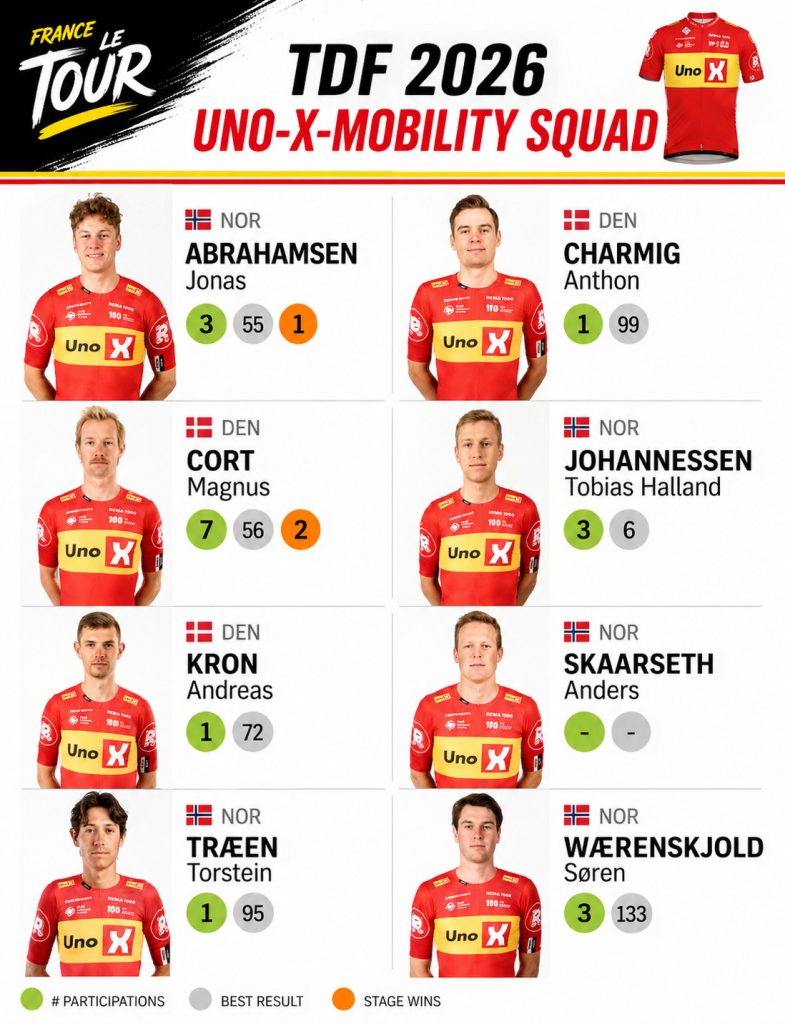
Uno-X Mobility — Rider by Rider
| Rider | Nat | Age | Role | Primary stage territory |
|---|---|---|---|---|
| Tobias Halland Johannessen | 🇳🇴 | 26 | GC Leader | Summit finishes · Stage 1 TTT · Stage 16 ITT |
| Magnus Cort | 🇩🇰 | 33 | Stage Hunter | Reduced group sprints · Medium mountain finishes |
| Jonas Abrahamsen | 🇳🇴 | 29 | Breakaway Threat / Support | Long breakaways · KOM attempts · Sprint support |
| Søren Wærenskjold | 🇳🇴 | 25 | Sprinter | Flat stages · Reduced bunch finishes |
| Anders Skaarseth | 🇳🇴 | 30 | Road Captain | Race reading · Tactical decisions · All terrain |
| Anthon Charmig | 🇩🇰 | 26 | Breakaway Card / All-terrain | Hilly stages · Crosswinds · Lead-out support |
| Anders Halland Johannessen | 🇳🇴 | 26 | Breakaway Card / Climber | Hilly and semi-mountain stages |
| Torstein Træen | 🇳🇴 | 32 | Climbing Support | High mountain finals for Johannessen |
Reserves: Andreas Leknessund and Anders Halland Johannessen — Tobias’s twin brother.
Tobias Halland Johannessen — Norway’s Best-Ever Tour Finisher
Born August 23, 1999, in Drøbak. Height 1.76m, weight 62kg. The numbers that matter most: 6th at the 2025 Tour de France, the best overall result by a Norwegian rider in Tour de France history, achieved despite spending the opening week fighting an illness serious enough that he considered abandoning on Stage 7 at Mur de Bretagne.
“I was the last one in the race, and I was not feeling good, but then I decided to just go all out to the finish and then just take it from there,” he said in January. “A couple of days later, I felt quite good again.”
What he produced from that low point to the Paris finish, six days after nearly pulling the plug, is why Uno-X and most serious GC observers treat him as a genuine top-5 contender rather than a hopeful. He is an attacker by instinct and a climber by physiology. At 62kg, he produces numbers on extended mountain gradients that most riders his age haven’t reached yet.
The 2026 preparation has been deliberate. He spent the winter in a Danish wind tunnel refining his aerodynamic position, “I will not tell every gain, but it was quite massive,” he said, and worked specifically on TT comfort, which matters on a Tour route that opens with a team time trial and has a 26km individual TT in week three. His 2026 season confirmed the investment: 9th UAE Tour, 4th Tirreno-Adriatico, 2nd Milano-Torino, 3rd Itzulia Basque Country, then 5th at Tour Auvergne-Rhône-Alpes despite a poor opening stage — with consecutive 2nd, 3rd, 3rd finishes on the three closing mountain stages.
“I think I’m in better form than last year. I also feel more confident. All the training has been perfect too, so I think July will be fun,” he said before the Tour Auvergne-Rhône-Alpes. That was before his form peaked further across the race’s closing weekend. Cyclingnews rated him as one of the most underrated GC riders in the peloton after those final mountain stages, calling his performances direct evidence that he is living up to his 2021 Tour de l’Avenir-winning potential.
His stated brief for 2026 is “three steadier weeks”, avoiding the early illness drain, building a GC position through the opening Pyrenean stages rather than fighting from behind, and arriving at the Alpe d’Huez double in week three with real legs and a real time gap to fight for.
Magnus Cort — The Most Debated Selection on the Roster
Magnus Cort has twice won stages at the Tour de France, with Astana in 2018 and EF Education-EasyPost in 2022, plus stage victories at the Giro d’Italia and Vuelta a España. His Grand Tour record is extensive. His Tour-specific instinct in reduced group sprints and punchy mountain finishes is proven. At most squads, he would be an automatic selection with no discussion required.
At Uno-X in 2026, his place was not treated as untouchable.
Before the official announcement, TV 2 cycling commentator Magnus Drivenes, expert Mads Kaggestad, and former pro Alexander Kristoff were each asked to pick their own Uno-X Tour squads. Kristoff and Kaggestad included Cort. Drivenes did not, he selected Andreas Leknessund instead, saying, “It almost hurts to leave out a rider of Magnus Cort’s calibre.”
The reason the debate existed: Cort’s 2026 results have been uneven. He won Stage 2 at Volta a Catalunya and took 3rd on Stage 3 of Tour de Suisse. Away from those highlights, DNF at Itzulia Basque Country, 100th at Liège-Bastogne-Liège, quiet across most of Switzerland outside that one podium. Drivenes noted that even the Tour de Suisse result raised questions: “He struggled during the stage and had to let the peloton go several times, and that indicates that his form is not where it’s been at his best.” His 2025 season ended early with persistent fatigue problems, adding a health dimension that form statistics alone cannot settle.
Uno-X backed experience over certainty. They are right to. Cort’s 2022 Tour, three stages for EF on a race where he was similarly considered a secondary selection, is the closest comparable to what a fully firing Cort produces at this race. When the conditions suit him and the form clicks, he is one of the most dangerous finishers in a reduced group in the peloton.
The question for July is whether the conditions click.
Jonas Abrahamsen — The Entertainer Who Already Proved It
Jonas Abrahamsen is not a hopeful at the Tour de France. He is a winner.
In 2025, Abrahamsen became the first Norwegian rider to win a Tour de France stage since Thor Hushovd in 2011, the same Thor Hushovd who now runs Uno-X as General Manager. That stage victory arrived from a breakaway, which is exactly how Abrahamsen races. He reads the break early, survives the selection, and finishes with more left in his legs than anyone expects.
In 2026, his role is dual and that duality is what makes him irreplaceable in this squad. He is a permanent breakaway threat on any stage where the wind direction, the route profile, and the size of the peloton create an opportunity. He is also a support rider, covering sprint days alongside Wærenskjold and mountain days in the group protecting Johannessen. Few riders in the WorldTour can credibly serve both functions. Abrahamsen has done both in the same Grand Tour.
Søren Wærenskjold — Close to a Win and Getting Closer
Wærenskjold is 25, Norwegian, and the team’s designated sprinter for the seven flat stages on the 2026 Tour route. He has been close to a Tour de France stage win on multiple occasions, close in the sense of top-5 finishes on sprint days rather than just participation. Gabriel Rasch’s framing is honest: “He is the kind of rider who does not want too much help, but on the flat stages he will have a few riders available.”
That independent sprint style suits Uno-X’s resources. They cannot build a dedicated nine-man sprint train around him. What they can provide is Charmig for crosswind protection, Abrahamsen for positioning in the final kilometre, and Wærenskjold’s own ability to read a sprint and find the right wheel. Whether that is enough to beat the lead-out trains of Alpecin-Deceuninck or Lidl-Trek on a full flat stage is the unanswered question. On reduced bunch finishes, where the sprint trains are fractured and position beats speed, his chances improve significantly.
Anders Skaarseth — The Race Captain Back From Injury
Skaarseth is the team’s road captain, the rider whose role is primarily organizational rather than physical. He reads the race from inside the peloton, communicates to the team car what is developing before the tactical moment arrives, and makes the call on when to chase and when to let a breakaway go.
Those decisions shape Tours of France. A road captain who misreads a dangerous move by 90 seconds has lost his GC leader time that cannot be recovered on any climb. Rasch describes him as “back at a very high level after a long injury comeback,” which means his presence in this squad is itself a story of timing. A road captain at full capacity in July is a different resource than one still finding form.
Anthon Charmig — The Stage Winner Who Can Also Protect
Charmig won Stage 1 of Tour Auvergne-Rhône-Alpes in 2026, breaking away with nine riders on a 240km marathon stage and dropping them all on the final climb. That result tells you what you need to know about his profile: endurance engine, climbing ability, and a finishing kick that beats riders who have been surviving rather than attacking.
At the Tour, he serves multiple functions. On breakaway stages with medium mountain finishes, he is a genuine stage-win threat. On flat stages with crosswinds, his strength makes him a positioning asset for Wærenskjold. On mountain days in the GC group, he contributes climbing support before Træen takes the final 10km responsibility. That versatility across three completely different stage types is exactly what a squad without unlimited depth needs.
Andreas Kron — The Danish Climbing Breakaway Card (Replaced by Anders Halland)
Kron’s profile is distinct from Charmig’s. He is less dangerous from a sprint finish and more dangerous from a sustained climb. His best results come on hilly and semi-mountain stages where a breakaway survives because the peloton’s GC teams are managing position rather than chasing hard. Get Kron in the right move on the right day, a stage with 3,000 metres of climbing and a tough final ascent, and he finishes. That profile suits specific stages on the 2026 route: the Vosges and Massif Central stages in weeks one and two, where the climbing is hard enough to thin the break but not hard enough to bring the GC leaders to the front.
Torstein Træen — The Fix for Johannessen’s Weakness
Gabriel Rasch was specific about why the 2025 Tour exposed a structural gap in their GC support: “We have been a bit weak there before, with Tobias being alone when there are still around 30 riders left.” Træen is the solution.
The 32-year-old Norwegian finished 9th overall at the 2025 Vuelta a España after wearing the red leader’s jersey in the opening week. That result, sustained GC riding across a three-week race, tells you he can stay with a high-altitude GC group deep into a Grand Tour’s decisive stages. His job in July is specific: be the last Uno-X rider at the front of the GC group when the final climb begins, deliver Johannessen with enough remaining capacity to attack, and then drift backward knowing he has done the critical work.
The Reserve Storyline: Leknessund vs. Cort, and the Twin-Brother Angle
Andreas Leknessund and Anders Halland Johannessen are named as reserves, and both carry their own story. Leknessund came close to stage podiums on three occasions at the 2026 Giro d’Italia and had a genuine case for a Tour spot. TV 2’s Drivenes explicitly picked him over Cort in his alternative squad. His exclusion came down to depth: Uno-X faces three Grand Tours this year, and Leknessund’s profile fitted the Vuelta program better than the Tour’s specific demands.
Anders Halland Johannessen is Tobias’s twin brother. If Tobias goes down, his reserve replacement is the person who knows exactly how he thinks and how he races, not by scouting report, but by growing up together, training together, and sharing a last name that now appears twice on the UCI startlist.
The Racing Plan — Breakaway Boys With a GC Plan
The identity Uno-X built over three wildcard Tour appearances is both an asset and a constraint. They are the team that attacks. The team that goes in the break when the big squads are controlling. The team that makes the race entertaining on days when the GC leaders are conserving. That reputation has earned them global coverage, fan affection, and, in 2025, a stage win that validated everything they had been building.
Now it has to coexist with something more conservative.
Gabriel Rasch is not hiding what changes in 2026: “We will probably be a bit more conservative and a bit more boring because of the GC, but we will continue to go in breakaways and race offensively when we think it makes sense. We are not a team that says we have to be in the breakaway just for fun. We go when we believe in it.”
That shift, from instinct-led attacking to calculated attacking, is the right evolution for a team with a genuine GC leader. But it requires Rasch to hold his riders back on stages where, in previous years, the green light would have been automatic. The tension is honest. Rasch does not pretend it is comfortable: “The most difficult thing is that we have riders who deserve to race and who have prepared well.”
The selection reflects the priority. More climbers than previous years. More riders capable of staying with the GC group when the mountains arrive. More structural support for Johannessen in the moments that cost him time in 2025 — not the summit finishes, where he excels, but the high-mountain mid-race kilometres where he was isolated before the decisive selection.
Stage-win map for Union-X:
Breakaway stages with medium climbs, Abrahamsen, Anders, Charmig. Reduced group finishes after hard but not summit stages, Cort. Full flat sprint stages, Wærenskjold. Summit finishes if GC leaders neutralize each other, Johannessen. Rasch’s own answer when pressed for the biggest opportunity: “Winning a stage from the breakaway is our biggest opportunity.”
The 2026 route delivers several candidate stages. The Vosges stages in week two, the Massif Central transition stages, and specific hilly days before the Alps all produce the terrain where breakaways survive long enough for Abrahamsen and Anders to finish the job.
Can Uno-X Mobility Get Johannessen a Top-5 GC Finish?
The honest answer requires two separate conversations, what Johannessen is capable of, and what the GC field looks like above him.
On the first point, the evidence in 2026 is strong. Cyclingnews currently rates him as one of the most underrated GC riders in the peloton. Multiple previews list him alongside Juan Ayuso and Cian Uijtdebroeks in the tier immediately below the top-3 favourites of Pogačar, Vingegaard, and Evenepoel. Those who watched him close out Tour Auvergne-Rhône-Alpes with three consecutive mountain stage podiums in the final weekend describe a rider arriving at the Tour in the best shape of his career.
The second point is where clarity matters. Pogačar and Vingegaard are in a different category to everyone else in this race, including Johannessen. Even on his best day at the 2025 Tour, the days when he was healthy and attacking, the time gap between him and the top two was measured in minutes over three weeks. Rasch is clear-eyed: Uno-X are not setting targets like competing with Pogačar or Vingegaard. Top-5 is the goal. That means finishing ahead of Evenepoel, Ayuso, Skjelmose, Pidcock, Uijtdebroeks, and several other riders who all arrive at Barcelona with the same ambition and different levels of team support.
Where the 2026 route helps Johannessen:
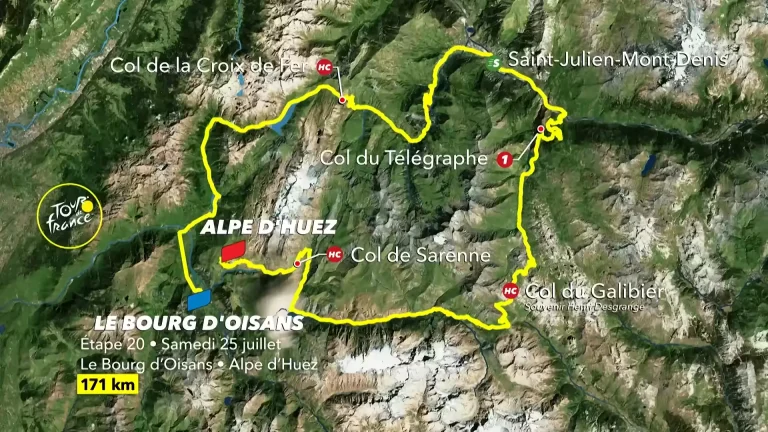
The back-to-back Alpe d’Huez finishes on Stages 19 and 20 are built for a pure climber who attacks rather than defends. With Træen providing climbing cover and Anders and Charmig capable of surviving into the final GC group on mountainous stages, Uno-X arrives at those two decisive finales with more depth than they have ever had. The 26km individual TT on Stage 16 near Lake Geneva is the main time-loss risk — Johannessen’s TT work over the winter should limit the damage, but he cannot beat Vingegaard or Evenepoel against the clock.
Where the route hurts them:
The Stage 1 team time trial in Barcelona. Uno-X are not a TTT powerhouse. If they lose 45–60 seconds to Visma or UAE in the opening 19.7km, Johannessen starts his GC campaign from behind before the first real mountain appears. That deficit is manageable, but it means the Pyrenees in the opening week are about recovering lost ground rather than gaining it.
The ceiling is top-5. The floor, if the TTT goes badly and Johannessen repeats the illness issues of 2025, is top-10. The most likely outcome, based on his form trajectory and the route profile, is somewhere between 4th and 7th. That range still makes him the best Norwegian Tour finisher in history if he lands anywhere inside it.
What Bikes Does Uno-X Mobility Ride at the 2026 Tour de France?
Ridley is Belgian. Their design philosophy is aerodynamics-first, it is in the brand’s DNA across every generation of their flagship road bikes. The partnership with Uno-X returns Ridley to the WorldTour after several years at the ProTeam level, and the 2026 Tour is their most visible stage in years.
Two models appear at this Tour. The choice between them is not preference, it is a calculated decision based on gradient profiles, wind forecasts, and stage length.
Ridley Noah Fast — The Aero Weapon
The third-generation Noah Fast was developed from a blank sheet with a single objective: build the fastest aero road bike in the peloton. At 50 km/h, it is 8.5 watts faster than its predecessor. Every element, the oversized down tube, the extended head tube, the long narrow profiles, is optimized for aerodynamic efficiency. At current professional road racing speeds, aerodynamics plays a larger role than weight across most terrain because of the exponential relationship between speed and air resistance.
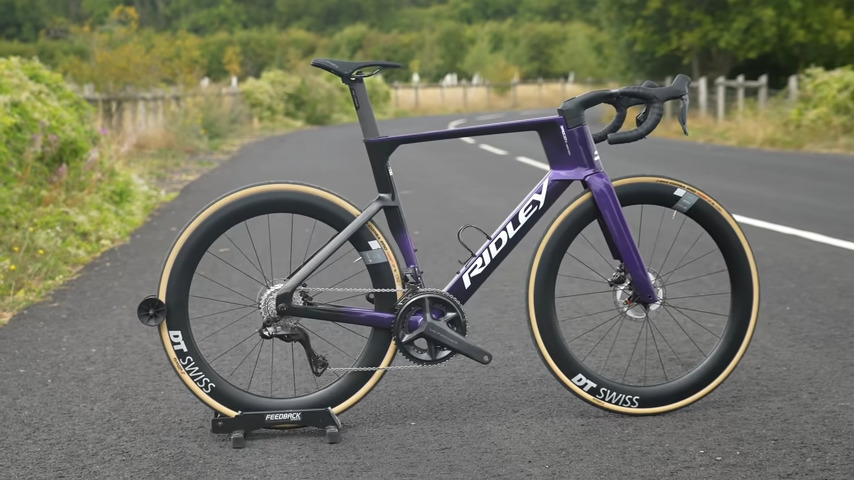
The Noah Fast handles flat stages, sprint days, hilly terrain, and rolling stages where the peloton moves above 45km/h. On a day like Stage 4 from Barcelona into the French Pyrenean foothills — fast, directional, with crosswind potential — it is the default choice for the entire squad. For Wærenskjold on sprint days, the aero advantage compounds over the final 20km where bunch speed exceeds anything a lighter climbing frame can offer.
Ridley Falcn RS — The Climbing Machine
The Falcn RS is lighter than the Noah Fast and built for terrain where gradient beats aerodynamics. Frame weight of 825–830 grams. Compatible only with electronic groupsets. Ridley’s own testing establishes the crossover point precisely: the Falcn RS outperforms the Noah Fast from 20 km/h on slopes of 7% or steeper — the steeper and the slower the climb, the more its lower weight compounds.
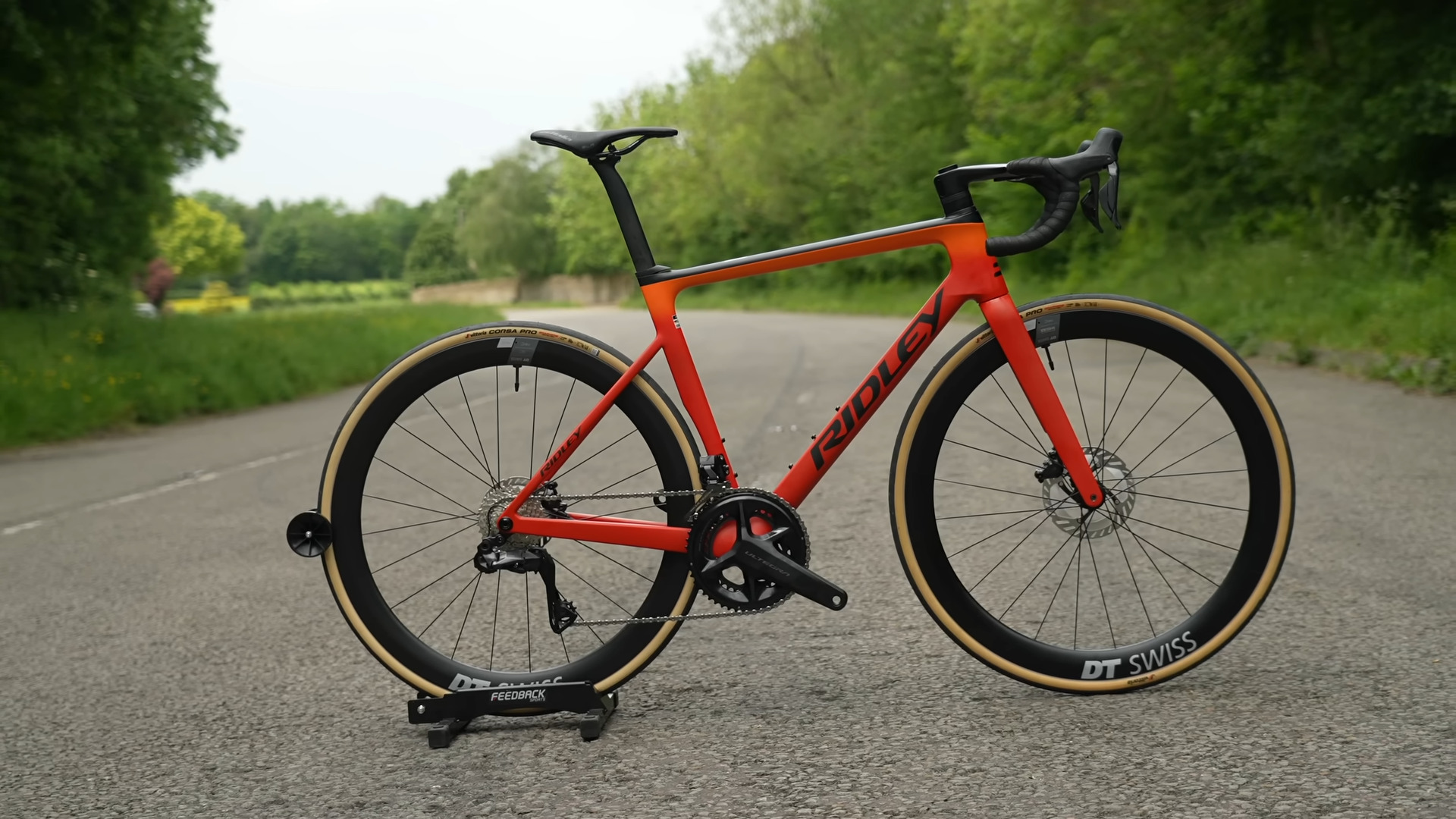
Stage 19 — Alpe d’Huez summit finish after a hilly parcours. Stage 20 — Alpe d’Huez again via the Col de Sarenne, steeper and slower than the standard approach. These are Falcn RS stages. Johannessen and Træen will be on Falcn RS builds when the race goes into those two days. The weight savings over 21 hairpin bends at altitude are not cosmetic. They are the difference between staying with the front group and losing contact on the 7th or 8th switchback.
Full 2026 Component Specification
Across both the Noah Fast and Falcn RS, the squad runs a consistent setup:
- Groupset: SRAM Red AXS 12/13-speed wireless electronic
- Wheels: DT Swiss (varying depths by stage — shallower for climbing, deeper for flat)
- Tyres: Continental (road race compound)
- Saddles: Prologo
- Kit: Official Uno-X Mobility 2026 Tour de France livery — matte black base, red front, white detail; the Union-X concept visible in every kilometre of racing
Race-specific adaptation:
At Paris-Roubaix earlier this season, Uno-X ran SRAM Red XPLR on the Noah Fast in a unique 12-speed configuration with a 56-tooth chainring, an unconventional setup optimized specifically for cobblestone conditions with no steep climbing. That level of component granularity across race types is how WorldTour teams marginalize the margins.
The Ridley Noah Fast and Falcn RS in official Uno-X Mobility team livery are available for configuration on Ridley’s website — including the replica 2026 team design as an option. [Ridley configurator →]
Uno-X Mobility Sponsors & Commercial Partners 2026
Uno-X, the Norwegian fuel and retail company (a Reitan Group brand), has backed the team consistently since 2017 — through Continental seasons, ProTeam seasons, and now the WorldTour. That consistency is commercially rare in professional cycling and provides the organizational foundation that allows long-term planning rather than annual negotiation.
The 2026 commercial structure around that foundation shows what WorldTour status changes for a team’s partner conversations. Guaranteed starts at every Grand Tour and every Monument means guaranteed broadcast exposure across Eurosport, GCN, and national broadcasters across Norway, Denmark, and most of Europe. That is a different proposition than wildcards.
Faxe Kondi is the most significant new partner of 2026. The Danish sports drink brand owned by Royal Unibrew joined in February on a deal covering both the men’s and women’s WorldTour programmes. The activation structure is full-funnel, not logo placement but an integration across jersey visibility at all major races, race-adjacent events, rider campaigns, in-store retail activation within Faxe Kondi’s Danish retail footprint, and social media activations. The commercial logic is specific: Faxe Kondi is not buying abstract WorldTour reach. It is buying a Scandinavian cultural access point, Danish riders Magnus Cort and Søren Wærenskjold as the human connection between the brand and its Danish audience, on the biggest cycling stage in the world.
Craft Sportswear, part of New Wave Group (one of Scandinavia’s larger sportswear groups), joined in late May as the official footwear partner for the remainder of the 2026 season, covering shoes for riders and staff across both teams.
Equipment partners:
Ridley (bikes), SRAM (groupset), DT Swiss (wheels), Continental (tyres), Prologo (saddles).
The commercial challenge ahead: Whether this partner ecosystem can sustain WorldTour-level costs across the full 2026–2028 licence period is not a settled question. The title sponsorship from Uno-X provides a stable anchor. But mandatory Grand Tour and Monument participation raises operating costs significantly beyond ProTeam levels, and the commercial development layer around the Uno-X core needs to grow proportionally with the team’s ambitions. For now, the trajectory is deliberate and Scandinavian in its patience. That combination, deliberate and patient, has built everything this team has achieved so far.
Team Staff & Management — The People Behind Union-X
The staff structure in 2026 reflects the WorldTour upgrade across every department, not just the rider roster.
Thor Hushovd — General Manager is the most symbolic hire the team has made. Hushovd is the last Norwegian to win a Tour de France stage before Jonas Abrahamsen did it in 2025. He wore yellow at this race. He won four stages across his career, including sprint stages and hilly finishes that required exactly the tactical instincts Union-X now tries to deploy at squad level. His presence gives the organization direct Tour de France experience in its leadership structure — not in the archived sense of a former champion, but in the practical sense of someone who has made decisions inside the race that Rasch and the riders are now making.
Gabriel Rasch — Head of Sports and Lead Tour DS is the voice on the team radio and the tactical brain behind three years of wildcard Tour campaigns. A former professional cyclist himself, Rasch’s public communication about the team’s strategy — unusually direct for a sport where teams often obscure intentions — has become part of Uno-X’s identity. He does not pretend the GC target is more achievable than it is. He does not hide the tension between breakaway instinct and GC caution. That transparency builds credibility with the fans and media who have made this team one of the sport’s more watchable presences.
Stig Kristiansen — Sports Director works alongside Rasch for the Tour de France campaign, handling tactical decisions on the road when the race splits across multiple groups.
Christian “Gummi” Andersen — Sports Director provides the third set of eyes on a race where three weeks of daily decision-making requires rotating focus and attention.
Michael Blaudzun and Asbjørn Kragh Andersen are newly recruited sports directors for the 2026 WorldTour programme — both bringing former professional pedigrees that extend the team’s tactical depth across the full season calendar that WorldTour status demands.
Uno-X Mobility at the Tour de France — Four Starts, One Stage Win, One Norwegian Record
The history of Uno-X at the Tour de France is four years of building toward exactly the moment this team finds itself in now.
2023 — First appearance (wildcard).
The debut. Tobias Halland Johannessen finishes 3rd on Stage 6, one of the first signals that this team carries a GC rider with Tour potential, not just a breakaway squad. Jonas Abrahamsen spends time in the polka-dot jersey. The team introduces itself to a global audience through attacking tactics and visible aggression on stages the big teams want to control.
2024 — Second wildcard
Building on 2023. More breakaway attempts, more KOM points, more visibility. The team shows they are not a one-year curiosity but a genuine annual presence in the race narrative.
2025 — Third appearance
The stage win. Abrahamsen becomes the first Norwegian Tour stage winner since Thor Hushovd in 2011. Johannessen finishes 6th overall — sick for the first week, nearly abandons, comes back and finishes as the best Norwegian Tour result in history. Ridley later cites this season as direct validation of the Uno-X partnership: development feedback from the riders during the Falcn RS and Noah Fast design process contributed to a platform capable of producing Tour-level results.
2026 — Fourth appearance
No wildcard needed. They are here by right, as a WorldTour team, with a GC leader arriving in his best-ever form and a squad built around a specific plan to improve on 6th place. The stakes have changed. The identity, Union-X, breakaway boys, Scandinavian courage, has not.
Related Content
- → [2026 Tour de France Stage 1: Team Time Trial in Barcelona — Full Preview]
- → [2026 Tour de France Route: All 21 Stages Explained]
- → [2026 Tour de France Complete Start List: All 23 Teams & 184 Riders]
- → [Team Visma | Lease a Bike: Tour de France 2026 Complete Guide]
Last updated: July 23, 2026. Start list confirmed. Pre-race information current as of publication. Live stage results, GC standings, and breaking news updated throughout the race.