This is the complete guide to NSN Cycling Team at the Tour de France 2026, covering their confirmed 8-rider start list with individual roles and stage-type breakdown, Scott Foil RC and Plasma RC bike specifications, the Barcelona-inspired jersey and Racing for Change concept, the team’s extraordinary transformation from Israel-Premier Tech to NSN, full sponsor and partner breakdown, and why Biniam Girmay’s 2026 form makes him the most dangerous green jersey contender the Tour has seen since his own 2024 campaign.
TL;DR
- Who leads NSN at the 2026 Tour? Biniam Girmay — Eritrean history maker, three Tour de France stage wins, the 2024 green jersey, now in his first Tour with NSN after signing a three-year deal in December 2025. Three wins in the first half of 2026 mark his best early-season return since 2022. He is more confident, better supported, and hungrier than when he last wore green in Paris.
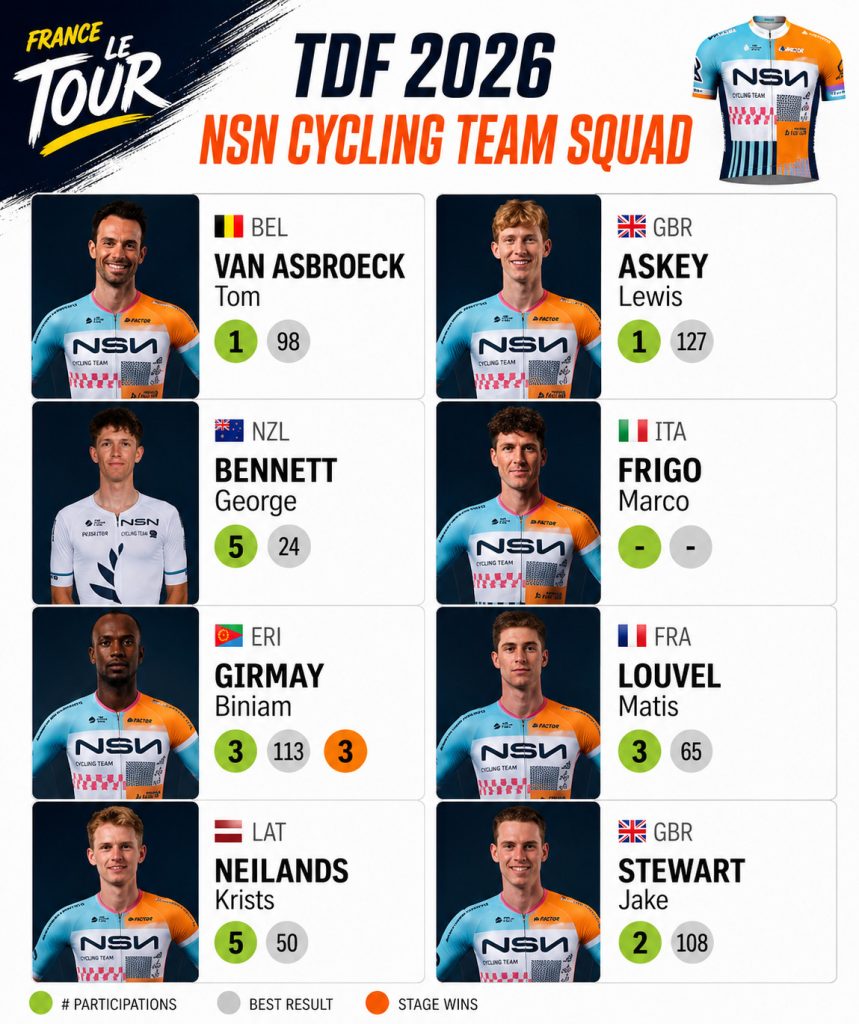
- Who is in the 8-rider squad? Jake Stewart and Lewis Askey anchor the British leadout duo. Matis Louvel and Tom Van Asbroeck complete the sprint support group. George Bennett and Krists Neilands hunt breakaway stages across three weeks. Marco Frigo makes his Tour debut as the mountain card.
- What is NSN? Born from a joint collaboration between global sports and entertainment company NSN (Never Say Never), co-founded by Andrés Iniesta, and Swiss investment firm Stoneweg — racing under a Swiss flag, operating from Spain, and rebuilt from what was formerly Israel-Premier Tech.
- What bikes do they ride? Scott Foil RC 20 for road stages and Scott Plasma RC TT for time trials, with SRAM Red AXS groupset and Zipp 353 NSW wheels — Scott’s return to the WorldTour after a year of absence.
What Is NSN Cycling Team? The Rebrand That Cycling Had Never Seen Before
Most professional cycling teams evolve gradually. A new sponsor here, a kit color change there, a head coach swap between seasons. NSN Cycling Team did none of that. What happened between October 2025 and January 2026 was something the sport had never produced before: a complete organizational demolition and rebuild inside a single off-season, under the most public pressure any team had faced in the modern era.
The foundation goes back to 2014. Ron Baron and Ran Margaliot founded Cycling Academy in Tel Aviv, a Continental outfit whose stated mission was developing young talent for the international peloton. The team grew steadily. First victories in 2015. First Grand Tour entry at the 2018 Giro d’Italia, which opened its first stage in Jerusalem, the first time in the Giro’s 101-year history that the race had started outside Europe. WorldTour status arrived under the names Start-Up Nation and then Premier Tech in 2020.
Then came the Gaza war. From 2023 onward, every race the team entered became a protest site. Stages of the Vuelta a España were curtailed. The team was pushed out of the Italian autumn Classics over safety concerns. In 2025, an estimated 100,000 protesters lined the streets of Madrid during the Vuelta’s final stage. Title sponsor Premier Tech, the Canadian agricultural technology company, announced its withdrawal, calling continued involvement “unsustainable.” Bike supplier Factor followed. Team owner Sylvan Adams stepped back from day-to-day operations. The team’s original Israeli identity was, effectively, over.
What filled that space was not a patch. In November 2025, international sports and entertainment company Never Say Never (NSN) and global investment platform Stoneweg entered a joint venture to take over the WorldTour and Development team structure entirely. NSN registered the team in Switzerland, based operations in Spain, and confirmed Adams was “no longer contributing financially, nor an owner of the team, and is not an owner nor investor in NSN or Stoneweg.” Complete. Clean. Documented.
NSN itself, the company, not just the team, is a seven-year-old Barcelona-based organization co-founded by twelve individuals, one of whom is Andrés Iniesta: the midfielder who scored the only goal in Spain’s 2010 World Cup final, who spent 22 years at FC Barcelona, and who is one of the most recognizable sporting figures in the city the Tour de France is starting in this July. NSN operates across football, music, audiovisual production, marketing, and brand management. It owns Helsingør FC in Denmark’s Second Division and holds a majority stake in gravel bike brand GUAVA. It has offices in Barcelona, Madrid, Tokyo, Mexico City, and Dubai. This is not a shell company built to launder a cycling team’s reputation. It is a functioning global sports and entertainment business that now owns a WorldTour cycling team.
Stoneweg, meanwhile, is headquartered in Geneva with €11 billion in assets under management, offices across 23 locations in 17 countries, and a prior relationship with the old team dating to 2023. Their investment formalized what had been a minority stake into co-ownership.
On December 9, 2025, Iniesta stood in Barcelona and formally presented Biniam Girmay as NSN’s team leader. They unveiled the new kit at the same event. The old identity was done. The new one began in front of cameras in the city that would host the Tour de France Grand Départ seven months later.
That timing, the rebrand, the Barcelona connection, the Girmay signing, and the Tour starting in Iniesta’s city, is not coincidence. It is a deliberate, staged narrative that NSN built from the first announcement. The race arriving at the team’s front door on July 4 is the payoff.
NSN Cycling Team 2026 Tour de France Start List — All 8 Riders
NSN announced their Tour de France roster on June 25 — seven riders built around protecting and delivering Girmay, with three flexible cards capable of hunting stage wins across terrain that does not suit a sprint finish.
NSN Cycling Team — Rider by Rider
| Rider | Nat | Age | Role | Primary stage territory |
|---|---|---|---|---|
| Biniam Girmay | 🇪🇷 | 26 | Sprint Leader / Green Jersey | Flat stages · Reduced group finishes · Hilly sprints |
| Jake Stewart | 🇬🇧 | 27 | Leadout #1 | Flat stages · Final kilometer |
| Lewis Askey | 🇬🇧 | 24 | Leadout #2 | Flat stages · Sprint positioning |
| Matis Louvel | 🇫🇷 | 26 | Sprint Support / Stage Hunter | Flat stages · Breakaway opportunities |
| Tom Van Asbroeck | 🇧🇪 | 34 | Sprint Support / Experience | Flat stages · Bunch control |
| George Bennett | 🇳🇿 | 36 | Breakaway / Mountain Hunter | Mountain and hilly stages |
| Krists Neilands | 🇱🇻 | 30 | Breakaway / Road Captain | Hilly and medium mountain stages |
| Marco Frigo | 🇮🇹 | 25 | Mountain Support / Debutant | Mountain stages · Climbing support |
Biniam Girmay — Cycling’s History Maker, Now Racing for More
Born 2 April 2000 in Asmara, Eritrea. Signed a three-year NSN contract in January 2026 after five seasons at Intermarché-Wanty. His estimated annual salary exceeds €1 million, a figure that reflects not just his sprint results but his singular position as the most commercially and culturally significant African rider in professional cycling’s history.
Read the record once and it still surprises. First black African to win a Grand Tour stage (Giro d’Italia, Stage 10, 2022). First African to win a WorldTour Classic (Gent-Wevelgem, 2022). First black African to win a Tour de France stage (Stage 3, 2024). First African to win the Tour de France green points jersey (2024, 33-point winning margin over Jasper Philipsen). These are not consecutive achievements across a decade. They happened across three seasons, by a rider who turned 26 two months before the 2026 Tour.
His 2024 Tour de France was the benchmark. He led the points classification from Stage 5 onward. He won stages 3, 8, and 12 — each on different terrain, against different finish profiles, showing his ability to adapt his sprint to the road rather than waiting for the perfect flat stage. He beat Wout van Aert in a bunch sprint. He beat Philipsen on a false flat. He won in a reduced group after a hard day. Three different ways to win, three times in three weeks. That is a complete sprinter.
His first season at NSN has been a careful recalibration. A new team means a new leadout train to calibrate, new equipment to optimize, new race-day communication protocols to establish. The Volta a la Comunitat Valenciana stage win in January ended a dry spell dating to his 2024 green jersey. By the Baloise Belgium Tour the week before this Tour announcement, stage win plus two additional top-10 finishes across five days, the calibration is clearly done.
Three wins in the first half of 2026 is his best early-season return since 2022. That was the year he won Gent-Wevelgem in March and the Giro stage in May, arriving at that summer in the best form of a career that was still accelerating. The 2026 trajectory mirrors it. Different team, same upward arc.
“Everybody who knows me understands how special the Tour de France is to me,” he said before the announcement. “But I’m more interested in creating more special moments than looking back on what I’ve achieved in the past. I know my form is good. I’m going into this year’s race full of confidence and with a real sense of anticipation for the first sprint opportunities.“
Jake Stewart — The British Leadout Anchor
Jake Stewart is 27, British, and forms the first half of NSN’s core leadout corridor with Lewis Askey. His résumé includes a Paris-Nice stage win and the British national championship, a rider capable of delivering Girmay in the final kilometer and, on the right hilly finish, competing for his own result in a reduced sprint. His track cycling background gives him the explosive acceleration from depth that makes a leadout rider dangerous even when position is partially lost entering the final 300 metres. For Girmay, having a leadout man who can generate speed from fourth wheel rather than requiring a direct line is the difference between a sprint win and a sprint podium.
Lewis Askey — Cobblestone Instincts in a Sprint Train
Askey is 24, British, and arrived at NSN with a Classics pedigree, Paris-Roubaix, Flanders, Yorkshire cobblestones baked into his race instincts since his formative racing years. That background translates directly to Tour leadout positioning: the ability to hold a line under physical contact, maintain speed through chaos in a compressed bunch, and resist being squeezed out in the final kilometer’s fight for position. He and Stewart working in combination give Girmay a two-rider British corridor into the final 200 metres, a structure NSN has spent the first six months of 2026 refining race by race.
Matis Louvel — The French Stage Hunter and Sprint Contributor
Louvel is 26, French, and serves dual functions in the NSN structure. On sprint stages, he sits in the lead-out chain ahead of Stewart and Askey, providing aerodynamic shelter and pacing through the peloton’s fastest sections. On medium-mountain stages where the sprint train fractures, he is a genuine breakaway threat, his Paris-Tours win and Tour de l’Ain stage victory both came from moves where he read the race early, went long, and finished. Being the sole French rider on a team that starts the Tour in Barcelona adds a cultural dimension: he races with particular awareness of what French cycling fans expect from a French representative on the sport’s biggest stage.
Tom Van Asbroeck — Six Years Away, Back With Something to Prove
Tom Van Asbroeck returns to the Tour de France after a six-year absence at 34, the Belgian classics rider who won Omloop Het Nieuwsblad and Kuurne-Brussel-Kuurne in his peak form years, now repurposed as the veteran presence in NSN’s sprint structure. His role is not statistics but experience: knowing when the sprint train is breaking down, improvising in scenarios the younger leadout riders have not seen before, and providing a physical presence in the bunch that intimidates in the way only a rider who has been at this level for a decade can manage. Six years is a long time to be away from the Tour. He is not here to watch.
George Bennett — Sixth Tour, Still Hunting
George Bennett is 36, the reigning New Zealand national road champion, and arrives at his sixth Tour de France with a specific brief from Sam Bewley: keep NSN present across as much of the three weeks as possible when the sprint stages are over. He has a Tour top-10 overall to his name and a Vuelta a España podium. His mountain instinct, developed across a career defined by high-altitude racing, makes him the first name into a breakaway on any stage where the profile gives a three-to-five rider move a genuine chance of staying clear. On the two Alpe d’Huez stages, 19 and 20, where NSN’s sprint structure becomes entirely irrelevant, Bennett is the team’s racing card.
Krists Neilands — Latvia’s Road Captain at the Sixth Tour
Krists Neilands is 30, Latvian national champion, and also on his sixth Tour alongside Bennett. His road captain responsibilities have grown at NSN across 2026, reading the race from inside the peloton, making tactical calls before the team car has time to respond, and managing Girmay’s position on stages where the GC teams control the pace and the sprint setup begins 40km from the finish. His Paris-Roubaix background, lateral races, exposed crosswinds, physical position battles, translates directly to the Tour’s chaotic bunch stages. The road captain at a sprint-focused team is the person who decides whether the race is on or off before the final 20km. Neilands makes that call.
Marco Frigo — The Italian Debutant Built for What Comes After Barcelona
Marco Frigo is 25, Italian, and the only rider on the NSN roster who has never started a Tour de France. He makes his debut on the hardest Tour route since 2022, 54,540 metres of climbing across 21 stages, with back-to-back Alpe d’Huez finishes on stages 19 and 20. His role in the opening two weeks is mountain support: helping Bennett in the valleys before the road goes genuinely steep, protecting the team’s presence in the GC group on transition stages, and giving NSN a card to play in the high Alps when their sprint infrastructure is irrelevant. His Giro d’Italia experience showed a climber with genuine capacity at altitude. The Tour at 25 is the stage where that capacity meets the sport’s defining test.
The Racing Plan — Sprints First, Everything Else When the Race Allows
NSN’s structure at this Tour is the clearest of any squad in the peloton. Seven riders organized around one objective: deliver Biniam Girmay at the front of every viable sprint stage. Bennett, Neilands, and Frigo provide coverage across the 14 non-sprint stages where a different strategy applies.
Sam Bewley does not dress it up. “We’ve got a good group of riders for the race, focused predominantly around Bini and the sprints. But the race is 21 stages. We want to have a purpose and a goal across the entire race, so it’s important to have guys like George, Krists, and Marco there so we can keep NSN in the race across as much of the three weeks as possible.”
He is also honest about what the 2026 route gives and takes from them. The Tour opens with a 19.7km team time trial in Barcelona, terrain that suits a squad built for bunch sprint delivery about as well as it sounds. Then Stages 2 and 3 move through hilly Spanish terrain before crossing into France, where the flat stages that generate Girmay’s primary opportunities begin to appear. His first genuine sprint shot comes on Stage 5 into Pau. Bewley’s admission: “Selfishly, I wish the race started with a bunch sprint, but it’s going to be so cool beginning the Tour in NSN’s home city.”
The sprint opportunity map for 2026: Of 21 stages, approximately 6-7 are genuine flat bunch sprint candidates where the peloton is expected to control the breakaway and a mass sprint decides the finish. Another 3-4 stages on medium-mountain terrain produce reduced bunch finishes — scenarios where Girmay’s ability to finish in a thinned sprint group of 30-40 riders is more valuable than pure flat speed. That combination gives NSN 9-11 realistic Girmay stage-win opportunities across three weeks.
The green jersey picture: Jasper Philipsen from Alpecin-Deceuninck is the main rival for the points classification — the defending champion in the sprint hierarchy, with arguably the most organized lead-out train in the peloton. But the 2026 route’s mountain-heavy design reduces the number of pure flat sprint stages compared to recent editions. That distinction matters: Philipsen’s lead-out is most efficient on fully flat stages where his whole train can function for the final 5km. On harder, reduced-group finishes, Girmay’s ability to read the race and generate his own sprint from a smaller field closes that gap significantly. His 2024 green jersey was built partly on those harder finishes. The 2026 route suits that approach again.
“We feel confident with the guys we have to be able to deliver some good stage outcomes from breakaways, mountain stages, or however the Tour plays out, in addition to our primary focus of the sprints,” Bewley says. That confidence is grounded in the Baloise Belgium Tour: five days of mixed terrain, Girmay winning a stage with the NSN leadout in its current configuration, two further top-10 finishes alongside it. The train has been tested. It is ready.
How Good Is Girmay’s 2026 Form? Comparing the Numbers to 2024
Three wins by the end of June is the benchmark. In 2022, Girmay won Gent-Wevelgem in March and the Giro stage in May, arriving at that summer with his two biggest results yet, fresh motivation, and a career in acceleration. He had never ridden the Tour de France. That was the year his history-making began.
In 2024, his Tour preparation followed a different arc, quieter spring, building through the Giro, then the explosion across three weeks in France that produced the green jersey and three stage wins. That trajectory was not visible in early-season win counts; it built quietly and peaked in July.
In 2026, the early-season trajectory is closer to 2022 than 2024. Three wins before July, with the most recent arriving the week before the Tour announcement. A new team environment that, by his own account, has improved his race-day setup and confidence. The Volta a la Comunitat Valenciana win in January ended his longest dry spell since turning professional. The Baloise Belgium Tour win confirmed the NSN leadout is calibrated.
The variable is what a new team structure costs in July specifically. The 2024 green jersey was built with an Intermarché-Wanty leadout that he had spent four seasons developing. NSN’s train is seven months old. Stewart and Askey are talented — but Tour de France sprint positioning under maximum pressure, against Alpecin-Deceuninck’s organized lead-out machinery, is where experience compounds exponentially. If NSN’s leadout makes one critical positioning error in the final kilometer of a flat stage, Girmay will not win. That is the honest risk.
The mitigating factor: Girmay in 2024 won in scenarios where the lead-out was not perfect. He won from chaotic finishes, from reduced groups, and from situations where his tactical reading of a sprint overcame positioning disadvantages. That self-sufficiency, the ability to manufacture a result without ideal delivery, is exactly what makes him more than a pure lead-out-dependent sprinter.
The Barcelona Grand Départ — Why This Race Is Personal for NSN
The Tour de France does not start in a team’s home city often. For NSN, it does not get more personal than this.
Andrés Iniesta played 22 seasons at FC Barcelona. He scored the goal that won Spain’s 2010 World Cup. He is not a peripheral co-owner of NSN, he is one of 12 co-founders and the most publicly visible human face of the company. His company owns a WorldTour cycling team. That team’s home is Barcelona. The Tour de France starts in Barcelona on July 4. These things are not unrelated.
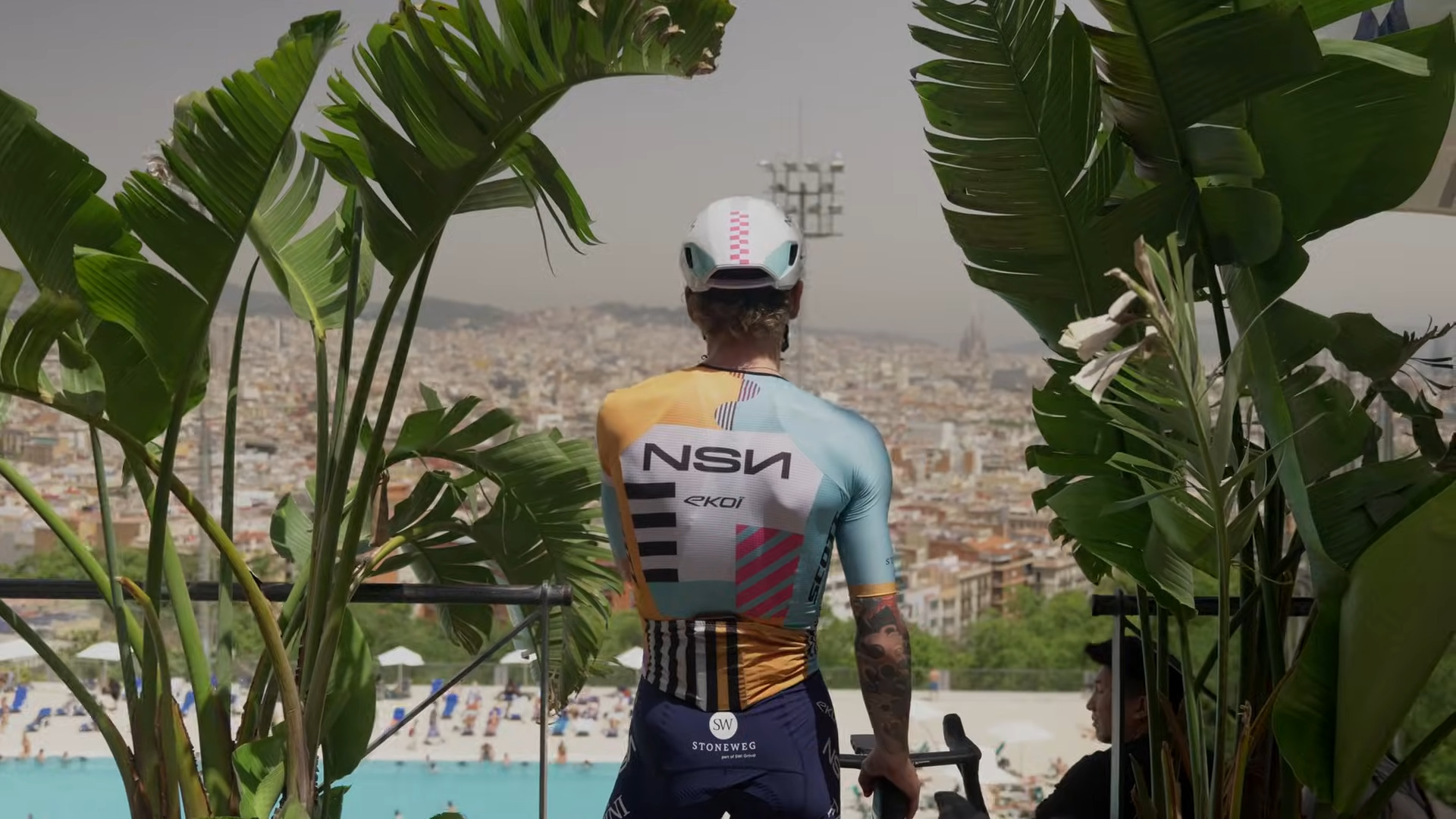
The 2026 jersey design makes the connection explicit. Designed by Stijn Dossche of stycle.design and produced by Ekoï, the kit blends geometry, color blocks, and patterns directly inspired by contemporary Barcelona — described on the team’s own website as “a city that never stands still, where tradition meets modernity, movement becomes identity, and where people dare to dream big.” It is not a generic race kit. It is a city on fabric.
The design also reaches further than Barcelona. The Rwanda Imigongo artform, a traditional geometric pattern from East Africa, features on the 2026 jersey as part of NSN’s Racing for Change project: a stated commitment to developing cycling infrastructure and talent pathways across Africa. In 2026, NSN riders come from 15 different countries. Girmay’s presence at the front of the peloton, as the sport’s most celebrated African cyclist, is not separate from that project. He is the proof of concept. Every stage win he takes in 2026 is the Racing for Change program’s most visible advertisement.
The team races 21 stages in July in the city where their identity was announced, on bikes designed around that city, led by a rider who represents the program that city’s jersey celebrates. That is not a coincidence of scheduling. It is architecture.
What Bikes Does NSN Cycling Team Ride at the 2026 Tour de France?
Scott’s return to the WorldTour runs through NSN. The Swiss brand, whose aerodynamic handlebar innovation helped Greg LeMond win the 1989 Tour by eight seconds, was absent from the sport’s highest level in 2025 after its previous team, Q36.5 Pro Cycling, moved to Pinarello. NSN gives Scott its WorldTour platform back. The partnership is a multi-year deal, and the 2026 Tour de France is its most significant showcase.
Two models appear at this Tour. The choice between them by stage type is pre-determined rather than day-of.
Scott Foil RC 20 — Built for WorldTour Sprinters
Scott’s own framing: designed to meet the demands of WorldTour sprinters, attackers, and breakaway riders. The fastest road bike they have ever produced. Every element, frame profiles, integrated cockpit, aerodynamic tube shaping, optimized for speed above all else.
It is also NSN’s mountain stage bike in 2026. Scott no longer separates their road range into distinct aero and climbing models, the Foil RC covers both terrain types. For Girmay on flat sprint stages, the aerodynamics compound with his sprint speed across the final 10km where bunch speeds exceed 55km/h. For Bennett and Frigo in the mountains, the same frame handles the climbing loads with a stiffness-to-weight ratio that Scott has refined through multiple WorldTour seasons.
Scott Plasma RC TT — Stage 1 and Stage 16
Scott’s stated objective for the Plasma RC was straightforward: the fastest TT bike with disc brakes on the market. Built using CFD technology and advanced carbon modelling, every aspect of the platform was reconsidered rather than evolved. NSN riders will use it on Stage 1, the 19.7km team time trial in Barcelona where individual times count, and Stage 16, the 26km individual TT near Lake Geneva in week three.
For NSN, those two TT stages are not GC opportunities. They are damage limitation. The team’s strength is not time trial output. But minimizing the gap to Visma and UAE in those stages determines Girmay’s points jersey math, every second lost to the peloton is a second where bonus sprint points become more valuable.
Full Component Specification
Across both platforms, the spec is consistent across the squad:
- Groupset: SRAM Red AXS wireless electronic
- Wheels: Zipp 353 NSW Tubeless Disc — SRAM’s most advanced wheelset, with an integrated wireless tyre pressure sensor and ceramic bearings, first SRAM AXS-connected wheelset
- Saddles: Selle Italia SLR 3D Carbon (standard) / SLR Carbon Fill and SLR 3D Elite (by rider preference)
- Helmets: Ekoï R-AERO (road stages) / Ekoï Pure Aero (time trials)
- Sunglasses: Ekoï E-Lens Evo
- Computers: Hammerhead Karoo — with real-time data feeding into team radio tactical decisions
- Nutrition: NDURANZ Nrgy Gel 45, Nrgy Drink 90, Training Bar 30, and Regen recovery formula
- Maintenance: Morgan Blue cleaning and lubrication protocol across all race and training bikes
The Scott Foil RC 20 — the same bike Girmay and the NSN squad ride at the 2026 Tour de France — is available via Scott’s official retail network.
NSN Cycling Team Sponsors & Commercial Partners 2026
A team rebuilt from scratch inside one off-season needs a commercial structure that matches the ambition of its sporting reset. NSN has assembled a partner ecosystem that reflects both the Swiss and Spanish identities of the new organization.
Owners: NSN Never Say Never and Stoneweg in joint venture. NSN is a seven-year-old global sports and entertainment company with offices across five continents. Stoneweg is a Geneva-based alternative investment group with €11 billion in assets under management, their prior relationship with the old team since 2023 made the transition structurally smoother than it appeared from the outside.
CBH Compagnie Bancaire Helvétique: Three-year partnership announced in 2026 with the Swiss private bank. The CBH relationship reflects NSN’s Swiss registration and Stoneweg’s Geneva financial infrastructure, shared values of precision, long-term orientation, and European institutional credibility underpinning a cycling team that needed exactly that framing after the chaos of 2023-2025.
Other commercial partners: Cantini Fantini (Italian wine producer, Abruzzo region, multiple Italian wine awards); Brainvest Wealth Management (international wealth management across Switzerland, US, and Brazil); Peace Park Capital (CLO investment specialists, over US$17 billion in CLO transactions); HURU backpacks; Dare 2b casual clothing; Mikakus footwear.
Equipment partners: Scott (bikes), SRAM (groupset), Zipp (wheels), Ekoï (clothing, helmets, sunglasses, one of three WorldTour teams Ekoï supports in 2026), Selle Italia (saddles), Hammerhead (computers), NDURANZ (nutrition), Elite (smart trainers and bidons), Topeak (tools and hardware), Morgan Blue (maintenance).
Racing for Change: NSN’s social mission is not a corporate CSR paragraph in an annual report. It is built into the team’s kit design, rider selection philosophy, and public communications. The Rwanda Imigongo artform on the 2026 Tour jersey is the most visible expression of a program designed to use professional cycling’s global platform to develop cycling infrastructure, education, and opportunity across Africa. In a team that races riders from 15 countries, that mission is carried in the peloton every day the race runs.
NSN Cycling Team Management & Staff
The staff continuity through the rebrand is what made the transition operationally possible. NSN inherited the team’s sporting and logistical infrastructure from IPT, experienced sports directors, a functioning Development Team, existing race relationships, and built a new identity around that infrastructure rather than replacing everything at once.
Sam Bewley — Head Sports Director is the voice on the team radio at the Tour de France. A former professional cyclist whose career took him to multiple Grand Tours, Bewley now translates professional racing instinct into tactical decisions from inside the team car. His public communication about the squad is consistently measured, he does not oversell Girmay’s chances, does not downplay the TTT disadvantage, and does not pretend the three opening Barcelona stages suit his team. That clarity is how serious teams talk about serious races.
Kjell Carlström — General Manager is the organizational bridge between IPT and NSN. His management of the rebrand, navigating UCI licensing, sponsor transitions, rider contracts, and public communications simultaneously, is the reason the team arrived at the 2026 Tour de France as a functioning WorldTour squad rather than a rebuilt development program. His statement at the rebrand announcement set the tone: “NSN shares our commitment to innovation, development, and pushing the boundaries of what’s possible in cycling.”
Steve Bauer — retained in senior management; Canadian cycling legend and 1988 Tour de France podium finisher. His presence in the team’s management structure provides direct access to Tour de France experience at a leadership level, the kind of institutional knowledge that no recruitment process can manufacture.
The Development Team: NSN Development Team continues as a UCI Continental team alongside the WorldTour squad, providing the rider pipeline that has been central to the organization since 2021. The Development structure gives NSN a formal pathway from continental racing to WorldTour and gives young riders a reason to commit to the organization’s long-term vision rather than treating NSN as a stepping stone.
NSN Cycling Team History — From a Tel Aviv Garage to the Tour de France’s Biggest Story
The full history of NSN Cycling Team is the history of four distinct organizations sharing one continuous UCI licence, one set of mechanics, and one unbroken ambition.
2014: Israel Cycling Academy — Ron Baron and Ran Margaliot in Tel Aviv, Continental licence, stated mission to develop young talent for the international peloton. First victory in 2015 at the Tour d’Azerbaïdjan.
2018: First Grand Tour — The team enters the Giro d’Italia for the first time. The opening stage runs in Jerusalem — the first Grand Tour stage start outside Europe in 101 years of racing history. The team is building global visibility through national identity.
2020-2022: WorldTour as Israel Start-Up Nation, then Israel-Premier Tech — Sylvan Adams co-founds the team’s WorldTour chapter. They reach the top level but are relegated back to ProTeam status at the end of 2022 after insufficient ranking points. The team’s original sporting project and its political dimensions begin to entangle.
2023-2025: The protest years — Stage cancellations at the Vuelta. Safety exclusions from Italian Classics. Premier Tech exits. Factor exits. Adams steps back. The old identity exhausts itself under sustained public pressure at the cost of the sport’s basic operational stability.
2025: The pivot — NSN and Stoneweg take over in November. Scott signs in December. Girmay signs in December. Iniesta presents the new team in Barcelona in December. From implosion to rebuild in six weeks.
2026: NSN Cycling Team — Ethan Vernon wins the team’s first stage under the new name at the Tour Down Under in January. Girmay wins the Volta a la Comunitat Valenciana. The team posts 13 victories across the first half of the season. They arrive at the Tour de France in Barcelona, their home city, with a clear identity, a proven leader, and something to show the sport they are now.
Related Content
- → [2026 Tour de France Stage 1: Team Time Trial in Barcelona — Full Preview]
- → [2026 Tour de France Route: All 21 Stages Explained]
- → [Tour de France Green Jersey: How the Points Classification Works]
- → [2026 Tour de France Complete Start List: All 23 Teams & 184 Riders]
- → [Team Visma | Lease a Bike: Tour de France 2026 Complete Guide]
- → [Uno-X Mobility: Tour de France 2026 Complete Guide]
Last updated: July 23, 2026. Start list confirmed. Pre-race information current as of publication. Live stage results, points standings, and breaking news updated throughout the race.